Instructions for Side by Side Printing
- Print the notecards
- Fold each page in half along the solid vertical line
- Cut out the notecards by cutting along each horizontal dotted line
- Optional: Glue, tape or staple the ends of each notecard together
multi choice chapter 10. Muscle Tissue
front 1 The different types of muscle tissue differ from each other by a) microscopic anatomy. b) location. c) type of Control. d) both microscopic anatomy and location. e) All of these choices are correct. | back 1 e |
front 2 Which of the following is NOT a major function of muscle tissue? a) moving blood throughout the body b) generating heat through contractions c) stabilizing the movement of joints d) promoting movement of body structures e) production of vitamins. | back 2 e |
front 3 Which property of muscle gives it the ability to stretch without damage? a) electrical excitability b) contractility c) extensibility d) elasticity e) thermogenesis | back 3 c |
front 4 In an isometric contraction the muscle develops tension but does not a) lengthen. b) widen. c) does not expend energy. d) conduct electrical current. e) exhibit elasticity. | back 4 a |
front 5 This is the outermost layer of connective tissue surrounding a skeletal muscle. a) tendon b) ligament c) endomysium d) epimysium e) perimysium | back 5 d |
front 6 What type of tendon is formed when the connective tissue elements of a skeletal muscle extend as a broad flat layer?
| back 6 d |
front 7 After the fusion of myoblasts, the muscle fiber loses its ability to do what? a) grow b) lengthen c) contract d) go through cell division. e) all of the answer choices | back 7 d |
front 8 Which of the following correctly lists the sequence of structures that action potentials must move through to excite skeletal muscle contraction?
e) myofibrils, myofilaments, mitochondria | back 8 d |
front 9 The contractile organelles of a skeletal muscle fiber are thread-like structures called a) myofibrils. b) myoglobin. c) mitochondria. d) Z discs. e) M lines. | back 9 a |
front 10 Release of calcium from these structures triggers skeletal muscle contraction. a) myofibrils b) mitochondria c) terminal cisterns of sarcoplasmic reticulum d) T-tubules e) none of the answer choices | back 10 c |
front 11 Release of calcium from these structures triggers skeletal muscle contraction. a) myofibrils b) mitochondria c) terminal cisterns of sarcoplasmic reticulum d) T-tubules e) none of the answer choices | back 11 c |
front 12 Which of the following describe the regeneration capacity of cardiac muscle cells?
| back 12 b |
front 13 Which of the following regions of a sarcomere contain thin filaments? a) I band b) A band c) H zone d) Both I band and A band. e) All of these answer choices are correct. | back 13 d |
front 14 Which of the following regions of the sarcomere contain thick filaments?
e) All of these answer choices are correct | back 14 e |
front 15 ) Myofibrils contain
e) none of these answers are correct | back 15 d |
front 16 Which of the following functions as a motor protein in all three types of muscle tissue?
| back 16 b |
front 17 What regulatory proteins can be found in the thin filaments of skeletal muscle fibers? a) troponin and titin b) tropomyosin and troponin c) myosin and titin d) titin and tropomyosin e) tropomyosin and myosin | back 17 b |
front 18 Which of the regions of a sarcomere contain titin? a) the A band only b) the H zone only c) the zone of overlap only d) from M line to Z disc e) the I band only | back 18 d |
front 19 Which of the following proteins is used to reinforce the sarcolemma and to help transmit the tension generated by the sarcomeres to the tendons?
| back 19 e |
front 20 During muscle contraction by the sliding filament mechanism, thin filaments are pulled towards the
| back 20 c |
front 21 Calcium ions are released from the sarcoplasmic reticulum into the cytosol
| back 21 a |
front 22 What energizes the myosin head? a) the actin filaments b) calcium ions c) potassium ions d) ATP hydrolysis reaction e) ADP synthesis | back 22 d |
front 23 ) Skeletal muscle contraction will continue to occur as long as the following chemicals are available in the cytosol of the muscle fiber. a) ATP and acetylcholine (ACh) b) calcium ions and ATP c) ACh and potassium ions d) sodium ions and ATP e) calcium and ACh | back 23 b |
front 24 To stimulate skeletal muscle contraction, acetylcholine must cross the _____ of the neuromuscular junction and bind to receptors on the motor endplate. a) node of Ranvier b) synaptic cleft c) sarcolemma d) synaptic end bulb e) transverse tubule | back 24 b |
front 25 Which of the following are commonly used to produce ATP during skeletal muscle contraction? a) creatine phosphate b) anaerobic cellular respiration c) aerobic cellular respiration d) All of these choices are correct. e) None of these choices are correct. | back 25 d |
front 26 In skeletal muscles, the combined amounts of creatine phosphate and ATP provide enough energy for the muscle to contract maximally for approximately a) 15 seconds. b) 15 minutes. c) 1.5 minutes. d) 5 seconds. e) one minute. | back 26 a |
front 27 Which of the following consists of a somatic motor neuron and all the skeletal muscle fibers it stimulates? a) sarcomere b) motor unit c) neuromuscular junction d) muscle unit e) multi-unit smooth muscle | back 27 b |
front 28 A brief contraction of all muscle fibers in a motor unit in response to a single action potential moving down the somatic motor neuron is known as a) isometric contraction. b) isotonic contraction. c) tetany. d) refractory period. e) twitch contraction. | back 28 e |
front 29 Which of the following is referred to as the period of lost excitability in skeletal muscle fibers? a) refractory period b) contraction period c) latent period d) relaxation period e) wave summation | back 29 a |
front 30 Increasing the number of active motor units within a skeletal muscle is called a) wave summation. b) fused tetanus. c) motor unit recruitment. d) muscle tone. e) flaccidity. | back 30 c |
front 31 This is the least powerful type of skeletal muscle fiber. a) slow oxidative fiber b) fast oxidative fiber c) fast glycolytic fiber d) slow glycolytic fiber e) None of these choices. | back 31 a |
front 32 Which of the following microscopic structures is only found in the cardiac muscle tissue?
| back 32 d |
front 33 Which of the following types of muscle tissue contract when excited by their own autorhythmic muscle fibers? a) cardiac muscle b) slow twitch oxidative skeletal muscle c) multi-unit smooth muscle d) fast twitch glycolytic skeletal muscle e) All of these choices are correct. | back 33 a |
front 34 Smooth muscle tone is maintained by the prolonged presence of _____ in the muscle cell’s cytosol? a) ATP b) calcium ions c) phosphate ions d) myoglobin e) None of these choices. | back 34 b |
front 35 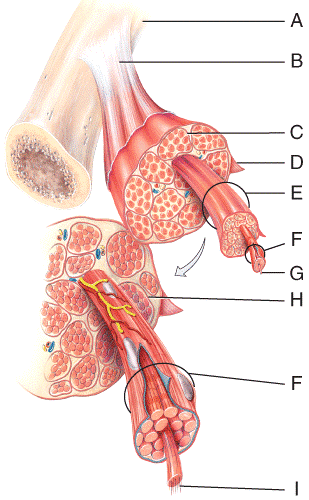 On the diagram, where is the outer most layer of connective tissue encircling the entire muscle
| back 35 b |
front 36 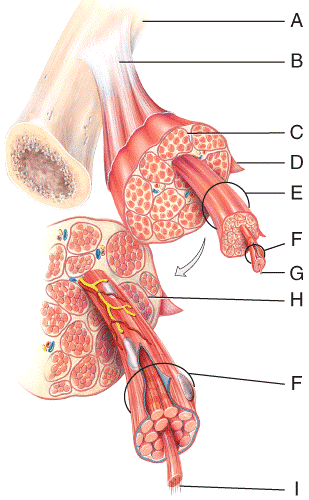 Which of the labeled structures on the diagram holds muscles with similar functions together, allows free movement of muscles, carries nerves, blood vessels and lymphatic vessels, and fills spaces between muscles?
| back 36 b |
front 37 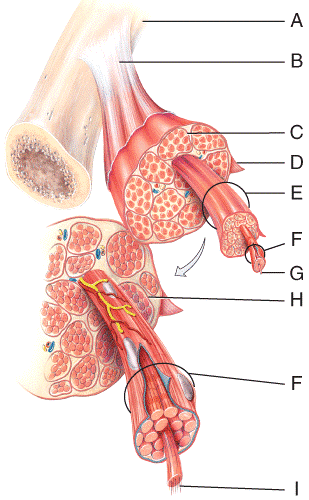 ) In the diagram, a tendon is formed by the merging of the following structures
| back 37 a |
front 38  Which of the following structures are made of dense regular connective tissue?
| back 38 b |
front 39 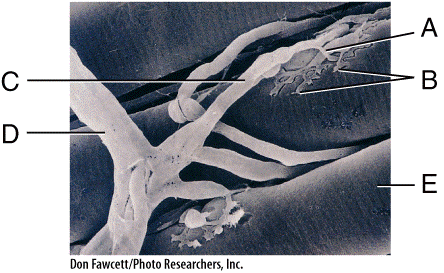 In the diagram, the neurotransmitter, acetylcholine, is released from this area.
| back 39 a |
front 40 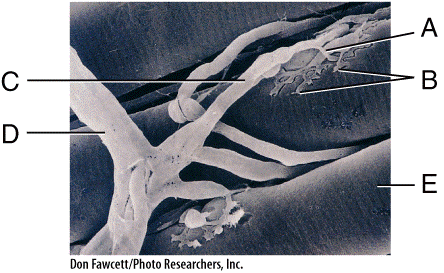 In the diagram, where is the axon terminal?
| back 40 a |
front 41 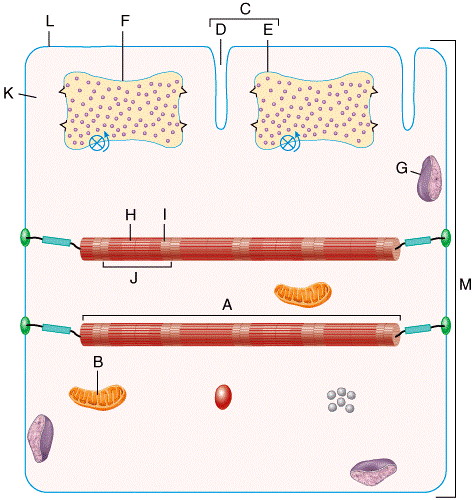 ) In the diagram, where would you find stored Ca2+?
| back 41 d |
front 42 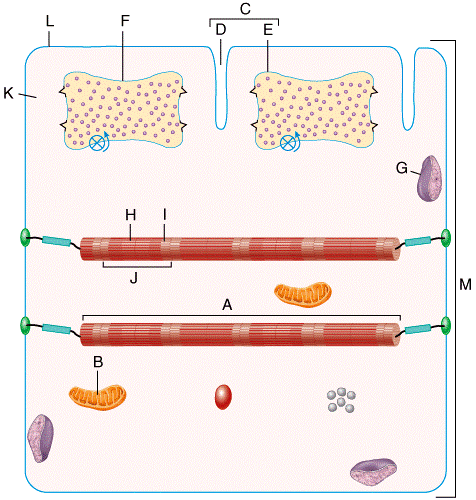 In the diagram, individual muscle fibers are covered by this layer.
| back 42 c |
front 43 In the diagram, what is the basic functional unit of a myofibril?
| back 43 c |
front 44  In the diagram, which structure helps return a stretched sarcomere to its resting length?
| back 44 c |
front 45 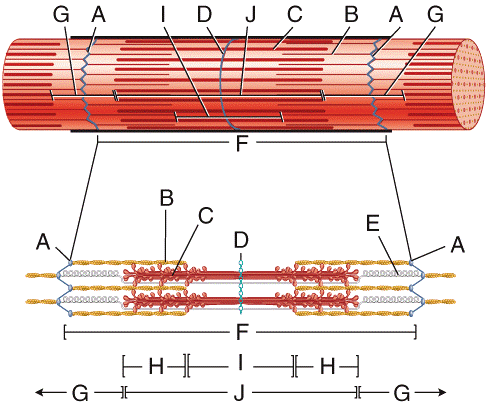 In the diagram, which labeled structure contains motor proteins that convert the energy in ATP into mechanical movements?
| back 45 a |
front 46 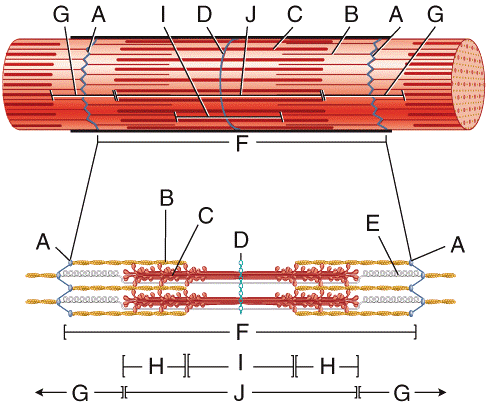 In the diagram, where is the I band?
| back 46 a |
front 47 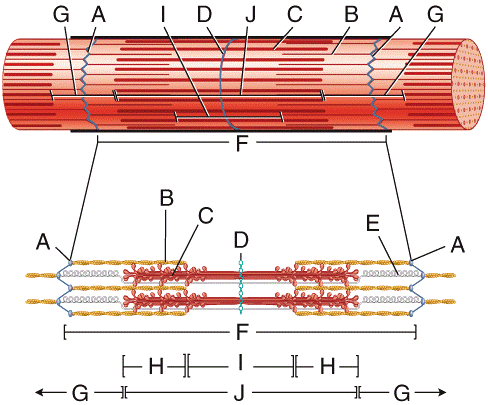 In the diagram, which structure(s) moves towards the center of the sarcomere (closer together) when the fiber contracts?
| back 47 a |
front 48 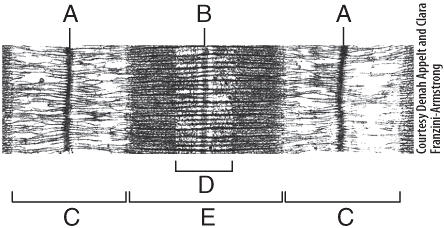 In the diagram, where are thick filaments found?
| back 48 b |
front 49 Which of the following disorders is characterized by the wasting away of muscles due to the progressive loss of myofibrils? a) muscular hypertrophy b) muscular atrophy c) fibromyalgia d) myasthenia gravis e) tremors | back 49 b |
front 50 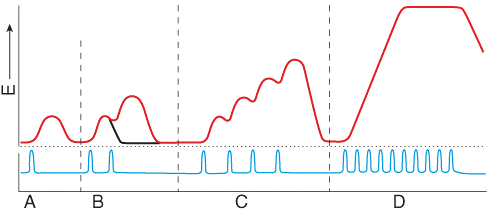 Which portion of this myogram shows a single twitch of the muscle?
e) none of these choices | back 50 a |
front 51 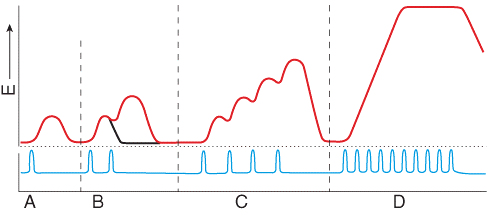 What is being shown by the axis labeled E?
| back 51 c |
front 52 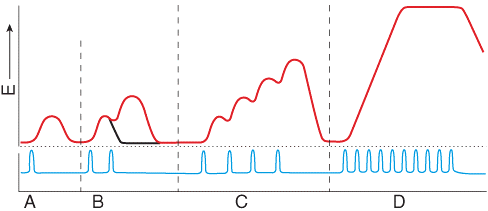 Which area of the myogram shows sustained contraction with partial relaxation?
| back 52 c |
front 53 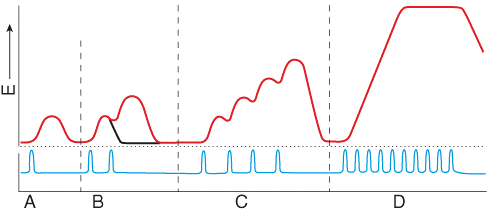 ) Which area of the myogram shows a sustained contraction where individual twitches are indiscernible?
| back 53 d |
front 54  Which figure exhibits isometric contraction of the biceps brachii muscle?
| back 54 c |
front 55 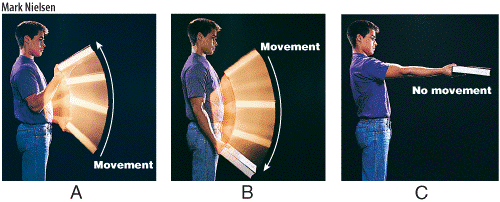 Which figure exhibits concentric contraction of the biceps brachii muscle?
| back 55 a |
front 56 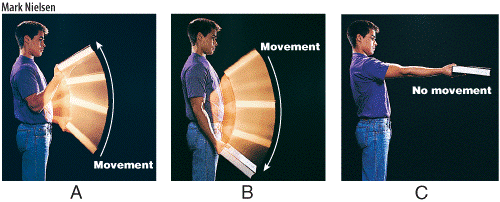 Which figure exhibits a contraction of the biceps brachii muscle in which its length increases?
| back 56 b |
front 57 Which is a NOT a side-effect of anabolic steroid use by male athletes? a) sterility b) baldness c) diminished testosterone secretion d) deepening of the voice e) atrophy of testes | back 57 d |
front 58 Which of the following types of abnormal contractions of skeletal muscle may be caused by holding a position for a prolonged period? a) spasm b) fasciculation c) tremor d) fibrillation e) cramp | back 58 e |
front 59 Which of the following is a common effect of aging on skeletal muscle? a) loss of muscle mass b) decrease in maximal strength c) a slowing of muscle reflexes d) loss of flexibility e) all of these are correct | back 59 e |
front 60 Which of the following statements does NOT accurately describe aerobic cellular respiration in skeletal muscles? a) Pyruvic acid generated by glycolysis enters the mitochondria. b) O2 is essential. c) CO2 is produced as a waste product. d) Lactic acid is continually produced. e) Can be used to generate ATP from fats, proteins or carbohydrates. | back 60 d |
front 61 After prolonged strenuous exercise has stopped, heavy breathing will often continue for several minutes in order to provide the oxygen needed to a) convert the lactic acid produced during exercise back into glycogen. b) resynthesize creatine phosphate. c) replace oxygen displaced from muscle myoglobin. d) All of these choices e) None of these choices | back 61 d |
front 62 Which of the following types of muscle tissue is capable of undergoing the stress-relaxation response when they are stretched? a) cardiac muscle fibers b) fast glycolytic fibers c) fast oxidative-glycolytic fibers d) slow oxidative fibers e) single-unit smooth muscle fibers | back 62 e |
front 63 Cross bridges are formed during muscle contraction when _____ on the thick filaments binds to _____ on the thin filaments.
| back 63 c |
front 64 In a neuromuscular junction, the effect of acetylcholine (ACh) binding to receptors on the motor end plate lasts only briefly due to a) rapid uptake of the ACh into the myofiber. b) endocytosis of the ACh receptor into the myofiber. c) rapid destruction of ACh in the synaptic cleft by acetylcholinesterase. d) rapid destruction of ACh in the synaptic cleft by monoamine oxidase. e) diffusion of the ACh out of the synaptic cleft. | back 64 c |
front 65 During which period of a twitch contraction does the muscle action potential move along the sarcolemma of the muscle cell and trigger calcium release into the sarcoplasm? a) latent period b) contraction period c) relaxation period d) absolute refractory period e) relative refractory period | back 65 a |
front 66 Which of following is a common characteristic of fast glycolytic (FG) skeletal muscle fibers? a) large amount of myoglobin. b) many mitochondria. c) low concentration of creatine kinase in the sarcoplasm. d) slow myosin ATPase. e) high amount of glycogen in the sarcoplasm. | back 66 e |
front 67 Myasthenia Gravis is an autoimmune disorder that targets the ACh receptors at the NMJ and ultimately reduces the number of available receptors. Predict what happens if you treat the patient with a drug that inhibits the activity of acetylcholinesterase? a) prevent contraction b) weak contraction c) normal contraction d) cause spasm e) none of these choices | back 67 c |
front 68 Leg muscles are predominantly composed of which type of muscle fiber? a) slow oxidative b) fast glycolytic c) fast oxidative-glycolytic d) slow glycolytic e) fast oxidative | back 68 c |