Print Options

Card layout: ?

← Back to notecard set|Easy Notecards home page

Instructions for Side by Side Printing
  1. Print the notecards
  2. Fold each page in half along the solid vertical line
  3. Cut out the notecards by cutting along each horizontal dotted line
  4. Optional: Glue, tape or staple the ends of each notecard together
  1. Verify Front of pages is selected for Viewing and print the front of the notecards
  2. Select Back of pages for Viewing and print the back of the notecards
    NOTE: Since the back of the pages are printed in reverse order (last page is printed first), keep the pages in the same order as they were after Step 1. Also, be sure to feed the pages in the same direction as you did in Step 1.
  3. Cut out the notecards by cutting along each horizontal and vertical dotted line
To print: Ctrl+PPrint as a list

63 notecards = 16 pages (4 cards per page)

Viewing:

Final Exam Semester One Unit Four

front 1

A human cell containing 22 autosomes and a Y chromosome is

A) a sperm

B) an egg

C) a zygote

D) a somatic cell of a male

back 1

A

front 2

Homologous chromosomes move toward opposite poles of a dividing cell during

A) mitosis

B) meiosis I

C) meiosis II

D) fertilization

back 2

B

front 3

Meiosis II is similar to mitosis in that

A) sister chromatids separate during anaphase

B) DNA replicated before the division

C) the daughter cells are diploid

D) homologous chromosomes synapse

back 3

A

front 4

If the DNA content of a diploid cell in the G1 phase of a cell cycle is x, then the DNA content of the same cell at metaphase of meiosis I would be

A) 0.25x

B) 0.5x

C) x

D) 2x

back 4

D

front 5

If the DNA content of a diploid cell in the G1 phase of a cell cycle is x, then the DNA content of the same cells at metaphase of meiosis II would be

A) 0.25x

B) 0.5x

C) x

D) 2x

back 5

C

front 6

In his work with pneumonia-causing bacteria and mice, Griffith found that

A) the protein coat from pathogenic cells was able to transform nonpathogenic cells

B) heat-killed pathogenic cells caused pneumonia

C) some substance from pathogenic cells was transferred to nonpathogenic cells, making them pathogenic

D) the polysaccharide coat of bacteria caused pneumonia

back 6

C

front 7

What is the basis for the difference in how the leading and lagging strands of DNA molecules are synthesized?

A) the origins of replication occur only at the 5' end

B) helicases and single-strand binding proteins work at the 5' end

C) DNA polymerase can join new nucleotides only to the 3' end of a pre-existing strand

D) DNA ligase works only in the 3' → 5' direction

back 7

C

front 8

In analyzing the number of different bases in a DNA sample, which result would be consistent with the base-pairing rules?

A) A = G

B) A + G = C + T

C) A + T = G + C

D) A = C

back 8

B

front 9

The elongation of the leading strand during DNA synthesis

A) progresses away from the replication fork

B) occurs in the 3' → 5' direction

C) does not require a template strand

D) depends on the action of DNA polymerase

back 9

D

front 10

In a nucleosome, the DNA is wrapped around

A) histones

B) ribosomes

C) plymerase molecules

D) a thymine dimer

back 10

A

front 11

E. Coli cells grown on 15N medium are transferred to 14N medium and allowed to grow for more generations (two rounds of DNA replication). DNA extracted from these cells is centrifuged. What density distribution of DNA would you expect in this experiment?

A) one high-density and one low-density band

B) one intermediate-density band

C) one high-density and one intermediate-density band

D) one low-density band and one intermediate-density band

back 11

D

front 12

A biochemist isolates, purifies, and combines in a test tube a variety of molecules needed for DNA replication. When she adds some DNA to the mixture, replication occurs, but each DNA molecule consists of a normal strand paired with numerous segments of DNA a few hundred nucleotides long. What has she probably left out of the mixture?

A) DNA polymerase

B) DNA ligase

C) Okazaki fragments

D) primase

back 12

B

front 13

The spontaneous loss of amino groups form adenine in DNA results in hypoxanthine, and uncommon base, opposite thymine.What combination of proteins could repair such damage?

A) nuclease, DNA polymerase, DNA ligase

B) telomerase, primase, DNA polymerase

C) telomerase, helicase, single-stranded binding protein

D) DNA ligase, replication fork proteins, adenylyl cyclase

back 13

A

front 14

The human genome is minimally contained in which of the following?
A) every human cell
B) each human chromosome
C) the entire DNA of a single human
D) the entire human population
E) each human gene

back 14

A

front 15

Which of the following defines a genome?
A) representation of a complete set of a cell's polypeptides
B) the complete set of an organism's polypeptides
C) the complete set of a species' polypeptides
D) a karyotype
E) the complete set of an organism's genes

back 15

E

front 16

If a horticulturist breeding gardenias succeeds in having a single plant with a particularly desirable set of traits, which of the following would be her most probable and efficient route to establishing a line of such plants?

A) Backtrack through her previous experiments to obtain another plant with the same traits.
B) Breed this plant with another plant with much weaker traits.
C) Clone the plant asexually to produce an identical one.
D) Force the plant to self-pollinate to obtain an identical one.
E) Add nitrogen to the soil of the offspring of this plant so the desired traits continue.

back 16

C

front 17

Which of the following is a true statement about sexual vs. asexual reproduction?
A) Asexual reproduction, but not sexual reproduction, is characteristic of plants and fungi.
B) In sexual reproduction, individuals transmit 50% of their genes to each of their offspring.
C) In asexual reproduction, offspring are produced by fertilization without meiosis.
D) Sexual reproduction requires that parents be diploid.
E) Asexual reproduction produces only haploid offspring.

back 17

B

front 18

There is a group of invertebrate animals called rotifers, among which a particular group of species reproduces, as far as is known, only asexually. These rotifers, however, have survived a long evolutionary history without evidence of having been overcome by excessive mutations.

60) Since the rotifers develop from eggs, but asexually, what can you predict?
A) The eggs and the zygotes are all haploid.
B) The animals are all hermaphrodites.
C) While asexual, both males and females are found in nature.
D) All males can produce eggs.
E) No males can be found.

back 18

E

front 19

How is natural selection related to sexual reproduction as opposed to asexual reproduction?
A) Sexual reproduction results in many new gene combinations, some of which will lead to differential reproduction.
B) Sexual reproduction results in the most appropriate and healthiest balance of two sexes in the population.
C) Sexual reproduction results in the greatest number of new mutations.
D) Sexual reproduction allows the greatest number of offspring to be produced.
E) Sexual reproduction utilizes far less energy than asexual reproduction.

back 19

A

front 20

In the human species, all somatic cells have 46 chromosomes. Which of the following can also be true?
A) A plant species (privet shrubs) has 46 chromosomes per cell.
B) Some adult humans have 69 chromosomes per cell.
C) Some adult humans have 23 chromosomes per cell.
D) A certain fungal species has only one chromosome per cell.
E) A certain bacterial species has 23 chromosomes.

back 20

A

front 21

The human X and Y chromosomes
A) are both present in every somatic cell of males and females alike.
B) are of approximately equal size and number of genes.
C) are almost entirely homologous, despite their different names.
D) include genes that determine an individual's sex.
E) include only genes that govern sex determination.

back 21

D

front 22

Which of the following is true of a species that has a chromosome number of 2n = 16?

A) The species is diploid with 32 chromosomes per cell.
B) The species has 16 sets of chromosomes per cell.
C) Each cell has eight homologous pairs.
D) During the S phase of the cell cycle there will be 32 separate chromosomes.
E) A gamete from this species has four chromosomes.

back 22

C

front 23

The karyotype of one species of primate has 48 chromosomes. In a particular female, cell division goes awry and she produces one of her eggs with an extra chromosome (25). The most probable source of this error would be a mistake in which of the following?
A) mitosis in her ovary
B) metaphase I of one meiotic event
C) telophase II of one meiotic event
D) telophase I of one meiotic event
E) either anaphase I or II

back 23

E

front 24

A triploid cell contains three sets of chromosomes. If a cell of a usually diploid species with 42 chromosomes per cell is triploid, this cell would be expected to have which of the following?
A) 63 chromosomes in 31 1/2 pairs
B) 63 chromosomes in 21 sets of 3
C) 63 chromosomes, each with three chromatids
D) 21 chromosome pairs and 21 unique chromosomes

back 24

B

front 25

Independent assortment of chromosomes is a result of

A) the random and independent way in which each pair of homologous chromosomes lines up at the metaphase plate during meiosis I.
B) the random nature of the fertilization of ova by sperm.
C) the random distribution of the sister chromatids to the two daughter cells during anaphase II.
D) the relatively small degree of homology shared by the X and Y chromosomes.
E) the random and independent way in which each pair of homologous chromosomes lines up at the metaphase plate during meiosis I, the random nature of the fertilization of ova by sperm, the random distribution of the sister chromatids to the two daughter cells during anaphase II, and the relatively small degree of homology shared by the X and Y chromosomes.

back 25

A

front 26

Eukaryotic sexual life cycles show tremendous variation. Of the following elements, which do all sexual life cycles have in common?

I. Alternation of generations
II. Meiosis
III. Fertilization
IV. Gametes
V. Spores

A) I, IV, and V
B) I, II, and IV
C) II, III, and IV
D) II, IV, and V
E) I, II, III, IV, and V

back 26

C

front 27

Referring to a plant's sexual life cycle, which of the following terms describes the process that leads directly to the formation of gametes?
A) sporophyte meiosis
B) gametophyte mitosis
C) gametophyte meiosis
D) sporophyte mitosis
E) alternation of generations

back 27

B

front 28

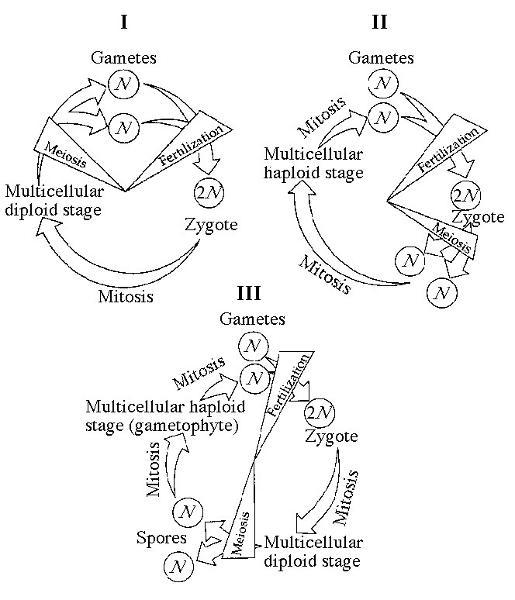
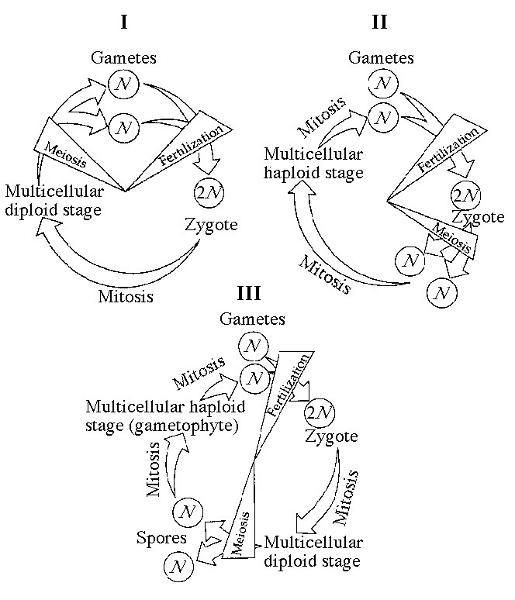
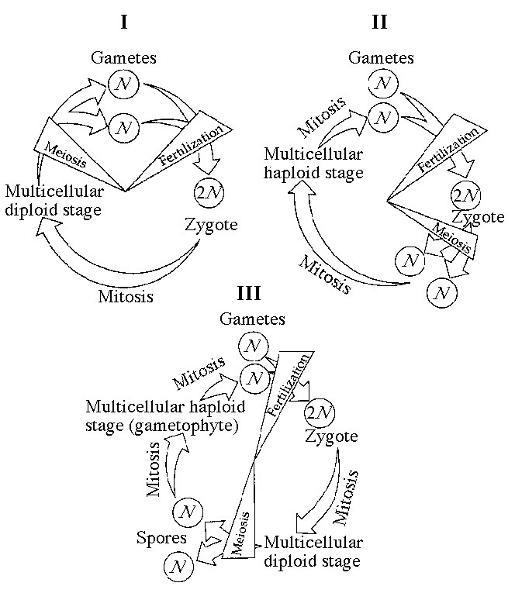
Which of the life cycles is typical for animals?
A) I only
B) II only
C) III only
D) I and II
E) I and III

back 28

A

front 29

Which of the life cycles is typical for plants and some algae?
A) I only
B) II only
C) III only
D) I and II
E) I and III

back 29

C

front 30

Which of the life cycles is typical for most fungi and some protists?
A) I only
B) II only
C) III only
D) I and II
E) I and III

back 30

B

front 31

Which life cycle stage is found in plants but not animals?
A) gamete
B) zygote
C) multicellular diploid
D) multicellular haploid
E) unicellular diploid

back 31

D

front 32

At which stage of mitosis are chromosomes usually photographed in the preparation of a karyotype?
A) prophase
B) metaphase
C) anaphase
D) telophase
E) interphase

back 32

B

front 33

A given organism has 46 chromosomes in its karyotype. We can therefore conclude which of the following?
A) It must be human.
B) It must be a primate.
C) It must be an animal.
D) It must be sexually reproducing.
E) Its gametes must have 23 chromosomes.

back 33

E

front 34

When Thomas Hunt Morgan crossed his red-eyed F₁ generation flies to each other, the F₂ generation included both red- and white-eyed flies. Remarkably, all the white-eyed flies were male. What was the explanation for this result?

A) The gene involved is on the Y chromosome.
B) The gene involved is on the X chromosome.
C) The gene involved is on an autosome, but only in males.
D) Other male-specific factors influence eye color in flies.
E) Other female-specific factors influence eye color in flies.

back 34

B

front 35

Thomas Hunt Morgan's choice of Drosophila melanogaster has been proven to be useful even today. Which of the following has/have continued to make it a most useful species?

I. its four pairs of chromosomes
II. a very large number of visible as well as biochemically mutant phenotypes
III. easy and inexpensive maintenance
IV. short generation time and large number of offspring

A) I and IV only
B) II and III only
C) I, II, and III only
D) II, III, and IV only
E) I, II, III, IV, and V

back 35

E

front 36

The centimorgan (cM) is a unit named in honor of Thomas Hunt Morgan. To what is it equal?
A) the physical distance between two linked genes
B) 1% frequency of recombination between two genes
C) 1 nanometer of distance between two genes
D) the distance between a pair of homologous chromosomes
E) the recombination frequency between two genes assorting independently

back 36

B

front 37

Sturtevant provided genetic evidence for the existence of four pairs of chromosomes in Drosophila in which of these ways?

A) There are four major functional classes of genes in Drosophila.
B) Drosophila genes cluster into four distinct groups of linked genes.
C) The overall number of genes in Drosophila is a multiple of four.
D) The entire Drosophila genome has approximately 400 map units.
E) Drosophila genes have, on average, four different alleles.

back 37

B

front 38

Which of the following is the meaning of the chromosome theory of inheritance as expressed in the early 20th century?

A) Individuals inherit particular chromosomes attached to genes.
B) Mendelian genes are at specific loci on the chromosome and in turn segregate during meiosis.
C) Homologous chromosomes give rise to some genes and crossover chromosomes to other genes.
D) No more than a single pair of chromosomes can be found in a healthy normal cell.
E) Natural selection acts on certain chromosome arrays rather than on genes.

back 38

B

front 39

A gene is considered to be non-Mendelian in its inheritance pattern if it seems to "violate" Mendel's laws. Which of the following would be considered Mendelian?
A) a gene whose expression varies depending on the gender of the transmitting parent
B) a gene derived solely from maternal inheritance
C) a gene transmitted via the cytoplasm or cytoplasmic structures
D) a gene transmitted to males from the maternal line and from fathers to daughters
E) a gene transmitted by a virus to egg-producing cells

back 39

D

front 40

Which of the following produces a Mendelian pattern of inheritance?
A) genomic imprinting
B) a mitochondrial gene mutation
C) a chloroplast gene mutation
D) viral genomes that inhabit egg cytoplasm
E) a trait acted upon by many genes

back 40

E

front 41

Correns described that the inheritance of variegated color on the leaves of certain plants was determined by the maternal parent only. What phenomenon does this describe?
A) mitochondrial inheritance
B) chloroplast inheritance
C) genomic imprinting
D) infectious inheritance
E) sex-linkage

back 41

B

front 42

Males are more often affected by sex-linked traits than females because

A) male hormones such as testosterone often alter the effects of mutations on the X chromosome.
B) female hormones such as estrogen often compensate for the effects of mutations on the X chromosome.
C) X chromosomes in males generally have more mutations than X chromosomes in females.
D) males are hemizygous for the X chromosome.
E) mutations on the Y chromosome often worsen the effects of X-linked mutations.

back 42

D

front 43

SRY is best described in which of the following ways?

A) a gene present on the X chromosome that triggers female development
B) an autosomal gene that is required for the expression of genes on the Y chromosome
C) a gene region present on the Y chromosome that triggers male development
D) an autosomal gene that is required for the expression of genes on the X chromosome
E) a gene required for development, and males or females lacking the gene do not survive past early childhood

back 43

C

front 44

Red-green color blindness is a sex-linked recessive trait in humans. Two people with normal color vision have a color-blind son. What are the genotypes of the parents?
A) XcXc and XcY
B) XcXc and XCY
C) XCXC and XcY
D) XCXC and XCY
E) XCXc and XCY

back 44

E

front 45

Cinnabar eyes is a sex-linked recessive characteristic in fruit flies. If a female having cinnabar eyes is crossed with a wild-type male, what percentage of the F₁ males will have cinnabar eyes?
A) 0%
B) 25%
C) 50%
D) 75%
E) 100%

back 45

E

front 46

Calico cats are female because
A) the males die during embryonic development.
B) a male inherits only one of the two X-linked genes controlling hair color.
C) the Y chromosome has a gene blocking orange coloration.
D) only females can have Barr bodies.
E) multiple crossovers on the Y chromosome prevent orange pigment production.

back 46

B

front 47

Sex determination in mammals is due to the SRY region of the Y chromosome. An abnormality of this region could allow which of the following to have a male phenotype?
A) Turner syndrome, 45, X
B) translocation of SRY to an autosome of a 46, XX individual
C) a person with an extra X chromosome
D) a person with one normal and one shortened (deleted) X
E) Down syndrome, 46, XX

back 47

B

front 48

In humans, clear gender differentiation occurs, not at fertilization, but after the second month of gestation. What is the first event of this differentiation?
A) formation of testosterone in male embryos
B) formation of estrogens in female embryos
C) anatomical differentiation of a penis in male embryos
D) activation of SRY in male embryos and masculinization of the gonads
E) activation of SRY in females and feminization of the gonads

back 48

D

front 49

Which of the following differentiates between independent assortment and segregation?
A) The law of independent assortment requires describing two or more genes relative to one another.
B) The law of segregation requires describing two or more genes relative to one another.
C) The law of segregation requires having two or more generations to describe.
D) The law of independent assortment is accounted for by observations of prophase I.
E) The law of segregation is accounted for by anaphase of mitosis.

back 49

A

front 50

Mendel's observation of the segregation of alleles in gamete formation has its basis in which of the following phases of cell division?
A) prophase I of meiosis
B) anaphase II of meiosis
C) metaphase I of meiosis
D) anaphase I of meiosis
E) anaphase of mitosis

back 50

D

front 51

At what point in cell division is a chromosome lost so that, after fertilization with a normal gamete, the result is an embryo with 45, X?

I. an error in anaphase I
II. an error in anaphase II
III. an error of the first postfertilization mitosis
IV. an error in pairing

A) I or II only
B) II or IV only
C) III or IV only
D) I, II, or III only
E) I, II, III, or IV

back 51

E

front 52

Polytene chromosomes of Drosophila salivary glands each consist of multiple identical DNA strands that are aligned in parallel arrays. How could these arise?
A) replication followed by mitosis
B) replication without separation
C) meiosis followed by mitosis
D) fertilization by multiple sperm
E) special association with histone proteins

back 52

B

front 53

In trying to determine whether DNA or protein is the genetic material, Hershey and Chase made use of which of the following facts?
A) DNA contains sulfur, whereas protein does not.
B) DNA contains phosphorus, whereas protein does not.
C) DNA contains nitrogen, whereas protein does not.
D) DNA contains purines, whereas protein includes pyrimidines.
E) RNA includes ribose, whereas DNA includes deoxyribose sugars.

back 53

B

front 54

Which of the following investigators was/were responsible for the following discovery?
In DNA from any species, the amount of adenine equals the amount of thymine, and the amount of guanine equals the amount of cytosine.
A) Frederick Griffith
B) Alfred Hershey and Martha Chase
C) Oswald Avery, Maclyn McCarty, and Colin MacLeod
D) Erwin Chargaff
E) Matthew Meselson and Franklin Stahl

back 54

D

front 55

Cytosine makes up 42% of the nucleotides in a sample of DNA from an organism. Approximately what percentage of the nucleotides in this sample will be thymine?
A) 8%
B) 16%
C) 31%
D) 42%
E) It cannot be determined from the information provided.

back 55

A

front 56

What is meant by the description "antiparallel" regarding the strands that make up DNA?
A) The twisting nature of DNA creates nonparallel strands.
B) The 5' to 3' direction of one strand runs counter to the 5' to 3' direction of the other strand.
C) Base pairings create unequal spacing between the two DNA strands.
D) One strand is positively charged and the other is negatively charged.
E) One strand contains only purines and the other contains only pyrimidines.

back 56

B

front 57

Use the following list of choices for the following question
I. helicase
II. DNA polymerase III
III. ligase
IV. DNA polymerase I
V. primase

31) Which of the enzymes removes the RNA nucleotides from the primer and adds equivalent DNA nucleotides to the 3' end of Okazaki fragments?
A) I
B) II
C) III
D) IV
E) V

back 57

D

front 58

In E. coli, there is a mutation in a gene called dnaB that alters the helicase that normally acts at the origin. Which of the following would you expect as a result of this mutation?
A) No proofreading will occur.
B) No replication fork will be formed.
C) The DNA will supercoil.
D) Replication will occur via RNA polymerase alone.
E) Replication will require a DNA template from another source.

back 58

B

front 59

What is a syndrome?
A) a characteristic facial appearance
B) a group of traits, all of which must be present if an aneuploidy is to be diagnosed
C) a group of traits typically found in conjunction with a particular chromosomal aberration or gene mutation
D) a characteristic trait usually given the discoverer's name
E) a characteristic that only appears in conjunction with one specific aneuploidy

back 59

C

front 60

If nondisjunction occurs in meiosis II during gametogenesis, what will be the result at the completion of meiosis?
A) All the gametes will be diploid.
B) Half of the gametes will be n + 1, and half will be n - 1.
C) 1/4 of the gametes will be n + 1, 1/4 will be n - 1, and 1/2 will be n.
D) There will be three extra gametes.
E) Two of the four gametes will be haploid, and two will be diploid.

back 60

C

front 61

After telophase I of meiosis, the chromosomal makeup of each daughter cell is
A) diploid, and the chromosomes are each composed of a single chromatid.
B) diploid, and the chromosomes are each composed of two chromatids.
C) haploid, and the chromosomes are each composed of a single chromatid.
D) haploid, and the chromosomes are each composed of two chromatids.
E) tetraploid, and the chromosomes are each composed of two chromatids.

back 61

D

front 62

For a species with a haploid number of 23 chromosomes, how many different combinations of maternal and paternal chromosomes are possible for the gametes?
A) 23
B) 46
C) 460
D) 920
E) about 8 million

back 62

E

front 63

There is a group of invertebrate animals called rotifers, among which a particular group of species reproduces, as far as is known, only asexually. These rotifers, however, have survived a long evolutionary history without evidence of having been overcome by excessive mutations.

61) Assuming that the eggs are diploid, tetraploid, or partially tetraploid, what mechanism may still occur without fertilization?
A) meiosis in each generation
B) meiosis in every second generation
C) independent assortment of maternal and paternal chromosomes
D) meiosis in times of adverse environmental conditions
E) crossing over of homologs

back 63

E