Instructions for Side by Side Printing
- Print the notecards
- Fold each page in half along the solid vertical line
- Cut out the notecards by cutting along each horizontal dotted line
- Optional: Glue, tape or staple the ends of each notecard together
AP Bio Chapter Test Review
front 1 Which of the following statements correctly describes the normal tonicity conditions for typical plant and animal cells? A. The animal cell is in an isotonic solution, and the plant cell is in a hypotonic solution B. The animal cell is in an isotonic solution, and the plant cell is in a hypertonic solution C. The animal cell is in a hypotonic solution, and the plant cell is in an isotonic cell D. The animal cell is in a hypertonic solution, and the plant cell is in a hypotonic solution. | back 1 A, because all plant cells are hypertonic, and that means their environments are hypotonic. |
front 2 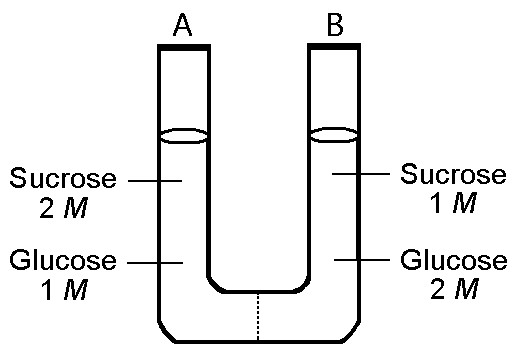 The solutions in the two arms of this U-tube are separated by a
membrane that is permeable to water and glucose but not to sucrose.
Side A is half-filled with a solution of 2 M sucrose and 1 M glucose.
Side B is half-filled with 1 M sucrose and 2 M glucose. Initially, the
liquid levels on both sides are equal. | back 2 C, because if you add both sides together, they are both 3 in terms of tonicity. |
front 3 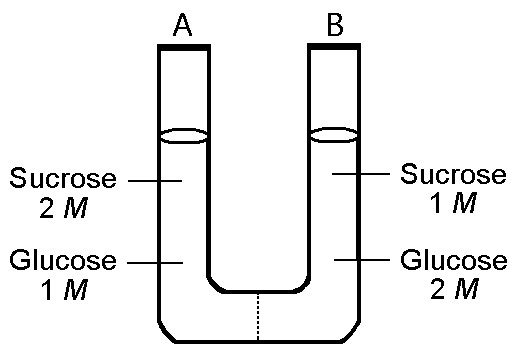 After the system reaches equilibrium, what changes are observed?
| back 3 C, because glucose is permeable, so it will balance itself out. But since sucrose cannot move through the border, water will go into side A to reach equillibrium |