Instructions for Side by Side Printing
- Print the notecards
- Fold each page in half along the solid vertical line
- Cut out the notecards by cutting along each horizontal dotted line
- Optional: Glue, tape or staple the ends of each notecard together
Bio 201 Central Nervous System
front 1 What two structures make up the CNS? | back 1 Brain and Spinal Cord |
front 2 Describe the roles of the three types of neurons in the spinal cord (sensory, motor, and interneuron). SENSORY | back 2 Sensory Neuron- –about 10 million –deliver information to CNS |
front 3 Describe the roles of the three types of neurons in the spinal cord (sensory, motor, and interneuron). MOTOR | back 3 Motor Neuron- –about 1/2 million –deliver commands to peripheral effectors |
front 4 Describe the roles of the three types of neurons in the spinal cord (sensory, motor, and interneuron). INTERNEURON | back 4 Interneuron- (AKA - association neurons) –about 20 billion –interpret, plan, and coordinate signals in and out |
front 5 Draw AND label (including the functions of the regions that you label) of a spinal cord cross section. | back 5 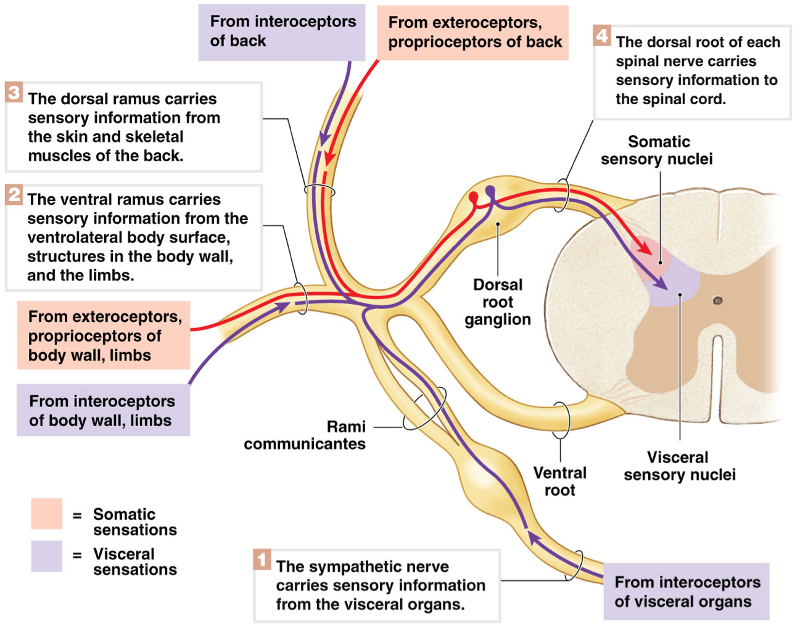 |
front 6 Diagram AND label the five steps that occur in a neural reflex. Make sure to keep the sensory and motor neurons straight! | back 6 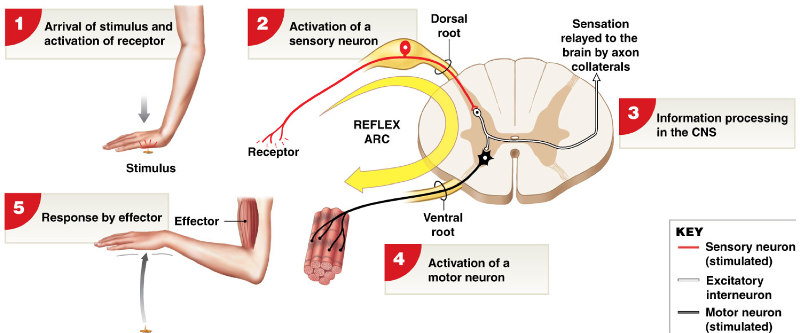 |
front 7 Compare and contrast innate and acquired reflexes. | back 7 Innate reflexes:
Acquired reflexes:
|
front 8 Compare and contrast somatic and visceral reflexes. | back 8 Somatic reflexes:
–superficial reflexes of skin, mucous membranes –stretch reflexes (deep tendon reflexes) e.g., patellar reflex Visceral reflexes (autonomic reflexes):
|
front 9 Compare and contrast monosynaptic and polysynaptic reflexes. | back 9 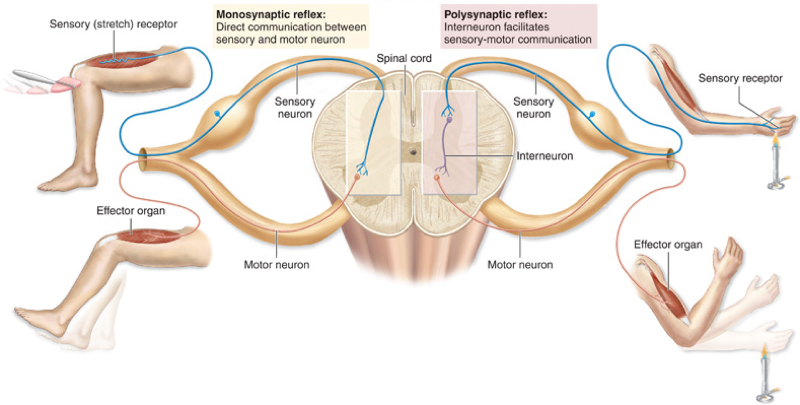 –monosynaptic - sensory neuron synapses directly onto motor neuron –polysynaptic - at least 1 interneuron between sensory neuron and motor neuron |
front 10 Compare and contrast spinal reflexes and cranial reflexes. | back 10 –spinal reflexes:
–cranial reflexes:
|
front 11 Diagram AND label a monosynaptic spinal reflex, using the stretch reflex as an example | back 11 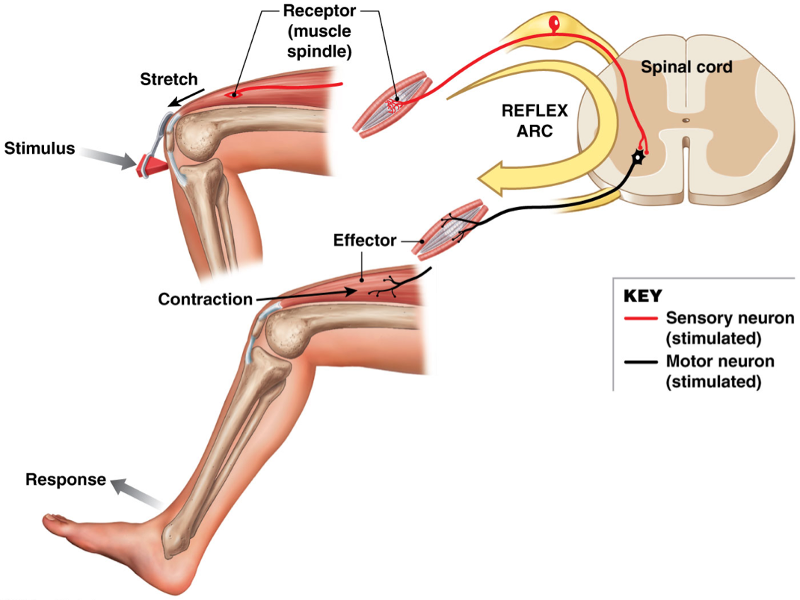 Have least delay between sensory input and motor output:–i.e. patellar reflex) Brain cannot override the reflex Completed in 20–40 msec |
front 12 Explain the roles of intrafusal and extrafusal muscle fibers in the stretch reflex as well as the adjustment of muscles tension in postural reflexes | back 12 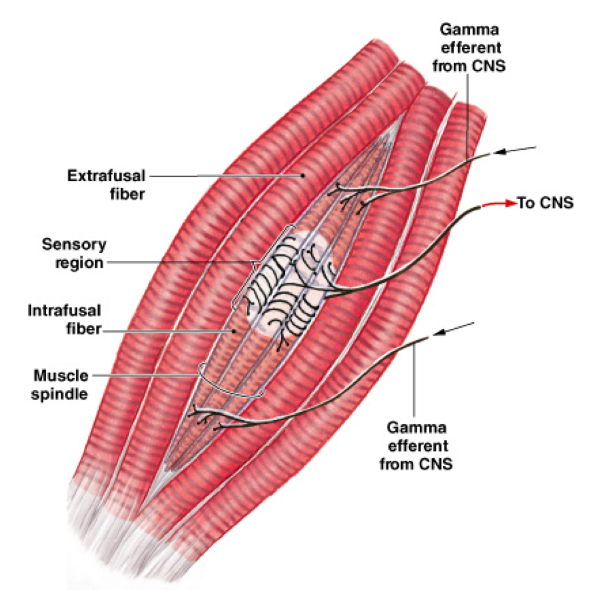 Bundles of small, specialized intrafusal muscle fibers: –innervated by sensory and motor neurons Surrounded by extrafusal muscle fibers: –which maintain tone and contract muscle |
front 13 Get acquainted with some of the common clinical tendon reflexes (as you will be testing these in your patients!) | back 13 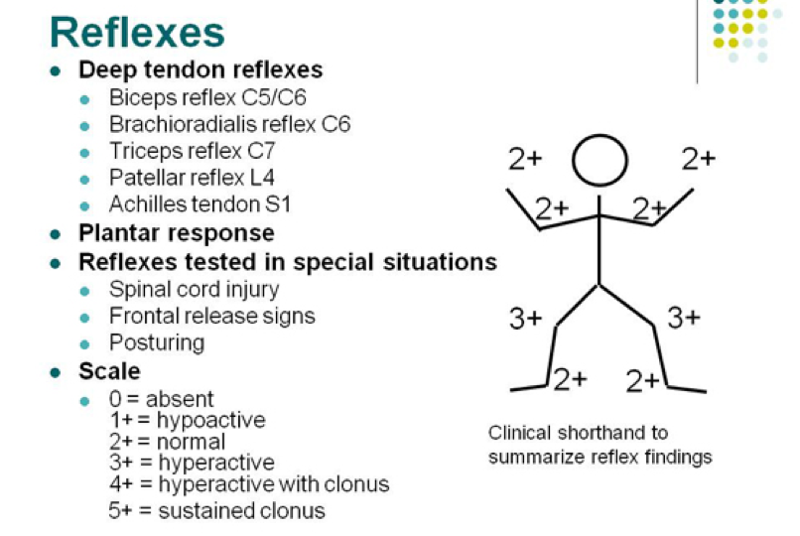 |
front 14 Diagram AND explain the events that occur during the flexor reflex. Make sure to include that little interneuron! | back 14 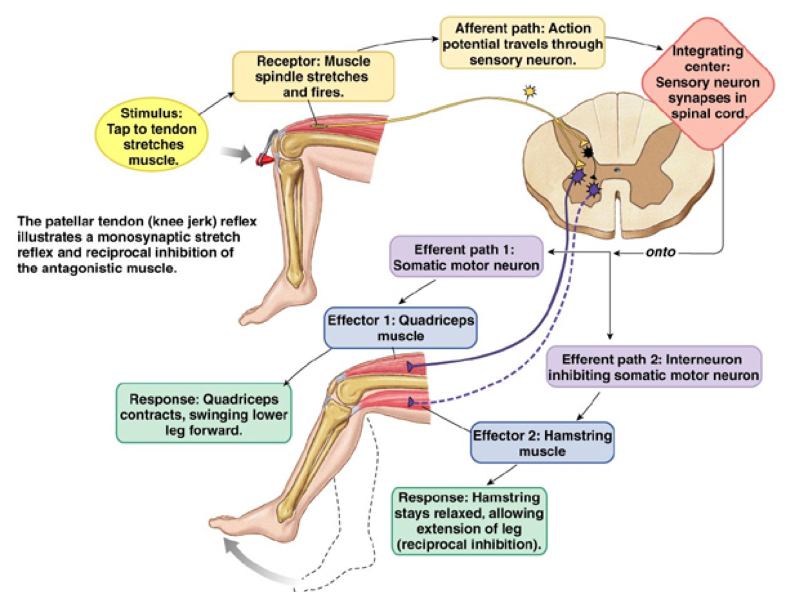 |
front 15 Explain the importance of reciprocal inhibition. Give an example! | back 15 For Stretch R eflex or the F lexor R eflex to work: –the stretch reflex of antagonistic (extensor) muscle must be inhibited (reciprocal inhibition) by interneurons in spinal cord |
front 16 Diagram AND label the events which occur during the tendon reflex. What would happen to us if we didn’t have this reflex? | back 16 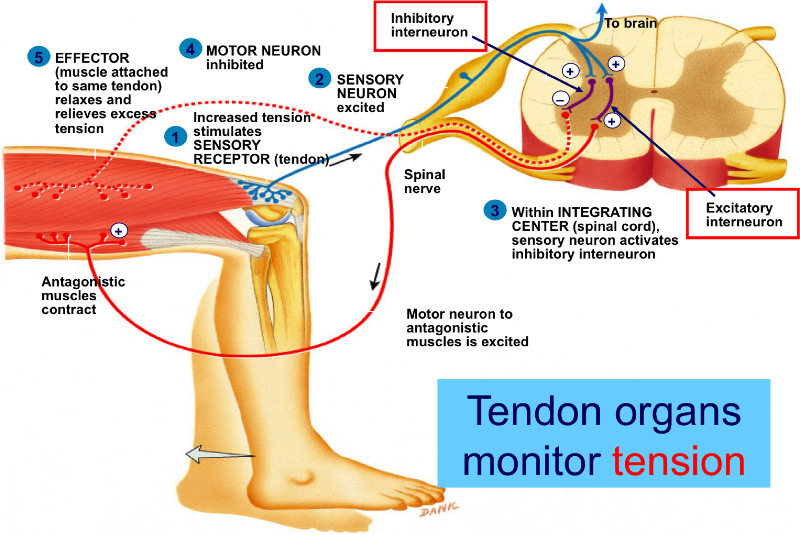 |
front 17 What would happen to us if we didn't have the tendon reflex? | back 17 If we did not have the tendon reflex then we would not be preventing skeletal muscles from developing too much tension, tearing or breaking tendons |
front 18 What does ipsilateral mean? How about contralateral? | back 18 Ipsilateral reflex arcs: –occur on same side of body as stimulus –stretch, tendon, and withdrawal reflexes Crossed extensor reflexes: –involves a contralateral reflex arc –occurs on side opposite stimulus |
front 19 Now that you know what ipsilateral and contralateral mean, diagram an example of the crossed extensor reflex. | back 19 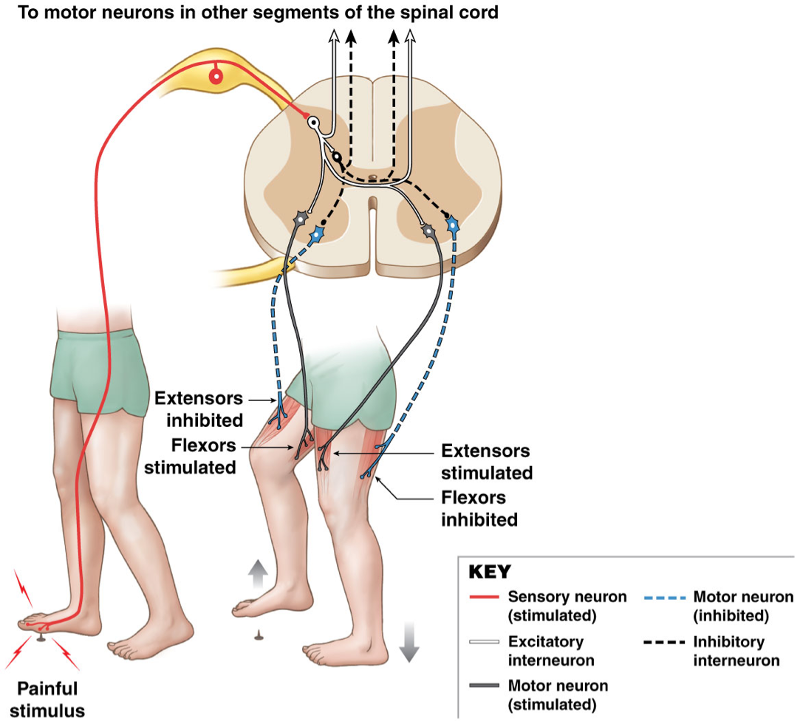 |
front 20 Polysynaptic Spinal Reflexes - The Crossed Extensor Reflex | back 20 Occur simultaneously, coordinated with flexor reflex e.g., flexor reflex causes leg to pull up: crossed extensor reflex straightens other leg to receive body weight |
front 21 Review the meanings of rostral and caudal. | back 21 Areas of the brain: Rostral (toward forehead) Caudal (toward cord) |
front 22 What region comprises the bulk of the volume of the human brain? | back 22 –cerebrum is 83% of brain volume; cerebellum contains 50% of the neurons |
front 23 Explain the difference between a gyrus and a sulcus. | back 23 –Gyri = folds; mountain –Sulci = grooves; valley |
front 24 What is a fissure in the brain? | back 24 Divides cerebral hemispheres |
front 25 Explain the difference between nuclei and tracts in the brain | back 25 Nuclei = deeper masses of gray matter Tracts = bundles of axons (white matter) |
front 26 Compare and contrast grey and white matter in the brain. | back 26 Gray matter = neuron cell bodies, dendrites, and synapses –forms cortex over cerebrum and cerebellum –forms nuclei deep within brain White matter = bundles of axons –forms tracts that connect parts of brain |
front 27 List the three meninges and the two spaces. Which of these three is located deepest (closest to the brain)? | back 27 Three Meninges: Dura Mater- outermost layer- contains the Subdural space Arachnoid Layer-contains the subarachnoid space Pia mater-***deepest layer Two Spaces: Subdural Space Subarachnoid space |
front 28 Under which layer of the brain does CSF circulate? | back 28 –from choroid plexus –through ventricles –to central canal of spinal cord –into subarachnoid space around the brain, spinal cord, and cauda equina |
front 29 Meninges of the Brain | back 29 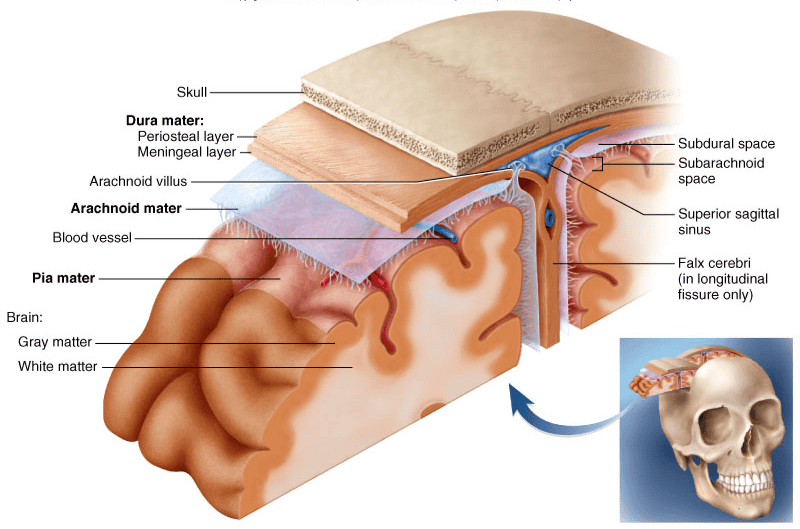 |
front 30 Under which of the layers in the brain are the dural sinuses located? | back 30 Dura mater |
front 31 Where would a subdural hematoma occur if someone got hit in the head? | back 31 A subdural hematoma would occur in the space between the dural mater and middle layer of the meninges. |
front 32 Describe the pathophysiology of meningitis? Make sure to include where you would insert a needle during a spinal tap. | back 32
–lumbar puncture (spinal tap) |
front 33 Label the locations of the following ventricles:
| back 33 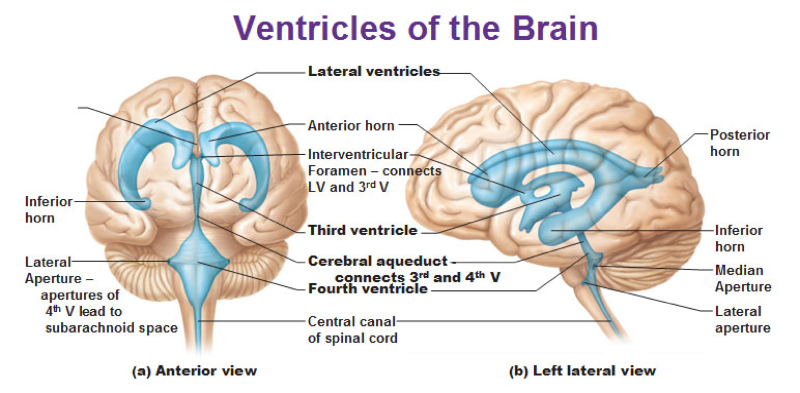 |
front 34 What two ventricles of the brain do each of the following connect:
| back 34 Interventricular foramen- connects to LV and 3rdV Cerebral aqueduct- connects to 3rd and 4th Ventricle |
front 35 Predict the effects if either the interventricular foramen or the cerebral aqueduct were to become occluded. | back 35 Brain damage from build up of CSF. – hydrocephalus
|
front 36 Where is cerebrospinal fluid made, how is it circulated, and what is its purpose in the CNS? Spend some time looking at the choroid plexus! | back 36 Formed by the choroid plexus CIRCULATES through ventricles, to central canal of spinal cord, into subarachnoid space around the brain, spinal cord, and cauda equina Functions: –Forms cushion for brain and other CNS organs –Gives buoyancy to brain (which reduces weight by 97%) to prevent brain from crushing under own weight Transports nutrients, chemical messengers, and waste |
front 37 Explain the role of arachnoid villi and arachnoid granulations on the circulation of CSF. | back 37 Arachnoid villi: –extensions of subarachnoid space –extend through dura mater to superior sagittal sinus Arachnoid granulations: –large clusters of villi –absorb CSF into venous circulation |
front 38 What causes hydrocephalus? | back 38 When CSF becomes obstructed |
front 39 Compare and contrast the structures involved AND the functions of both blood brain barrier and the blood CSF barrier. BLOOD BRAIN BARRIER | back 39 BLOOD BRAIN BARRIER- Structure: Endothelial cells stitched together by tight junctions Very effectively protects the brain from many common bacterial infections. Thus, infections of the brain are very rare. ***ASTROCYTES |
front 40 Compare and contrast the structures involved AND the functions of both blood brain barrier and the blood CSF barrier. BLOOD CSF BARRIER | back 40 BLOOD CSF BARRIER- barrier at choroid plexus are ependymal cells joined by tight junctions Function: Acts as barrier and produces CSF |
front 41 Which portions of the brain make up the brain stem? | back 41 –Midbrain –Pons –Medulla oblongata |
front 42 The midbrain is responsible for which functions? | back 42 Coordinates head and eye movement when we visually follow a moving object or see something out of corner of eye, even when we are not conscious of it Coordinates head reflex movement to unexpected auditory stimulus – startle reflex |
front 43 What is the major function of the pons? | back 43 Helps to maintain normal rhythm of breathing |
front 44 Which portion of the brain stem adjusts the force and rate of heartbeat, vomiting, sneezing, etc? | back 44 Medulla Oblaganta |
front 45 Which major region of the brain coordinates skeletal muscle contractions needed for smooth, coordinated movements of our daily lives? | back 45 Cerebellum |
front 46 List the three bilaterally symmetric structures of the diencephalon. | back 46 –Thalamus –Hypothalamus –Epithalamus |
front 47 List the three bilaterally symmetric structures of the diencephalon. Which of these three makes up the major portion of the diencephalon? | back 47 The thalamus makes up 80% of the diencephalon |
front 48 List the three bilaterally symmetric structures of the diencephalon. Which of these three regulates hunger and fullness? | back 48 Hypothalamus |
front 49 List the three bilaterally symmetric structures of the diencephalon. Which portion serves as a gateway between the cerebral cortex and the rest of the body (where a sorting out and “editing” process occurs)? | back 49 Thalamus |
front 50 List the three bilaterally symmetric structures of the diencephalon. Which portion of the diencephalon is responsible for regulation body temperature (and does so by initiating sweating or shivering)? | back 50 Hypothalamus |
front 51 List the three bilaterally symmetric structures of the diencephalon. Which portion contains the gland responsible for the sleep/wake cycle? | back 51 Epithalamus |
front 52 What are some of the structures that comprise the "limbic" system, and where in the brain are they located? What are the general functions of the limbic system? | back 52 Hippocampus –organizes sensory and cognitive information into a new memory Amygdala- emotional memory They are located in the cerebral hemispheres and diencephalon. |
front 53 Describe the role of the basal ganglia, using Parkinson’s disease to aid in your explanation. Be specific! | back 53 With Parkinson's Disease, an inhibition of dopamine produces a balanced, restrained output of muscle-regulating signals from the basal nuclei. However with PD, neurons leading from the substantia nigra degenerate and thus do not release normal amounts of dopamine. Without the dopamine the excitatory effects of acetylcholine are not restrained, and the basal nuclei produce an excess of signals that affect voluntary muscles in several areas of the body. Overstimulation of these muscles cause rigidity and tremors of the head and limbs; an abnormal, shuffling gait: absence of relaxed arm-swinging while walking; and a forward tilting of the trunk. |
front 54 What are some of the functions of the reticular formation. Make sure to describe the different “types” of sleep. | back 54 Normal Sleep: decreased activity of Ret. Form. = decreased cerebral cortex activity Paradoxical Sleep (REM: dream sleep): impulses received by some parts of the brain but not by others. Comatose: Ret. Form. ceases to function – cerebral cortex can’t be aroused |
front 55 Compare the roles of association fibers, commissural fibers, and projection fibers of white matter. Association Fibers | back 55 Fibers that connect areas of the cerebral cortex within the SAME hemispheres of the cerebral cortex |
front 56 Compare the roles of association fibers, commissural fibers, and projection fibers of white matter. Commissural Fibers | back 56 Fibers that connect one cerebral hemisphere to the other |
front 57 Compare the roles of association fibers, commissural fibers, and projection fibers of white matter. Projection Fibers | back 57 Fibers that connect the cerebrum and other parts of that brain and/or spinal cord |
front 58 The cerebrum is also called the | back 58 The cerebral cortex |
front 59 Where is the corpus callosum located, and what is its primary function? | back 59 Corpus Callosum is a major pathway between the hemispheres. Aids communication between cerebral areas and between cerebral cortex and CNS |
front 60 The gray matter makes up which portion of the cerebrum? The white matter makes up which portion of the cerebrum? | back 60 The gray matter makes up the outer portion of the cerebrum and the white matter makes up the inner portion of the cerebrum |
front 61 Locate the following of the cerebrum:
| back 61 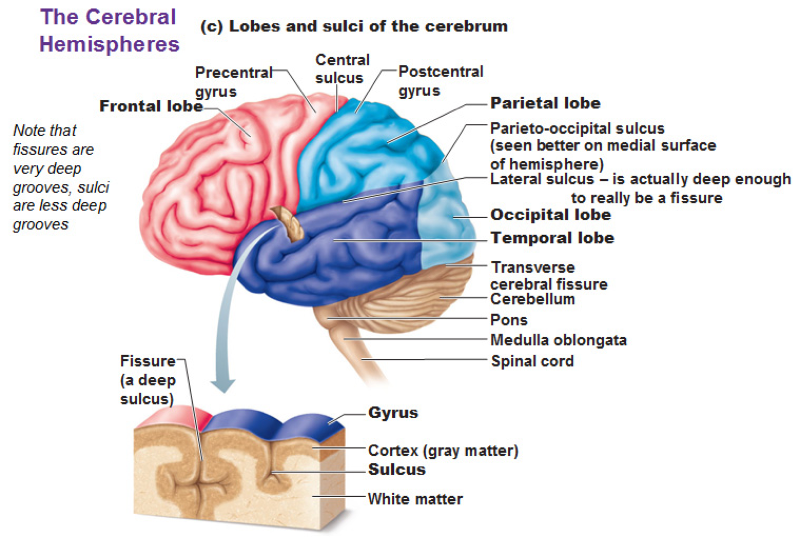 |
front 62 Longitudinal fissure | back 62 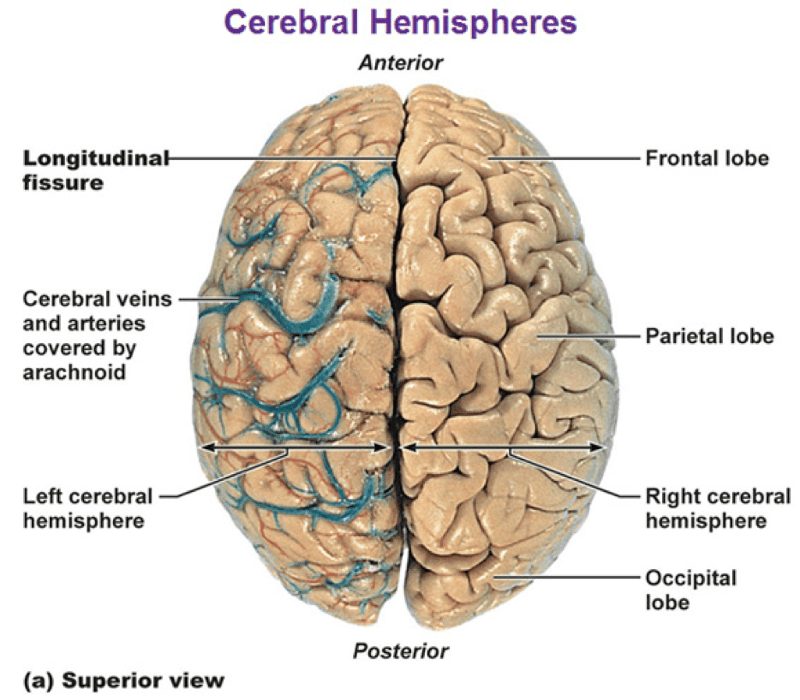 |
front 63 List the four major lobes of the cerebrum AND the main functions of each lobe. | back 63 Frontal Lobe –voluntary motor functions –planning, mood, smell and social judgment Parietal Lobe –receives and integrates sensory information Occipital Lobe –visual center of brain Temporal Lobe –areas for hearing, smell, learning, memory, emotional behavior |
front 64 Describe the location AND functions of the sensory association areas of the cerebrum. | back 64 Interpret sensory information Somesthetic association area (parietal lobe) –position of limbs; location of touch or pain; shape, weight and texture of an object Visual association area (occipital lobe) –identify things we see –faces recognized in temporal lobe Auditory association area (temporal lobe) –recall the name of a piece of music or identify a person by his voice |
front 65 Describe the location AND functions of the area(s) of the cerebrum involved in motor control. | back 65 Intention to contract a muscle begins in motor association (premotor) area of frontal lobes Precentral gyrus (primary motor area) relays signals to spinal cord –pyramidal cells called upper motor neurons –supply muscles of contralateral side |
front 66 What does contralateral motor control refer to? Make sure to explain what decussate means! | back 66 Right hemisphere controls left side of body Left hemisphere controls right side Decussate is a crossing in the medulla |
front 67 Why are the face and hands represented by such a large region of the cerebral cortex? | back 67 lots of sensations needed so they have larger area in cerebral cortex |
front 68 Compare and contrast the locations AND functions of Wernicke and Broca’s area in the cerebral cortex. | back 68 Wernicke area posterior –permits recognition of spoken and written language and creates plan of speech (sensory speech) Broca area anterior –generates motor signals for larynx, tongue, cheeks and lips –transmits to primary motor cortex for action (Motor speech) |
front 69 List AND describe the three types of aphasias covered in class. Lesion to Broca | back 69 Lesion to Broca = nonfluent aphasia –slow speech, difficulty in choosing words |
front 70 List AND describe the three types of aphasias covered in class. Lesion to Wernicke | back 70 Lesion to Wernicke = fluent aphasia –speech normal and excessive, but makes little sense |
front 71 List AND describe the three types of aphasias covered in class. Anomic aphasia | back 71 Anomic aphasia –speech and understanding are normal but text and pictures make no sense |
front 72 What is a lobotomy? | back 72 a surgical operation involving incision into the prefrontal lobe of the brain |
front 73 Describe, in detail, the concept of lateralization. | back 73 Left hemisphere - categorical hemisphere –specialized for spoken and written language, sequential and analytical reasoning (math and science), analyze data in linear way Right hemisphere - representational hemisphere –perceives information more holistically, perception of spatial relationships, pattern, comparison of special senses, imagination and insight, music and artistic skill Highly correlated with handedness –91% of people right-handed are left side dominant Lateralization develops with age females have more communication between hemispheres (corpus callosum thicker posteriorly) |
front 74 MEMORIZE the names, numbers, functions, and whether or not each cranial nerve is sensory, motor, or both! You will thank me later for this, even though it seems like a pain in the rear right now! J | back 74 Making Separate Cards. |
front 75 Predict what effects damage to each of the cranial nerves might cause. For example, a person will have trouble moving their right eye in which directions if the Oculomotor Nerve (CN III) is damaged. | back 75 Come Back ***** |
front 76 Use the idea of two point discrimination to explain what a receptive field is. | back 76 Area is monitored by a single receptor cell The larger the receptive field, the more difficult it is to localize a stimulus So, when you use the two point pair of blunt dividers, the minimum point to where they can feel both points at the same time then that is where you can locate the nerve densities. Therefore, the further apart the dividers are the more difficult it is to localize a stimulus. |
front 77 Compare and contrast tonic and phasic receptors. Draw a couple of graphs! | back 77 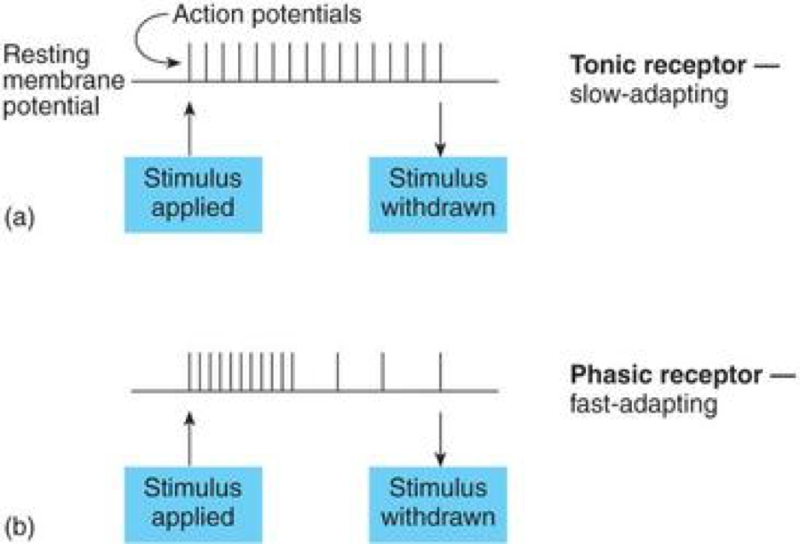 Tonic –Are always active Phasic –Are normally inactive –Become active for a short time whenever a change occurs –Provide information about the intensity and rate of change of a stimulus |
front 78 Use a graph to explain the concept of adaptation. | back 78 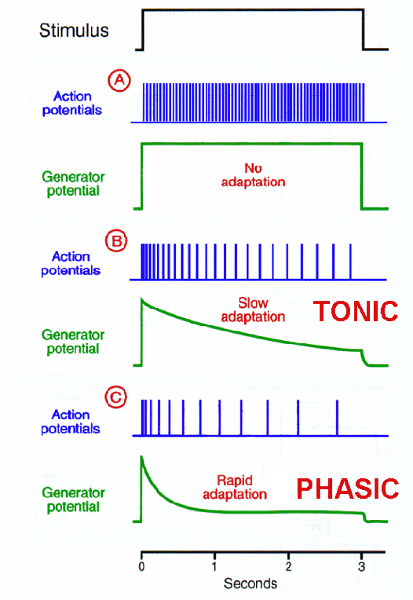 |
front 79 Pain receptors = | back 79 AKA nociceptors |
front 80 Where are pain receptors found? | back 80 Are common in the: –superficial portions of the skin –joint capsules –within the periostea of bones –around the walls of blood vessels Free nerve endings with large receptive fields |
front 81 What are the two types of pain receptor fibers and what types of information do each of them carry? | back 81 Myelinated Type A Pain Fibers- Carry sensations of fast pain, or prickling pain, such as that caused by an injection or a deep cut Type C Pain Fibers- Carry sensations of slow pain, or burning and aching pain |
front 82 Where might one find thermoreceptors? | back 82 Are free nerve endings located in: –the dermis –skeletal muscles –the liver –the hypothalamus |
front 83 Compare and contrast, in detail, the three classes of mechanoreceptors. Tactile receptors | back 83 Tactile receptors: –provide the sensations of touch, pressure, and vibration |
front 84 Compare and contrast, in detail, the three classes of mechanoreceptors. Baroreceptors | back 84 Baroreceptors: –detect pressure changes in the walls of blood vessels and in portions of the digestive, reproductive, and urinary tracts Monitor change in pressure Consist of free nerve endings that branch within elastic tissues in wall of distensible organ (such as a blood vessel) |
front 85 Compare and contrast, in detail, the three classes of mechanoreceptors. Proprioceptors | back 85 Proprioceptors: –monitor the positions of joints and muscles –the most structurally and functionally complex of general sensory receptors Muscle spindles: monitor skeletal muscle length, trigger stretch reflexes Golgi tendon organs: located at the junction between skeletal muscle and its tendon, stimulated by tension in tendon, monitor external tension developed during muscle contraction Receptors in joint capsules: free nerve endings detect pressure, tension, and movement at the joint |
front 86 Where might you find chemoreceptors? Briefly, how do they work | back 86 Located in the: –carotid bodies: –near the origin of the internal carotid arteries on each side of the neck Aortic bodies: –between the major branches of the aortic arch –Receptors monitor Ph, carbon dioxide, and oxygen levels in arterial blood |
front 87 Describe the difference in terms of location AND function of white matter and gray matter in the spinal cord. | back 87 Exterior white mater – conduction tracts Internal gray matter - mostly cell bodies |
front 88 Compare and contrast the dorsal and ventral horns of the spinal cord. | back 88 Dorsal (posterior) horns – SENSORY NEURONS! Ventral (anterior) horns – MOTOR NEURONS! |
front 89 Compare and contrast afferent and efferent neurons. Afferent | back 89 The Afferent (sensory) nervous system is all of the nerve pathways carrying signals TO the brain and/or spinal cord. Carries toward the central nervous system. |
front 90 Compare and contrast afferent and efferent neurons. Efferent | back 90 The Efferent (motor) nervous system consists of all the nerve pathways carrying signals OUT of the brain and/or spinal cord. Carries away from the central nervous system |
front 91 Draw out, in detail, the following SENSORY pathways from the spinal cord to the brain, making sure to include what type of information is relayed in each pathway:
| back 91 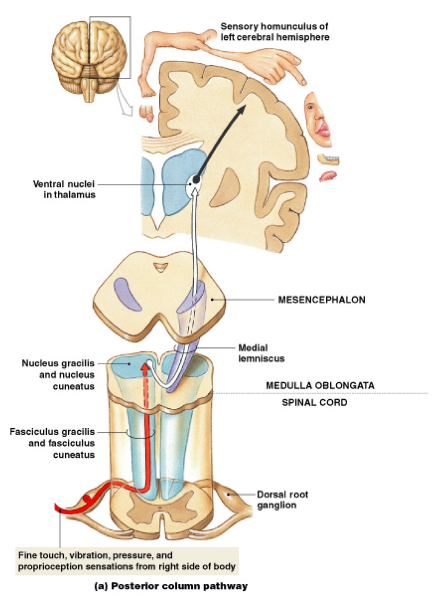 |
front 92 Sensory pathway- Posterior column | back 92 Carries sensations pressure, vibration, and proprioception |
front 93 Sensory pathway- Anterior spinothalamic tract | back 93 Carries crude touch and pressure sensations |
front 94 Sensory pathway- Lateral spinothalamic tract | back 94 Carries pain and temperature sensations |
front 95 Sensory pathway- Spinocerebellar tract | back 95 conveys information to the cerebellum about limb and joint position |
front 96 Diagram AND explain the differences between upper and lower motor neurons. | back 96 Upper motor neuron: cell body lies in a CNS processing center (i.e. cerebral cortex)
activity in upper motor neuron may facilitate or inhibit lower motor neuron Lower motor neuron: cell body lies in a nucleus of the brain stem or spinal cord
–only axon of lower motor neuron extends outside CNS –destruction of or damage to lower motor neuron eliminates voluntary and reflex control over innervated motor unit |
front 97 Where do most motor fibers decussate as they descend? | back 97 Medulla Oblaganta |
front 98 Draw out the following MOTOR pathways from the brain to the spinal cord, making sure to include what type of information is relayed in each pathway: | back 98 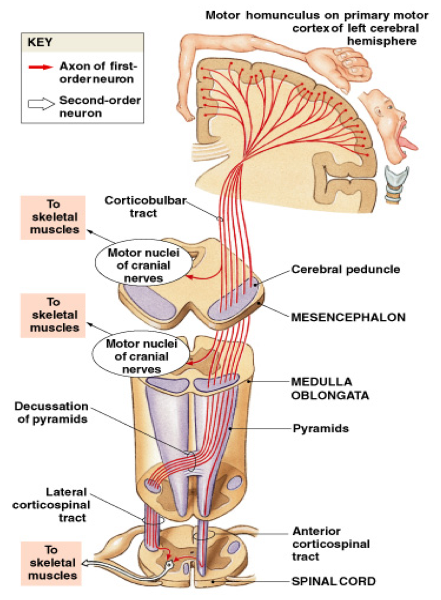 |
front 99 Draw out the following MOTOR pathways from the brain to the spinal cord, making sure to include what type of information is relayed in each pathway: Lateral corticospinal tract | back 99 ***Lateral c orticospinal tracts (to skeletal muscles of trunk and limbs) |
front 100 Draw out the following MOTOR pathways from the brain to the spinal cord, making sure to include what type of information is relayed in each pathway: Anterior corticospinal tract | back 100 no data |
front 101 Draw out the following MOTOR pathways from the brain to the spinal cord, making sure to include what type of information is relayed in each pathway: Corticobulbar tract | back 101 no data |
front 102 What are the “pyrmids” in the medulla of the brainstem? | back 102 As they descend, corticospinal tracts are visible along the ventral surface of medulla oblongata as pair of thick bands, the pyramids |
front 103 Predict the effects of an upper vs. a lower motor neuron lesion in the lateral corticopsinal tract. | back 103 no data |
front 104 Briefly describe the components and functions of the medial and lateral pathways. | back 104 a. Medial Pathway Components - Primarily concerned with control of
muscle tone and gross movements of neck, trunk, and proximal limb
muscles |