Instructions for Side by Side Printing
- Print the notecards
- Fold each page in half along the solid vertical line
- Cut out the notecards by cutting along each horizontal dotted line
- Optional: Glue, tape or staple the ends of each notecard together
Formulas
front 1 Index of Refraction Formula | back 1 *Speed of Light in Air -----------Divided by-------------- Speed of light in Material *186,000 miles per second |
front 2 Minimum Blank Size Formula (MBS) | back 2 Formula = *(GCD minus PD) + ED *GCD = "Geometric Center Distance" which is calculated like this: (A + DBL) FYI: PD = pupillary distance. ED is the diagonal measurement of lens in frame. A is width measurement of lens in frame. DBL is distance between lenses a.k.a bridge measurement in frame. |
front 3 Slab Off Formula | back 3
|
front 4 Toric Transposition | back 4 used to determine lens power in the principal meridians |
front 5 How do you find the total or absolute lens power at 180 degrees or 90 degrees when Rx gives it at 45 degrees or 135 degrees? | back 5 Divide cylinder in half and add to sphere |
front 6 How do you determine the lens power 90 degrees away from the cylinder axis? | back 6 Algebraically add sphere power to cylinder power |
front 7 Prentice's Rule | back 7 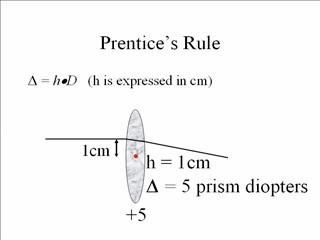 Amount of induced prism = power of lens x decentration in centimeters *In the picture, the lens power is +5. The decentration in the picture is 1cm. So, 1cm x power of 5 = 5 prism diopters (the amount of induced prism) |
front 8 Horizontal Decentration Formula | back 8 *GCD minus PD divided by 2 *GCD = Geometric Center Distance. PD= Pupillary Distance |
front 9 Definition of Decentration | back 9 Put simply, imagine this: Your patient has a specific PD at distance and at near. You measure this by using your pupilometer. The frame that your patient has chosen also has a PD. The frame PD is measured by adding the eye size to the bridge size. Decentration is simply a big word for how far we have to move the optical center in or out, when making the lenses so that when the lens is mounted in the frame, the optical center sits right in front of your patient's pupil. If the optical center does not sit right in front of your patient's pupil, we will create unwanted prism. |
front 10 Vertical Decentration Formula | back 10 Seg Height - ("B measurement" / 2)
|