front 1 Which of the following occurs in meiosis but not in mitosis?
A)
chromosome replication
B) synapsis of chromosomes
C)
production of daughter cells
D) alignment of chromosomes at the
equator
E) condensation of chromatin | back 1 Answer: B
Synapsis of chromosomes |
front 2 Which of the following most accurately describes a cyclin?
A) It is present in similar concentrations throughout the cell
cycle.
B) It is activated to phosphorylate by complexing with a
Cdk.
C) It decreases in concentration when MPF activity
increases.
D) It activates a Cdk molecule when it is in
sufficient concentration.
E) It activates a Cdk when its
concentration is decreased. | back 2 Answer: D
It activates a Cdk molecule when it is in sufficient concentration |
front 3 The function of phosphatases in signal transduction is best described
as to
A) move the phosphate group of the transduction pathway to
the next molecule of a series.
B) prevent a protein kinase from
being reused when there is another extracellular signal.
C)
amplify the transduction signal so it affects multiple
transducers.
D) amplify the second messengers such as cAMP.
E) inactivate protein kinases and turn off the signal transduction. | back 3 Answer: E
inactivate protein kinases and turn off the signal transduction |
front 4 Cells from an advanced malignant tumor most often have very abnormal
chromosomes, and often an abnormal total number of chromosomes. Why
might this occur?
A) Cancer cells are no longer density
dependent.
B) Cancer cells are no longer anchorage dependent.
C) Chromosomally abnormal cells can still go through cell cycle
checkpoints.
D) Chromosomally abnormal cells still have normal
metabolism.
E) Transformation introduces new chromosomes into cells. | back 4 Answer: C
Chromosomally abnormal cells can still go through cell cycle checkpoints. |
front 5 Why do neurons and some other specialized cells divide infrequently?
A) They no longer have active nuclei.
B) They no longer
carry receptors for signal molecules.
C) They have been shunted
into G₀.
D) They can no longer bind Cdk to cyclin.
E) They
show a drop in MPF concentration. | back 5 Answer: C
They have been shunted into G₀ |
front 6 When a neuron responds to a particular neurotransmitter by opening
gated ion channels, the neurotransmitter is serving as which part of
the signal pathway?
A) receptor
B) relay molecule
C)
transducer
D) signal molecule
E) endocrine molecule | back 6 Answer: D
signal molecule |
front 7 Why is apoptosis potentially threatening to the healthy
"neighbors" of a dying cell?
A) Cell death would
usually spread from one cell to the next via paracrine signals.
B) Lysosomal enzymes exiting the dying cell would damage
surrounding cells.
C) Released cellular energy would interfere
with the neighbors' energy budget.
D) Bits of membrane from the
dying cell could merge with neighbors and bring in foreign receptors.
E) Neighboring cells would activate immunological responses. | back 7 Answer: B
Lysosomal enzymes exiting the dying cell would damage surrounding cells. |
front 8 Which of the following defines a genome?
A) representation of a
complete set of a cell's polypeptides
B) the complete set of an
organism's polypeptides
C) the complete set of a species'
polypeptides
D) a karyotype
E) the complete set of an
organism's genes | back 8 Answer: E
the complete set of an organism's genes |
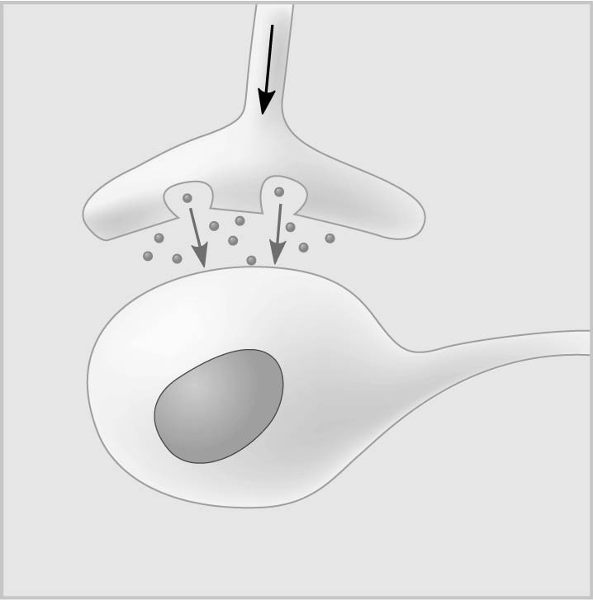
front 9 In the figure, the dots in the space between the two structures
represent which of the following?
A) receptor molecules
B)
signal transducers
C) neurotransmitters
D) hormones
E) pheromones | back 9 Answer: C
neurotransmitters |
front 10 30) Which of the following is a protein synthesized at specific times
during the cell cycle that associates with a kinase to form a
catalytically active complex?
A) PDGF
B) MPF
C) protein kinase
D) cyclin
E) Cdk | |
front 11 The human X and Y chromosomes
A) are both present in every
somatic cell of males and females alike.
B) are of approximately
equal size and number of genes.
C) are almost entirely
homologous, despite their different names.
D) include genes that
determine an individual's sex.
E) include only genes that govern
sex determination. | back 11 Answer: D
include genes that determine an individual's sex |
front 12 Consider this pathway: epinephrine → G protein-coupled receptor → G
protein → adenylyl cyclase → cAMP. Identify the second messenger.
A) cAMP
B) G protein
C) GTP
D) adenylyl
cyclase
E) G protein-coupled receptor | |
front 13 After telophase I of meiosis, the chromosomal makeup of each daughter
cell is
A) diploid, and the chromosomes are each composed of a
single chromatid.
B) diploid, and the chromosomes are each
composed of two chromatids.
C) haploid, and the chromosomes are
each composed of a single chromatid.
D) haploid, and the
chromosomes are each composed of two chromatids.
E) tetraploid,
and the chromosomes are each composed of two chromatids. | back 13 Answer: D
haploid, and the chromosomes are each composed of two chromatids |
front 14 Which of the following is true concerning cancer cells?
A) They do not exhibit density-dependent inhibition when growing
in culture.
B) When they stop dividing, they do so at random
points in the cell cycle.
C) They are not subject to cell cycle
controls.
D) When they stop dividing, they do so at random
points in the cell cycle, and they are not subject to cell cycle
controls.
E) When they stop dividing, they do so at random
points in the cell cycle; they are not subject to cell cycle controls;
and they do not exhibit density-dependent inhibition when growing in culture. | back 14 Answer: E
When they stop dividing, they do so at random points in the cell
cycle; they are not subject to cell cycle controls; and they do not
exhibit density-dependent inhibition when growing in culture. |
front 15 Testosterone functions inside a cell by
A) acting as a signal
receptor that activates tyrosine kinases.
B) binding with a
receptor protein that enters the nucleus and activates specific genes.
C) acting as a steroid signal receptor that activates ion
channel proteins.
D) becoming a second messenger that inhibits
adenylyl cyclase.
E) coordinating a phosphorylation cascade that
increases spermatogenesis. | back 15 Answer: B
binding with a receptor protein that enters the nucleus and
activates specific genes |
front 16 The activation of receptor tyrosine kinases is characterized by
A) dimerization and phosphorylation.
B) dimerization and
IP3 binding.
C) a phosphorylation cascade.
D) GTP
hydrolysis.
E) channel protein shape change. | back 16 Answer: A
dimerization and phosphorylation |
front 17 66) Homologous chromosomes move toward opposite poles of a dividing
cell during
A) mitosis.
B) meiosis I.
C) meiosis II.
D) fertilization.
E) binary fission. | |
front 18 One difference between cancer cells and normal cells is that cancer
cells
A) are unable to synthesize DNA.
B) are
arrested at the S phase of the cell cycle.
C) continue to
divide even when they are tightly packed together.
D) cannot
function properly because they are affected by density-dependent
inhibition.
E) are always in the M phase of the cell cycle. | back 18 Answer: C
continue to divide even when they are tightly packed together. |
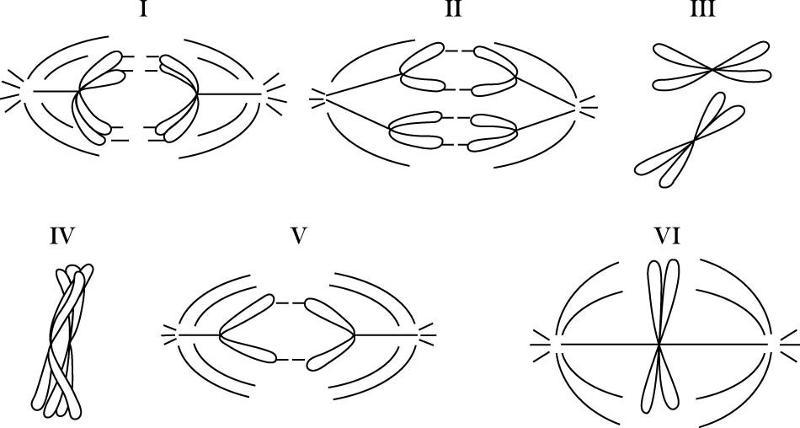
front 19 Figure 13.2 of a single pair of homologous chromosomes as they might
appear during various stages of either mitosis or meiosis
52) Which diagram represents anaphase I of meiosis?
A)
c
B) II
C) IV
D) V
E) VI | |
front 20 Independent assortment of chromosomes occurs.
A) The statement
is true for mitosis only.
B) The statement is true for meiosis I
only.
C) The statement is true for meiosis II only.
D) The
statement is true for mitosis and meiosis I.
E) The statement is
true for mitosis and meiosis II. | back 20 Answer: B
The statement is true for meiosis I only |
front 21 Lipid-soluble signaling molecules, such as testosterone, cross the
membranes of all cells but affect only target cells because
A)
only target cells retain the appropriate DNA segments.
B)
intracellular receptors are present only in target cells.
C)
most cells lack the Y chromosome required.
D) only target cells
possess the cytosolic enzymes that transduce the testosterone.
E) only in target cells is testosterone able to initiate the
phosphorylation cascade leading to activated transcription factor. | back 21 Answer: B
intracellular receptors are present only in target cells |
front 22 Which of the following is characterized by a cell releasing a signal
molecule into the environment, followed by a number of cells in the
immediate vicinity responding?
A) hormonal signaling
B)
autocrine signaling
C) paracrine signaling
D) endocrine
signaling
E) synaptic signaling | back 22 Answer: C
paracrine signaling |
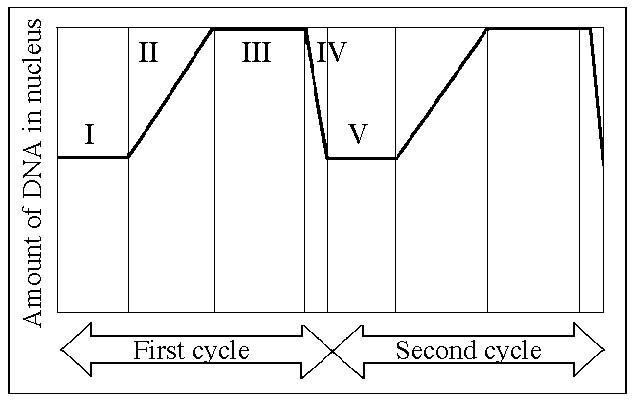
front 23 In the figure above, mitosis is represented by which numbered part(s)
of the cycle?
A) I
B) II
C) III
D) IV
E) V | |
front 24 Where do the microtubules of the spindle originate during mitosis in
both plant and animal cells?
A) centromere
B)
centrosome
C) centriole
D) chromatid
E) kinetochore | |
front 25 One of the major categories of receptors in the plasma membrane
reacts by forming dimers, adding phosphate groups, and then activating
relay proteins. Which type does this?
A) G protein-coupled
receptors
B) ligand-gated ion channels
C) steroid
receptors
D) receptor tyrosine kinases | back 25 Answer: D
receptor tyrosine kinases |
front 26 For the following question, match the key event of meiosis with the
stages listed below.
I. Prophase I V. Prophase II
II. Metaphase I VI. Metaphase II
III. Anaphase I VII.
Anaphase II
IV. Telophase I VIII. Telophase II
38) Tetrads of chromosomes are aligned at the equator of the
spindle; alignment determines independent assortment.
A) I
B) II
C) IV
D) VI
E) VIII | |
front 27 Which of the following is true of transcription factors?
A)
They regulate the synthesis of DNA in response to a signal.
B)
They transcribe ATP into cAMP.
C) They initiate the epinephrine
response in animal cells.
D) They control gene expression.
E) They regulate the synthesis of lipids in the cytoplasm. | back 27 Answer: D
They control gene expression. |
front 28 GTPase activity is involved in the regulation of signal transduction
because it
A) increases the available concentration of
phosphate.
B) decreases the amount of G protein in the membrane.
C) hydrolyzes GTP binding to G protein.
D) converts cGMP
to GTP.
E) phosphorylates protein kinases. | back 28 Answer: C
hydrolyzes GTP binding to G protein |
front 29 What is a cleavage furrow?
A) a ring of vesicles
forming a cell plate
B) the separation of divided prokaryotes
C) a groove in the plasma membrane between daughter nuclei
D) the metaphase plate where chromosomes attach to the spindle
E) the space that is created between two chromatids during anaphase | back 29 Answer: C
a groove in the plasma membrane between daughter nuclei |
front 30 What explains the increased concentration of Ca⁺⁺ in the ER?
A)
Calcium ions are actively imported from the cytoplasm into the ER.
B) Calcium concentration is kept low in the cytoplasm because of
its high usage level.
C) Calcium cannot enter the plasma
membrane through ion channels.
D) Calcium levels in the blood or
other body fluids are extremely low.
E) The Ca ions are recycled
from other molecules in the ER. | back 30 Answer: A
Calcium ions are actively imported from the cytoplasm into the ER. |
front 31 In a human karyotype, chromosomes are arranged in 23 pairs. If we
choose one of these pairs, such as pair 14, which of the following do
the two chromosomes of the pair have in common?
A) Length and
position of the centromere only.
B) Length, centromere position,
and staining pattern only.
C) Length, centromere position,
staining pattern, and traits coded for by their genes.
D)
Length, centromere position, staining pattern, and DNA sequences.
E) They have nothing in common except they are X-shaped. | back 31 Answer: C
Length, centromere position, staining pattern, and traits coded for
by their genes |
front 32 Which of the following does not occur during mitosis?
A)
condensation of the chromosomes
B) replication of the DNA
C) separation of sister chromatids
D) spindle formation
E) separation of the spindle poles | back 32 Answer: B
replication of the DNA |
front 33 What are scaffolding proteins?
A) ladderlike proteins that
allow receptor-ligand complexes to climb through cells from one
position to another
B) microtubular protein arrays that allow
lipid-soluble hormones to get from the cell membrane to the nuclear
pores
C) large molecules to which several relay proteins attach
to facilitate cascade effects
D) relay proteins that orient
receptors and their ligands in appropriate directions to facilitate
their complexing
E) proteins that can reach into the nucleus of
a cell to affect transcription | back 33 Answer: C
large molecules to which several relay proteins attach to
facilitate cascade effects |
front 34 Density-dependent inhibition is explained by which of the following?
A) As cells become more numerous, they begin to squeeze
against each other, restricting their size and ability to produce
control factors.
B) As cells become more numerous, the cell
surface proteins of one cell contact the adjoining cells and they
stop dividing.
C) As cells become more numerous, the protein
kinases they produce begin to compete with each other, such that the
proteins produced by one cell essentially cancel those produced by
its neighbor.
D) As cells become more numerous, more and more
of them enter the S phase of the cell cycle.
E) As cells become
more numerous, the level of waste products increases, eventually
slowing down metabolism. | back 34 Answer: B
As cells become more numerous, the cell surface proteins of one
cell contact the adjoining cells and they stop dividing. |
front 35 Where do apoptotic signals come from?
A) the nucleus only
B) the ER only
C) ligand binding only
D)
mitochondrial protein leakage only
E) all of the above | |
front 36 Why do chromosomes coil during mitosis?
A) to increase
their potential energy
B) to allow the chromosomes to move
without becoming entangled and breaking
C) to allow the
chromosomes to fit within the nuclear envelope
D) to allow the
sister chromatids to remain attached
E) to provide for the
structure of the centromere | back 36 Answer: B
to allow the chromosomes to move without becoming entangled and breaking |
front 37 If there are 20 chromatids in a cell, how many centromeres are there?
A) 10
B) 20
C) 30
D) 40
E) 80 | |
front 38 Measurements of the amount of DNA per nucleus were taken on a large
number of cells from a growing fungus. The measured DNA levels ranged
from 3 to 6 picograms per nucleus. In which stage of the cell cycle
did the nucleus contain 6 picograms of DNA?
A) G₀
B) G₁
C) S
D) G₂
E) M | |
front 39 Which of the following is a protein maintained at constant levels
throughout the cell cycle that requires cyclin to become catalytically
active?
A) PDGF
B) MPF
C) protein kinase
D)
cyclin
E) Cdk | |
front 40 Adenylyl cyclase has the opposite effect of which of the following?
A) protein kinase
B) protein phosphatase
C)
phosphodiesterase
D) phosphorylase
E) GTPase | back 40 Answer: C
phosphodiesterase |