Instructions for Side by Side Printing
- Print the notecards
- Fold each page in half along the solid vertical line
- Cut out the notecards by cutting along each horizontal dotted line
- Optional: Glue, tape or staple the ends of each notecard together
Biology
front 1 Both Cellular respiration and fermentation ordinarily begin with what molecule? | back 1 Glucose |
front 2 What role does cellular respiration play in the metabolism of an organism? | back 2 Cellular respiration convert large molecules into sources of energy that they can manage. |
front 3 Is fermentation an effective method of making energy for cells? | back 3 No for the most part it reduces NAD+ to NADH and in turn cause problems, due to excess NADH. |
front 4 Why does the substrate (sugars we use) used make a difference in the amount of ATP and carbon dioxide that is produced during fermentation? | back 4 Because we have higher glucose it is going to be more efficiently used. |
front 5 Why is it important to have optimal temperature and PH for cells to carry our cellular processes? | back 5 If its not at the optimal temperature or PH the cell can end up failing at it's respective job. |
front 6 List and explain two examples where humans use fermentation commercially. | back 6 The alcoholic beverages that can be produced by fermentation vary
widely, depending primarily on two factors—the plant
that is fermented and the enzymes used for fermentation Antibiotic can be fermented if no other commercially efficient method is available. For example, the important drug cortisone can be prepared by the fermentation. |
front 7 What is the difference between fermentation and cellular respiration? | back 7 Fermentation and cellular respiration differ in that fermentation does not require oxygen while cellular respiration does. Fermentation and cellular respiration are also different because water molecules are not produced during fermentation but are produced during cellular respiration. All fermentation reactions occur in the cell's cytoplasm but during cellular respiration, only glycolysis occurs in the cytoplasm. Lastly, fermentation produces a net gain of 2 ATPs while cellular respiration produces a net gain of 32 ATPs. |
front 8 What is chemical reaction for cellular respiration? | back 8 C₆H₁₂O₆ + 6O₂ → 6CO₂ + 6H₂O + energy The equation expressed in words would be glucose + oxygen → carbon dioxide + water+ energy |
front 9 Deamination? | back 9 Deamination is the bodily process in which amino groups are removed from excess proteins. This happens most often in the liver, though it also occurs in the kidneys. This process allows the system to convert excess amino acids into usable resources such as hydrogen and carbon. The process also plays a vital role in removing nitrogen waste from the body. Amino groups discarded as a result of the process are converted into ammonia, which is later expelled from the body through urination. |
front 10 What is substrate level phosphorylation? | back 10 the formation of high-energy phosphate bonds by phosphorylation of
ADP to ATP (or GDP to GTP) coupled to cleavage of a high-energy
metabolic intermediate. |
front 11 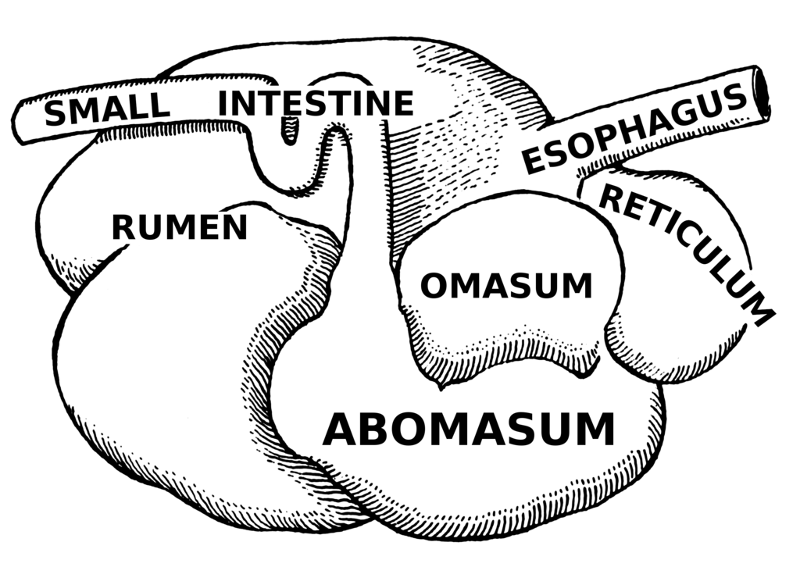 Rumen | back 11 the first stomach of a ruminant, which receives food or cud from the esophagus, partly digests it with the aid of bacteria, and passes it to the reticulum. ie cow |
front 12 Ruminants, don't need to know this | back 12 Ruminants are mammals that are able to acquire nutrients from plant-based food by fermenting it in a specialized stomach prior to digestion, principally through bacterial actions. The process typically requires the fermented ingesta (known as cud) to be regurgitated and chewed again. The process of rechewing the cud to further break down plant matter and stimulate digestion is called rumination. There are about 150 species of ruminants, which include both domestic and wild species. Ruminating mammals include cattle, goats, sheep, giraffes, yaks, deer, antelope, and some macropods.[3] |
front 13 What is the net production of ATP from glycosis? What is the overall? What is it from the Krebs cycle? | back 13 2 ATP produced (least) 36 - from electron transport change - most ATP produced (most) 4 ATP produced |
front 14 Osmosis - | back 14 move high to low, Osmosis is the spontaneous net movement of solvent molecules through a semi-permeable membrane into a region of higher solute concentration, in the direction that tends to equalize the solute concentrations on the two sides. |
front 15 Chemiosmosis | back 15 movement of chemicals, high and low, is the movement of ions across a selectively permeable membrane, down their electrochemical gradient. More specifically, it relates to the generation of ATP by the movement of hydrogen ions across a membrane during cellular respiration or photosynthesis. |
front 16 Fermentation occurs in | back 16 yeast, some animals produces ethonol |
front 17 What are the purpose? NAD+ / NADH FADH / FADH2 | back 17 They are transporters to the electron transport train. |
front 18 Redox reaction oxidation - reduction - | back 18 is a oxidation reduction reaction loss of electrons e- gain of electron e+ |
front 19 Where does cellular respiration occur? | back 19 in the cell / cytoplasm |
front 20 Exergonic- Endergonic- | back 20 An exergonic process is one in which there is a positive flow of energy, release of energy Endergonic is a consumption of energy |
front 21 Electronic Transport Train | back 21 ATP Synthesis (to make or put together) is making substrate level phosphorylation. |
front 22 Compare Herbivore, Carnivore | back 22 Herbivores are animals which only eat plant material. This means leaves, flowers, fruits or even wood. Sheep, horses, rabbits and snails are well known examples of herbivores which eat grass and leaves. Carnivores eat meat. A carnivore is a predator because it has to find and catch its prey. Some carnivores, such as wolves, hunt in a group called a pack. |
front 23 Cecum | back 23 In herbivores, the cecum stores food material where bacteria are able to break down the cellulose. ie rabbit |
front 24 Omnivore teeth structure - purpose of teeth Molars Incisors Canines | back 24
Molars - grinding teeth patterns on posterior teeth
Incisors - piercing and ripping cusps on anterior teeth Canines - tear food, These teeth have one cusp, or pointed edge, and are used for holding or grasping food, and are very strong, stable teeth. |
front 25 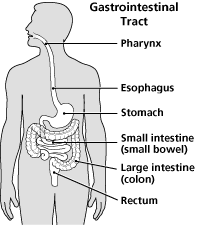 Digestive system order and what they do? | back 25 Mouth - Breaks down foot particles, Salivary glands moisten and lubricate food, Pharynx - Swallows, Esphagus - transports food, Stomach - stores and churns food, Small Intestine - completes digestion, Large Intestine - reabsorbs water, ions and vitamins, stores waste, Rectum - expels waste, Anus - opening for waste elimination |
front 26 Pancreas | back 26 Pancreas - regulates blood glucose levels, bicarbonates neutralize stomach acid |
front 27 Liver | back 27 Liver - breaks down and builds up many biological molecules, stores vitamins and iron, destroys old blood cells, destroys poison, and produces bile. |
front 28 Villa in small intestine | back 28 Intestinal villi (singular: villus) are small, finger-like projections that protrude from the epithelial lining of the intestinal wall. |
front 29 Essential Substances | back 29
oxygen, water, proteins
with about 10 essential amino acids, |
front 30 Mastication | back 30 Mastication or chewing is the process by which food is crushed and ground by teeth. It is the first step of digestion, and it increases the surface area of foods to allow more efficient break down by enzymes. During the mastication process, the food is positioned by the cheek and tongue between the teeth for grinding and mixed with fluid secretions. |
front 31 BMR rate is? | back 31 Basal Metabolic Rate is the minimum rate of energy consumption. It is relatively constant for a given individual. Exercise raises the metabolic rate above the basal levels, so the amount of energy the body requires per day is determined not only the BMR but also by the level of physical activity. |