Instructions for Side by Side Printing
- Print the notecards
- Fold each page in half along the solid vertical line
- Cut out the notecards by cutting along each horizontal dotted line
- Optional: Glue, tape or staple the ends of each notecard together
Exercise 6 Classification of Tissues
front 1 Tissue | back 1 Group of cells that are similar in structure |
front 2 Connective tissue | back 2 - anchors, packages, and supports body organs - the most durable tissue type - abundant nonliving extracellular matrix - most widespread tissue in the body |
front 3 Epithelium tissue | back 3 - lines body cavities and covers the body's external surface - cells may absorb, secrete and filter - synthesizes hormones |
front 4 Muscle tissue | back 4 - pumps blood, flushes urine out of body, and allows one to swing a bat - major function is to contract |
front 5 Nervous tissue | back 5 - transmits electrical signals - most involved in regulating and controlling body functions - forms nerves and the brain |
front 6 Describe five general characteristics of epithelial tissue. | back 6 Polarity, Cellularity (specializd contacts-cells fit closely together) , Supported by Connective tissue, Avascularity and Regeneration |
front 7 On what basis are epithelial tissues classified? | back 7 arrangement or relative number of layers and cell shape |
front 8 List five major functions of epithelium in the body, and give examples of each. | back 8 1. protection; epithelium covering body surface protects against
bacterial invasion and chemical damage. |
front 9 How does the function of stratified epithelia differ from the function of simple epithelia? | back 9 Stratified epithelia has more layers for protection, simple epithelia allow materials to move across them and are less protective. |
front 10 Where is ciliated epithelium found? What role does it play? | back 10 Lining of the trachea, most of the upper respiratory tract. There role is to secrete substances, mucus; propulsion of mucus by ciliary action. |
front 11 Transitional epithelium is actually stratified squamous epithelium with special characteristics. How does it differ structurally from other stratified squamous epithelia? How does the structural difference support its function? | back 11 - When stretched, its top layers are squamous, when not stretched, top layers are pillow shaped. - The surface cells have the ability to slide over one another, increasing the internal volume of the organ. |
front 12 How do the endocrine and exocrine glands differ in structure and function? | back 12 Endocrine glands are ductless, and there function is to release all hormones into the extracellular fluid where they enter blood stream and lymphatic vessels. But Exocrine glands have ducts, and they secrete through the ducts to an epithelial surface. |
front 13 Simple Squamous | back 13 - Alveolar sacs of lungs - Forms the thin serous membranes; a single layer of flattened cells |
front 14 Simple Cuboidal | back 14 - Tubules of the kidney |
front 15 Simple Columnar | back 15 - Lining of the stomach |
front 16 Stratified Squamous | back 16 - Lining of the esophagus - Epidermis of the skin |
front 17 Transitional | back 17 - Lining of bladder; peculiar cells that have the ability to slide over each other |
front 18 What are three general characteristics of connective tissues? | back 18 1. Rich supply of blood vessels. |
front 19 What functions are performed by connective tissue? | back 19 protection, support, and bind together tissues of the body |
front 20 How are the functions of connective tissue reflected in its structure? | back 20 There is a wide variety in the structures of connective tissue. This is reflected in the wide variety of functions they perform. Also, the large amount of nonliving matrix seen provides the strength needed to protect the body and carry out the normal functions of the body. |
front 21 Adipose connective tissue | back 21 - acts as a storage depot for fat - insulates against heat loss |
front 22 Areolar connective tissue | back 22 - composes basement membranes; a soft packaging tissue with a jellylike matrix |
front 23 Dense fibrous connective tissue | back 23 - attaches bones to bones and muscles to bones - the dermis of the skin |
front 24 Elastic cartilage | back 24 - provides a flexible framework for the external ear - walls of large arteries |
front 25 Fibrocartilage | back 25 - makes up the intervertebral discs |
front 26 Hyaline cartilage | back 26 - forms the larynx the costal cartilages of the ribs and the embryonic skeleton - firm structurally amorphous matrix heavily invaded with fibers; appears glassy and smooth |
front 27 Osseous tissue | back 27 - forms the hip bone - matrix hard owing to calcium salts; provides levers for muscles to act on |
front 28 Why do adipose cells remind people of a ring with a single jewel? | back 28 They contain a large fat-filled vacuole occupying most of the cell volume. The nucleus is pushed to the periphery, giving the cell a "signet ring" appearance. |
front 29 What two physiological characteristics are highly developed in neurons, nerve cells? | back 29 iirritability and conductivity |
front 30 In what ways are neurons similar to other cells? | back 30 they contain a nucleus and the usual organelles |
front 31 How are neurons and other cells different? | back 31 their cytoplasm is drawn out into long processes |
front 32 Describe how the unique structure of a neuron relates to its function in the body. | back 32 Neurons conduct impulses over relatively long distances in the body, this is facilitated by their long cytoplasmic extensions |
front 33 Skeletal | back 33 - voluntarily controlled - striated - has several nuclei per cell - found attached to bone - allows you to direct your eyeballs - contains branching cylindrical cells - contains long, nonbranching cylindrical cells - concerned with locomotion of the body as a whole |
front 34 Cardiac | back 34 - involuntarily controlled - striated - has a single nucleus in each cell - has intercalated discs - changes the internal volume of an organ as it contacts - tissue of the heart |
front 35 Smooth | back 35 - involuntarily controlled - has a single nucleus in each cell - found in the walls of the stomach, uterus and arteries - contains spindle-shaped cells |
front 36 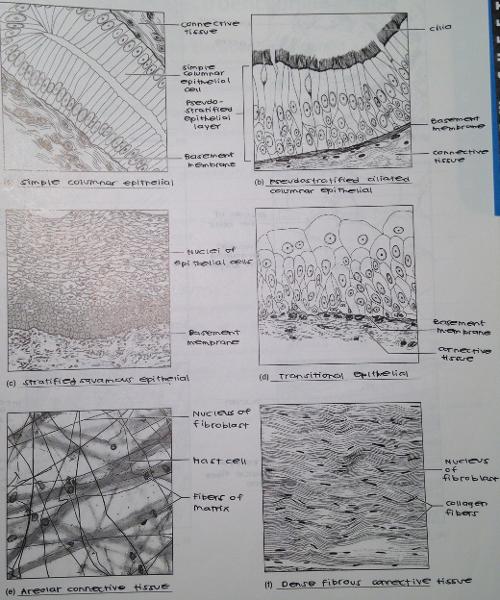 | back 36 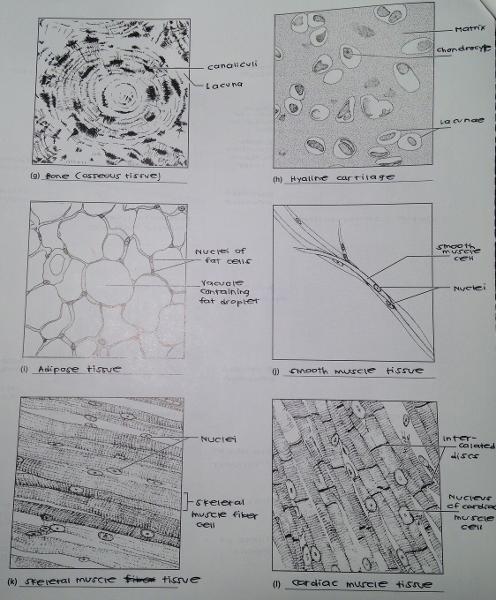 |