Instructions for Side by Side Printing
- Print the notecards
- Fold each page in half along the solid vertical line
- Cut out the notecards by cutting along each horizontal dotted line
- Optional: Glue, tape or staple the ends of each notecard together
Exam 3, Chapter 14
front 1 PATHOLOGY, INFECTION, AND DISEASE
| back 1 The study of disease. |
front 2 PATHOLOGY, INFECTION, AND DISEASE
| back 2 The study of the cause of a disease. |
front 3 PATHOLOGY, INFECTION, AND DISEASE
| back 3 The development of disease. |
front 4 PATHOLOGY, INFECTION, AND DISEASE
| back 4 Colonization of the body by pathogens. |
front 5 PATHOLOGY, INFECTION, AND DISEASE
| back 5 An abnormal state in which the body is not functioning normally. |
front 6 NORMAL MICROBIOTA AND THE HOST
| back 6 May be present for days, weeks, or months. |
front 7 NORMAL MICROBIOTA AND THE HOST
| back 7 Permanently colonize the host |
front 8 NORMAL MICROBIOTA AND THE HOST
| back 8 Is the relationship between normal microbiota and the host. |
front 9 SYMBIOSIS
| back 9 One organism benefits, and the other is unaffected. |
front 10 SYMBIOSIS
| back 10 Both organisms benefit. |
front 11 SYMBIOSIS
| back 11 One organism benefits at the expense of the other. |
front 12 SYMBIOSIS
| back 12 Some normal microbiota ordinarily do not cause disease in their normal habitat in a healthy person but may do so in a different environment. |
front 13 NORMAL MICROBIOTA AND THE HOST
| back 13 Is a competition between microbes. |
front 14 NORMAL MICROBIOTA AND THE HOST
| back 14 PROTECT THE HOST BY:
|
front 15 NORMAL MICROBIOTA AND THE HOST
| back 15 Live microbes applied to or ingested in the body, intended to exert a beneficial effect. |
front 16 KOCH'S POSTULATES | back 16 1. The same pathogen must be present in every case
|
front 17 KOCH'S POSTULATES: UNDERSTANDING DISEASE
| back 17 1. Microorganisms are isolated from a diseased or
|
front 18 KOCH'S POSTULATES | back 18 Koch's postulates are used to prove the cause
|
front 19 CLASSIFYING INFECTIOUS DISEASES
| back 19 A change in body function that is felt by a patient as a result of disease. |
front 20 CLASSIFYING INFECTIOUS DISEASES
| back 20 A change in body that can be measured or observed as a result of disease. |
front 21 CLASSIFYING INFECTIOUS DISEASES
| back 21 A specific group of signs and symptoms that accompany a disease. |
front 22 CLASSIFYING INFECTIOUS DISEASES
| back 22 A disease that is spread from one host to another. |
front 23 CLASSIFYING INFECTIOUS DISEASES
| back 23 A disease that is EASILY spread from one host to another. |
front 24 CLASSIFYING INFECTIOUS DISEASES
| back 24 A disease that is not transmitted from one host to another. |
front 25 OCCURENCE OF A DISEASE
| back 25 Fraction of a population that CONTRACTS A DISEASE during a specific time. |
front 26 OCCURENCE OF A DISEASE
| back 26 Fraction of a population HAVING A SPECIFIC DISEASE at a given time. |
front 27 OCCURENCE OF A DISEASE
| back 27 Disease that occurs occasionally in a population. |
front 28 OCCURENCE OF A DISEASE
| back 28 Disease constantly present in a population. |
front 29 OCCURENCE OF A DISEASE
| back 29 Disease acquired by many hosts in a given area in a short time. |
front 30 OCCURENCE OF A DISEASE
| back 30 Worldwide epidemic. |
front 31 OCCURENCE OF A DISEASE
| back 31 Immunity in most of a population. |
front 32 SEVERITY or DURATION OF A DISEASE
| back 32 Symptoms develop rapidly. |
front 33 SEVERITY or DURATION OF A DISEASE
| back 33 Disease develops slowly. |
front 34 SEVERITY or DURATION OF A DISEASE
| back 34 Symptoms are between acute and chronic. |
front 35 SEVERITY or DURATION OF A DISEASE
| back 35 Disease with a period of no symptoms when the causative agent is inactive. |
front 36 EXTENT OF HOST INVOLVEMENT
| back 36 Pathogens are limited to a small area of the body. |
front 37 EXTENT OF HOST INVOLVEMENT
| back 37 An infection throughout the body. |
front 38 EXTENT OF HOST INVOLVEMENT
| back 38 Systemic infection that began as a local infection. |
front 39 EXTENT OF HOST INVOLVEMENT
| back 39 Toxic inflammatory condition arising from the spread of microbes, especially bacteria or their toxins, from a focus of infection. |
front 40 EXTENT OF HOST INVOLVEMENT
| back 40 Bacteria in the blood. |
front 41 EXTENT OF HOST INVOLVEMENT
| back 41 Growth of bacteria in the blood. |
front 42 EXTENT OF HOST INVOLVEMENT
| back 42 Toxins in the blood. |
front 43 EXTENT OF HOST INVOLVEMENT
| back 43 Viruses in the blood. |
front 44 EXTENT OF HOST INVOLVEMENT
| back 44 Acute infection that causes the initial illness. |
front 45 EXTENT OF HOST INVOLVEMENT
| back 45 Opportunistic infection after a primary (predisposing) infection. |
front 46 EXTENT OF HOST INVOLVEMENT
| back 46 No noticeable signs or symptoms (inapparent infection). |
front 47 PREDISPOSING FACTORS | back 47 MAKE THE BODY MORE SUSCEPTIBLE TO DISEASE:
|
front 48 RESERVOIRS OF INFECTION | back 48 CONTINUAL SOURCES OF INFECTION:
|
front 49 TRANSMISSION OF DISEASES | back 49 CONTACT:
|
front 50 VEHICLE TRANSMISSION | back 50 Transmission by an inanimate reservoir (food, water, air). |
front 51 VECTORS | back 51 1. Arthropods, especially fleas, ticks, and
|
front 52 NOSOCOMIAL INFECTIONS | back 52 1. Are acquired as a result of a hospital stay.
|
front 53 NOSOCOMIAL INFECTIONS
| back 53 1. Microorganisms in hospital environments.
|
front 54 PRINCIPLE SITES OF NOSOCOMIAL INFECTIONS
| back 54 1. URINARY TRACT INFECTIONS:
|
front 55 COMMON CAUSES OF NOSOCOMIAL INFECTIONS | back 55 1. Coagulase-negative staphylococci: 15% of total
|
front 56 EMERGING INFECTIOUS DISEASES | back 56 Diseases that are new, increasing in incidence, or showing a potential to increase in the near future. |
front 57 EMERGING INFECTIOUS DISEASES | back 57 CONTRIBUTING FACTORS:
|
front 58 EPIDEMIOLOGY | back 58 1. The study of where and when diseases occur.
|
front 59 EPIDEMIOLOGY | back 59 1. John Snow (1848-1849)- mapped the occurrence of
|
front 60 EPIDEMIOLOGY
| back 60 Healthcare workers report specified disease to local, state, and national offices. |
front 61 EPIDEMIOLOGY
| back 61 Physicians are required to report occurrence. |
front 62 THE CDC
| back 62 Incidence of a specific notifiable disease. |
front 63 THE CDC
| back 63 Deaths from notifiable diseases. |
front 64 THE CDC
| back 64 Number of people affected in relation to the total population in a given time period. |
front 65 THE CDC
| back 65 Number of deaths from a disease in relation to the population at a given time. |
front 66 The term best associated with the cause of disease is:
| back 66 Etiology |
front 67 In a healthy human, resident microorganisms would be found in all of the following areas except:
| back 67 Bloodstream |
front 68 Healthcare professionals who fail to use aseptic techniques can cause:
| back 68 Nosocomial infections |
front 69 In the human intestinal tract, E. coli produces vitamins beneficial to the host and can inhibit pathogen growth. In turn, the bacterium is supplied with nutrients and an environment for growth. This symbiotic relationship between E. coli and its host is an example of:
| back 69 Mutualism |
front 70 Which of the following is not an example of microbial antagonism?
| back 70 Microbes producing vitamins and growth factors that can be utilized by the host. |
front 71 An infection transmitted by a hypodermic needle is transmitted by:
| back 71 Indirect contact |
front 72 Which of the following is not necessary to satisfy Koch's postulates?
| back 72 The organism must cause disease through toxin production. |
front 73 Infectious diseases which are easily passed from host to host within a population are best described as:
| back 73 Contagious |
front 74 An epidemic disease of worldwide proportions would best be described as:
| back 74 Pandemic |
front 75 The occurrence of streptococcal bronchopneumonia in an individual recovering from influenza is an example of a/an:
| back 75 Secondary infection |
front 76 Infections in which the pathogen is distributed throughout the body are referred to as "generalized infections" or:
| back 76 Systemic infections |
front 77 In a patient with bacteremia, you would expect to find:
| back 77 Bacteria in the blood. |
front 78 Which of the following diseases does not have a human reservoir?
| back 78 Tetanus |
front 79 Which if the following is an example of contact transmission?
| back 79 A person drinks from a cup used by another individual. |
front 80 Vector transmission is not responsible for:
| back 80 Influenza |
front 81 Any of the following may occur in diseases transmitted by vectors except:
| back 81 In biological transmission, the vector multiplies in the human host. |
front 82 Which of the following is the third stage of a disease?
| back 82 Period of illness. |
front 83 The morbidity rate is best defined as:
| back 83 The number of individuals, relative to the population, affected by a particular disease in a period of time. |
front 84 The ingestion of lactic acid bacteria for the purpose of preventing colonization by intestinal pathogens such as Salmonella enterica during antibiotic therapy is an example of:
| back 84 Probiotics |
front 85 An example of descriptive epidemiology is:
| back 85 John Snow's study of the London cholera outbreak in 1848-1849. |
front 86 Most microorganisms are pathogenic and harmful to the human body.
| back 86 False |
front 87 It is possible for a host to harbor a pathogen without development of disease.
| back 87 True |
front 88 Disease symptoms are readily measured by health-care professionals.
| back 88 False |
front 89 Tetanus, which humans acquire from wounds that become infected with the soil microbe Clostridium tetani, is considered noncommunicable.
| back 89 True |
front 90 Transmission of Salmonella through contaminated chicken salad at a family picnic is an example of vector transmission.
| back 90 False |
front 91 Water can serve as a human reservoir of Vibrio cholerae.
| back 91 False |
front 92 In biological transmission, pathogens reproduce in the vector.
| back 92 True |
front 93 A nosocomial infection is one that develops as a result of a stay in a health-care facility.
| back 93 True |
front 94 Depending on the disease, individuals can be contagious during the incubation period, prodromal period, period of illness, period of decline, and period of convalescence.
| back 94 True |
front 95 For the case control method in analytical epidemiology, a group of individuals with the disease is compared to matched controls.
| back 95 True |
front 96 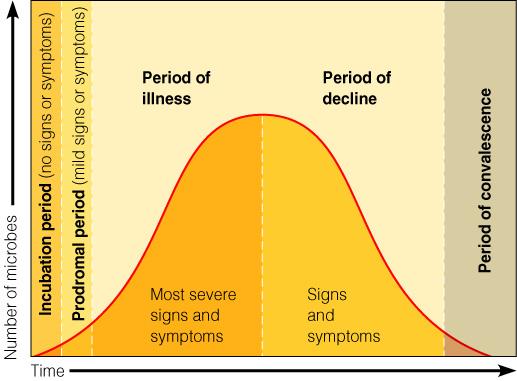 Michael woke up feeling suddenly like he was getting a sore throat and a headache. Which stage of a disease's progression is he most likely in?
| back 96 Prodromal period |
front 97  Tim ate raw oysters at a local restaurant and has since discovered he contracted hepatitis A. Which mode of transmission is this?
| back 97 Vehicle transmission |
front 98 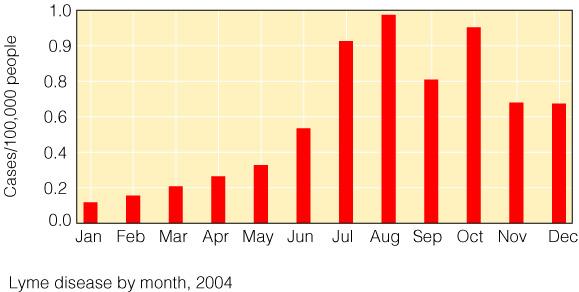 Which month is the number of cases of Lyme disease the greatest?
| back 98 August |
front 99 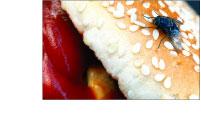 Houseflies can transfer the pathogens of typhoid fever from the feces of infected people to food. This is an example of ____________ transmission.
| back 99 Mechanical |
front 100 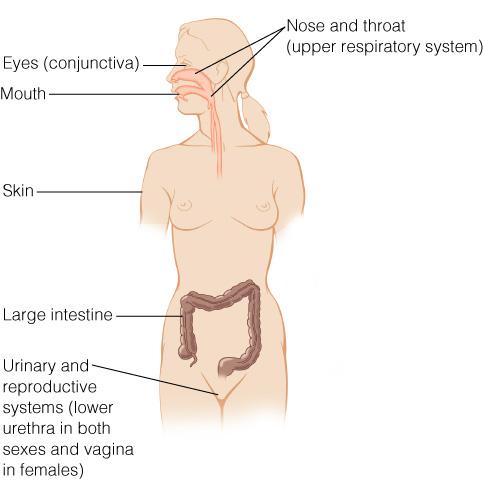 The figure shows the locations of normal microbiota on and in the human body. Which of these locations has the largest numbers of resident microbiota?
| back 100 Large intestine |
front 101 Following coronary artery bypass surgery, seven patients develop Rhodococcus bronchialis infections. Cultures of the operating rooms, Nurse A, and Nurse B are taken. R. bronchialis grows from the hand and nasal swabs of Nurse A. The patients' infections are an example of a(n):
| back 101 Nosocomial infection |
front 102 All members of the seven families for whom Mary Mallon prepared meals developed typhoid fever. Mary did not get sick. This is an example of a(n):
| back 102 Carrier state |
front 103 The difference between normal and transient microbiota is that normal microbiota:
| back 103 Are permanently present. |
front 104 Robert Koch demonstrated that infectious disease:
| back 104 Is caused by a microbe growing in the body. |
front 105 A disease that is constantly present in a population is called a(n):
| back 105 Endemic disease |
front 106 Emergence of infectious disease can be due to all of the following reasons. Which one can be affected by changing human behavior?
| back 106 Lack of vaccination |
front 107 Two patients developed endophthalmitis within 24 hours after corneal transplant surgery. The corneas have been stored in buffered media with gentamicin. Each patient had received a subconjunctival injection of gentamicin after transplantation. Streptococcus pneumoniae was isolated from conjunctival swabs of the affected eyes of both patients and from donor corneoscleral tissue. The post-transplant infections could have been prevented by:
| back 107 Antimicrobial susceptibility testing of the bacteria before surgery. |
front 108 On October 29, Barbara participated in a study group for her Microbiology class. On November 1, Barbara had a "scratchy throat" when she swallowed. On November 2, Barbara had a headache, runny nose, and watery eyes. She was fully recovered on November 7. Identify the prodromal period for this infection.
| back 108 Nov. 1 |
front 109 John Snow analyzed information on cholera victims. This is an example of:
| back 109 Descriptive epidemiology |
front 110 Florence Nightingale compared disease statistics for soldiers before and after use of sanitation measures. This is an example of:
| back 110 Analytical epidemiology |
front 111 Ehrlichiosis is transmitted by Ixodes scapularis ticks. This is an example of:
| back 111 Arthropod vector transmission |
front 112 Toxoplasmosis is transmitted to humans by cats. This is an example of:
| back 112 Direct contact |
front 113 The fungus Coccidioides immitis is found in the soil. Humans contract coccidioidomycosis by inhaling fungal spores. The reservoir for this disease is:
| back 113 Soil |
front 114 Which one of the following does not belong with the others?
| back 114 Measles |
front 115 Which one of the following diseases is noncommunicable?
| back 115 Botulism |
front 116 A continual source of infection is called a:
| back 116 Reservoir |
front 117 An infection that does not cause any signs of disease is a(n):
| back 117 Inapparent infection |
front 118 Alfalfa sprouts were responsible for transmitting Salmonella to 32 people in four states. This is an example of:
| back 118 Vehicle transmission |
front 119 Two patients developed endophthalmitis within 24 hours after corneal transplant surgery. The corneas had been stored in buffered media with gentamicin. Each patient had received a subconjunctival injection of gentamicin after transplantation. Streptococcus pneumoniae was isolated from conjunctival swabs of the affected eyes of both patients and from donor corneoscleral tissue. This is an example of:
| back 119 A nosocomial infection |
front 120 On October 29, Barbara participated in a study group for her Microbiology class. On November 1, Barbara had a "scratchy throat" when she swallowed. On November 2, Barbara had a headache, runny nose, and watery eyes. She was fully recovered on November 7. Identify the incubation period for this infection.
| back 120 Oct. 29-Nov. 1 |