Print Options

Card layout: ?

← Back to notecard set|Easy Notecards home page

Instructions for Side by Side Printing
  1. Print the notecards
  2. Fold each page in half along the solid vertical line
  3. Cut out the notecards by cutting along each horizontal dotted line
  4. Optional: Glue, tape or staple the ends of each notecard together
  1. Verify Front of pages is selected for Viewing and print the front of the notecards
  2. Select Back of pages for Viewing and print the back of the notecards
    NOTE: Since the back of the pages are printed in reverse order (last page is printed first), keep the pages in the same order as they were after Step 1. Also, be sure to feed the pages in the same direction as you did in Step 1.
  3. Cut out the notecards by cutting along each horizontal and vertical dotted line
To print: Ctrl+PPrint as a list

36 notecards = 9 pages (4 cards per page)

Viewing:

Fungi- yeasts and molds

front 1

back 1

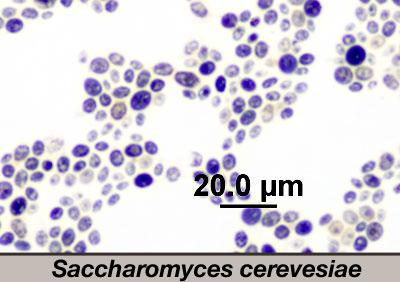
Saccharomyces is the common yeast often used in making wine, beeer and bread.

The term "yeast" simply refer to fungi that grow as single, round cells and don't form hyphae.

Yeast is not a taxonomic group, it's a Description of a body type.

these eukaryotic cells contain a nucleus (stained dark in this image) and a central vacuole.

front 2

back 2

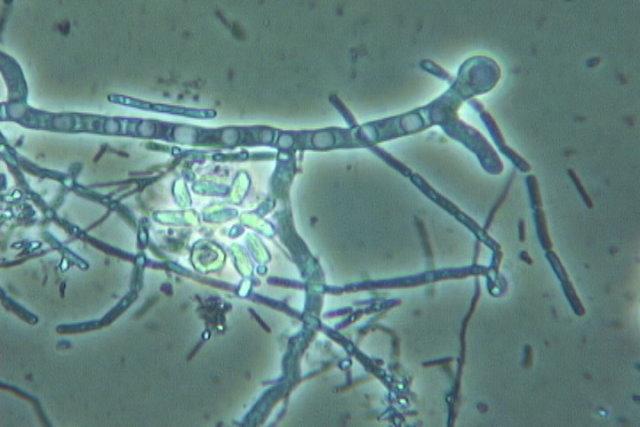
Hyphae- individual fungal filaments which collectively form a Mycelium.

They are dark in dematiaceous fungi and lack pigment in hyaline (moniliaceous)fungi.

Hyaline- All hyaline hyphae lack pigment- see photo

front 3

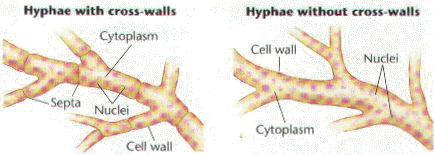
Septate -non septate

back 3

Hyphae with septa are called septate hyphae.
Septa are cross walls with pores to allow the movement of cytoplasm in hyphae.

Hyphae may be septate, and walls separate adjacent cells, or non septate if walls are absent.

front 4

back 4

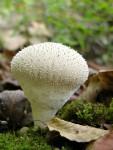
Macrofungi-
Filamentous fungi that produce fleshy reproductive structures-mushrooms, puffballs, and shelf fungi- although the majority of the fungus is filamentous and hidden underground or within decaying matter...
we call them Macrofungi

front 5

Define
conidia

back 5

Various asexual spores may be produced during the life cycle of many fungi. If they form at the ends of hyphae this is what they are.

front 6

Define
blastospores

back 6

Other asexual spores which are produced by budding.

front 7

Define
arthrospores

back 7

produced when a hypha breaks

front 8

Most distinctive features of The Kingdom fungi

back 8

Non Motile
Absorptive heterotrophs (they don't ingest)
Chitin = cell wall
Spores = reproductive means
Sexual & asexual

front 9

Define
absorptive heterotroph

back 9

Secretes exoenzymes into the environment, then absorbs the digested nutrients.

Most are saphrophytes that decompose dead organic matter but some are parasites of plants, animals or humans.

front 10

Define
saphrophyte (saprobe)

back 10

consumes dead organic matter.

front 11

Define
dimorphoc fungi

back 11

These have both mold and yeast life-cycle stages.

front 12

Define
mycelium

back 12

These are tangled mats of hyphae, or many hyphae tangled together.

front 13

Define
chlamydospores (chlamydoconidia)

back 13

These are formed at the end of some hyphae and are a resting stage

front 14

How are Fungi taxonomic categories created or what are they based on?

back 14

Formal taxonomic categories are based on the pattern of sexual spore production and the presence of crosswalls inthe hyphae.

front 15

Define the Class zygomycetes

back 15

terrestrial, have nonseptate hyphae, and produce nonmotile sporangiospores and zygospores

front 16

Define the Class Ascomycetes

back 16

Produce a sac (an ascus) in which the zygote undergoes meiosis to produce haploid ascospores. hyphae are septate

front 17

Define the Class Basidiomycetes

back 17

Septate hyphae, and during sexual reproduction produce a basidium that undergoes meiosis to produce four basidiospores attached to its surface.

front 18

Define the Class deuteromycetes

back 18

An unnatural assemblage of fungi in which sexual stages are either unknown or not used in classification. Most of these resemble ascomycetes.

front 19

Zygomycetes (specifics for lab)

back 19

*Called sporangium fungi
* ex: Rhizopus Stolonifer
* non septate
* asexual structure called sporangium- produces sporangiospores
* Sexual spore produced by conjugagtion when (+) hyphae and (-) fused is called zygospore.
* Zygospores can endure harsh environments until conditions improve and new sporangium.

front 20

Ascomycetes (specifics for lab)

back 20

* Called sac fungi
* ex: saccharomyces cerevisiae
* Can reproduce both sexually and asexually
* yeast reproduce asexually by budding
* Asexual spores called conidia
* Ascus (sacs)

front 21

basidiomycetes (specifics for lab)

back 21

* Called club fungi
* ex: mushrooms, puffballs, shelf fungi
* Some used as food, others cause crop damage
* seldom asexual
* Vegetative structures found below ground (hyphae and mycelium)for anchor and absorbing nutrients

front 22

back 22

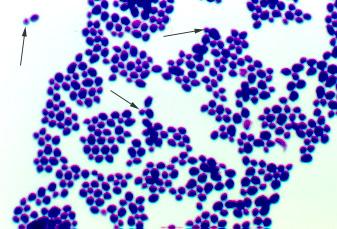
Candida albicans Vegetative cells
Note the oval shape and the nuclei

front 23

back 23

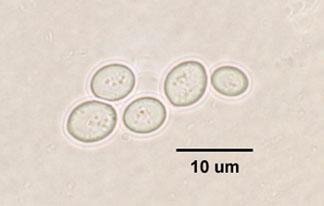
Saccharomyces cerevisiae Unstained

front 24

back 24

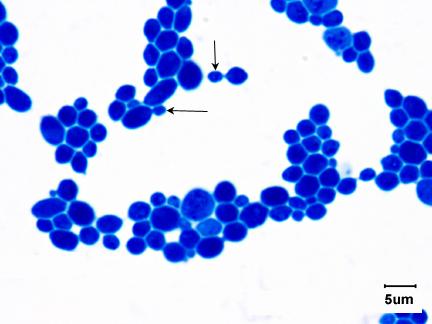
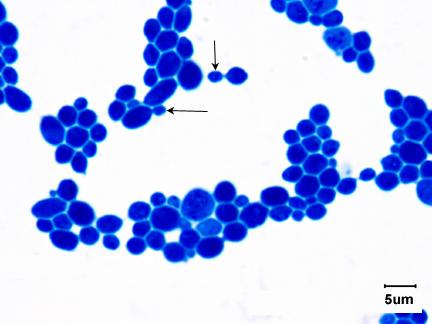
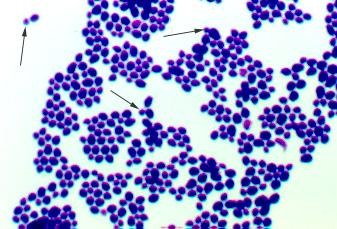
Saccharomyces cerevisiae
note the budding cells (arrows)

front 25

back 25

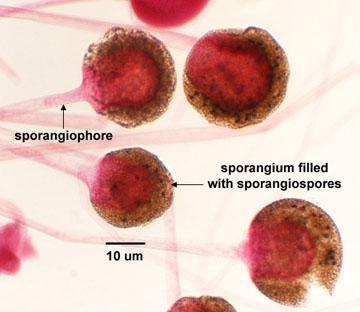
Rhizopus sporangiosphores

front 26

back 26

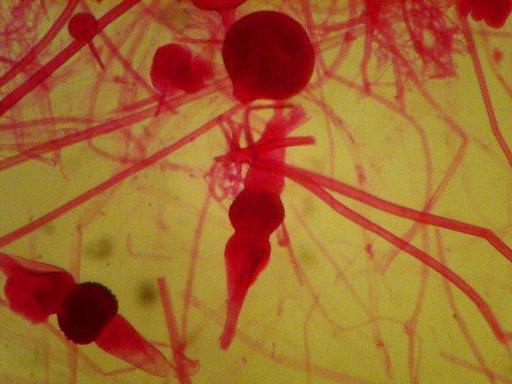
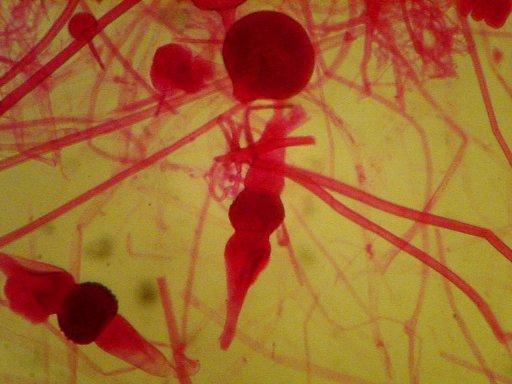
Rhizopus (nigricans) Zygospore

Perfect example of Rhizopus Zygospores in the middle and at bottom left.

look close there is a sporangium at center top too.

front 27

back 27

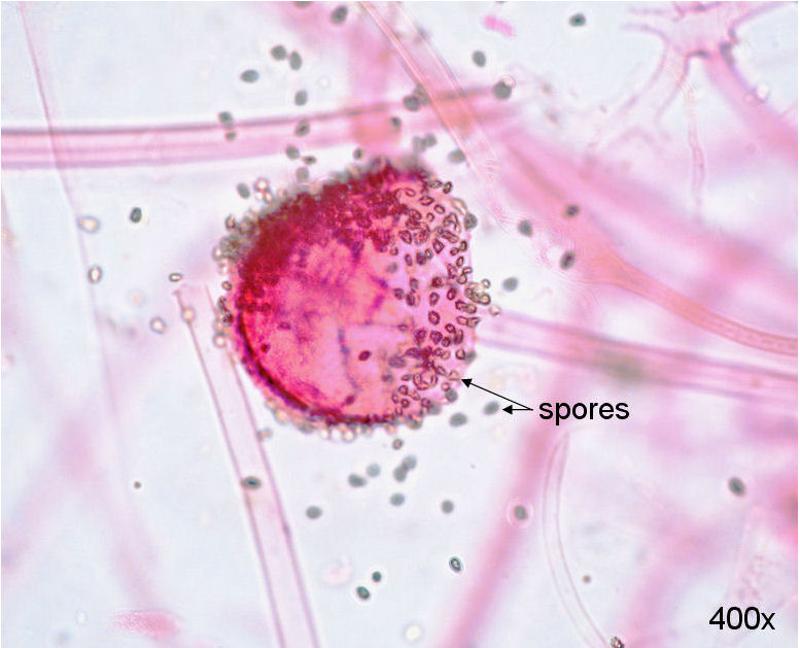
Rhizopus Sporangium

front 28

back 28

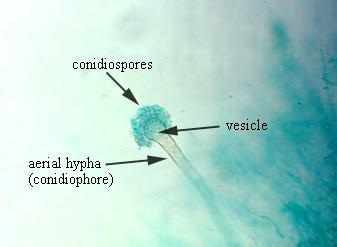
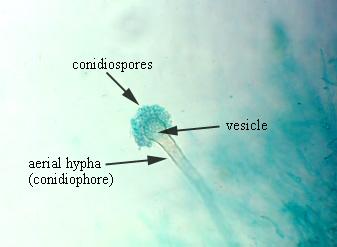
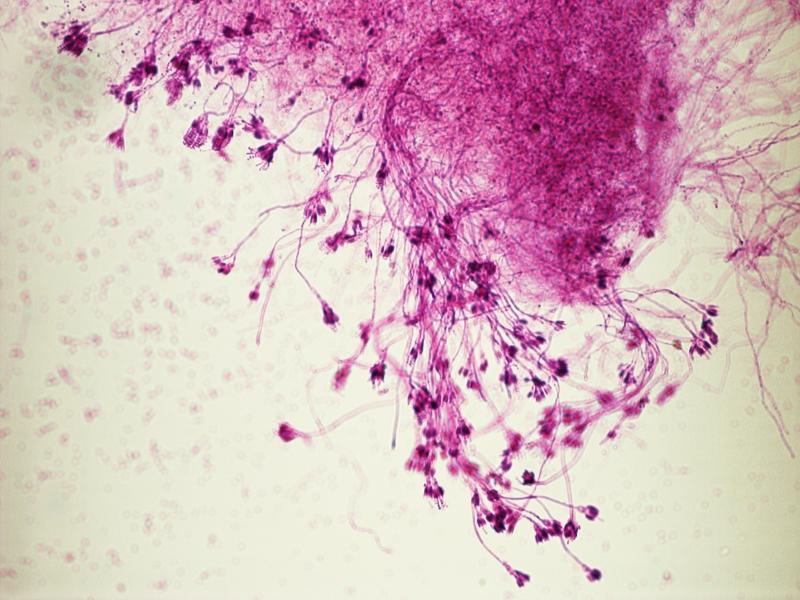
Aspergillus Conidiiospores

front 29

back 29

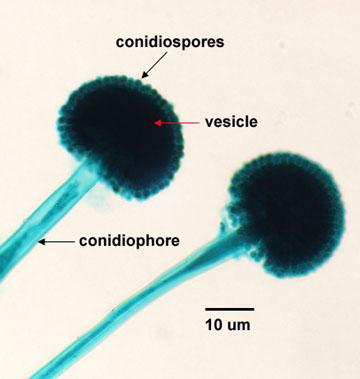
Aspergillus Conidiiospores

front 30

back 30

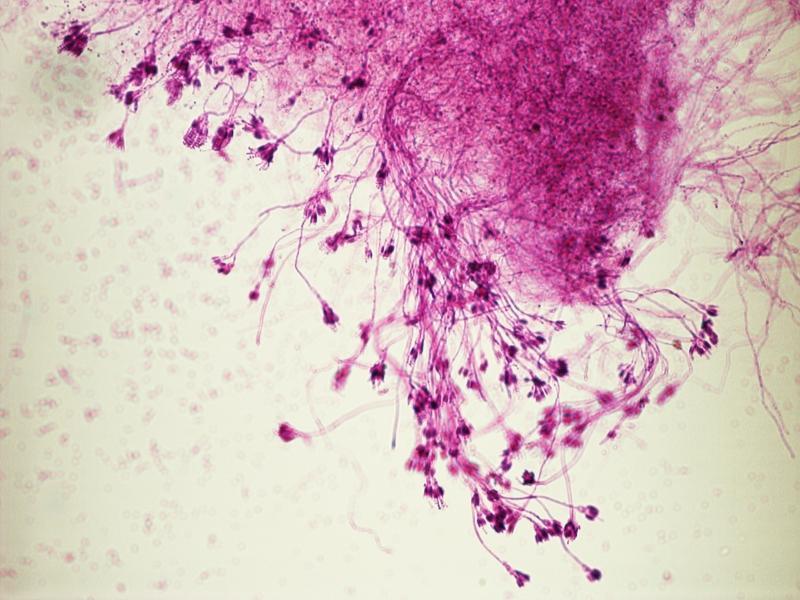
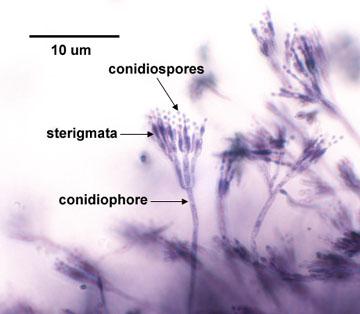
Penicillium

front 31

back 31

Penicillium Conidiospores

front 32

name the Group (yeast or mold)
Class / Phylum
Distinctive Features &
Diseases caused or uses

back 32

Rhizopus
* Mold
* Zygomycetes
* Features are sexual and asexual stages
* is a bread mold. certain species cause Zygomycosis

front 33

name the Group (yeast or mold)
Class / Phylum
Distinctive Features &
Diseases caused or uses

back 33

Aspergillus
* Mold
* Ascomycetes
* Features: the fruiting body with chains of conidia arising from one or two rows of philalides attached to a swollen vesicle at the end of an unbranched conidiopore.

* Used in soy sauce, citric acid (causes aspergillosis)

front 34

name the Group (yeast or mold)
Class / Phylum
Distinctive Features &
Diseases caused or uses

back 34

Penicillum
* Mold
* Ascomycetes
* Features: sexual reproduction results in the formation of ascospores, hence we classify in Ascomycetes

* Used to make penicillin. Only one species is pathogenic (P. marneffei) in Asia

front 35

name the Group (yeast or mold)
Class / Phylum
Distinctive Features &
Diseases caused or uses

back 35

Saccharomyces cerevisiae
* Yeast
* Ascomycetes
* One of the budding yeasts, used to make bread, beer, wine, no mycelium, produces a colony like bacteria (
* Not a pathogen)

front 36

name the Group (yeast or mold)
Class / Phylum
Distinctive Features &
Diseases caused or uses

back 36

Candida albicans
* yeast
* Ascomycetes
* Budding yeast, normal part of human flora
* Causes thrush, vulvovaginitis, candidiasis