Instructions for Side by Side Printing
- Print the notecards
- Fold each page in half along the solid vertical line
- Cut out the notecards by cutting along each horizontal dotted line
- Optional: Glue, tape or staple the ends of each notecard together
Chapter 16- Molecular Basis of Inheritance
front 1 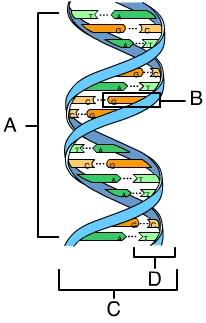 In the accompanying image, a nucleotide is indicated by the letter _____. | back 1 B |
front 2 Which of these is a difference between a DNA and an RNA molecule? | back 2 DNA is usually double-stranded, whereas RNA is usually single-stranded. |
front 3 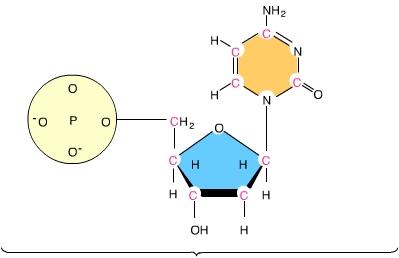 This is an image of a(n) _____. | back 3 nucleotide |
front 4 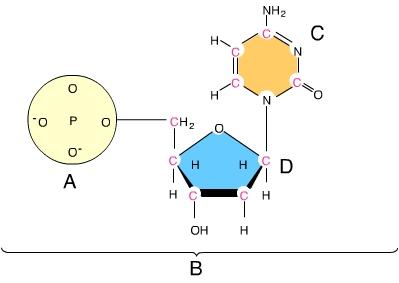 The letter A indicates a _____. | back 4 phosphate group |
front 5 A nitrogenous base is indicated by the letter _____. | back 5 C |
front 6 You can tell that this is an image of a DNA nucleotide and not an RNA nucleotide because you see a _____. | back 6 sugar with two, and not three, oxygen atoms |
front 7 Which of these nitrogenous bases is found in DNA but not in RNA? | back 7 thymine |
front 8 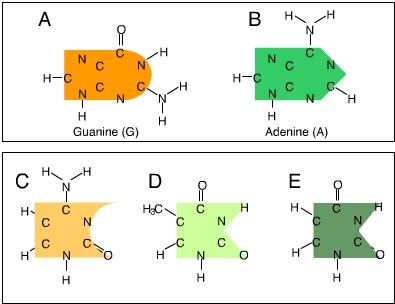 Which of these is(are) pyrimidines? | back 8 C, D, and E
|
front 9 In a nucleotide, the nitrogenous base is attached to the sugar's _____ carbon and the phosphate group is attached to the sugar's _____ carbon. | back 9 1' ... 5' |
front 10 Nucleic acids are assembled in the _____ direction. | back 10 5' to 3' |
front 11 In a DNA double helix an adenine of one strand always pairs with a(n) _____ of the complementary strand, and a guanine of one strand always pairs with a(n) _____ of the complementary strand. | back 11 thymine ... cytosine |
front 12 Griffith's experiments with S. pneumoniae were significant because they showed that traits could be transferred from one organism to another. What else did he find that was significant? | back 12 The transferred traits were heritable. |
front 13 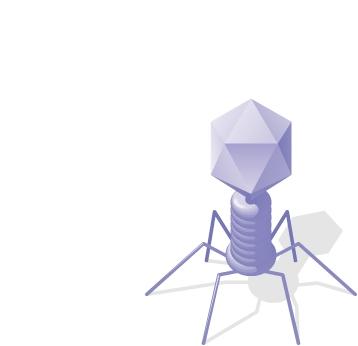 This is an image of a _____. | back 13 phage
|
front 14 Who demonstrated that DNA is the genetic material of the T2 phage? | back 14 Hershey and Chase |
front 15 The radioactive isotope 32P labels the T2 phage's _____. | back 15 DNA |
front 16 Hershey and Chase used _____ to radioactively label the T2 phage's proteins. | back 16 35S |
front 17 After allowing phages grown with bacteria in a medium that contained 32P and 35S, Hershey and Chase used a centrifuge to separate the phage ghosts from the infected cell. They then examined the infected cells and found that they contained _____, which demonstrated that _____ is the phage's genetic material. | back 17 labeled DNA ... DNA |
front 18 In the Hershey and Chase experiment that helped confirm that DNA, not protein, was the hereditary material, what was the key finding? | back 18 Radioactively labeled phosphorus was present inside the infected bacteria. |
front 19 Who conducted the X-ray diffraction studies that were key to the discovery of the structure of DNA? | back 19 Franklin |
front 20 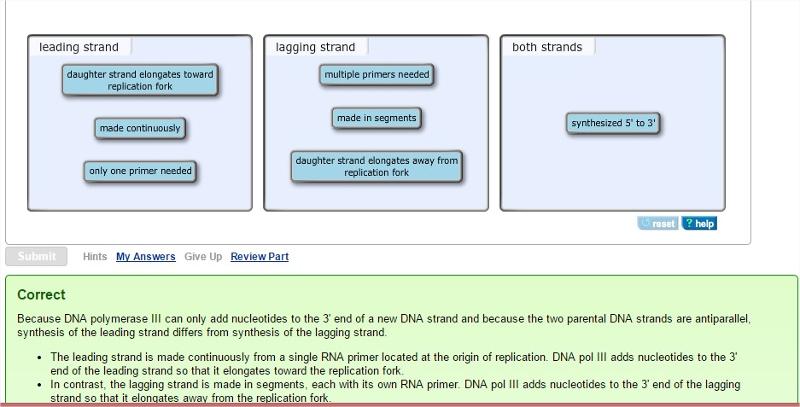 AISHA DO ITEMS 8 | back 20 AISHA DO ITEMS 8 |
front 21 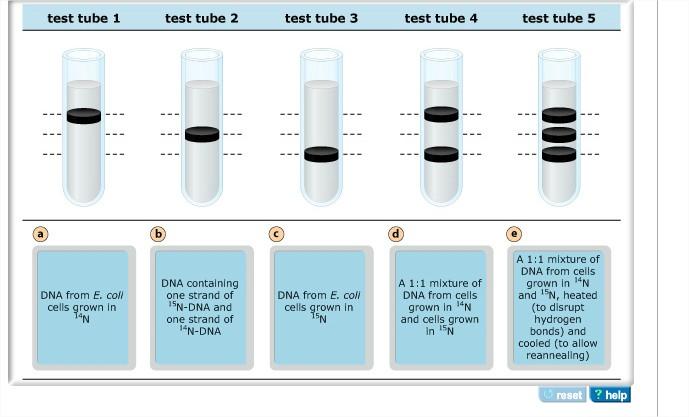 | back 21 AISHA DO ITEMS 8 |
front 22 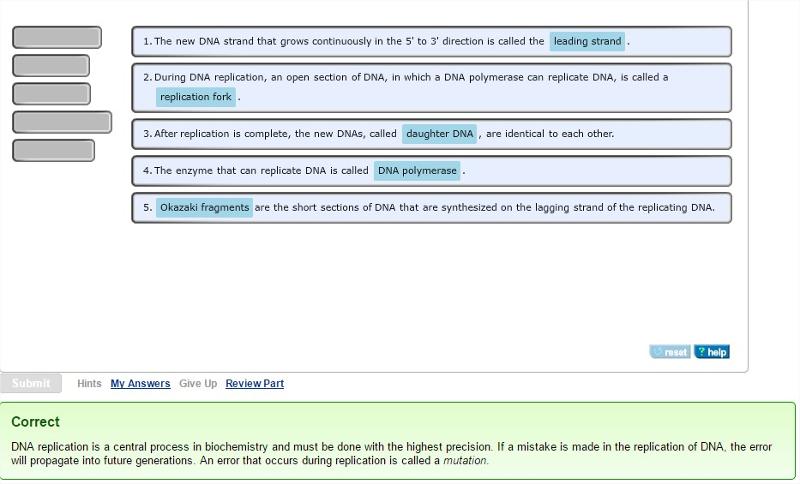 | back 22 AISHA DO ITEMS 8 |
front 23 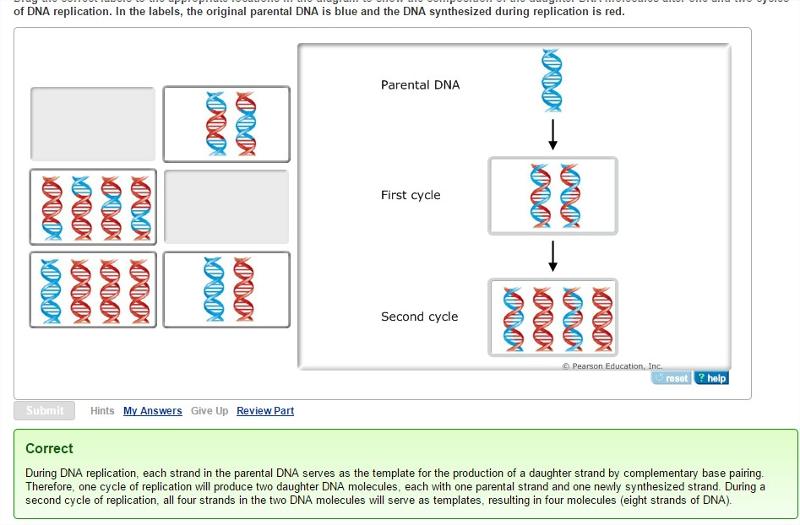 | back 23 AISHA DO ITEMS 8 |
front 24 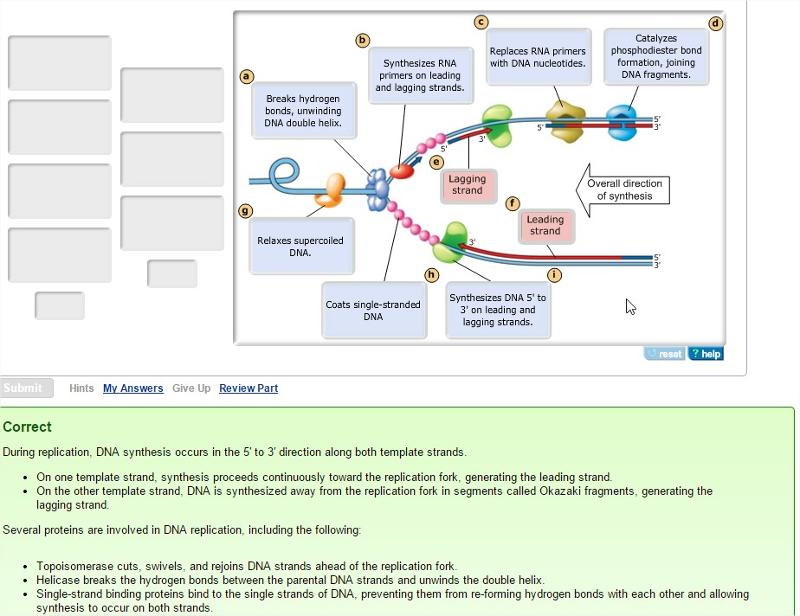 AISHA DO ITEM 9 | back 24 ITEM 9 |
front 25 item 10 | back 25 item 10 |
front 26 part B item 1 | back 26 part b item 1 |
front 27 part b item 2 | back 27 item 2 |
front 28 After DNA replication is completed, _____. | back 28 each new DNA double helix consists of one old DNA strand and one new DNA strand |
front 29 The first step in the replication of DNA is catalyzed by _____. | back 29 helicase |
front 30 The action of helicase creates _____. | back 30 replication forks and replication bubbles |
front 31 Why is the new DNA strand complementary to the 3' to 5' strands assembled in short segments? | back 31 DNA polymerase can assemble DNA only in the 5' to 3' direction |
front 32 The synthesis of a new strand begins with the synthesis of a(n) _____. | back 32 RNA primer complementary to a preexisting DNA strand |
front 33 An old DNA strand is used as a _____ for the assembly of a new DNA strand. | back 33 template |
front 34 Short segments of newly synthesized DNA are joined into a continuous strand by _____. | back 34 Ligase |
front 35 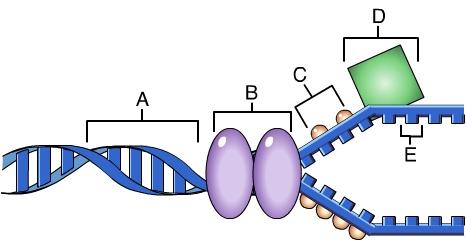 Which of these is responsible for catalyzing the formation of an RNA primer? | back 35 D |
front 36 Why is the new DNA strand complementary to the 5' to 3' strands assembled in short segments? | back 36 DNA polymerase can assemble DNA only in the 5' to 3' direction |
front 37 What catalyzes DNA synthesis? | back 37 DNA polymerase |
front 38 Which of the following statements about DNA synthesis is true? | back 38 Primers are short sequences that allow the initiation of DNA synthesis. |
front 39 Which part of a deoxynucleoside triphosphate (dNTP) molecule provides the energy for DNA synthesis? | back 39 Phosphate groups |
front 40 Which of the following enzymes creates a primer for DNA polymerase? | back 40 Primase |
front 41 Which of the following statements about Okazaki fragments in E. coli is true? | back 41 They are formed on the lagging strand of DNA. |
front 42 Which of the following enzymes is important for relieving the tension in a helix as it unwinds during DNA synthesis? | back 42 Topoisomerase |
front 43 True or false? Single-stranded DNA molecules are said to be antiparallel when they are lined up next to each other but oriented in opposite directions. | back 43 True |
front 44 DNA replication is said to be semiconservative. What does this mean? | back 44 Each new double helix consists of one old and one new strand. |
front 45 What is the function of helicase in DNA replication? | back 45 It untwists the double helix and separates the two DNA strands. |
front 46 What process repairs damage to a preexisting double helix? | back 46 nucleotide excision repair |
front 47 In nucleotide excision repair, damaged DNA is excised by what enzyme(s)? | back 47 nuclease |
front 48 What are the repetitive DNA sequences present at the ends of eukaryotic chromosomes called? | back 48 telomeres |
front 49 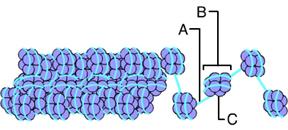 The letter A indicates _____. | back 49 DNA double helix |
front 50 Where would RNA polymerase attach? | back 50 A |
front 51 The letter C indicates _____. | back 51 Histones |
front 52 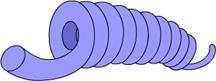 What is this an image of? | back 52 supercoils |
front 53 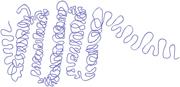 What is this an image of? | back 53 loops |
front 54 Which of the following is true of DNA during interphase? | back 54 It exists as chromatin and is less condensed than mitotic chromosomes. |
front 55 What are chromosomes made of? | back 55 DNA and proteins |
front 56 Research indicates that the best estimate of your age is from ______. | back 56 markers in your cells |
front 57 The cells examined from the 2,400 people in this study were from | back 57 blood |
front 58 Which of the following damages cells and causes cell aging? | back 58 inflammation |
front 59 The researchers used strands of DNA located at the ends of chromosomes (called telomeres) to classify the cells they studied. What assumption did they make about telomeres? | back 59 Longer telomeres indicate younger cells. |
front 60 The researchers found that telomeres were ______. | back 60 longer in individuals who exercised regularly |
front 61 The research showed that individuals who _______ had younger looking cells based on telomere measurements. | back 61 exercised for an average of 30 minutes per day |
front 62 In his work with pneumonia-causing bacteria and mice, Griffith found that | back 62 some substance from pathogenic cells was transferred to nonpathogenic cells, making them pathogenic. |
front 63 What is the basis for the difference in how the leading and lagging strands of DNA molecules are synthesized? | back 63 DNA polymerase can join new nucleotides only to the 3' end of a growing strand. |
front 64 In analyzing the number of different bases in a DNA sample, which result would be consistent with the base-pairing rules? | back 64 A + G = C + T |
front 65 The elongation of the leading strand during DNA synthesis | back 65 depends on the action of DNA polymerase. |
front 66 In a nucleosome, the DNA is wrapped around | back 66 histones |
front 67 E. coli cells grown on 15N^{15}{\rm N} medium are transferred to 14N^{14}{\rm N} medium and allowed to grow for two more generations (two rounds of DNA replication). DNA extracted from these cells is centrifuged. What density distribution of DNA would you expect in this experiment? | back 67 one low-density and one intermediate-density band |
front 68 A biochemist isolates, purifies, and combines in a test tube a variety of molecules needed for DNA replication. When she adds some DNA to the mixture, replication occurs, but each DNA molecule consists of a normal strand paired with numerous segments of DNA a few hundred nucleotides long. What has she probably left out of the mixture? | back 68 DNA Ligase |
front 69 The spontaneous loss of amino groups from adenine in DNA results in hypoxanthine, an uncommon base, opposite thymine. What combination of proteins could repair such damage? | back 69 nuclease, DNA polymerase, DNA ligase |
front 70 Meselson and Stahl cultured E. coli for several generations in a medium with a heavy isotope of nitrogen, 15N. They transferred the bacteria to a medium with a light isotope of nitrogen, 14 N. After two rounds of DNA replication, half the DNA molecules were light (both strands had 14N) and half were hybrids (15N-14N). What did the researchers conclude from these results? | back 70 DNA replication is semiconservative. |
front 71 DNA is a self-replicating molecule. What accounts for this important property of DNA? | back 71 The nitrogenous bases of the double helix are paired in specific combinations: A with T and G with C. |
front 72 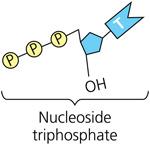 Nucleotides are added to a growing DNA strand as nucleoside triphosphates. What is the significance of this fact? | back 72 Hydrolysis of the two phosphate groups (P-Pi) and DNA polymerization are a coupled exergonic reaction. |
front 73 During DNA replication, the leading strand is synthesized continuously, whereas the lagging strand is synthesized as Okazaki fragments. Why is this so? | back 73 DNA synthesis can take place only in the 5' to 3' direction. |
front 74 Select the most accurate statement describing DNA replication complexes. | back 74 DNA replication complexes are grouped into factories, which are anchored to the nuclear matrix. |