Instructions for Side by Side Printing
- Print the notecards
- Fold each page in half along the solid vertical line
- Cut out the notecards by cutting along each horizontal dotted line
- Optional: Glue, tape or staple the ends of each notecard together
Chapter 3 Transducers - Review
front 1 A transducer converts one form of ______________ to another. | back 1 Energy |
front 2 Ultrasound transducers convert ________________ energy into ____________ energy, and vise versa | back 2 Electric, ultrasounf |
front 3 Ultrasound transducers operate on the ______________ principle. | back 3 Piezoelectric |
front 4 Single-element transducers are in the form of ____________. | back 4 Disks |
front 5 The ___________ of a transducer element changes when voltage is applied to its faces. | back 5 Thickness |
front 6 The term transducer is used to refer to a transducer __________ or to a transducer ______________. | back 6 Element, assembly |
front 7 A transducer _________________ is part of a transducer _________________. | back 7 Element, assembly |
front 8 An electrical voltage pulse, when applied to a transducer, produces an ultrasound _____________ of a _____________ that is equal to that of the voltage pulse. | back 8 Pulse, frequency |
front 9 The resonance frequency of an element is determined by by its ______________. | back 9 Thickness |
front 10 Operating frequency ______________ as transducer element thickness is increased. | back 10 Decreases |
front 11 The addition of damping material reduces the number of ___________ in the pulse, thus improving ___________ __________. It increases ______________. | back 11 Cycles, axial resolution, bandwidth |
front 12 Damping material reduces the _____________ of the transducer and _______________ _______________. It increases _______________. | back 12 Efficiency, sensitivity |
front 13 Ultrasound transducers typically generate pulses of ___________ or _____________ cycles. | back 13 Two, three |
front 14 For a particular transducer element material, if a thickness of .4 mm yields an operating frequency of 5 MHz, the thickness required for an operating frequency of 10 MHz is ________________ mm. | back 14 .2 mm
|
front 15 Which of the following transducer frequencies would have the thinnest element?
| back 15 E) 10 MHz |
front 16 The matching layer on the transducer surface reduces _________ caused by _____________. | back 16 reflection |
front 17 A coupling agent on the skin surface eliminates reflection caused by _______________. | back 17 air |
front 18 True or False?
| back 18 False |
front 19 True or False?
| back 19 False |
front 20 The damping layer is in front or back of the element. | back 20 Back |
front 21 The matching layer is in front or back of the element. | back 21 Front |
front 22 The matching layer has ___________ impedance | back 22 intermediate |
front 23 Elements in linear arrays are in the form of _____________. | back 23 rectangles |
front 24 Transducer assemblies are also called ___________.
| back 24 F) more than one of the above
|
front 25 Operating frequency is also called ________. | back 25 resonance frequency |
front 26 Mixtures of a piezoelectric ceramic and a non-piezoelectric polymer are called _______________. | back 26 composites |
front 27 To operate a transducer at more than one frequency requires ______________ _____________. | back 27 broad bandwidth |
front 28 It is practical to attempt to operate a 5-MHz transducer with a bandwidth of 1 MHz at 6 MHz? | back 28 No
|
front 29 It is practical to attempt to operate a 5-MHz transducer with a bandwidth of 2.5 at 3 and 7 MHz? | back 29 No
|
front 30 A beam is divided into two regions, called the _______ zone and the ____________ zone. | back 30 Near, far |
front 31 The dividing point between the two regions is at a distance from the transducer equal to ___________ _______ length. | back 31 Near zone |
front 32 Transducer size is also called _______________. | back 32 aperture |
front 33 Near zone length increases with increasing source __________ and ______________. | back 33 aperture, frequency |
front 34 Which transducer element has the longest near zone?
| back 34 C) 8 mm, 7 MHz |
front 35 A higher frequency transducer produces a ____________ near-zone length. | back 35 longer |
front 36 A smaller frequency transducer produces a ____________ near-zone length. | back 36 shorter |
front 37 True or False?
| back 37 false
|
front 38 Which of the following transducers can focus at 6 cm?
| back 38 C) 4 MHz, near-zone length of 10 cm |
front 39 Sound may be focused by using a ____________.
| back 39 D) more than one of the above.
|
front 40 True or False?
| back 40 False |
front 41 The distance from a transducer to the location of the narrowest beam width produced by a focused transducer is called ______________. | back 41 focal length |
front 42 Transducer arrays are transducer assemblies with several transducer _______________. | back 42 elements |
front 43 Linear arrays scan beams by _____________ element groups. | back 43 sequencing |
front 44 A phased linear array with a single line of elements can focus in ________________ dimensions. | back 44 One
|
front 45 Focusing in section thickness can be accomplished with _________ elements of a _______. | back 45 curved, lens |
front 46 Electronic focusing in section thickness requires multiple rows of ___________. | back 46 elements |
front 47 Match the following
| back 47 A) Linear array - 1) Voltage pulses are applied in succession to groups of elements across the face of a transducer
|
front 48 If the elements of a phased array are pulsed in rapid succession from right to left, the resulting beam is ___________.
| back 48 B) steered left |
front 49 If the elements of a phased array are pulsed in rapid succession from outside in, the resulting beam is ___________.
| back 49 C) focused |
front 50 _____________ and _______________ describe how arrays are constructed.
| back 50 A) linear
|
front 51 ____________, ___________, and ____________ describe how arrays are operated.
| back 51 B) phased
|
front 52 Shorter time delays between elements fired from outside in results in ____________ curvature in the emitted pulse and a _____________ focus.
| back 52 C) less, deeper |
front 53 A rectangular image is a result of linear scanning of the beam. This means that pulses travel in ___________ _______________ direction from _____________ starting points across the transducer face. | back 53 The same, different |
front 54 A sector image is a result of sector steering of the beam. This means that pulses travel in ___________ directions from a common _____________ at the transducer face. | back 54 different, origin |
front 55 In ______________ and ____________ arrays, pulses travel out in different directions from different starting points on the transducer face. | back 55 convex, vector |
front 56 Axial resolution is the minimum reflector separation required along the direction of the ___________ ___________ to produce separate ________________. | back 56 sound travel, echoes |
front 57 Axial resolution depends directly on ___________ __________ ____________. | back 57 spatial pulse length |
front 58 True or False?
| back 58 True |
front 59 If there are three cycles of a 1 -mm wavelength in a pulse, the axial resolution is ___________ mm. | back 59 1.5 mm
|
front 60 For Pulse traveling through soft tissue in which the frequency is 3 MHz and there are four cycles per pulse, the axial resolution is ___________mm. | back 60 1 mm
|
front 61 If there are two cycles per pulse, the axial resolution is equal to the ____________. At 5 MHz in soft tissue, this is _____________mm. | back 61 wavelength, .3 mm
|
front 62 Doubling the frequency causes axial resolution to be ________. | back 62 halved |
front 63 Doubling the number of cycles per pulse causes axial resolution to be ________________. | back 63 Doubled |
front 64 True or False?
| back 64 False |
front 65 True or False?
| back 65 False |
front 66 If frequencies less than __________ MHz are used, axial resolution is not sufficient. | back 66 2 Mhz |
front 67 If frequencies higher than __________ MHz are used, penetration is not sufficient. | back 67 15 Mhz |
front 68 Increasing frequency improves resolution because ___________ is reduced, thus reducing ____________ ___________ ___________. | back 68 wavelength, Spatial pulse length |
front 69 Increasing frequency decreases penetration because _________ is increased. | back 69 attenuation |
front 70 Lateral resolution is the minimum ___________ between two reflectors at the same depth such that when a beam is scanned across them, two separate __________ are produced. | back 70 separation, echoes |
front 71 Lateral resolution is equal to __________ ____________ in the scan plane. | back 71 beam width |
front 72 Lateral resolution does not depend on _____________.
| back 72 E) dampening |
front 73 True or False?
| back 73 True |
front 74 True or False?
| back 74 True |
front 75 True or False?
| back 75 False
|
front 76 Lateral resolution is determined by:
| back 76 B) frequency
|
front 77 Match the following transducer assembly parts with the functions:
| back 77 A) Cable - 4) Converts voltage pulses
|
front 78 Which of the following improve sound transmission from the transducer element into the tissue?
| back 78 A) Matching layer
|
front 79 A 5 -MHz unfocused transducer with an element thickness of .4 mm, an element width of 13 mm, and a near-zone length of 14 cm produces two-cycle pulses. Determine the following
| back 79 A) 10
|
front 80 Lateral resolution is improved by _____________.
| back 80 C) focusing |
front 81 For an unfocused transducer, the best lateral resolution (minimum beam width) is ____________ the transducer width. This value of lateral resolution is found at a distance from the transducer face that is equal to the _________________ ______________ length. | back 81 half, near-zone |
front 82 For a focused transducer, the best lateral resolution (minimum beam width) is found in the __________ region. | back 82 focal |
front 83 An unfocused 3.5-MHz, 13-mm transducer will yield a minimum beam width (best lateral resolution) of ________ mm. | back 83 6.5 mm
|
front 84 An unfocused 3.5-MHz, 13-mm transducer produces three-cycle pulses. The axial resolution in soft tissue is ___________ mm. | back 84 .7 mm
|
front 85 True or False?
| back 85 True |
front 86 True or False?
| back 86 False |
front 87 The two resolutions may be comparable in the ____________ region of a strongly focused beam. | back 87 Focal |
front 88 True or False?
| back 88 True |
front 89 True or False?
| back 89 False |
front 90 Match each transducer characteristic with the sound beam characteristic it determines
| back 90 A) Element thickness - 1) Axial resolution, 2) lateral resolution, 3) operating frequency
|
front 91 The principle on which ultrasound transducers operate is the _______________.
| back 91 E) piezoelectric effect |
front 92 Which of the following is not decreased by damping
| back 92 A) refraction |
front 93 Which three things determine beam diameter for a disk transducer?
| back 93 B) frequency
|
front 94 True or False?
| back 94 True
|
front 95 The lower and upper limits of the frequency range useful in diagnostic ultrasound are determined by ___________ and ___________ requirements respectively. | back 95 resolution, penetration |
front 96 The range of frequencies useful for most applications of diagnostic ultrasound is ____________ to __________ MHz | back 96 2, 15 |
front 97 Because diagnostic ultrasound is usually two or three cycles long, axial resolution is usually equal to ___________ to __________ wavelength | back 97 1, 1.5 |
front 98 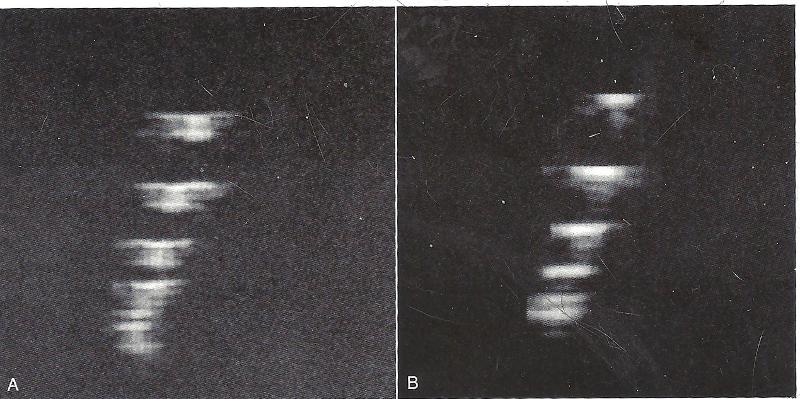 What is the axial resolution A-B?
| back 98 3 mm, 2 mm |
front 99 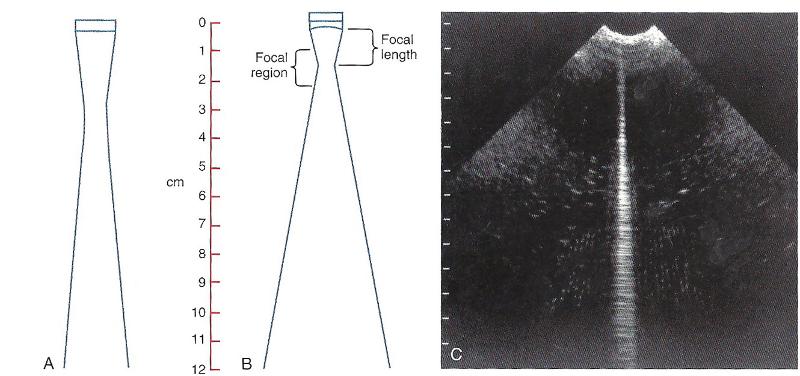 At what depth is the best lateral resolution C?
| back 99 4 cm |
front 100 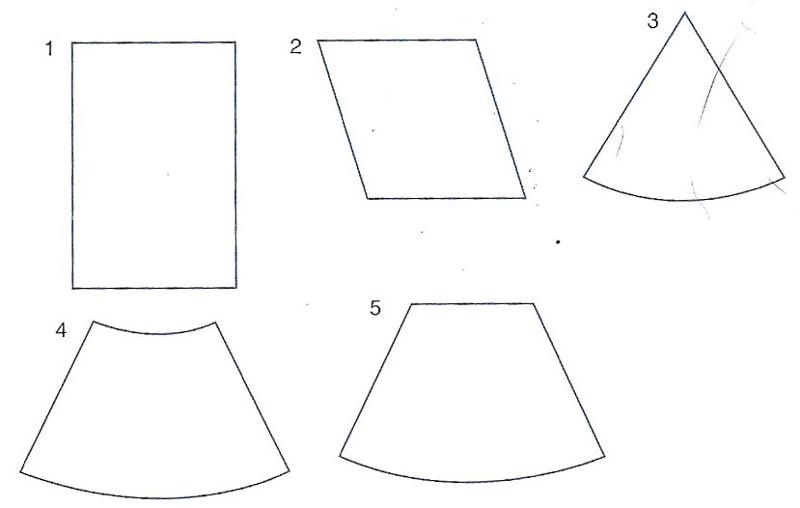 Match the transducer type with the display formats
| back 100 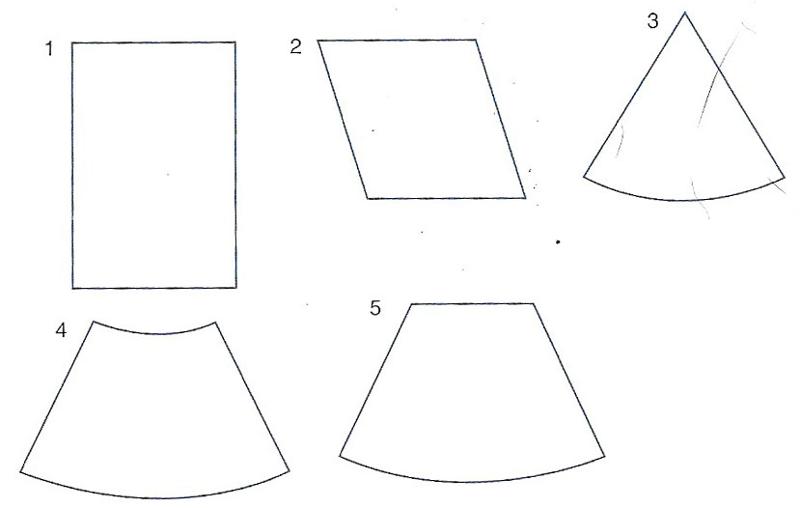 A) Linear array - 1
|