Instructions for Side by Side Printing
- Print the notecards
- Fold each page in half along the solid vertical line
- Cut out the notecards by cutting along each horizontal dotted line
- Optional: Glue, tape or staple the ends of each notecard together
Chapter 13, Viruses, Viroids, and Prions
front 1 Capsid | back 1 Protein coat |
front 2 Envelope | back 2 Cover capsids and composed of combo of lipids, proteins, and carbs |
front 3 Glycoprotein spikes | back 3 Covers envelope and can be used to adhere to RBCs |
front 4 Lytic cycle | back 4 One of two methods of viral reproduction. The lytic cycle results in the destruction of the infected cell and its membrane |
front 5 Lysogenic cycle | back 5 One of two methods of viral reproduction. Lysogenic cycle is characterized by integration of the bacteriophage nucleic acid into the host bacterium's genome or formation of a circular replicon in the bacterium's cytoplasm |
front 6 Bacteriophage | back 6 Virus that infects bacteria |
front 7 Oncogene | back 7 A gene that has the potential to cause cancer |
front 8 Latent viral infections | back 8 Virus remains latent in nerve cells of host for long periods without causing disease |
front 9 Persistent viral infections | back 9 A disease process that occurs gradually over a long period |
front 10 Retrovirus | back 10 Retroviridae is a family of enveloped viruses that replicate in a host cell through the process of reverse transcription |
front 11 Prions | back 11 A microscopic protein particle similar to a virus but lacking nucleic acid |
front 12 Cytopathic effects | back 12 Cell infection by a virus causes observable death or damage which can be used for counting or detecting viruses |
front 13 Proto-oncogenes | back 13 A normal gene that can undergo mutation to become an oncogene, a gene that has the ability to induce cancer |
front 14 Positive sense | back 14 A positive (+) strand of RNA is one that can act directly as messenger RNA |
front 15 Negative sense | back 15 Serve as template for positive strands |
front 16 Teratogenic agent | back 16 Drug, virus, or irradiation that can cause malformation of the fetus |
front 17 Helical viruses | back 17 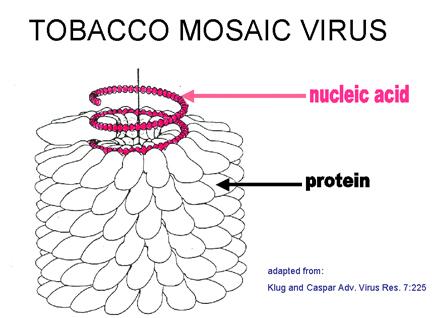 Resemble long rods, their capsids a hollow cylinder with a helical structure |
front 18 Polyhedral viruses | back 18 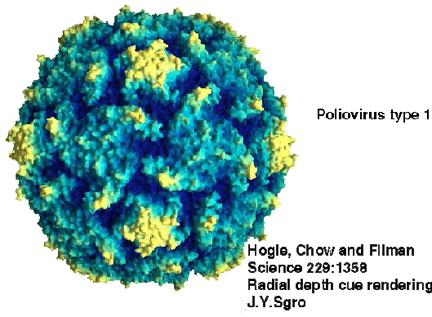 Usually have a capsid in the shape of an icosahedron(20 regular shape triangular faces) |
front 19 Enveloped viruses | back 19 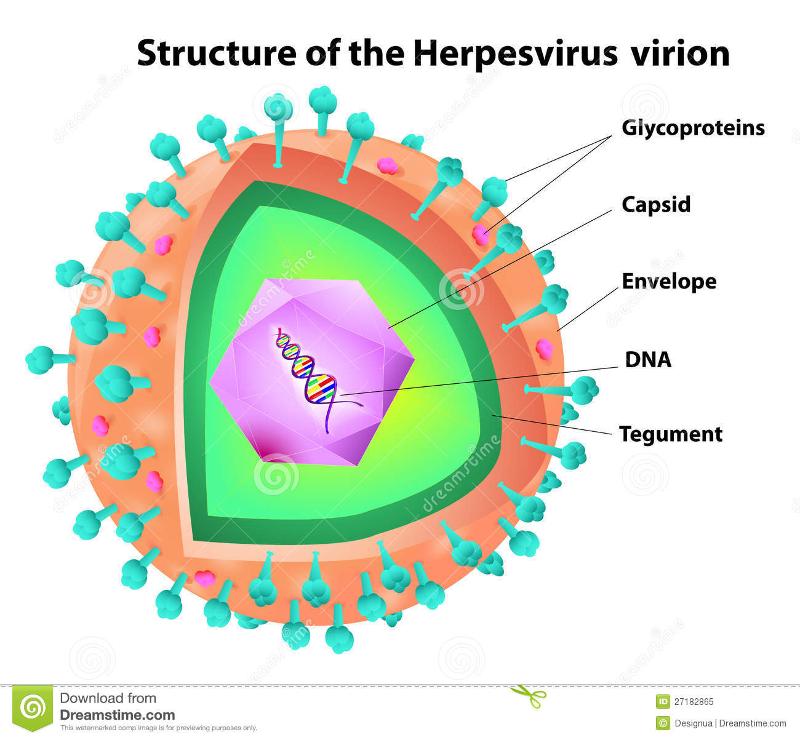 Envelope covering their capsid. Vary in shape |
front 20 Complex viruses | back 20 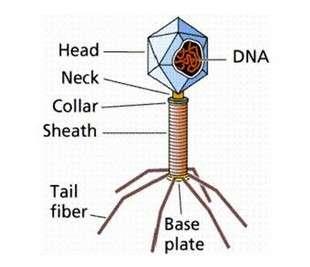 Ex-Poxviruses. Don't contain identifiable capsids. May have several coats around nucleic acid or have polyhedral head and helical tail |
front 21 3 Methods for identifying viruses | back 21 Nucleic acid, morphology, presence/abscence of envelope |
front 22 Viral identification | back 22 The most common method is serological. Virus is detected by its reaction to antibodies |
front 23 Two different ways to cultivate viruses | back 23 Living animals and cell cultures |
front 24 Adenoviridae | back 24 Mastadenovirus, cause common colds, some cause tumors in animals |
front 25 Parvoviridae | back 25 Human parvovirus B19, fifth disease |
front 26 Poxviridae | back 26 Orthopoxvirus, smallpox, and cowpox |
front 27 Herpesviridae | back 27 HHV1 & HHV2, chickenpox and shingles |
front 28 Hepadnaviridae | back 28 Hepadnavirus, Hepatitis B, uses reverse transcriptase to produce its DNA from mRNA |
front 29 Picornaviridae | back 29 Polio, Rhinovirus, more than 100 rhinoviruses exist and are most common cause of colds |
front 30 Togaviridae | back 30 Rubivirus, rubella, transmitted by respiratory route |
front 31 Filoviridae | back 31 Filovirus, Ebola and Marburg are filoviruses |
front 32 Paramyxoviridae | back 32 Paramyxovirus, causes mumps |
front 33 Bunyaviridae | back 33 Hantavirus, associated with rodents |
front 34 Retroviridae | back 34 Lentivirus, HIV is lentivirus that causes AIDS |
front 35 Live vaccines | back 35 Live, attenuated vaccines contain a version of the living microbe that has been weakened in the lab so it can’t cause disease. Because a live, attenuated vaccine is the closest thing to a natural infection, these vaccines are good “teachers” of the immune system: They elicit strong cellular and antibody responses and often confer lifelong immunity with only one or two doses. |
front 36 INACTIVATED VACCINES | back 36 Scientists produce inactivated vaccines by killing the disease-causing microbe with chemicals, heat, or radiation. Such vaccines are more stable and safer than live vaccines: The dead microbes can’t mutate back to their disease-causing state. Inactivated vaccines usually don’t require refrigeration, and they can be easily stored and transported in a freeze-dried form, which makes them accessible to people in developing countries.
|
front 37 Naturally acquired active immunity | back 37 occurs when a person is exposed to a live pathogen, and develops a primary immune response, which leads to immunological memory. This type of immunity is “natural” because it is not induced by deliberate exposure. |
front 38 Naturally acquired passive immunity | back 38 antibody-mediated immunity conveyed to a fetus by its mother during pregnancy |
front 39 Artificially acquired active immunity | back 39 can be induced by a vaccine, a substance that contains antigen. A vaccine stimulates a primary response against the antigen without causing symptoms of the disease. |
front 40 Artificially acquired passive immunity | back 40 A passive immunity that renders short-term immunization by the transfer of antibodies administered by artificial means, such as human or animal blood plasma or pooled human immunoglobulin administered through intravenous or intramuscular route |
front 41 Monoclonal antibodies | back 41 an antibody, produced by a single clone of cells grown in culture, that is both pure and specific and is capable of proliferating indefinitely to produce unlimited quantities of identical antibodies: used in diagnosis, therapy, and biotechnology |
front 42 Humoral immunity | back 42 The component of the immune system involving antibodies that are secreted by B cells and circulate as soluble proteins in blood plasma and lymph. |
front 43 Antibody | back 43 a blood protein produced in response to and counteracting a specific antigen. Antibodies combine chemically with substances that the body recognizes as alien, such as bacteria, viruses, and foreign substances in the blood. |
front 44 Antigen | back 44 a toxin or other foreign substance that induces an immune response in the body, especially the production of antibodies. |
front 45 B cells | back 45 a lymphocyte not processed by the thymus gland, and responsible for producing antibodies. |
front 46 T cells | back 46 a specialized lymphocyte that doesn't secrete antibodies, but has antigen receptors attached to their surface. Involved in cell-mediated immune system. |
front 47 Cell-mediated immune system | back 47 The immune response produced when sensitized T cells attack foreign antigens and secrete lymphokines that initiate the body's humoral immune response. |
front 48 Immunoglobulin | back 48 any of a class of proteins present in the serum and cells of the immune system, that function as antibodies. |
front 49 Macrophage | back 49 a large phagocytic cell found in stationary form in the tissues or as a mobile white blood cell, especially at sites of infection. |
front 50 Vaccine | back 50 a substance that is usually injected into a person or animal to protect against a particular disease |
front 51 Vaccination | back 51 is the administration of antigenic material (a vaccine) to stimulate an individual's immune system to develop adaptive immunity to a pathogen. |
front 52 Agglutination reaction | back 52 The clumping of cells such as bacteria or red blood cells in the presence of an antibody. The antibody or other molecule binds multiple particles and joins them, creating a large complex |
front 53 Neutralization reaction | back 53 The reaction of an acid with a base to form a salt and water. Usually, the reaction of hydrogen ions with hydrogen ions to form water molecules. |
front 54 Complement fixation reaction | back 54 an immunological medical test that can be used to detect the presence of either specific antibody or specific antigen in a patient's serum. |
front 55 Fluorescent antibody technique | back 55 A form of fluorescent antibody technique utilizing a fluorochrome conjugated to an antibody, which is added directly to a tissue or cell suspension |
front 56 ELISA | back 56 enzyme-linked immunosorbent assay, an immunological assay technique making use of an enzyme bonded to a particular antibody or antigen. |