Print Options

Card layout: ?

← Back to notecard set|Easy Notecards home page

Instructions for Side by Side Printing
  1. Print the notecards
  2. Fold each page in half along the solid vertical line
  3. Cut out the notecards by cutting along each horizontal dotted line
  4. Optional: Glue, tape or staple the ends of each notecard together
  1. Verify Front of pages is selected for Viewing and print the front of the notecards
  2. Select Back of pages for Viewing and print the back of the notecards
    NOTE: Since the back of the pages are printed in reverse order (last page is printed first), keep the pages in the same order as they were after Step 1. Also, be sure to feed the pages in the same direction as you did in Step 1.
  3. Cut out the notecards by cutting along each horizontal and vertical dotted line
To print: Ctrl+PPrint as a list

55 notecards = 14 pages (4 cards per page)

Viewing:

Ch.20 Cambell bio

front 1

1) Assume that you are trying to insert a gene into a plasmid. Someone gives you a preparation of genomic DNA that has been cut with restriction enzyme X. The gene you wish to insert has sites on both ends for cutting by restriction enzyme Y. You have a plasmid with a single site for Y, but not for X. Your strategy should be to
A) insert the fragments cut with restriction enzyme X directly into the plasmid without cutting the plasmid.
B) cut the plasmid with restriction enzyme X and insert the fragments cut with restriction enzyme Y into the plasmid.
C) cut the DNA again with restriction enzyme Y and insert these fragments into the plasmid cut with the same enzyme.
D) cut the plasmid twice with restriction enzyme Y and ligate the two fragments onto the ends of the DNA fragments cut with restriction enzyme X.
E) cut the plasmid with restriction enzyme X and then insert the gene into the plasmid.

back 1

Answer: C

front 2

2) How does a bacterial cell protect its own DNA from restriction enzymes?
A) by adding methyl groups to adenines and cytosines
B) by using DNA ligase to seal the bacterial DNA into a closed circle
C) by adding histones to protect the double-stranded DNA
D) by forming "sticky ends" of bacterial DNA to prevent the enzyme from attaching
E) by reinforcing the bacterial DNA structure with covalent phosphodiester bonds

back 2

Answer: A

front 3

3) What is the most logical sequence of steps for splicing foreign DNA into a plasmid and inserting the plasmid into a bacterium?

I. Transform bacteria with a recombinant DNA molecule.
II. Cut the plasmid DNA using restriction enzymes.
III. Extract plasmid DNA from bacterial cells.
IV. Hydrogen-bond the plasmid DNA to nonplasmid DNA fragments.
V. Use ligase to seal plasmid DNA to nonplasmid DNA.

A) I, II, IV, III, V
B) II, III, V, IV, I
C) III, II, IV, V, I
D) III, IV, V, I, II
E) IV, V, I, II, III

back 3

Answer: C

front 4

4) A principal problem with inserting an unmodified mammalian gene into a BAC, and then getting that gene expressed in bacteria, is that
A) prokaryotes use a different genetic code from that of eukaryotes.
B) bacteria translate polycistronic messages only.
C) bacteria cannot remove eukaryotic introns.
D) bacterial RNA polymerase cannot make RNA complementary to mammalian DNA.
E) bacterial DNA is not found in a membrane-bounded nucleus and is therefore incompatible with mammalian DNA.

back 4

Answer: C

front 5

5) A gene that contains introns can be made shorter (but remain functional) for genetic engineering purposes by using
A) RNA polymerase to transcribe the gene.
B) a restriction enzyme to cut the gene into shorter pieces.
C) reverse transcriptase to reconstruct the gene from its mRNA.
D) DNA polymerase to reconstruct the gene from its polypeptide product.
E) DNA ligase to put together fragments of the DNA that code for a particular polypeptide.

back 5

Answer: C

front 6

6) Why are yeast cells frequently used as hosts for cloning?
A) They easily form colonies.
B) They can remove exons from mRNA.
C) They do not have plasmids.
D) They are eukaryotic cells.
E) Only yeast cells allow the gene to be cloned.

back 6

Answer: D

front 7

7) The DNA fragments making up a genomic library are generally contained in
A) BACs.
B) recombinant viral RNA.
C) individual wells.
D) DNA-RNA hybrids.
E) radioactive eukaryotic cells.

back 7

Answer: A

front 8

8) Yeast artificial chromosomes contain which of the following elements?
A) centromeres only
B) telomeres only
C) origin of replication only
D) centromeres and telomeres only
E) centromeres, telomeres, and an origin of replication

back 8

Answer: E

front 9

9) Which of the following best describes the complete sequence of steps occurring during every cycle of PCR?

1. The primers hybridize to the target DNA.
2. The mixture is heated to a high temperature to denature the double-stranded target DNA.
3. Fresh DNA polymerase is added.
4. DNA polymerase extends the primers to make a copy of the target DNA.

A) 2, 1, 4
B) 1, 3, 2, 4
C) 3, 4, 1, 2
D) 3, 4, 2
E) 2, 3, 4

back 9

Answer: A

front 10

10) A researcher needs to clone a sequence of part of a eukaryotic genome in order to express the sequence and to modify the polypeptide product. She would be able to satisfy these requirements by using which of the following vectors?
A) a bacterial plasmid
B) BAC to accommodate the size of the sequence
C) a modified bacteriophage
D) a human chromosome
E) a YAC with appropriate cellular enzymes

back 10

Answer: E

front 11

11) A student wishes to clone a sequence of DNA of ~200 kb. Which vector would be appropriate?
A) a plasmid
B) a typical bacteriophage
C) a BAC
D) a plant virus
E) a large polypeptide

back 11

Answer: C

front 12

12) Sequencing an entire genome, such as that of C. elegans, a nematode, is most important because
A) it allows researchers to use the sequence to build a "better" nematode, which is resistant to disease.
B) it allows research on a group of organisms we do not usually care much about.
C) the nematode is a good animal model for trying out cures for viral illness.
D) a sequence that is found to have a particular function in the nematode is likely to have a closely related function in vertebrates.
E) a sequence that is found to have no introns in the nematode genome is likely to have acquired the introns from higher organisms.

back 12

Answer: D

front 13

13) To introduce a particular piece of DNA into an animal cell, such as that of a mouse, you would find more probable success with which of the following methods?
A) the shotgun approach
B) electroporation followed by recombination
C) introducing a plasmid into the cell
D) infecting the mouse cell with a Ti plasmid
E) transcription and translation

back 13

Answer: B

front 14

14) The major advantage of using artificial chromosomes such as YACs and BACs for cloning genes is that
A) plasmids are unable to replicate in cells.
B) only one copy of a plasmid can be present in any given cell, whereas many copies of a YAC or BAC can coexist in a single cell.
C) YACs and BACs can carry much larger DNA fragments than ordinary plasmids can.
D) YACs and BACs can be used to express proteins encoded by inserted genes, but plasmids cannot.
E) All of these are correct.

back 14

Answer: C

front 15

15) Which of the following is used to make complementary DNA (cDNA) from RNA?
A) restriction enzymes
B) gene cloning
C) DNA ligase
D) gel electrophoresis
E) reverse transcriptase

back 15

Answer: E

front 16

16) Why is it so important to be able to amplify DNA fragments when studying genes?
A) DNA fragments are too small to use individually.
B) A gene may represent only a millionth of the cell's DNA.
C) Restriction enzymes cut DNA into fragments that are too small.
D) A clone requires multiple copies of each gene per clone.
E) It is important to have multiple copies of DNA in the case of laboratory error.

back 16

Answer: B

front 17

17) Pax-6 is a gene that is involved in eye formation in many invertebrates, such as Drosophila. Pax-6 is found as well in vertebrates. A Pax-6 gene from a mouse can be expressed in a fly and the protein (PAX-6) leads to a compound fly eye. This information suggests which of the following?
A) Pax-6 genes are identical in nucleotide sequence.
B) PAX-6 proteins have identical amino acid sequences.
C) Pax-6 is highly conserved and shows shared evolutionary ancestry.
D) PAX-6 proteins are different for formation of different kinds of eyes.
E) PAX-6 from a mouse can function in a fly, but a fly's Pax-6 gene cannot function in a mouse.

back 17

Answer: C

front 18

18) Why are BACs preferred today rather than bacteriophages for making genomic libraries?
A) The BAC carries more DNA.
B) The BAC can carry entire genes and their regulatory elements.
C) Larger BACs are easier to store.
D) The BAC can carry entire genes and their regulatory elements, and larger BACs are easier to store.
E) The BAC carries more DNA, the BAC can carry entire genes and their regulatory elements, and larger BACs are easier to store.

back 18

Answer: E

front 19

19) The reason for using Taq polymerase for PCR is that
A) it is heat stable and can withstand the temperature changes of the cycler.
B) only minute amounts are needed for each cycle of PCR.
C) it binds more readily than other polymerases to primer.
D) it has regions that are complementary to primers.
E) All of these are correct.

back 19

Answer: A

front 20

20) Why might a laboratory be using dideoxy nucleotides?
A) to separate DNA fragments
B) to clone the breakpoints of cut DNA
C) to produce cDNA from mRNA
D) to sequence a DNA fragment
E) to visualize DNA expression

back 20

Answer: D

front 21

21) In order to identify a specific restriction fragment using a probe, what must be done?
A) The fragments must be separated by electrophoresis.
B) The fragments must be treated with heat or chemicals to separate the strands of the double helix.
C) The probe must be hybridized with the fragment.
D) The fragments must be separated by electrophoresis and the fragments must be treated with heat or chemicals to separate the strands of the double helix.
E) The fragments must be separated by electrophoresis, the fragments must be treated with heat or chemicals to separate the strands of the double helix, and the probe must be hybridized with the fragment.

back 21

Answer: E

front 22

22) Which of the following modifications is least likely to alter the rate at which a DNA fragment moves through a gel during electrophoresis?
A) altering the nucleotide sequence of the DNA fragment
B) methylating the cytosine bases within the DNA fragment
C) increasing the length of the DNA fragment
D) decreasing the length of the DNA fragment
E) neutralizing the negative charges within the DNA fragment

back 22

Answer: A

front 23

23) DNA fragments from a gel are transferred to a nitrocellulose paper during the procedure called Southern blotting. What is the purpose of transferring the DNA from a gel to a nitrocellulose paper?
A) to attach the DNA fragments to a permanent substrate
B) to separate the two complementary DNA strands
C) to transfer only the DNA that is of interest
D) to prepare the DNA for digestion with restriction enzymes
E) to separate out the PCRs

back 23

Answer: A

front 24

24) DNA microarrays have made a huge impact on genomic studies because they
A) can be used to eliminate the function of any gene in the genome.
B) can be used to introduce entire genomes into bacterial cells.
C) allow the expression of many or even all of the genes in the genome to be compared at once.
D) allow physical maps of the genome to be assembled in a very short time.
E) dramatically enhance the efficiency of restriction enzymes.

back 24

Answer: C

front 25

25) Which of the following describes the transfer of polypeptide sequences to a membrane to analyze gene expression?
A) Southern blotting
B) Northern blotting
C) Western blotting
D) Eastern blotting
E) RT-PCR

back 25

Answer: C

front 26

26) Which of the following uses reverse transcriptase to make cDNA followed by amplification?
A) Southern blotting
B) Northern blotting
C) Western blotting
D) Eastern blotting
E) RT-PCR

back 26

Answer: E

front 27

27) RNAi methodology uses double-stranded pieces of RNA to trigger a breakdown or blocking of mRNA. For which of the following might it more possibly be useful?
A) to raise the rate of production of a needed digestive enzyme
B) to decrease the production from a harmful gain-of-function mutated gene
C) to destroy an unwanted allele in a homozygous individual
D) to form a knockout organism that will not pass the deleted sequence to its progeny
E) to raise the concentration of a desired protein

back 27

Answer: B

front 28

28) A researcher has used in vitro mutagenesis to mutate a cloned gene and then has reinserted this into a cell. In order to have the mutated sequence disable the function of the gene, what must then occur?
A) recombination resulting in replacement of the wild type with the mutated gene
B) use of a microarray to verify continued expression of the original gene
C) replication of the cloned gene using a bacterial plasmid
D) transcription of the cloned gene using a BAC
E) attachment of the mutated gene to an existing mRNA to be translated

back 28

Answer: A

front 29

29) Which of the following techniques used to analyze gene function depends on the specificity of DNA base complementarity?
A) Northern blotting
B) use of RNAi
C) in vitro mutagenesis
D) in situ hybridization
E) restriction fragment analysis

back 29

Answer: C

front 30

30) Silencing of selected genes is often done using RNA interference (RNAi). Which of the following questions would not be answered with this process?
A) What is the function of gene 432 in this species of annelid?
B) What will happen in this insect's digestion if gene 173 is not able to be translated?
C) Is gene HA292 responsible for this disorder in humans?
D) Will the disabling of this gene in Drosophila and in a mouse cause similar results?
E) Is the gene on Drosophila chromosome 2L at this locus responsible for part of its production of nitrogen waste?

back 30

Answer: C

front 31

31) In large scale, genome-wide association studies in humans, correlation is sought between
A) lengthy sequences that might be shared by most members of a population.
B) single nucleotide polymorphisms found only in persons with a particular disorder.
C) single nucleotide polymorphisms found in families with a particular introns sequence.
D) single nucleotide polymorphisms in two or more adjacent genes.
E) large inversions that displace the centromere.

back 31

Answer: B

front 32

32) For a particular microarray assay (DNA chip), cDNA has been made from the mRNAs of a dozen patients' breast tumor biopsies. The researchers will be looking for
A) a particular gene that is amplified in all or most of the patient samples.
B) a pattern of fluorescence that indicates which cells are overproliferating.
C) a pattern shared among some or all of the samples that indicates gene expression differing from control samples.
D) a group of cDNAs that act differently from those on the rest of the grid.
E) a group of cDNAs that match those in non-breast cancer control samples from the same population.

back 32

Answer: C

front 33

33) Which of the following is most closely identical to the formation of twins?
A) cell cloning
B) therapeutic cloning
C) use of adult stem cells
D) embryo transfer
E) organismal cloning

back 33

Answer: E

front 34

34) In 1997, Dolly the sheep was cloned. Which of the following processes was used?
A) use of mitochondrial DNA from adult female cells of another ewe
B) replication and dedifferentiation of adult stem cells from sheep bone marrow
C) separation of an early stage sheep blastula into separate cells, one of which was incubated in a surrogate ewe
D) fusion of an adult cell's nucleus with an enucleated sheep egg, followed by incubation in a surrogate
E) isolation of stem cells from a lamb embryo and production of a zygote equivalent

back 34

Answer: D

front 35

35) Which of the following problems with animal cloning might result in premature death of the clones?
A) use of pluripotent instead of totipotent stem cells
B) use of nuclear DNA as well as mtDNA
C) abnormal regulation due to variant methylation
D) the indefinite replication of totipotent stem cells
E) abnormal immune function due to bone marrow dysfunction

back 35

Answer: C

front 36

36) Reproductive cloning of human embryos is generally considered unethical. However, on the subject of therapeutic cloning there is a wider divergence of opinion. Which of the following is a likely explanation?
A) Use of adult stem cells is likely to produce more cell types than use of embryonic stem cells.
B) Cloning to produce embryonic stem cells may lead to great medical benefits for many.
C) Cloning to produce stem cells relies on a different initial procedure than reproductive cloning.
D) A clone that lives until the blastocyst stage does not yet have human DNA.
E) No embryos would be destroyed in the process of therapeutic cloning.

back 36

Answer: B

front 37

37) Which of the following is true of embryonic stem cells but not of adult stem cells?
A) They can differentiate into many cell types.
B) They make up the majority of cells of the tissue from which they are derived.
C) They can continue to replicate for an indefinite period.
D) They can provide enormous amounts of information about the process of gene regulation.
E) One aim of using them is to provide cells for repair of diseased tissue.

back 37

Answer: B

front 38

38) A researcher is using adult stem cells and comparing them to other adult cells from the same tissue. Which of the following is a likely finding?
A) The cells from the two sources exhibit different patterns of DNA methylation.
B) Adult stem cells have more DNA nucleotides than their counterparts.
C) The two kinds of cells have virtually identical gene expression patterns in microarrays.
D) The nonstem cells have fewer repressed genes.
E) The nonstem cells have lost the promoters for more genes.

back 38

Answer: A

front 39

39) In animals, what is the difference between reproductive cloning and therapeutic cloning?
A) Reproductive cloning uses totipotent cells, whereas therapeutic cloning does not.
B) Reproductive cloning uses embryonic stem cells, whereas therapeutic cloning does not.
C) Therapeutic cloning uses nuclei of adult cells transplanted into enucleated nonfertilized eggs.
D) Therapeutic cloning supplies cells for repair of diseased or injured organs.

back 39

Answer: D

front 40

40) As genetic technology makes testing for a wide variety of genotypes possible, which of the following is likely to be an increasingly troublesome issue?
A) use of genotype information to provide positive identification of criminals
B) using technology to identify genes that cause criminal behaviors
C) the need to legislate for the protection of the privacy of genetic information
D) discrimination against certain racial groups because of major genetic differences
E) alteration of human phenotypes to prevent early disease

back 40

Answer: C

front 41

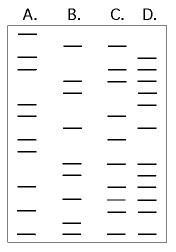
The DNA profiles that follow represent four different individuals.

41) Which of the following statements is consistent with the results?
A) B is the child of A and C.
B) C is the child of A and B.
C) D is the child of B and C.
D) A is the child of B and C.
E) A is the child of C and D.

back 41

Answer: B

front 42

42) Which of the following statements is most likely true?
A) D is the child of A and C.
B) D is the child of A and B.
C) D is the child of B and C.
D) A is the child of C and D.
E) B is the child of A and C.

back 42

Answer: B

front 43

43) Which of the following are probably siblings?
A) A and B
B) A and C
C) A and D
D) C and D
E) B and D

back 43

Answer: D

front 44

A eukaryotic gene has "sticky ends" produced by the restriction endonuclease EcoRI. The gene is added to a mixture containing EcoRI and a bacterial plasmid that carries two genes conferring resistance to ampicillin and tetracycline. The plasmid has one recognition site for EcoRI located in the tetracycline resistance gene. This mixture is incubated for several hours, exposed to DNA ligase, and then added to bacteria growing in nutrient broth. The bacteria are allowed to grow overnight and are streaked on a plate using a technique that produces isolated colonies that are clones of the original. Samples of these colonies are then grown in four different media: nutrient broth plus ampicillin, nutrient broth plus tetracycline, nutrient broth plus ampicillin and tetracycline, and nutrient broth without antibiotics.

44) Bacteria that contain the plasmid, but not the eukaryotic gene, would grow
A) in the nutrient broth plus ampicillin, but not in the broth containing tetracycline.
B) only in the broth containing both antibiotics.
C) in the broth containing tetracycline, but not in the broth containing ampicillin.
D) in all four types of broth.
E) in the nutrient broth without antibiotics only.

back 44

Answer: D

front 45

45) Bacteria containing a plasmid into which the eukaryotic gene has integrated would grow in
A) the nutrient broth only.
B) the nutrient broth and the tetracycline broth only.
C) the nutrient broth, the ampicillin broth, and the tetracycline broth.
D) all four types of broth.
E) the ampicillin broth and the nutrient broth.

back 45

Answer: E

front 46

46) Bacteria that do not take up any plasmids would grow on which media?
A) the nutrient broth only
B) the nutrient broth and the tetracycline broth
C) the nutrient broth and the ampicillin broth
D) the tetracycline broth and the ampicillin broth
E) all three broths

back 46

Answer: A

front 47

A group of six students has taken samples of their own cheek cells, purified the DNA, and used a restriction enzyme known to cut at zero, one, or two sites in a particular gene of interest.

47) Why might they be conducting such an experiment?
A) to find the location of this gene in the human genome
B) to prepare to isolate the chromosome on which the gene of interest is found
C) to find which of the students has which alleles
D) to collect population data that can be used to assess natural selection
E) to collect population data that can be used to study genetic drift

back 47

Answer: C

front 48

48) Their next two steps, in order, should be
A) use of a fluorescent probe for the gene sequence, then electrophoresis.
B) electrophoresis of the fragments followed by autoradiography.
C) electrophoresis of the fragments, followed by the use of a probe.
D) use of a ligase that will anneal the pieces, followed by Southern blotting.
E) use of reverse transcriptase to make cDNA, followed by electrophoresis.

back 48

Answer:C

front 49

49) Analysis of the data obtained shows that two students each have two fragments, two students each have three fragments, and two students each have one only. What does this demonstrate?
A) Each pair of students has a different gene for this function.
B) The two students who have two fragments have one restriction site in this region.
C) The two students who have two fragments have two restriction sites within this gene.
D) The students with three fragments are said to have "fragile sites."
E) Each of these students is heterozygous for this gene.

back 49

Answer: B

front 50

50) Which of the following tools of recombinant DNA technology is incorrectly paired with its use?
A) restriction enzymeanalysis of RFLPs
B) DNA ligasecutting DNA, creating sticky ends of restriction fragments
C) DNA polymerasepolymerase chain reaction to amplify sections of DNA
D) reverse transcriptaseproduction of cDNA from mRNA
E) electrophoresisseparation of DNA fragments

back 50

Answer:B

front 51

51) Plants are more readily manipulated by genetic engineering than are animals because
A) plant genes do not contain introns.
B) more vectors are available for transferring recombinant DNA into plant cells.
C) a somatic plant cell can often give rise to a complete plant.
D) genes can be inserted into plant cells by microinjection.
E) plant cells have larger nuclei.

back 51

Answer: C

front 52

52) A paleontologist has recovered a bit of tissue from the 400-year-old preserved skin of an extinct dodo (a bird). To compare a specific region of the DNA from the sample with DNA from living birds, which of the following would be most useful for increasing the amount of dodo DNA available for testing?
A) RFLP analysis
B) polymerase chain reaction (PCR)
C) electroporation
D) gel electrophoresis
E) Southern blotting

back 52

Answer:B

front 53

53) DNA technology has many medical applications. Which of the following is not done routinely at present?
A) production of hormones for treating diabetes and dwarfism
B) production of microbes that can metabolize toxins
C) introduction of genetically engineered genes into human gametes
D) prenatal identification of genetic disease alleles
E) genetic testing for carriers of harmful alleles

back 53

Answer: C

front 54

54) In recombinant DNA methods, the term vector can refer to
A) the enzyme that cuts DNA into restriction fragments.
B) the sticky end of a DNA fragment.
C) a SNP marker.
D) a plasmid used to transfer DNA into a living cell.
E) a DNA probe used to identify a particular gene.

back 54

Answer: D

front 55

55) Which of the following would not be true of cDNA produced using human brain tissue as the starting material?
A) It could be amplified by the polymerase chain reaction.
B) It could be used to create a complete genomic library.
C) It was produced from mRNA using reverse transcriptase.
D) It could be used as a probe to detect genes expressed in the brain.
E) It lacks the introns of the human genes.

back 55

Answer: B