Print Options

Card layout: ?

← Back to notecard set|Easy Notecards home page

Instructions for Side by Side Printing
  1. Print the notecards
  2. Fold each page in half along the solid vertical line
  3. Cut out the notecards by cutting along each horizontal dotted line
  4. Optional: Glue, tape or staple the ends of each notecard together
  1. Verify Front of pages is selected for Viewing and print the front of the notecards
  2. Select Back of pages for Viewing and print the back of the notecards
    NOTE: Since the back of the pages are printed in reverse order (last page is printed first), keep the pages in the same order as they were after Step 1. Also, be sure to feed the pages in the same direction as you did in Step 1.
  3. Cut out the notecards by cutting along each horizontal and vertical dotted line
To print: Ctrl+PPrint as a list

62 notecards = 16 pages (4 cards per page)

Viewing:

Energetics

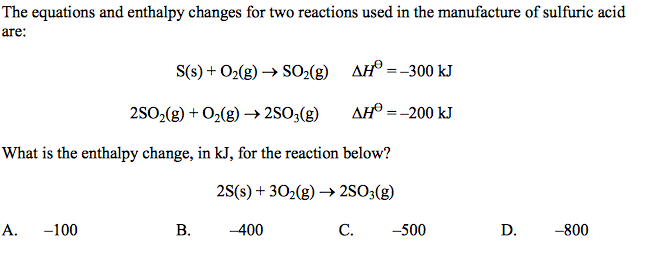
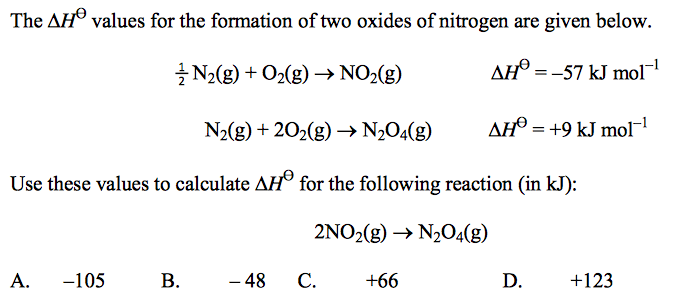
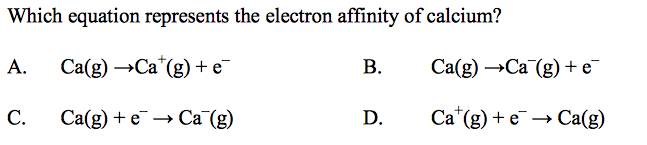
front 1

What energy changes occur when chemical bonds are formed and broken?
A. Energy is absorbed when bonds are formed and when they are broken.
B. Energy is released when bonds are formed and when they are broken.
C. Energy is absorbed when bonds are formed and released when they are broken.
D. Energy is released when bonds are formed and absorbed when they are broken.

back 1

D

front 2

The temperature of a 2.0 g sample of aluminium increases from 25°C to 30°C. How many joules of heat energy were added? (Specific heat of Al = 0.90 J g–1K–1)
A. 0.36
B. 2.3
C. 9.0
D. 11

back 2

C

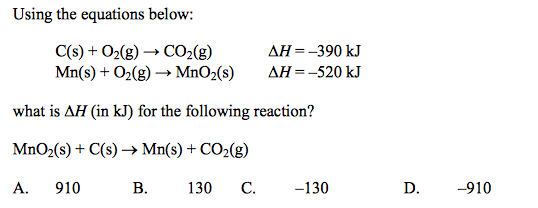
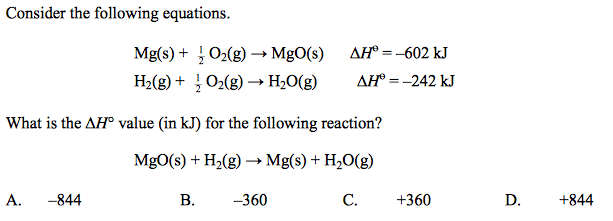
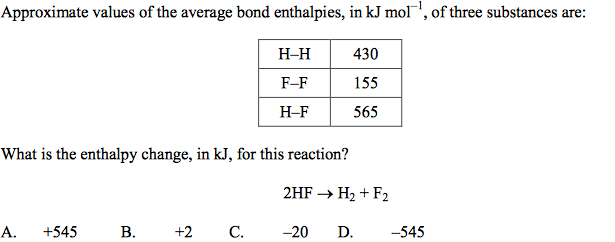
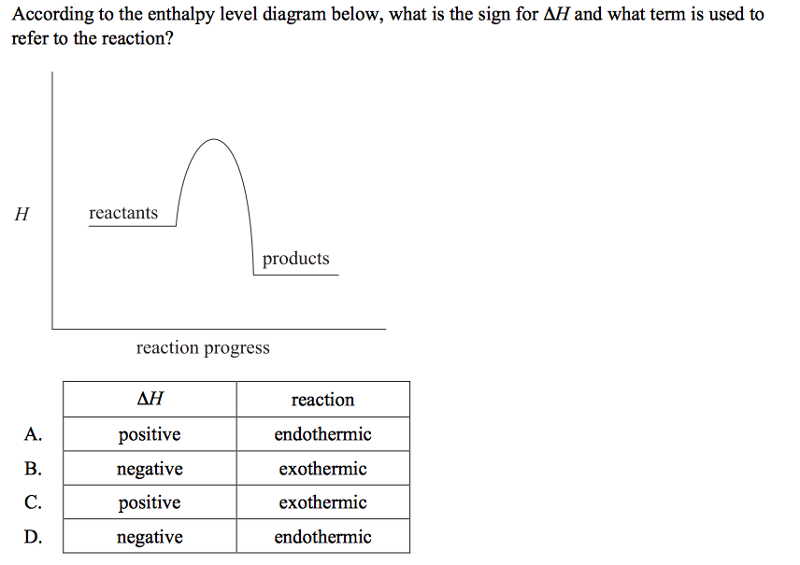
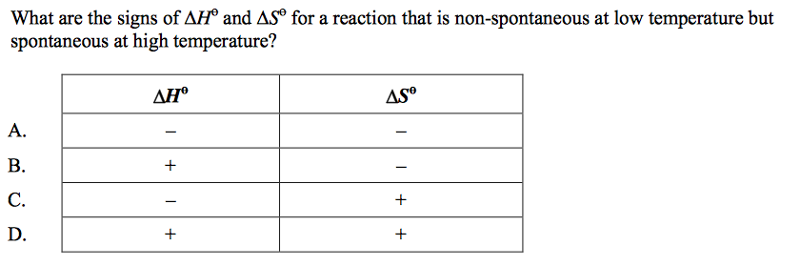
front 3

back 3

B

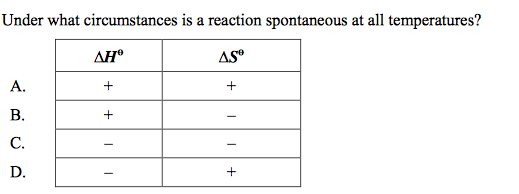
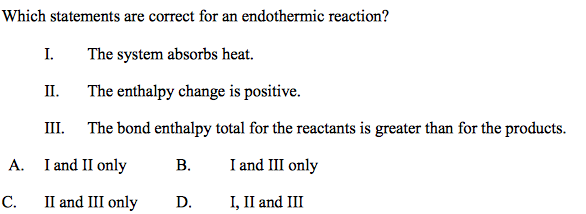
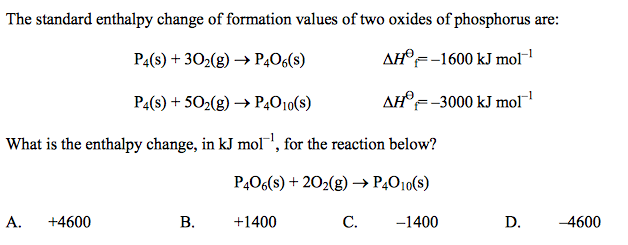
front 4

back 4

D

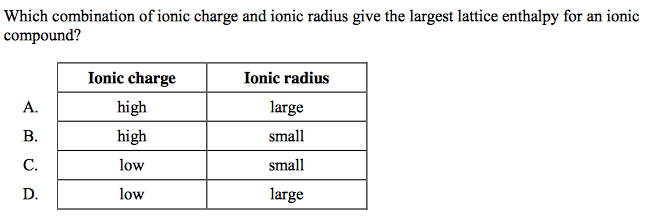
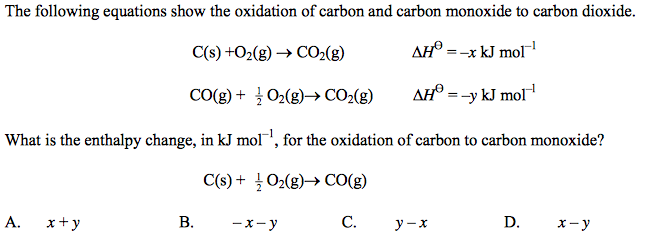
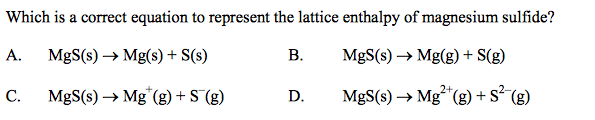
front 5

back 5

B

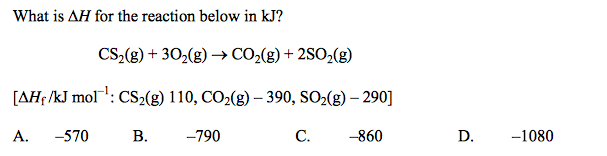
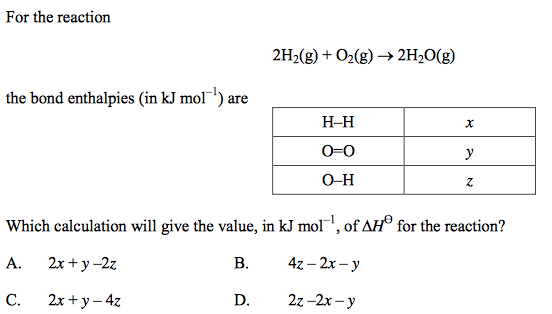
front 6

back 6

D

front 7

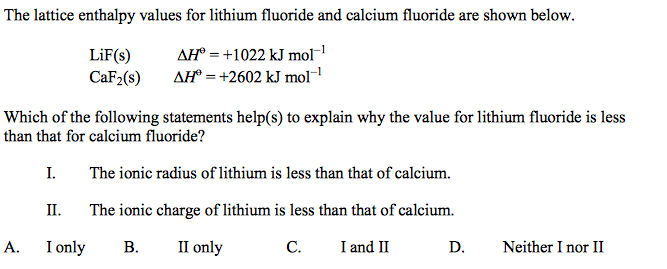
Which statements about exothermic reactions are correct?
I. They have negative DH values
II. The products have a lower enthalpy than the reactants.
III. The products are more energetically stable than the reactants.
A. I and II only
B. I and III only
C. II and III only
D. I, II and III

back 7

D

front 8

A sample of a metal is heated. Which of the following are needed to calculate the heat absorbed by the sample?
I. The mass of the sample
II. The density of the sample
III. The specific heat capacity of the sample
A. I and II only
B. I and III only
C. II and III only
D. I, II and III

back 8

B

front 9

The average bond enthalpies for O—O and O==O are 146 and 496 kJ mol–1 respectively. What is the enthalpy change, in kJ, for the reaction below?
H—O—O—H(g) -> H—O—H(g) + 1⁄2O==O(g)
A. – 102
B. + 102
C. + 350
D. + 394

back 9

A

front 10

Which reaction has the greatest positive entropy change?
A. CH4(g) + 11⁄2O2(g) → CO(g) + 2H2O(g)
B. CH4(g) + 11⁄2O2(g) → CO(g) + 2H2O(l)
C. CH4(g) + 2O2(g) → CO2(g) + 2H2O(g)
D. CH4(g) + 2O2(g) → CO2(g) + 2H2O(l)

back 10

A

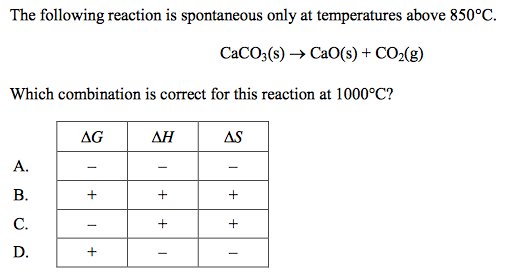
front 11

back 11

C

front 12

back 12

B

front 13

When the solids Ba(OH)2 and NH4SCN are mixed, a solution is produced and the temperature drops.
Ba(OH)2(s) + 2NH4SCN(s) → Ba(SCN)2(aq) + 2NH3(g) + 2H2O(l)
Which statement about the energetics of this reaction is correct?
A. The reaction is endothermic and DH is negative.
B. The reaction is endothermic and DH is positive.
C. The reaction is exothermic and DH is negative.
D. The reaction is exothermic and DH is positive.

back 13

B

front 14

back 14

A

front 15

Which reaction occurs with the largest increase in entropy?
A. Pb(NO3)2(s) + 2KI(s) → PbI2(s) + 2KNO3(s)
B. CaCO3(s) → CaO(s) + CO2(g)
C. 3H2(g) + N2(g) → 2NH3(g)
D. H2(g) + I2(g) → 2HI(g)

back 15

B

front 16

The ∆H and ∆S values for a certain reaction are both positive. Which statement is correct about the spontaneity of this reaction at different temperatures?
A. It will be spontaneous at all temperatures.
B. It will be spontaneous at high temperatures but not at low temperatures.
C. It will be spontaneous at low temperatures but not at high temperatures.
D. It will not be spontaneous at any temperature

back 16

B

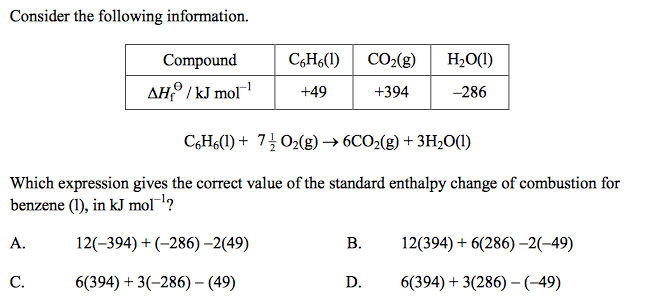
front 17

back 17

C

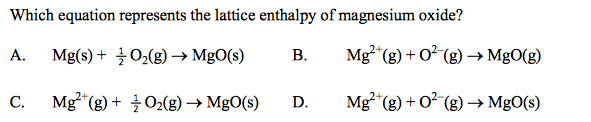
front 18

back 18

B

front 19

back 19

C

front 20

back 20

D

front 21

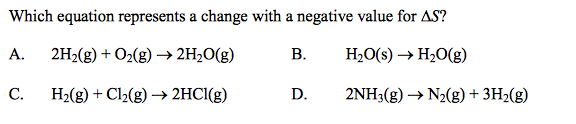
Which reaction has a positive entropy change, ∆S?

back 21

C

front 22

Separate solutions of HCl(aq) and H2SO4(aq) of the same concentration and same volume were completely neutralized by NaOH(aq). X kJ and Y kJ of heat were evolved respectively. Which statement is correct?
A. X = Y
B. Y = 2X
C. X = 2Y
D. Y = 3X

back 22

B

front 23

back 23

A

front 24

The mass m (in g) of a substance of specific heat capacity c (in J g–1 K–1 ) increases by t°C. What is the heat change in J?
A. mct
B. mc(t + 273)
C. mct
D. mc(t + 273)/1000

back 24

A

front 25

The average bond enthalpy for the C―H bond is 412 kJ mol–1. Which process has an enthalpy change closest to this value?
A. CH4(g) → C(s) + 2H2(g)
B. CH4(g) → C(g) + 2H2(g)
C. CH4(g) → C(s) + 4H(g)
D. CH4(g) → CH3(g) + H(g)

back 25

D

front 26

For a certain reaction at 298 K the values of both ∆H and ∆S are negative. Which statement about the sign of ∆G for this reaction must be correct?
A. It is negative at all temperatures.
B. It is positive at all temperatures.
C. It is negative at high temperatures and positive at low temperatures.
D. It cannot be determined without knowing the temperature.

back 26

D

front 27

Which type of reaction is referred to in the definition of standard enthalpy change of formation?
A. the formation of a compound from its elements
B. the formation of a crystal from its ions
C. the formation of a molecule from its atoms
D. the formation of a compound from other compounds

back 27

A

front 28

The following equation shows the formation of magnesium oxide from magnesium metal.
2Mg(s) + O2(g)->2MgO(s) DHӨ = –1204kJ Which statement is correct for this reaction?
A. 1204 kJ of energy are released for every mol of magnesium reacted.
B. 602 kJ of energy are absorbed for every mol of magnesium oxide formed.
C. 602 kJ of energy are released for every mol of oxygen gas reacted.
D. 1204 kJ of energy are released for every two mol of magnesium oxide formed.

back 28

D

front 29

back 29

C

front 30

A simple calorimeter was used to determine the enthalpy of combustion of ethanol. The experimental value obtained was –920 kJ mol–1. The Data Booklet value is –1371 kJ mol–1. Which of the following best explains the difference between the two values?
A. incomplete combustion of the fuel
B. heat loss to the surroundings
C. poor ventilation in the laboratory
D. inaccurate temperature measurements

back 30

B

front 31

What is the correct order of decreasing entropy for a pure substance? A. gas A. gas > liquid > solid
B. solid > liquid > gas
C. solid > gas > liquid
D. liquid > solid > gas

back 31

A

front 32

back 32

C

front 33

Which statement about bond enthalpies is correct?
A. Bond enthalpies have positive values for strong bonds and negative values for weak
bonds.
B. Bond enthalpy values are greater for ionic bonds than for covalent bonds.
C. Bond breaking is endothermic and bond making is exothermic.
D. The carbon–carbon bond enthalpy values are the same in ethane and ethene.

back 33

C

front 34

An equation for a reaction in which hydrogen is formed is
CH4 + H2O -> 3H2 + CO DHӨ = +210 kJ
Which energy change occurs when 1 mol of hydrogen is formed in this reaction?
A. 70 kJ of energy are absorbed from the surroundings.
B. 70 kJ of energy are released to the surroundings.
C. 210 kJ of energy are absorbed from the surroundings.
D. 210 kJ of energy are released to the surroundings.

back 34

A

front 35

back 35

D

front 36

back 36

C

front 37

back 37

A

front 38

back 38

C

front 39

back 39

D

front 40

back 40

A

front 41

back 41

B

front 42

Which statement is correct for an endothermic reaction?
A. The products are more stable than the reactants and DH is positive.
B. The products are less stable than the reactants and DH is negative.
C. The reactants are more stable than the products and DH is positive.
D. The reactants are less stable than the products and DH is negative.

back 42

C

front 43

Which statement is correct about the reaction shown?
2SO2(g) + O2(g) <-> 2SO3(g) DH = –196 kJ
A. 196 kJ of energy are released for every mole of SO2(g) reacted.
B. 196 kJ of energy are absorbed for every mole of SO2(g) reacted.
C. 98 kJ of energy are released for every mole of SO2(g) reacted.
D. 98 kJ of energy are absorbed for every mole of SO2(g) reacted.

back 43

C

front 44

Which statements are correct for all exothermic reactions?
I. The enthalpy of the products is less than the enthalpy of the reactants.
II. The sign of H is negative.
III. The reaction is rapid at room temperature.
A. I and II only
B. I and III only
C. II and III only
D. I, II, and III

back 44

A

front 45

Which are characteristics of ions in an ionic compound with a large lattice enthalpy value?
A. Large ionic radius and high ionic charge
B. Small ionic radius and low ionic charge
C. Large ionic radius and low ionic charge
D. Small ionic radius and high ionic charge

back 45

D

front 46

back 46

C

front 47

Consider the following reactions:

back 47

A

front 48

back 48

C

front 49

Which statement is correct for an endothermic reaction?
A. Bonds in the products are stronger than the bonds in the reactants.
B. Bonds in the reactants are stronger than the bonds in the products.
C. The enthalpy of the products is less than that of the reactants.
D. The reaction is spontaneous at low temperatures but becomes non-spontaneous at high temperatures.

back 49

B

front 50

back 50

C

front 51

back 51

D

front 52

back 52

B

front 53

When 40 joules of heat are added to a sample of solid H2O at –16.0°C the temperature increases to –8.0°C. What is the mass of the solid H2O sample? [Specific heat capacity of H2O(s) = 2.0 J g–1K–1]
A. 2.5 g
B. 5.0 g
C. 10 g
D. 160 g

back 53

A

front 54

back 54

D

front 55

The HӨ and SӨ values for a reaction are both negative. What will happen to the spontaneity of this reaction as the temperature is increased?
A. The reaction will become more spontaneous as the temperature is increased.
B. The reaction will become less spontaneous as the temperature is increased.
C. The reaction will remain spontaneous at all temperatures.
D. The reaction will remain non-spontaneous at any temperature.

back 55

B

front 56

How much energy, in joules, is required to increase the temperature of 2.0 g of aluminium from 25 to 30°C? (Specific heat of Al = 0.90 J g–1 K–1).
A. 0.36
B. 4.5
C. 9.0
D. 54

back 56

C

front 57

back 57

C

front 58

back 58

B

front 59

back 59

B

front 60

back 60

C

front 61

Which reaction causes a decrease in the entropy of the system?

back 61

B

front 62

back 62

D