Instructions for Side by Side Printing
- Print the notecards
- Fold each page in half along the solid vertical line
- Cut out the notecards by cutting along each horizontal dotted line
- Optional: Glue, tape or staple the ends of each notecard together
Descent with Modification: A Darwinian View of Life
front 1 Which of the following statements best describes theories? | back 1 They are supported by, and make sense of, many observations. |
front 2 Catastrophism, meaning the regular occurrence of geological or meteorological disturbances (catastrophes), was Cuvier's attempt to explain the existence of | back 2 the fossil record. |
front 3 With what other idea of his time was Cuvier's theory of catastrophism most in conflict? | back 3 uniformitarianism |
front 4 What was the prevailing belief prior to the time of Lyell and Darwin? | back 4 Earth is a few thousand years old, and populations are unchanging. |
front 5 During a study session about evolution, one of your fellow students remarks, "The giraffe stretched its neck while reaching for higher leaves; its offspring inherited longer necks as a result." Which statement is most likely to be helpful in correcting this student's misconception? | back 5 Characteristics acquired during an organism's life are generally not passed on through genes. |
front 6 Which of the following is the most accurate summary of Cuvier's consideration of fossils found in the vicinity of Paris? | back 6 extinction of species yes; evolution of new species no |
front 7 In the mid-1900s, the Soviet geneticist Lysenko believed that his winter wheat plants, exposed to ever-colder temperatures, would eventually give rise to ever more cold-tolerant winter wheat. Lysenko's attempts in this regard were most in agreement with the ideas of | back 7 Lamarck. |
front 8 Charles Darwin was the first person to propose | back 8 a mechanism for evolution that was supported by evidence. |
front 9 Which of these conditions should completely prevent the occurrence of natural selection in a population over time? | back 9 All variation between individuals is due only to environmental factors. |
front 10 Natural selection is based on all of the following except | back 10 individuals adapt to their environments and, thereby, evolve. |
front 11 Which of the following represents an idea that Darwin learned from the writings of Thomas Malthus? | back 11 Populations tend to increase at a faster rate than their food supply normally allows. |
front 12 Given a population that contains genetic variation, what is the correct sequence of the following events, under the influence of natural selection? | back 12 1.Well-adapted individuals leave more offspring than do poorly adapted individuals.
|
front 13 A biologist studied a population of squirrels for 15 years. During that time, the population was never fewer than 30 squirrels and never more than 45. Her data showed that over half of the squirrels born did not survive to reproduce, because of both competition for food and predation. In a single generation, 90% of the squirrels that were born lived to reproduce, and the population increased to 80. Which inference(s) about this population might be true? | back 13 Two of the statements above are correct. |
front 14 Which of the following must exist in a population before natural selection can act upon that population? | back 14 genetic variation among individuals |
front 15 Which of Darwin's ideas had the strongest connection to Darwin having read Malthus's essay on human population growth? | back 15 struggle for existence |
front 16 If Darwin had been aware of genes, and of their typical mode of transmission to subsequent generations, with which statement would he most likely have been in agreement? | back 16 If natural selection can change one gene's frequency in a population over the course of generations then, given enough time and enough genes, natural selection can cause sufficient genetic change to produce new species from old ones. |
front 17 The role that humans play in artificial selection is to | back 17 choose which organisms breed, and which do not. |
front 18 Currently, two extant elephant species (X and Y) are placed in the genus Loxodonta, and a third species (Z) is placed in the genus Elephas. Thus, which statement should be true? | back 18 Species X and Y share a greater number of homologies with each other than either does with species Z. |
front 19 The rise of methicillin-resistant Staphylococcus aureus (MRSA) can be considered to be an example of artificial selection because | back 19 humans synthesize methicillin and create environments in which bacteria frequently come into contact with methicillin. |
front 20 In a hypothetical environment, fishes called pike-cichlids are visual predators of algae-eating fish (in other words, they locate their prey by sight). If a population of algae-eaters experiences predation pressure from pike-cichlids, which of the following is least likely to be observed in the algae-eater population over the course of many generations? | back 20 selection for larger female algae-eaters, bearing broods composed of more, and larger, young |
front 21 DDT was once considered a "silver bullet" that would permanently eradicate insect pests. Today, instead, DDT is largely useless against many insects. Which of these would have been required for this pest eradication effort to be successful in the long run? | back 21 None of the individual insects should have possessed genomes that made them resistant to DDT. |
front 22 If the bacterium Staphylococcus aureus experiences a cost for maintaining one or more antibiotic-resistance genes, then what should happen in environments from which antibiotics are missing? | back 22 These bacteria should be outcompeted and replaced by bacteria that have lost these genes. |
front 23 Of the following anatomical structures, which is homologous to the bones in the wing of a bird? | back 23 bones in the flipper of a whale |
front 24 If two modern organisms are distantly related in an evolutionary sense, then one should expect that | back 24 they should share fewer homologous structures than two more closely related organisms. |
front 25 Structures as different as human arms, bat wings, and dolphin flippers contain many of the same bones, these bones having developed from very similar embryonic tissues. How do biologists interpret these similarities? | back 25 Two of the statements above are correct. |
front 26 Over evolutionary time, many cave-dwelling organisms have lost their eyes. Tapeworms have lost their digestive systems. Whales have lost their hind limbs. How can natural selection account for these losses? | back 26 Under particular circumstances that persisted for long periods, each of these structures presented greater costs than benefits. |
front 27 Which of the following pieces of evidence most strongly supports the common origin of all life on Earth? | back 27 All organisms use essentially the same genetic code |
front 28 Logically, which of these should cast the most doubt on the relationships depicted by an evolutionary tree? | back 28 Relationships between DNA sequences among the species did not match relationships between skeletal patterns. |
front 29 Which of the following statements most detracts from the claim that the human appendix is a completely vestigial organ? | back 29 The appendix has a substantial amount of defensive lymphatic tissue. |
front 30 Members of two different species possess a similar-looking structure that they use in a similar fashion to perform the same function. Which information would best help distinguish between an explanation based on homology versus one based on convergent evolution? | back 30 The two species share many proteins in common, and the nucleotide sequences that code for these proteins are almost identical. |
front 31 Ichthyosaurs were aquatic dinosaurs. Fossils show us that they had dorsal fins and tails, as do fish, even though their closest relatives were terrestrial reptiles that had neither dorsal fins nor aquatic tails. The dorsal fins and tails of ichthyosaurs and fish are | back 31 Two of the responses above are correct. |
front 32 Both ancestral birds and ancestral mammals shared a common ancestor that was terrestrial. Today, penguins (which are birds) and seals (which are mammals) have forelimbs adapted for swimming. What term best describes the relationship of the bones in the forelimbs of penguins and seals, and what term best describes the flippers of penguins and seals? | back 32 homologous; analogous |
front 33 What must be true of any organ that is described as vestigial? | back 33 It must be homologous to some feature in an ancestor |
front 34 What is true of pseudogenes? | back 34 They are vestigial genes. |
front 35 It has been observed that organisms on islands are different from, but closely related to, similar forms found on the nearest continent. This is taken as evidence that | back 35 island forms and mainland forms descended from common ancestors. |
front 36 If one wanted to find the largest number of endemic species, one should visit which of the following geological features (assuming each has existed for several millions of years)? | back 36 an isolated ocean island in the tropics |
front 37 A high degree of endemism is most likely in environments that are | back 37 isolated and heterogeneous. |
front 38 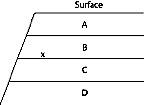 (The following questions refer to Figure 22.1, which shows an outcrop of sedimentary rock whose strata are labeled AD.)
| back 38 C |
front 39 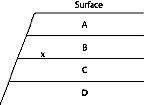 If x indicates the fossils of two closely related species, neither of which is extinct, then their remains may be found in how many of these strata? | back 39 two strata |
front 40 According to a 1999 study, the vegetarian finch is genetically no more similar to the tree finches than it is to the ground finches, despite the fact that it is placed in the same genus as the tree finches. Based on this finding, it is reasonable to conclude that the vegetarian finch | back 40 is no more closely related to the tree finches than it is to the ground finches, despite its classification. |
front 41 A 14th species that descended from the original ancestral finch, the Cocos Island finch, is endemic to its namesake island, located 550 km off Costa Rica. The Cocos Island finch is genetically much more similar to the tree finches than is the vegetarian finch, yet it is classified in its own genus Pinarolaxias. Moreover, the Cocos Island finch and the vegetarian finch are the two finch species that are most genetically different from the ancestral Galápagos finch. Thus, if classification is to reflect evolutionary relationships, the vegetarian finch should | back 41 be placed in its own genus. |
front 42 Which of the following is not an observation or inference on which natural selection is based? | back 42 Poorly adapted individuals never produce offspring |
front 43 Which of the following observations helped Darwin shape his concept of descent with modification? | back 43 South American temperate plants are more similar to the tropical plants of South America than to the temperate plants of Europe. |
front 44 Within six months of effectively using methicillin to treat S. aureus infections in a community, all new infections were caused by MRSA. How can this result best be explained? | back 44 Some drug-resistant bacteria were present at the start of treatment, and natural selection increased their frequency. |
front 45 The upper forelimbs of humans and bats have fairly similar skeletal structures, whereas the corresponding bones in whales have very different shapes and proportions. However, genetic data suggest that all three kinds of organisms diverged from a common ancestor at about the same time. Which of the following is the most likely explanation for these data? | back 45 Natural selection in an aquatic environment resulted in significant changes to whale forelimb anatomy. |
front 46 DNA sequences in many human genes are very similar to the sequences of corresponding genes in chimpanzees. The most likely explanation for this result is that | back 46 humans and chimpanzees share a relatively recent common ancestor. |