front 1 Phonology, morphology, and syntax are com-
ponents of form,
whereas semantics and pragmatics are components of content and use, respectivel | |
| back 2 involves acquiring the rules of language that govern the
sound
structure of syllables and words |
| back 3 We discuss in Chapter 1 how every lan-
guage has a relatively
small number of meaningful sounds, or phonemes. Phonemes are the
individual speech sounds in a language that signal a contrast in
meaning. Phonemes
are the individual speech sounds in a language
that signal a contrast in meaning. In General American English, for
instance, /r/ and /l/ are two different phonemes because exchanging
one sound for the other creates a different meaning (e.g., low vs.
row; liver vs. river). Words that differ by only one phoneme,
such as low and row,
are called minimal pairs |
front 4 As children develop their phonological system, they de-
velop an
internal representation of each phoneme in their native language,
which is important to differentiate minimal pairs. | |
front 5 As children develop their phonological system, they de-
velop an
internal representation of each phoneme in their native language,
which is important to differentiate minimal pairs. In essence, a
phonological representation
is a neurological imprint of a
phoneme that differentiates it from other phonemes. Having this
imprint (internal representation) does not necessarily correspond to
being able to produce a phoneme, as we can see here in this exchange
between the second author and her 3-year-old son,
Griffin:
Griffin: We need to “sine” the mirror.
LJ: Sign the
mirror?
Griffin: No, we need to “sign” it. (emphasizes the
initial /s/)
This exchange implies that Griffin has an internal
representation of the “sh” sound (the initial phoneme in shine), and
perceives the meaningful difference in the minimal pairs shine and
sign; however, his production does not match that internal
representation. This is not an uncommon sort of exchange with
children in this age range, whose internal phonological
representations seem to be more
sophisticated than their
expressive capabilities (at least for certain sounds, such as
“sh” and “th”). | |
| back 6 Phonological development also involves developing sensitivity to the
phonotactic rules of a person’s native language; these rules specify
“legal” (i.e., acceptable)
orders of sounds in syllables and
words and the places where specific phonemes can and cannot occur.
Early in development, children become sensitive to both. For example,
they recognize that /l/ + /h/ is an illegal combination of sounds in
English, and that /t/ + /s/ is legal in the final position of a
syllable (e.g., pots) but
illegal in the initial position. |
front 7 Phonological Building Blocks | back 7 Phonological Building Blocks
Phonological development begins
immediately after birth (if not before) as the in- fant experiences
speech in the environment. |
front 8 Cues to Segment Streams of Speech | back 8 Cues to Segment Streams of Speech
One of the earliest
phonological tasks infants face is parsing the streams of speech
occurring in the world around them. Early in development, infants
exhibit the capacity to use specific cues within the speech stream to
parse it into smaller units (e.g., words) and to separate
simultaneously occurring speech streams (e.g., the
speech on the
television vs. the mother’s speech; Hollich, Newman, & Jusczyk,
2005). One strategy infants use to parse speech streams is to draw on
prosodic and phonotactic cues (Estes, 2014; Gerken & Aslin, 2005). |
| back 9 When using prosodic cues, infants draw on their familiarity with word
and syllable stress patterns, or the rhythm of language, to break into
the speech stream. For example, infants exposed to English rapidly
become sensitive to prevalent stress patterns in English words,
including the strong–weak stress pattern
in such words as little
and grammar (Thiessen & Saffran, 2003 |
front 10 During the first year of life, infants use their knowledge of
predominant word-stress patterns to locate boundaries between words in
running streams of speech. For example,
they presume that a word
boundary occurs following two syllables of a strong– weak stress
pattern, given the prevalence of this word-stress pattern in English.
For the infant who hears “little boy,” this cueing strategy helps him
to isolate little and boy as separate words. Infants also recognize
relatively early that pauses of-
ten occur at the boundaries
between clauses and phrases (Gerken & Aslin, 2005; Hawthorne &
Gerken, 2014). Infants’ sensitivity to the way in which pausing marks
linguistic boundaries within speech streams, such as clause segments,
may support their syntactic development because it provides the
opportunity to analyze how smaller syntactic units combine to form
larger units of speech | |
| back 11 Infants also use phonotactic cues to parse the speech stream. Early
in development, infants become sensitive to the probability that
certain sounds will occur both in general and in specific positions of
syllables and words (Jusczyk, Luce, &
Charles-Luce, 1994).
Thus, when encountering a speech stream containing the
pho-
neme sequence /gz/, the English-learning infant recognizes
the improbability that this sequence starts a word. In contrast, this
sequence is both legal and probable in the final position of a word
(dogs, eggs), and he or she uses knowledge of these
probabilities to segment a likely word boundary following the
sequence. Knowledge of phonotactic probabilities and improbabilities
is an important tool for the infant to use to segment novel words from
a continuous speech stream (Estes, 2014). |
| back 12 Phonemic Inventory
Another major building block in phonological
development is the child’s acquisition of internal representations of
the phonemes composing his or her native language—termed phonological
knowledge—and his or her expression of these
phonemes to produce
syllables and words—termed phonological production or expression.
Children develop a full phonemic inventory gradually as they
make
more and more fine-tuned distinctions among phonemes. When
their inventory is
relatively small, children use a single
phoneme (e.g., /d/) to express multiple pho-
nemes (e.g., /t/,
/d/, /k/, and /g/). This means a 2-year-old might say both “take”
and “cake” as “dake.” Children gradually add more phonemes
until their inventory
is complete and adultlike. |
front 13 The child’s phonemic inventory includes both vowels and consonants.
Vowels develop prior to consonants, typically in the first year
of life. In contrast, not all consonants are acquired or expressed at
the same time; some emerge early in development (early consonants)
and others emerge later (late consonants) | |
front 14 Several factors influence the timing of development for specific
phonemes, including the phoneme’s frequency of occurrence in spoken
language, the number of words
a child uses that contain a given
phoneme, and, to some extent, the articulatory complexity of producing
the phoneme (Amayreh, 2003; To, Cheung, & McLeod,
2013).
Because of these influences, the order of consonantal acquisition
varies among languages; for example, English-speaking children master
/z/ earlier than Arabic-speaking children because this phoneme occurs
more frequently in English
than in Arabic (Amayreh, 2003). | |
front 15 In general, children’s phonological knowledge and production are
sufficiently well developed by age 3–4 years to provide for fully
intelligible speech. Although some consonantal phonemes will elude
mastery for several more years, the child’s inventory is large enough
to allow reasonable substitutions of mastered phonemes
for those
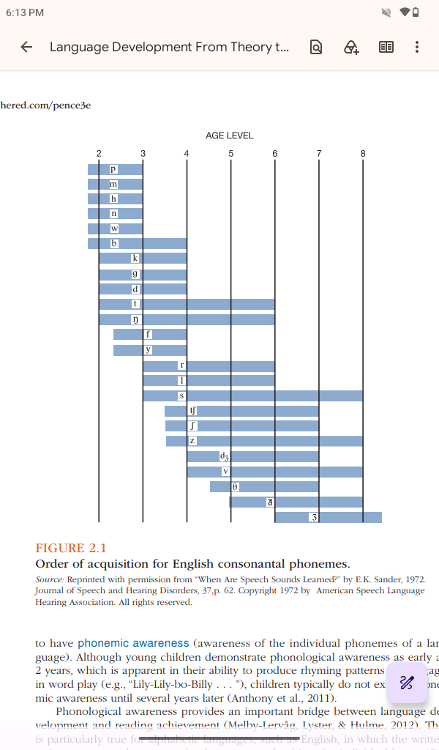
yet to be mastered (e.g., /d/ for the initial sound in that). Figure
2.1 pro- vides a summary of the order of mastery for the English
consonantal phonemes. Examining this figure, note that an
early-emerging phoneme is /m/ and a later emerging phoneme is /v/. Why
do you think /m/ would emerge early and /v/ later
among
English-speaking children? | |
| back 16 Phonological Awareness
Phonological awareness is an individual’s
ability to attend to the phonological units of speech through implicit
or explicit analysis. We can examine an individual’s phonological
awareness using a variety of simple oral tasks (so the individual
com-
pleting the tasks must listen to the phonological units and
not read them):
Syllable counting: How many syllables are in the word
psychologist? (Answer: four)
2. Rhyme detection: Of these four
words, which two rhyme: four, boat, hat, door? (Answer: four,
door)
3. Initial sound identification: What is the first sound
in the word boat? (Answer: /b/)
4. Initial sound elision: Say
the word boat without the /b/. (Answer: oat)
5. Phoneme
counting: How many sounds are in the word justice? (Answer: six) |
front 17 All of these tasks require an individual to attend to the
phonological units of words, ranging from fairly large units
(syllables, item 1) to the smallest units (each individual phoneme,
item 5). Of the five tasks, the latter three are the most chal-
lenging because one has to attend to the smallest units of phonology
by identifying or eliding the first sounds in words (items 3, 4, and
5), or by counting all of
the phonemes in a word (item 5). When
an individual is able to attend explicitly to the individual phonemes
in words, as is necessary for task 5, he or she is said | |
| back 18 to have phonemic awareness (awareness of the individual phonemes of a
language). Although young children demonstrate phonological awareness
as early as
2 years, which is apparent in their ability to
produce rhyming patterns and engage in word play (e.g.,
“Lily-Lily-bo-Billy . . . ”), children typically do not exhibit
phone-
mic awareness until several years later (Anthony et al., 2011). |
front 19 Phonological awareness provides an important bridge between language
de- velopment and reading achievement (Melby-Lervåg, Lyster, &
Hulme, 2012). This
is particularly true for alphabetic
languages, such as English, in which the written script represents
phonemes using letter-to-sound pairings for individual letters (B =
/b/) and letter sequences (e.g., OUGH = /o/). Phonics instruction
teaches children the relationships between letters and sounds, and
children who are “phonologically
aware” can better profit from
phonics instruction than children who are unaware
(see Metsala
& Ehri, 201 | back 19 Many children in the United States struggle to develop
basic
word-reading skills, and for many of these children, a contributor to
this struggle is underdeveloped phonological awareness (Fuchs et al.,
2012). Systematically teaching children to attend to the phonological
structure of language, through the use of games and other similar
activities, is an important aspect of early-reading instruction that
can have long-term, positive effects on future reading achievement
(Suggate, 2014). |
| back 20 Native Language
Infants’ phonological development is influenced
significantly by the phonemic composition of the language (or
languages) to which the infants are exposed. Speech sounds that are
phonemic in one language may not be phonemic in another. Thus,
children learning Arabic acquire representations of the phonemic
inventory of Arabic and not the inventory of English (or any other
language); for this reason, Arabic-speaking children will not develop
a phonemic representation of /p/
because it is not phonemic in
their language. |
front 21 Even when a given speech sound is phonemic in two languages, children
may acquire it at different times, depending on the frequency with
which it appears in words and its similarity to other phonemes in the
language inventory. In othernwords, the functional load of a phoneme
can vary among languages. | |
| back 22 Functional
load refers essentially to the importance of a
phoneme in the phonemic inventory of the language, which corresponds
to the volume of words that are distinguishable by that phoneme
(Wedel, Kaplan, & Jackson, 2013). If we draw again on the
comparison of English and Arabic, English-speaking children master /z/
by about
age 4 years (Grunwell, 1997), whereas Arabic-speaking
children do not master this phoneme until after age 6 years (Amayreh,
2003). In English, the phoneme /z/ has
a high functional load,
in part because it is used for pluralization (e.g., vans, dogs),
whereas in Arabic it has a low functional load (Amayreh, 2003). |
| back 23 Linguistic Experience
Even among children who are learning the
same language, differences exist in the timing of their establishment
of phonological representations and in their production of different
phonemes (McCune & Vihman, 2001). Children develop
phonological representations through their exposure to phonemic
contrasts in their language; thus, differences in the timing of
phonological development occur, at least in part, because of
variability in children’s phonological exposure. The internal
phonological representations of children reared in lower-income homes
can be less
mature and distinct than those of children of the
same age reared in higher-income homes, probably because of variations
in the children’s exposure to language (Mc- Dowell, Lonigan, &
Goldstein, 2007). The same holds true for children with a history of
chronic ear infections, whose phonological representations are less
mature than those of children without such a history (Haapala et al.,
2014). This is because
children with chronic ear infections
experience periods in which linguistic expo- sure is compromised. |
front 24 What is Morphological Development | back 24 What is Morphological Development?
Children’s morphological
development is their internalization of the rules of language that
govern word structure. Morphemes are the smallest meaningful units of
language, and many words include several morphemes. Morphemes allow
the grammatical inflection of words, as in adding -ed to walk to
create the past tense
verb walked, and they can change the
syntactic class of words, as in adding -like to the noun child to
create the adjective childlike. Morphological development thus
provides children with the tools for grammatical inflection, as well
as a means for
expanding their vocabulary from a smaller set of
root words (e.g., child) to an ex-
ponentially larger set of
derived forms (e.g., childless, childlike, childish). |
front 25 grammatical morphemes (also called inflectional morphemes) | back 25 grammatical morphemes include the plural -s (cat–cats),
the
possessive ’s (mom–mom’s), the past tense -ed (walk–walked), present
progressive -ing (do–doing), to name a few. |
| back 26 Derivational morphemes change a
word’s syntactic class and
semantic meaning. For example, taking the word like, we
can add
both prefixes (dislike, unlike) and suffixes (liken, likeable,
likeness) to vary
its meaning and syntactic role in a sentence. |
| back 27 Grammatical Morphemes
Children’s earliest words and sentences
contain few grammatical morphemes, but only for the first year or two.
At about age 2 years, children begin to use the first- appearing
grammatical morpheme, the present progressive -ing. Whereas before
then, the child might ask, “Where Mommy go?”, he or she now asks,
“Where Mommy going?” In subsequent chapters, we discuss in more detail
the child’s
timing and course of acquisition for learning the
major grammatical morphemes, which include not only the present
progressive -ing, but also the plural -s, the possessive ’s, and the
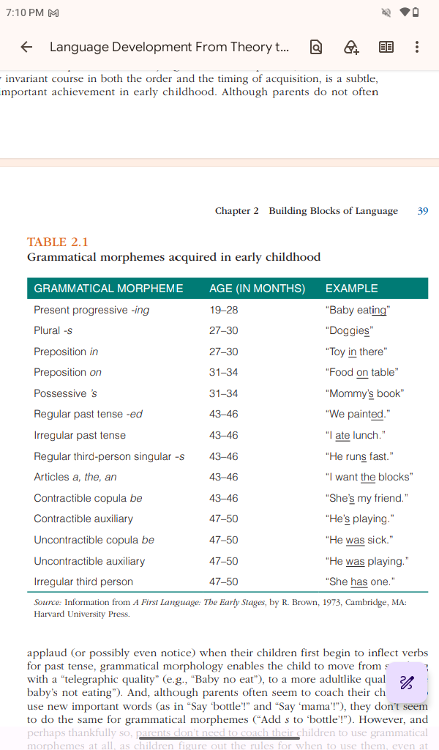
past tense -ed, as shown in Table 2.1. Note that the grammatical
morphemes in Table 2.1 include not only suffixes, but also several
free
morphemes. |
front 28 Suffixes (and prefixes) are called bound morphemes because they
must be bound or attached to other morphemes | |
front 29 In contrast, free morphemes can
stand alone; they include both
words with clear semantic referents (e.g., dream, dog, walk), and
words that serve primarily grammatical purposes (e.g., his, the,
that). Children’s early achievements in grammatical morphology include
acquiring not only bound morphemes but also several free morphemes
that serve purely
grammatical purposes, including the
prepositions in and on, and the articles the,
a, and an. | |
front 30 The child’s acquisition of the major grammatical morphemes, which
follows a fairly invariant course in both the order and the timing of
acquisition, is a subtle, but important achievement in early
childhood. Although parents do not often applaud (or possibly even
notice) when their children first begin to inflect verbs
for
past tense, grammatical morphology enables the child to move from
speaking
with a “telegraphic quality” (e.g., “Baby no eat”), to
a more adultlike quality (“The baby’s not eating”). And, although
parents often seem to coach their children to use new important words
(as in “Say ‘bottle’!” and “Say ‘mama’!”), they don’t seem to do the
same for grammatical morphemes (“Add s to ‘bottle’!”). However, and
perhaps thankfully so, parents don’t need to coach their
children to use grammatical morphemes at all, as children figure out
the rules for when to use them, even at
very young ages (Zapf
& Smith, 2007) | |
front 31 When researchers study children’s grammatical morphology, they often
examine obligatory contexts of use, and determine whether the child
has omitted or included the obligatory morpheme. | |
front 32 obligatory context occurs | back 32 An obligatory context occurs when a mature
grammar specifies
the use of a grammatical marker; for instance, in the phrase The
girl’s house, the possessive ’s is considered obligatory. Thus, if a
child says “The girl house,” he or she is omitting the possessive (’s)
morpheme in an obligatory context.
As another example, if a
child says “two baby,” he or she is omitting the plural (s) in an
obligatory context. When children include a grammatical morpheme in
75% o |
| back 33 We add derivational morphemes to root words to create derived words.
The corpus of words derived from a common root word (e.g., friend,
friendless, friendliness, befriend) share derivational relations. We
can create derived words by attaching
morphemes, both prefixes
and suffixes, to root words to yield polysyllabic words (words
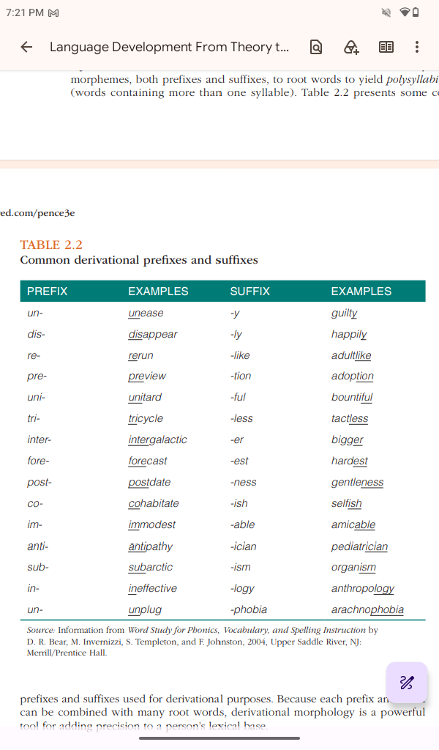
containing more than one syllable). Table 2.2 presents some
commoprefixes and suffixes used for derivational purposes. Because
each prefix and suffix
can be combined with many root words,
derivational morphology is a powerful
tool for adding precision
to a person’s lexical base. |
front 34 Influences on Morphological Development | back 34 Influences on Morphological Development
One of the seminal works
of child language research is Roger Brown’s (1973) book, A First
Language. In this key work, Brown carefully described children’s
development of 14 grammatical morphemes, showing how a core of
grammatical morphemes emerged in a uniform order among children (see
Research Paradigms:
Longitudinal Studies). These morphemes
appear in Table 2.1. Brown’s work had a tremendous influence on the
field of child language research, prompting many researchers to focus
on describing other such universalities in child language
development |
front 35 Since then, researchers have begun to appreciate the importance of
studying individual differences in language acquisition, and
identifying specific influences that do and do not affect the normal
course of language acquisition. For example, researchers have
questioned whether a child’s native language influences his or
her development of grammatical morphology. Contrary to what you
might expect, children learning languages that are richly inflected
(e.g., Spanish) do not acquire novel morphemes at faster rates than
those of children learning less richly inflected
languages
(e.g., English). | |
front 36 Second Language Acquisition
Persons learning a second language
that differs considerably in its grammatical morphology from their
native language may never master the grammatical morphology of the
second language (Bialystok & Miller, 1999; Jia, Aaronson, &
Wu,
2002). For instance, native Chinese speakers who learn
English as a second language find the plural marker difficult to
master because plurality is not inflected morphologically in the
Chinese language (Jia, 2003). This is particularly true when persons
learn a second language at an older age rather than at a younger age,
or
when a specific morpheme is not inflected in a person’s
native language. However, even for younger children, learning the
grammatical morphology of a second language can be challenging. Jia’s
(2003) longitudinal study of 10 Chinese-speaking
children during
a 5-year period focused on the acquisition of the plural -s, which is
not grammatically inflected in Chinese. Three of the 10 children, even
after 5 years’ immersion in English, never mastered the plural
morpheme, and those who did so were usually younger at their initial
immersion in English. The three children who did not master the plural
morpheme used it in fewer than 80% of obligatory con-
texts,
typically omitting the plural marker. | |
| back 37 Dialects are the variants of a single language. The dialects of a
language vary in a
number of important ways from the “general
dialect,” including their morphology. |
front 38 Even among speakers of a single language (e.g., English), achievement
of specific morphological building blocks can vary substantially as a
function of the morpho-
logical features of the dialect the
speakers are acquiring. In the United States, one dialect many
speakers share is African American English (AAE). Some morpho- logical
features of AAE differ from those of General American English (GAE),
including the use of copulative, or be, auxiliary verbs; verb tense
inflections; and possessive and plural inflections (Charity,
Scarborough, & Griffin, 2004). For in-
stance, a GAE speaker
may say, “Tom’s aunt,” whereas an AAE speaker may say, “Tom aunt,”
omitting the possessive marker. Some children learn only the AAE
dialect, whereas others learn the AAE dialect before, while, or after
learning the GAE dialect. AAE-speaking students who have more
knowledge of GAE tend to perform
better in reading development,
possibly because less of a mismatch occurs between the written form of
language they encounter in school (which uses GAE) and the
dialect they speak (Charity et al., 2004). | |
front 39 At least in part, the mismatch between AAE
and GAE involves
differences in morphology, particularly grammatical inflections.
Alternatively, it may also be that AAE-speaking students who have more
knowledge of GAE have a strong capability to code-switch; that is, to
switch between their two dialects (Connor & Craig, 2006; Craig,
Zhang, Hensel, & Quinn, 2009). Children
who can readily
switch between dialects may have a heightened meta-linguistic
awareness, which can support reading development. In this regard,
there may be benefits to helping children acquire the ability to
switch between dialects, with a focus on helping children understand
the value of their own dialect and the value
of learning the
dialect used in schooling. | |
front 40 Language Impairment
Language impairment affects morphological
development, often in significant ways. In fact, one hallmark of
specific language impairment (SLI), a developmental language disorder
we mentioned in Chapter 1 and discuss more thoroughly in Chapter 10,
is difficulty with grammatical morphology. For instance, whereas
typically developing children use the present progressive -ing with
more than 80% accuracy, children
with SLI use it with only 25%
accuracy (Conti-Ramsden & Jones, 1997). In general, children with
SLI seem to have very specific difficulties with verb tense markings,
such as the past tense inflection and the third-person singular
inflection (e.g., He
runs.). | |
front 41 What is Syntactic Development?
Syntactic development is
children’s internalization of the rules of language that govern how
words are organized into sentences. As Pinker (1994) stated in his
seminal work on language acquisition, The Language Instinct,
When a dog bites a man that is not news, but when a man bites a
dog that is news.
. . . The streams of words called “sentences”
. . . tell you who in fact did what to
whom. (p. 83) | |