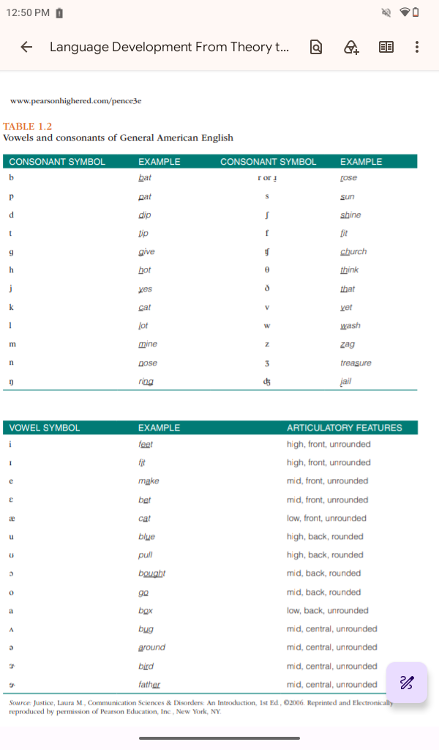
| back 1 refers to the rules of language governing the sounds that
make
syllables and words. Every language has a relatively small number of
meaningful
sounds, or phonemes.General American English (GAE;
also called Standard American English) has about 39 phonemes (give or
take a few, depending on the dialect), as shown in Table 1.2. GAE
relies on the combination of 15 vowels and 24 consonants to create
about 100,000 words. Some languages use more phonemes; others use fewer. |
| back 2 Allophones are the subtle variations of phonemes that occur as a
result of contextual influences on how phonemes are produced in
different words. For instance, the two /p/ phonemes in pop are
produced differently, given the position of each in the
word.
The initial /p/ is aspirated, meaning that it is produced with a small
puff of air. In contrast, the final /p/ is unaspirated. (The final /p/
can be aspirated but typically is not.) The two /p/ sounds in pop are
allophonic variations of a single phoneme,
and many phonemes
have several allophones. |
| back 3 In addition, each language has rules
governing how sounds are
organized in words, called phonotactics. For instance, in
English the phoneme /g/ never directly follows /s/ or /l/ at the
beginning of a syllable. |
| back 4 pertains to the rules of language governing the internal organization
of words. Previously, we defined morpheme as the smallest unit of
language that carries meaning; many words contain two or more
morphemes. We can “morph” (manipulate) words in a variety of ways to
change their meaning. For instance, we can add prefixes to words to
change their meaning—such as by adding
the morpheme pre- to
words to create preschool, predisposition, preview, and pretest. Also,
we can use suffixes to add grammatical information to words (i.e., to
indicate basic grammatical information such as tense or plurality) |
| back 5 include the plural -s
(cat–cats), the possessive ’s (mom–mom’s),
the past tense -ed (walk–walked), and the present progressive -ing
(do–doing), to name a few. Morphology is an important
linguistic
tool that not only allows us to add precision to language (e.g.,
“Tamika walk” vs. “Tamika had walked”), but also to expand vocabulary
exponentially using a relatively small core of words (base vocabulary)
and morphing them into a much
larger pool of word families
(e.g., school, schools, schooling, schooled, preschool). |
| back 6 Syntax (form) refers to the rules of language governing the internal
organization of sentences. Knowledge of the rules governing syntax
enables us to readily turn the simple statement He did it into the
question Did he do it?, and to embed
one simple sentence (e.g.,
Andre is angry) in another (e.g., Andre is not coming) to produce a
complex sentence (e.g., Andre, who is angry, is not coming). |
front 7 Syntax is what permits a child to produce a seemingly endless
sentence by linking a series of simple sentences: This is Thomas and
he is so mad at Lady and Lady goes off the siding and here comes Percy
and Thomas gets out of the way and Percy is coming so
fast. In
short, whereas semantics provides the meaning to utterances, syntax
provides the structure. Noam Chomsky’s well-known proposition that
Colorless green ideas sleep furiously illustrates the difference
between semantics and syntax, in which a
sentence is devoid of
meaning but conforms to sophisticated syntactic rules | |
| back 8 refers to the rules of language governing the meaning of individual
words and word combinations. When people produce a given word (e.g.,
cat) or phrase (black cat), they express a certain meaning. Semantics
thus involves consideration of the meaning of various words and
phrases. For instance, you know that a culprit is someone who has done
something wrong; the word run
has many meanings, whereas the word
stapler has only one meaning; the phrase bent over backwards has both
a figurative and a literal meaning; and the words pa-
paya,
banana, and kiwi go together conceptually |
front 9 If you ask a person to produce
the first word that comes to
mind when he or she hears the word “vehicle,” the semantic
relationship among words might provoke the person to respond “car”
(or, alternatively, “truck” or “tractor”). Knowledge of semantics
tells you something is
wrong with the sentence linguist, Noam
Chomsky produced, Colorless green ideas sleep furiously, and
differentiates the meaning the words express (semantics) from
the grammar that organizes them into a sentence (syntax)
(Pinker, 1994). | |
| back 10 pertains to the rules governing language use for social purposes, and
is a synonym for the term social communication. Pragmatics comprises
the set of rules that govern three important aspects of the social use
of
language: (a) using language for different functions or
intentions (communication
intentions); (b) organizing language
for discourse, including conversation; and (c)
knowing what to
say and when and how to say it (social conventions). In using
language for social purposes, pragmatic rules govern linguistic,
extralinguistic, and
paralinguistic aspects of communication,
such as word choice, turn taking, posture,
gestures, facial
expression, eye contact, proximity, pitch, loudness, and pauses. |
| back 11 Faced with the task of explaining how children develop their
remarkable language skills, scholars have often noted that the sheer
acquisition rate of language makes it difficult to study. For
instance, consider the following interaction between a mother and her
30-month-old daughter:
Tajika: Thomas the very useful engine is
in the siding.
Mother: He’s in the what?
Tajika: The siding.
This is the siding.
Mother: Oh, that’s the siding?
This
brief interaction shows the extraordinary capacity of young children
to learn and use new words at a stunning rate. Siding is a part of a
train track that runs off the main course. In this vignette, Tajika
has placed her miniature Thomas the Tank Engine on the siding. Her
mother did not know the meaning of siding, but
Tajika clearly did |
front 12 Erica Hoff, a scientist who studies early language development,
stated that language development reveals the genius in all children
(Hoff, 2013), whereas others have referred to infants and young
children as “scientists in cribs” (Gopnik, Melt- zoff, & Kuhl,
2009). The reference to children as geniuses and young scientists is
based on the fact that children acquire the complexities of language
at a seemingly
miraculous rate: Although at birth children
understand and use no words, withina year, they begin to understand
and use several words, and by about 24 months, they have a vocabulary
of several hundred words and can combine them into short sentences.
Whereas the 1-year-old can say only “mama” to request something to
drink, the 3-year-old can say, “Mom, Daddy said I could have
some chocolate milk and I think I’ll have it in the pink sippy cup. | |
front 13 The years of early language acquisition, from birth to about puberty,
are often called a critical period (or sometimes a sensitive period)
for language development | |
front 14 meaning that a window of opportunity exists during which language
develops most rapidly and with the greatest ease | |
front 15 A critical period for language development also im-
plies
periods of time in which the environment has particularly important
impacts on language growth.
One important study of the critical
period, as it applies to language development, involved research on
institutionalization of infants in Romania (Nelson et al.,
2007). Institutionalized care in Romania, at least until the
early 2000s, typically featured very limited stimulation of infants,
in part due to the very high child-to-care-
giver ratio in such
settings (Smyke et al., 2007) | |
front 16 The critical period in the human species for language development is
similar to the critical periods in other species for acquisition of
behaviors considered essential for survival. For instance, songbirds
show a critical period for song learning, although considerable
differences in the ways in which songbirds acquire songs occur among
the more than 4,000 songbird species (e.g., some songbirds
require early exposure to songs for song learning, whereas
others can develop song in isolation; Brenowitz & Beecher, 2005).
Because only one species of Homo sapiens exists, the critical period
of language development applies to all children
everywhere. | |
| back 17 Universality
Language is ubiquitous among the communities of the
world. Every human culture has one language, and sometimes many
languages, and all are equally com-
plex. The universality of
language, as Steven Pinker wrote in The Language Instinct
(1994), |
front 18 The universality concept, as applied to language, suggests all
persons around the world apply the same cognitive infrastructure to
the task of learning language, and that this cognitive infrastructure
is particularly suited to the task of developing sym-
bolic
representations for objects and actions (Christiansen & Kirby,
2003). Although world languages clearly vary in their syntactic
organization (e.g., some languages do not have auxiliary verbs,
whereas others do; see Tomasello, 2005), the cognitive
infrastructure is the same for all languages. Therefore, the way
in which children learn language, and the time points at which they
achieve certai | |
| back 19 Language is strictly a human capacity. No other animals share this
aptitude; thus, human language shows species specificity. Although
many nonhuman species can communicate, their communication abilities
tend to be relatively iconic, such that there is a transparent
relationship between what is being communicated and how
it is
being communicated. One study of the communication skills of domestic
dogs (Border Collies, for those interested in the details) revealed
they were able to fetch an object when shown a miniature version of
the object (Kaminksi, Tempelman, Call, & Tomasello, 2009). (They
did less well when asked to fetch objects shown
in a
photograph.) The study found domestic dogs could comprehend human
communication that featured iconic signs. Although this is an
interesting feat, it pales in comparison to what even very young
children can do, as little is iconic about human language. For
instance, a 2-year-old would have little difficulty comprehending
the phrase “Mommy will be home soon” even though it is not
iconic at all |
front 20 Animal communication systems differ in another important way from
human communication systems, specific to its hierarchical properties.
Human language provides a syntactic framework that permits the
combination of ideas into larger hierarchical propositions; in fact,
humans can produce an endless array of novel constructions with the
tool of syntax. Although animals can learn sequences of complex
actions, the hierarchical complexity of human lan-
guage far
exceeds the capabilities of even the most sophisticated of nonhuman
primates (Conway & Christiansen, 2001). No other animal has a
communication system that provides the means for combining symbols in
the way syntax al-
lows humans to use language. | |
| back 21 Semanticity Human language allows people to represent events that are
decontextualized, or removed from the present—to share what happened
before this moment or what may happen after this moment. This concept
is called semanticity or, alternatively,
displacement. As
mentioned previously, human language has no time or space boundaries
because the relationship between a referent and the language used to
describe it is completely arbitrary. For instance, the word cup has no
relationship to that to which it refers; the relationship is
completely arbitrary. As such, a person can say the word cup without
having a cup present, and other people will know to
what the
person is referring. Semanticity (or displacement) is the aspect of
language that allows people to represent the world to others, a
remarkable capacity shared
by no other species. |
| back 22 Productivity describes the principle of combination—specifically, the
combination of a small number of discrete units into seemingly
infinite novel creations. Productivity is a phenomenon that applies to
other human activities—such as mathematics and music—as well as to
language. With a relatively small set of rules governing language,
humans can produce an endless number of ideas and
new
constructions. For instance, humans use only a small set of sounds
(speakers of GAE use about 39) and can combine these small
units—according to a set of rules they know intuitively (e.g., /g/
cannot follow /l/ in English at the begin- ning of a syllable)—into an
infinite number of words. Likewise, humans use a relatively small
number of words and with them, can create an infinite variety of
new sentences, most of which no one has ever heard. Because of
the remarkable principle of productivity, you could, right now,
produce a sentence that no other person has ever uttered. |
front 23 The principle of productivity is inherent in language in its earliest
stages of acquisition: Children who are 18 months old and have about
50 words in their vocabulary can combine and recombine this small set
of words to produce sentences that neither they nor others have ever
heard. This feature of language is unique to humans because the units
of nonhuman communication systems cannot be recombined to make new
meanings. For instance, night monkeys have 16 communication units.
These units cannot be recombined to make more than 16 possible ways to
communicate because the principle of productivity does not apply | |
front 24 What are Language Differences
and Language Disorders? | back 24 For most children, language development follows a fairly invariant
path. Children around the world typically begin to communicate using
words around the same time (12 months), and they often begin to
combine words to form two-word com- binations (e.g., daddy shoe, mommy
go) by around 18 months. From that point,
they accrue thousands
of words in their productive vocabulary by age 5 years and achieve an
adultlike grammar well before puberty |
front 25 However, although this gen- eral developmental trajectory
characterizes most children, it does not describe them
all. In
fact, a comparison of any two children of about the same age will
reveal considerable differences in the form, content, and use of their
language. Such differences relate to the language being learned,
gender and temperament, and the language-learning environment. In
addition, some children show mild to severe disorders in language
acquisition as a result of innate genetic predispositions,
developmental disability, or injury or illness. In Chapter 10, we
provide a more in-depth examination of these topics. | |
| back 26 Language difference is a general term that describes the variability
among language users. Two children of exactly the same age will likely
show a range of differences if their language abilities are compared.
For example, they may differ in the number of words they understand,
the length of their sentences, the types of words they use, and the
way they share language with other people during conversation.
Sometimes the differences between two individuals are subtle.
However, in other instances the differences may be more
significant and may even compromise communication. For instance,
consider the following descriptions of young children
in the
United States:
• Lamika, a 5-year-old girl, speaks a dialect of
African American English. She attends a child care center in which
all the other children and her teachers speak GAE.
• Angela, a
3-year-old child with hearing loss, communicates by using Signed
Exact English. She attends a special preschool for children with
hearing loss, and most of her peers sign with American Sign
Language.
• Jack, a 2-year-old child, is learning Spanish and
English simultaneously. His family speaks both languages at home. In
his preschool, which includes mostly monolingual Spanish-speaking
children, he speaks primarily Spanish but some times uses the grammar
of English.
• Mimi, a 3-year-old child adopted from China at age
18 months, uses fewer vocabulary words and produces shorter sentences
than other children in her child care center.
These examples reveal how children (as well as adults) who live
in culturally and linguistically diverse communities show variability
in their language. |
| back 27 are the natural variations of a language that evolve within specific
cultural or geographic boundaries. These variations affect form,
content, and use.
In the United States, common dialects
include Appalachian
English, African American English, and Spanish-Influenced English.
Each of these dialects may show subtle to more significant variations
in form, content, and use from those of the GAE dialect. This finding
is also true of the dialects of English spoken around the world,
including those of Great Britain,
Australia, and New Zealand
Every language includes a range of dialectal variations, and the
number of dialects for a given language increases when users of a
language are spread across a large geographic region, when significant
geographic barriers isolate one community from other communities, or
when social barriers are present within a language community. Language
Diversity and Differences: African American English provides an
in-depth look at the African American English dialect. We provide a
more thorough discussion of language diversity and differences,
including dialects |
| back 28 Bilingualism
Although many children in the United States learn a
single language (monolin- gualism), others acquire two or more
languages (bilingualism). Hawaii is the only officially bilingual
state (English and Hawaiian), although a number of states are
unofficially bilingual, providing services in multiple
languages. This is particularly the case in cities, like the
international hub of Miami, Florida, in which the population is very
culturally and linguistically diverse. With such diversity increasing
across the United States, it is not surprising that today, about
one-fifth of Americans
speak a language other than English at home |
front 29 Bilingualism is the norm in many countries, such as Belgium, where
many citizens speak both French and Dutch. (There are in fact three
official languages in Belgium, as some persons also speak German.)
Canada is officially bilingual (English and French), and the
constitution requires that services be available in both languages.
India has a staggering 23 official languages, and most persons are
trilingual, speaking Hindi, English, and the language of their
community. Children who are raised bilingually often show language
differences not seen in children who are raised monolingually, such as
interchanges between the syntax and the vocabulary of the two
languages they are learning. This phenomenon is called
code
switching (Muñoz, Gillam, Peña, & Gulley-Faehnle, 2003). For
instance, a child who is bilingual in Spanish and English may produce
a sentence in Spanish that includes an English phrase or an English
sentence that reflects Spanish syntax. | |
front 30 Children who learn multiple languages can do so simultaneously or
sequentially. With simultaneous bilingualism, children acquire their
two languages concurrently. With sequential bilingualism, children
develop one language initially, then acquire a second language later.
Sequential bilingualism is relatively common for Hispanic children in
the United States who learn Spanish at home but then develop English
in preschool or elementary school. The English skills of a sequential | |
front 31 With simultaneous bilingualism, | back 31 children acquire their two languages concurrently |
| back 32 , children develop one language initially, then acquire a second
language later.
Sequential bilingualism is relatively common for
Hispanic
children in the United States who learn Spanish at home but then
develop English in preschool or elementary school. Spanish–English
child who is bilingual in the early stages of development will differ
from those of a child who learned both Spanish and English from birth,
and both children may show some differences in language form, content,
and use from those of monolingual English-speaking children. |
front 33 Although the language a child learns has clear influences on his or
her language development—for instance, the stories Chinese-speaking
children produce differ in their organizational structure from those
of English-speaking children (Wang & Leichtman, 2000)—all
languages are approximately equal in complexity. In other words,
although some differences can be seen among children as a function of
the
language (or languages) they are learning, all languages use
the same infrastructure of the human brain and thus are similar in complexity | |
front 34 The English language has many dialects. The term
dialect refers
to natural variations in form, content,
and use within a single
language. In the United
States, African American English (AAE)
is a prominent
dialect used not only by some African American
indi-
viduals, but also by persons of various other
ethnici-
ties and races. An individual’s use of AAE is typically
influenced by the amount of contact that person has
with
AAE-speaking peers rather than by his or her eth-
nic or racial
heritage, a point that holds true for any
English dialect | |
front 35 Like all other English dialects, AAE is a system-
atic,
rule-governed system with its own rules and
conventions that
influence form, content, and use. In
every way, AAE is
equivalent in its complexity to any
other English dialect
(Goldstein & Iglesias, 2013). This point is important because some
scholars in the past
suggested that AAE is an “impoverished”
version of
English, a perspective that shows a clear lack of
un-
derstanding of dialectal variations, including the fact
that all languages (and their dialects) are equivalent
in
complexity. Still, in many language communities
around the
world, people value and assign greater
prestige to some dialects
than others. | |
front 36 In the United States, some experts contend that
speakers of AAE
face risks in educational achieve-
ment because their dialect
differs from the one used
most commonly in schools, sometimes
called School
English (SE; Charity et al., 2004). One reason for
this
risk may be a mismatch between the AAE speaker’s
representation of linguistic features and the features
prominent in the dialect of his or her teachers, which
often (but not always) is GAE (Charity et al., 2004).
Another possibility is that some teachers, particu-
larly
those who speak the GAE dialect, may have a
negative bias toward
pupils who speak AAE, hold-
ing lower expectations and providing
less effective
instruction to these pupils. However, because
some
research shows that the level of familiarity with SE
among pupils who speak AAE is associated positively
with
their reading achievement (Charity et al., 2004),
practitioners
must improve their understanding of how
dialectal variations
both aid and inhibit children’s suc-
cess in school. | |
front 37 Gender
language impairment; | back 37 One relatively well-known fact is that girls have an advantage over
boys in lan- guage development. Girls usually begin talking earlier
than boys do (Karmiloff & Karmiloff-Smith, 2001) and develop their
vocabulary at a faster rate than boys do in the early years of life
(Rowe, Raudenbush, & Goldin-Meadow, 2012). Also,
boys are
more likely to have significant difficulties with language
development, or language impairment; in fact, prevalence estimates
show a ratio of about 2 or 3 boys to 1 girl (Dale, Price, Bishop,
& Plomin, 2003; Spinath, Price, Dale, & Plomin,
2004).
Despite these apparent differences between the genders, Kovas and
colleagues (2005) pointed out that gender differences in language
development are relatively minor, particularly as children move beyond
toddlerhood into the
preschool years
Why such gender differences in language development occur is
unclear. Experts point to the possibility of both biological and
environmental influences (Kovas et al., 2005). For example, parents
may talk more often to girls than to boys, which would help speed
language development. Alternatively, hormonal factors may contribute
to these differences |
front 38 Genetic Predisposition
Any preschool teacher is well aware that
young children of about the same age show incredible variability in
their language development. Some of this variability relates to
genetic predisposition. As a complex human trait, language ability is
unlikely to reside on a single gene. However, evidence points to the
influence of different alleles from a set of genes on all aspects of
language development, in-
cluding syntax, vocabulary, and phonology | |
front 39 Language-Learning Environment
The language-learning environment
in which children are reared exerts considerable influence on their
language development. Although children bring biologically endowed
abilities and propensities to the language-learning task, the neural
archi-
tecture that supports language acquisition is an “open
genetic program” (Cartwright,
2000, p. 195) | |
| back 40 This term means the neural architecture is calibrated on the basis
of input from the environment, or the “actual evidence” children
receive from the environment, concerning the form, content, and use of
the language or languages to which they are exposed (Cartwright,
2000). In short, everything the child experiences in his or her
environment will help calibrate his or her language-learning
apparatus |
front 41 Both genetic and environmental influences play signif-
icant
roles in language development. However, iden-
tifying the exact
contributions of genetic influences
relative to environmental
influences can be difficult.
One way to estimate the unique
influences of genetics
versus environment is twin studies, or
the twin method
(Kovas et al., 2005). When monozygotic (MZ) or
dizy-
gotic (DZ) twins grow up in the same household, they
are assumed to share 100% of their environmental
influences, both prenatally (in the womb) and post-
natally
(in the home environment; Kovas et al., 2005).
Researchers
interested in estimating the influence of
genetic versus
environmental influences on language
development collect
measures of language from sets
of twins, often repeatedly across
time. These research-
ers use a number of sophisticated
statistical tech-
niques to determine the genetic heritability of
certain
language skills by comparing MZ and DZ twins. They
also can isolate environmental influences on language
by
carefully controlling the amount of variability in lan-
guage
skill that can be attributed to genetic influences.
One of the
largest twin studies to date is the
Twins Early Development
Study (TEDS), conducted | |
front 42 The environmental aspects that seem to figure most prominently in the
young child’s language development are the quantity and quality of
language experienced.
Quantity refers to the sheer amount of
language a child experiences. Quality refers to the characteristics of
the language spoken in the child’s caregiving environment: the types
of words (e.g., nouns, verbs, adverbs), the construction of sentences
(e.g., simple, complex, compound), the intention of sentences (e.g.,
directives, declara-
tives, interrogatives), and the organization
and specificity of stories (e.g., emotional
expression,
situational details). | |
| back 43 refers to the sheer amount of language a child experiences. |
| back 44 refers to the characteristics of the language spoken in the child’s
caregiving environment:
the types of words (e.g., nouns, verbs,
adverbs), the construction of sentences (e.g.,
simple, complex,
compound), the intention of sentences (e.g., directives,
declara-
tives, interrogatives), and the organization and
specificity of stories (e.g., emotional
expression, situational details). |
front 45 How often toddlers and preschoolers participate
in
conversations with their caregivers is significantly associated with
language growth in the first few years of life, indicating that sheer
volume of talk is important (Zimmerman et al., 2009). However,
children who are exposed to an array of com- plex sentence forms
(e.g., sentences with subordinate clauses, such as That boy who
hit me is not my friend), in addition to simple sentence forms,
(e.g., That boy is not my friend) will use more complex sentence forms
than those used by children not exposed to such syntax (Huttenlocher,
Vasilyeva, Cymerman, & Levine, 2002). In
short,
characteristics of the language to which children are exposed in their
prominent caregiving environments (home, preschool, etc.) contribute
to the variability in
children’s language development. | |
| back 46 Studies of infants reared in mainstream United States communities
have revealed one particularly important aspect of the
language-learning environment: caregiver responsiveness.
This term refers to the promptness, contingency, and
ap-
propriateness of caregiver responses to children’s bids for
communication throughwords or other means (Tamis-LeMonda, Bornstein,
& Baumwell, 2001). Experts
contend responsiveness provides a
significant aid to children’s language development because it reflects
the child’s current topic of interest, and provides sensitive
input that promotes semantic and syntactic learning |
front 47 Higher degrees of caregiver
responsiveness during infancy and
early toddlerhood are associated with accel- erated rates of language
development in children. For instance, the results of one
study
revealed children of highly responsive mothers achieved the 50-word
mile- stone, on average, at age 15 months, whereas children of less
responsive mothers were more likely to achieve this milestone at about
age 21 months (Tamis-LeMonda
et al., 2001) | |
front 48 The contribution of caregivers’ responsive and sensitive language
input to children’s language development indicates quality of language
input is just as important as quantity. See Theory to Practice:
Children Who Are Linguistically Reticent
in the Classroom for a
description of how the relation between temperament and language has
influenced practice in the area of promoting linguistic interactions
with children who are reticent. | |
front 49 Language Disorders
Like any complex human trait, the ability to
develop language in a timely and effortless manner can be adversely
influenced by heritable weaknesses in the language mechanism, as well
as by the presence of certain developmental disabilities and brain
injuries. Children with language impairment show significant
difficulties in the development of language, typically achieving
language milestones more slowly than other children, and exhibiting
long-standing difficulties
with various aspects of language
form, content, and use. Next, we provide abrief overview of childhood
language impairment, a topic we address in more
detail in
Chapter 10 | |
front 50 Heritable Language Impairment | back 50 Heritable Language Impairment
Children with a heritable language
impairment exhibit depressed language abilities, typically with no
other concomitant impairment of intellect. Because of its specificity
to the functioning of language, this condition is often called
specific
language impairment (SLI), and it affects about 7%–10%
of children (Beitchman
et al., 1989; Tomblin et al., 1997). |
front 51 SLI is the most common type of communication
impairment
affecting children. It is the most frequent reason for administering
early intervention and special education services to toddlers through
fourth graders. Evidence suggests SLI is a heritable condition, as
indicated by both twin studies and family pedigree studies (Lai,
Fisher, Hurst, Vargha-Khadem, & Monaco, 2001;
Spinath et
al., 2004). The results of twin studies reveal a strong likelihood for
an MZ twin to have SLI if his or her twin is affected. Family pedigree
studies show a strong likelihood for a child to have SLI if a parent
is affected. | |
| back 52 Language impairment often co-occurs with certain developmental
disabilities. In such cases, language impairment is considered a
secondary disorder because it results secondary to a primary cause.
Common causes of a secondary language impairment include intellectual
disability and autism spectrum disorder. Intellectual disability is a
“condition of arrested or incomplete development of the mind, which is
especially characterized by impairment of skills manifested during the
developmental period”
(American Association on Mental
Retardation [AAMR], 2002, p. 103) |
front 53 For intellectual
disability to be diagnosed, an individual must
also exhibit limitations in adaptive behavior, and the activities of
daily living, such as difficulties with conceptual skills
(communication, functional academics, self-direction, health and
safety), social skills
(social relationships, leisure), or
practical skills (self-care, home living, community participation,
work; AAMR, 2002). One cause of intellectual disability is Down
syndrome, which is due to a chromosomal anomaly during the initial
stages of fetal
development. Whether intellectual disability
occurs because of Down syndrome or other causes, it is often
accompanied by significant language impairment. | |
front 54 autism spectrum dis-
order | back 54 Another type of secondary language impairment is autism spectrum
disorder (ASD). ASD is an umbrella term describing a variety of
developmental conditions characterized by significant difficulties in
social relationships and communication with others, and restricted and
repetitive behaviors. These difficulties are apparent within early
childhood, but may become more apparent over time, as the demands to
engage in complex communication with others increase
(American
Psychiatric Association, 2013). The number of children affected by ASD
has increased over the last several decades, with current estimates
indicating that about 1 in 68 children have ASD (Centers for Disease
Control and Prevention, 2014). Children with autism spectrum disorder
usually exhibit mild to
profound secondary language impairment,
and some children with this dis- ability never develop productive use
of language. |
front 55 The frequency with which children use language as
a tool to
communicate with other people varies sub-
stantially among
individual children. To some extent,
frequency relates to a
child’s facility with his or her
language, but it also relates
to temperament. | |
front 56 Tem- perament describes an individual’s “innate way of
ap-
proaching and experiencing the world” (Kristal, 2005,
p. 5), and it is a theoretical construct of human
be-
havior that helps researchers understand why some
children are bold and energetic, others are sensitive
and
timid, and some are inflexible (Kristal, 2005).
Given that
language development requires a child to
experience input from
the environment to “calibrate”
his or her language-learning
mechanisms, a reason-
able conclusion is that a child’s
temperament might
influence the amount of language input he or
she
experiences. For instance, a child who is bold may
solicit more language from parents and teachers,
whereas
the child who is reticent and shy may solicit
less language. | |
front 57 Theoretical perspectives on the potential inter-
action of
language development and temperament
suggest that an interaction
occurs between these
two constructs or that they influence one
another.
The results of studies on the possible interaction of
language and temperament provide support for this
theory.
For example, Evans (1996) found that 18 kin-
dergartners
characterized by teachers as very ret-
icent (e.g., rarely asking
for assistance when it was
needed, seldom participating in class
discussions)
performed more poorly than their more talkative
peers on a variety of language ability measures in
first
grade. What remains unclear is whether some
children are less
talkative because they have less de-
veloped language skills, or
whether children with less
developed language skills are less talkative | |
front 58 developed language skills are less talkative.
Theory and
research on the possibility of a
temperament–language
interaction have import-
ant implications for instruction in the
preschool and
kindergarten classroom, in which several important
goals include fostering children’s language skills,
promoting socialization among children, and promot-
ing
children’s ability to use language for a variety of
purposes.
Teachers may have difficulty helping chil-
dren who are verbally
reticent achieve these goals. | |
front 59 Teachers may have difficulty helping chil-
dren who are verbally
reticent achieve these goals.
One approach that has been tested
for increasing
children’s language use and complexity in the
pre-
school classroom is training teachers to use
inter-
action-promoting responses (Cabell et al., 2011).
Examples of interaction-promoting responses include
(a)
using a variety of questions, (b) inviting children
to take
turns, and (c) scanning the classroom and
inviting uninvolved
children to participate. Evidence
shows that when teachers use
these and other lan-
guage-promoting techniques in the preschool
class-
room, the children talk more and use more complex
vocabulary and grammar. Although the effects of
these
techniques have not been determined spe-
cifically for children
who are verbally reticent, they
provide a promising way to
translate theory and re-
search on the temperament–language
interaction to
inform practice. | |
front 60 A condition related to ASD is
social communication disorder (SCD) | back 60 A condition related to ASD is social communication disorder (SCD),
also called pragmatic communication disor-
der (American
Psychiatric Association, 2013). Individuals with SCD have particular
difficulty in the use of social communication, such as following the
rules of con- versation (e.g., taking turns, using eye contact) and
comprehending more complex
and abstract language (e.g.,
understanding a joke or idiom). SCD is distinctive from ASD in that
individuals typically have higher levels of language skill and do not
show the restrictive and repetitive behaviors characteristic of ASD.
Historically, persons with SCD may have been referred to as having
“high-functioning ASD,” but in
more recent years, it is
recognized that SCD is best conceptualized as a particular type of
disability that is distinct from that of autism. |
| back 61 Brain Injury
Language impairment can also occur as a function of
damage or injury to the mechanisms of the brain involved with language
functions. Brain injuries can occur in utero (before birth) and
perinatally (during the birthing process), but
they can also
occur after birth; these injuries are called acquired brain injurie |
front 62 Acquired brain injuries are a leading cause of death and disability
among young children. Brain damage resulting from physical trauma,
particularly blunt trauma to the head, is referred to as traumatic
brain injury (TBI). | |
front 63 Even though it is popularly believed that the brain of the young
child can readily heal following brain injury (because of plasticity),
this does not seem to be the case (Catroppa & Anderson, 2009). One
possible reason for this misperception is that some young children may
have delayed onset of impairment; problems sus-
tained during a
brain injury may not be evident until years later, when damaged areas
of the brain are applied to complex skills and activities. | |