Instructions for Side by Side Printing
- Print the notecards
- Fold each page in half along the solid vertical line
- Cut out the notecards by cutting along each horizontal dotted line
- Optional: Glue, tape or staple the ends of each notecard together
SWM 1, 2, 3 QUIZZES
front 1 What is the average pH of the acid mantle of an adult’s skin? 5.5 0 to 4.5 7.1 to 14 7.0 | back 1 5.5 * For adults, the average pH of skin hovers around 5.5. |
front 2 Which type of cells are the FIRST line of defense against environmental antigens? Desmosomes Merkel Cells Langerhans Cells Macrophages | back 2 Langerhans Cells * Langerhans cells are the first line of defense against environmental antigens. |
front 3 What is the process that occurs to dissipate heat by bringing warm blood closer to the surface of the skin? Vasodilation Sweating Vasoconstriction Pilomotor Reflex | back 3 Vasodilation * Vasodilation occurs when the blood vessels widen to allow more blood to flow to the skin's surface to dissipate heat. |
front 4 Which layer of the epidermis is responsible for producing new cells through mitosis? Stratum Lucidum Stratum Spinosum Stratum Germinativum Stratum Granulosum | back 4 Stratum Germinativum * Is the deepest layer of the epidermis and is responsible for producing new cells through mitosis. |
front 5 What is the extracellular matrix in the dermis made of? Sugars, protein, collagen, and elastin Blood vessels, lymphatics, and epithelial cells Fibroblasts, macrophages, and mast cells Connective tissue, adipose, and nerves | back 5 Sugars, protein, collagen, and elastin * The extracellular matrix is made of sugars, protein, collagen, and elastin. |
front 6 Which choice BEST describes the function of tendons? Attaches bone to bone Connects muscle to bone Provides a surface for bones to glide over Surround muscles to reduce friction | back 6 Connects muscle to bone * Tendons are fibrous connective tissues that have the specific function of connecting muscles to bones. |
front 7 What BEST describes the characteristics of healthy skeletal muscle? White and shiny in appearance Pearly white ribbon-like appearance Pink to dark red in color with striation Pale pink without striation | back 7 Pink to dark red in color with striation * When healthy healthy skeletal muscle is characterized by a pink to dark red color and is firm with striation. |
front 8 What is the primary composition of fascia? Adipose tissue Collagen Keratin Muscle tissue | back 8 Collagen * Fascia is a sheath of connective tissue that is primarily composed of collagen. |
front 9 Which component of blood is PRIMARILY involved in forming the INITIAL phase of a blood clot? Red blood cells White blood cells Platelets Eosinophils | back 9 Platelets * Platelets are crucial in the initial phase of blood clotting, as they create a platelet plug at the site of injury. |
front 10 What role does melanin play in protecting the skin from ultraviolet radiation? Creates a physical barrier by scattering and absorbing UV rays Increases transepidermal water loss to cool the skin Creates a protective film called the acid mantle Stimulates sweating to enhance evaporation and subsequent cooling | back 10 Creates a physical barrier by scattering and absorbing UV rays *Melanin protects against ultraviolet radiation by scattering and absorbing UV rays, creating a barrier that decreases the amount of UV penetration. |
front 11 What type of wound closure is described as allowing the wound to heal without approximating the edges? Primary intention Secondary intention Tertiary intention Quaternary intention | back 11 Secondary intention * Secondary intention healing allows the wound to fill in with granulation tissue naturally when edges cannot be approximated. |
front 12 What phase of wound healing does re-epithelialization occur in? Proliferative Hemostasis Maturation Inflammatory | back 12 Proliferative * Epithelial cells migrate across the wound bed, covering the wound during the proliferative phase. |
front 13 What is the primary purpose of the hemostasis phase during the wound-healing process? To promote rapid re-epithelialization of the wound surface To initiate a clotting cascade and form a plug to stop bleeding To increase the tensile strength through collagen synthesis To bring the edges of the wound together using mechanical means | back 13 To initiate a clotting cascade and form a plug to stop bleeding * Hemostasis phase is characterized by forming a clotting cascade, leading to a stable hemostatic plug to stop bleeding. This is crucial for preventing further blood loss and stabilizing the wound. |
front 14 Which phase of wound healing is primarily responsible for the cleanup of debris and bacteria from the wound? Proliferative Maturation Inflammatory Remodeling | back 14 Inflammatory * The inflammatory phase specifically targets removing bacteria and debris, preparing the wound for healing by facilitating a clean environment. |
front 15 Which characteristic is typical of chronic wounds? They heal in an orderly manner. They usually heal in 30 days. They typically heal by secondary intention. They seldom involve prolonged inflammation. | back 15 They typically heal by secondary intention. * Secondary Intention- a medical term for a wound that is left open and allowed to heal naturally from the bottom up, rather than being stitched or stapled shut. Chronic wounds usually heal by secondary intention. |
front 16 Which INTRINSIC factor is known to impact wound healing significantly? Smoking Alcohol use Environment Advanced age | back 16 Advanced age * Advanced age is an intrinsic factor that can impact wound healing. |
front 17 What disease hinders oxygen delivery to tissues due to blockages caused by crescent-shaped red blood cells? Diabetes mellitus Lupus Erythematous Cardiovascular disease Sickle-cell anemia | back 17 Sickle-cell anemia * Sickle-cell anemia hinders oxygen delivery to tissues due to blockages caused by crescent-shaped RBCs. |
front 18 What percentage of the uninjured skin does final matured scar tissue possess? 50% 60% 80% 100% | back 18 80% * Scar tissue eventually achieves 80% of the tensile strength of the original uninjured skin. |
front 19 How does the use of corticosteroids affect wound healing? Prolongs the inflammatory phase Effectively treats biofilm Reduces collagen synthesis Increases collagen synthesis | back 19 Reduces collagen synthesis * Corticosteroids can reduce collagen synthesis, which is critical for the strength of new tissue. |
front 20 How do matrix metalloproteinases (MMPs) affect chronic wounds? They enhance collagen synthesis. They degrade essential proteins and ECM. They stimulate rapid epithelialization. They reduce inflammation. | back 20 They degrade essential proteins and ECM. Matrix Metalloproteinases (MMPs) are: Are a large family of calcium-dependent, zinc-containing enzymes (endopeptidases). Their primary function is to break down and remodel proteins in the extracellular matrix (ECM), which is the structural network supporting cells in tissues |
front 21 What is a primary benefit of using standardized clinical assessment tools in wound management? They provide a personalized approach to wound care. They ensure consistency and accuracy in assessments. They reduce the need for documentation. They eliminate the need for clinical judgment. | back 21 They ensure consistency and accuracy in assessments. * Standardized tools ensure that wound assessments are consistent and accurate, which helps track progress and compare outcomes. |
front 22 What are some of the key factors assessed by the Malnutrition Screening Tool (MST)? Level of physical activity Amount of sleep Unintentional weight loss Skin integrity | back 22 Unintentional weight loss * The MST includes questions about unintentional weight loss to help identify patients at risk for malnutrition. |
front 23 What does the acronym SMART stand for? Simple, Manageable, Attainable, Relevant, Time-based Specific, Measurable, Attainable, Relevant, Time-based Specific, Manageable, Attainable, Realistic, Time-sensitive Simple, Measurable, Appropriate, Realistic, Timely | back 23 Specific, Manageable, Attainable, Realistic, Time-sensitive * SMART stands for: Specific, Measurable, Attainable, Relevant, Time-based |
front 24 Which laboratory test is commonly used to assess protein status and is a good indicator of nutrition over the past few days? Serum Albumin Hemoglobin A1C Prealbumin Blood Urea Nitrogen (BUN) | back 24 Prealbumin * Prealbumin has a short half-life of 2 to 3 days, making it a good indicator of recent protein intake and nutritional status over the past few days. |
front 25 What percentage of weight loss over six months is considered significant and warrants further evaluation by a dietitian? 2% 5% 10% 7.5% | back 25 7.5% * Now, a 10% weight loss over six months is considered significant and may indicate malnutrition or other underlying health issues, warranting further evaluation. |
front 26 Which team model integrates knowledge and methods from various disciplines, maintaining discipline-specific roles but collaborating closely and sharing information? Multidisciplinary Interdisciplinary Transdisciplinary Unidisciplinary | back 26 Multidisciplinary * Multidisciplinary teams work independently but coordinate their efforts. Interdisciplinary teams integrate knowledge and methods from various |
front 27 Meaning of Interdisciplinary collaboraton | back 27 A workflow that synthesizes and weaves different fields together to create a cohesive, unified approach |
front 28 Multidisciplinary team approach | back 28 A workflow that has experts working independently in parallel, keeping their disciplinary boundaries. |
front 29 If a clinician notices a low prealbumin level, which test result should they check to determine if this reading is altered by inflammation? C-Reactive Protein (CRP) Serum Albumin Blood Glucose Blood Urea Nitrogen (BUN) | back 29 C-Reactive Protein (CRP) * CRP levels indicate the presence of inflammation, which can affect prealbumin readings, differentiating between nutritional deficiencies and inflammatory responses. |
front 30 Which body mass index indicates that a patient is underweight? 17.5 18.5 20.4 25.9 | back 30 17.5 * A body mass index that is below 18.5 is considered underweight. |
front 31 What is the primary characteristic of a vesicle? Solid elevated lesion greater than 1 cm Circular, fluid-filled lesion up to 1 cm Flat, discolored spot less than 1 cm Large, thickened area greater than 1 cm | back 31 Circular, fluid-filled lesion up to 1 cm * A vesicle is characterized as a small, fluid-filled lesion up to 1 cm in diameter. |
front 32 What type of lesion is a solid, elevated area greater than 1 cm diameter and can extend below the skin’s surface? Papule Macule Vesicle Nodule | back 32 Nodule A nodule is a solid, elevated lesion greater than 1 cm in diameter and can extend into deeper layers of the skin. |
front 33 A clinician performs a skin assessment and observes white, star-shaped scars on a patient's inner ankle. Based on these findings, what condition might the clinician suspect? Telangiectasia Lichenification Atrophie blanche Ecchymosis | back 33 Atrophie blanche * Atrophie blanche is characterized by white, star-shaped scars that commonly appear on the lower legs, ankles, or feet, often associated with poor blood supply and delayed healing. |
front 34 what is Telangiectasia? | back 34 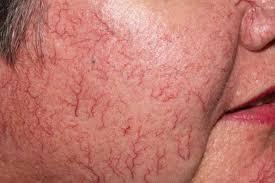 Refers to the permanent widening of tiny blood vessels (capillaries, arterioles, or venules) near the surface of the skin or mucous membranes. It appears as fine red, blue, or purple lines or branch-like patterns, often commonly referred to as "spider veins" Seen on face- cheeks, nose etc. |
front 35 What is Lichenification? | back 35 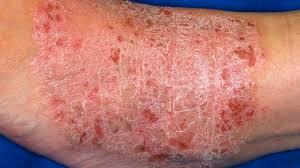 A skin condition characterized by thick, leathery, and hardened skin with deep, exaggerated wrinkles or skin lines. It is the skin's protective response to chronic, long-term scratching or rubbing, which creates a frustrating itch-scratch cycle |
front 36 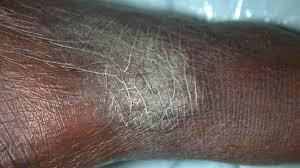 What condition is this? Ecchymosis Telangiectasia Lichenification | back 36 Lichenification |
front 37 Definitions
| back 37 The term purpura is used to describe violaceous non-blanching hemorrhagic lesions larger than 2 mm (if smaller, it is called "petechiae". That can be flat or raised so they can be macules, papules, patches, or plaques. The term "palpable purpura" is used in association with indicate small vessel vasculitis. |
front 38 What is ecchymosis? | back 38 The medical term for a common bruise. It occurs when small blood vessels break and leak blood into the tissues just beneath the skin or mucous membranes, creating a flat, dark purple, blue, or red patch that is larger than 1 cm in diameter. |
front 39 What is hematoma | back 39 A raised bruise...localized collection of clotted or pooled blood that gathers outside of a blood vessel. Often caused by trauma or injury, they can range from harmless, superficial bruises to serious, life-threatening conditions depending on their size and location in the body |
front 40 A clinician performs a skin assessment and presses on a red area of the patient's skin to check for blanching. What should the clinician expect to see if the area is blanchable? The area remains red without any change. The area turns white temporarily and then returns to red. The area turns blue and stays blue. The area becomes more swollen. | back 40 The area turns white temporarily and then returns to red. * Turning blue suggests cyanosis. If the area is blanchable, it will turn white (blanch) when pressure is applied and then return to red once the pressure is released, indicating good blood flow. |