Instructions for Side by Side Printing
- Print the notecards
- Fold each page in half along the solid vertical line
- Cut out the notecards by cutting along each horizontal dotted line
- Optional: Glue, tape or staple the ends of each notecard together
B Exam: Sedimentations
front 1 How many zones are there in a sedimentation tank? | back 1 4 |
front 2 Which is the largest zone in a sedimentation tank? | back 2 Settling Zone |
front 3 In a conventional sedimentation tank, how long is the detention time? | back 3 2-6 hours |
front 4 What is short-circuiting? | back 4 When water takes a direct path from the influent to the effluent without fully mixing with the contents of the tank. |
front 5 What do you call the 4 zones in a sedimentation tank? | back 5 Inlet, Settling, Sedimentation or Sludge, and Outlet |
front 6 What affects the settling process? | back 6 Temperature and Turbidity |
front 7 What are the advantages of a solid contact unit? | back 7 Save on land use, all processes take place in one tank, save on chemicals, ability to adjust the slurry, especially to deal with algal problems, capital and maintenance costs are reduced. |
front 8 For the volume over volume test, a ______ sample is taken from the ______ zone, and allowed to settle for ______ minutes? | back 8 Ans. 100 mL, reaction zone, and 5 minutes |
front 9 What advice can you give to an operator at a neighboring plant who is experiencing high chemical costs? | back 9 Recirculate chemicals. |
front 10 When you took sludge samples, you determined that there was too much sludge in the tank. What will you do to correct this problem? | back 10 Increase the number of blow downs or increase the duration of the blow downs, or both |
front 11 Observation of the treatment process indicated that there is not enough sludge in the treatment tank. What action is needed? | back 11 Reduce the number of blow downs or their duration/ adjust the recirculation rate |
front 12 How do you adjust the recirculation rate? | back 12 Increase or decrease the flow (Some solid-contact units have a sludge recirculation device) |
front 13 By ______ the recirculation rate, a ______ amount of sludge will be held in the tank. | back 13 Increasing, Larger |
front 14 If the recirculation rate is too high, ______ will be carried over to the ______ | back 14 Sludge slurry, filter |
front 15 How are the bottoms of sedimentation tanks and solid-contact units configured to aid in sludge removal? | back 15 They are sloped toward the center |
front 16 What would you install to improve sedimentation? | back 16 Tube Settlers |
front 17 What affects the efficiency of tube settlers? | back 17 High Winds |
front 18 The gathering of a liquid or dissolved substance on the surface or interface zone of another material is called? | back 18 Adsorption |
front 19 An electrical system for the preventing of rust or corrosion of metal surfaces that are in contact with water is called? | back 19 Cathodic Protection |
front 20 In direct filtration, what process is omitted? | back 20 Sedimentation |
front 21 A water treatment process in which solid particles settle out of water being treated is called? | back 21 Sedimentation |
front 22 Put these processes in their correct order - flocculation, filtration, sedimentation, and coagulation. | back 22 Coagulation, flocculation, Sedimentation, and Filtration |
front 23 How do you prevent short-circuiting? | back 23 Install Baffles |
front 24 If an over dose of coagulant occurs, what happens in solids-contact tank? | back 24 Sludge settles too rapidly, and there is not enough sludge slurry recirculated |
front 25 How many sedimentation basins or solid contact units are needed in a WTP? | back 25 2 |
front 26 How does the operator of a solids-contact unit control the performance of the unit? | back 26 Adjusting the chemical dosage, recirculation rate, and sludge control |
front 27 A solid contact unit has a surface-loading rate of 0.95 GPM/sq ft. What is the rise rate in feet per minute? | back 27 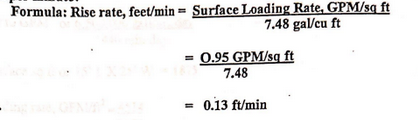 |
front 28 What factors control the detention time? | back 28 Flow and Tank Volume |
front 29 Lower temperatures cause what condition in solids-contact tank? | back 29 Slow settling |
front 30 Solids-contact units are most unstable during what conditions? | back 30 During rapid changes in temperature, flows and turbidity |
front 31 When there is a large increase in turbidity of the flow to a solids-contact unit, what action is needed? | back 31 Ans. Jar Test |
front 32 What will happen if the recirculation rate is too low? | back 32 Sludge will settle to fast and there will not be enough sludge recirculating |
front 33 How is pin floc removed? | back 33 Ans. Filtration |
front 34 What is the best test to evaluate the water treatment processes? | back 34 Turbidity |
front 35 What is the best way to control chemical feed rates/dosages n a WTP | back 35 Electronically Controlled Chemical Feeders |
front 36 A WTP is having problems maintaining its sludge blanket. What action is needed? | back 36 Adjust recirculation rate |
front 37  A water treatment solids-contact unit is 75 ft long25 ft wide and 10 feet deep. What is the surface loading rate of the tank at a flow 6.5 MGD during the 3PM to 11 PM shift | back 37 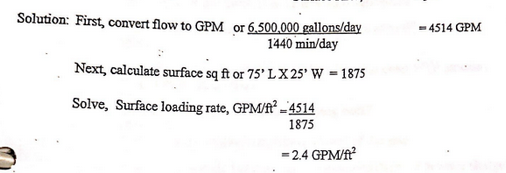 |