Instructions for Side by Side Printing
- Print the notecards
- Fold each page in half along the solid vertical line
- Cut out the notecards by cutting along each horizontal dotted line
- Optional: Glue, tape or staple the ends of each notecard together
B Exam: Filtration
front 1 The release of dissolved air in saturated cold water due to a decrease in pressure causes which of the following? | back 1 Air Binding |
front 2 The color in filtered water is called? | back 2 True Color |
front 3 What is the final step for removal of suspended solids? | back 3 Filtration |
front 4 Which FAC Chapter addresses drinking water standards, monitoring, and reporting? | back 4 FAC 62-550 |
front 5 Inaccurate test results are generally due to? | back 5 Poor sampling techniques |
front 6 What is the highest possible turbidity reduction expected when operating a filtration process under optimum conditions? | back 6 99.5% |
front 7 How is pin point floc removed? | back 7 Filtration |
front 8 Direct filtration omits which process? | back 8 Sedimentation |
front 9 What are the main removal mechanisms in a filter? | back 9 Adsorption and sedimentation |
front 10 Sand drying beds are similar to what type of filters? | back 10 Gravity Sand Filters |
front 11 Which of the following coagulants is generally used as a filter aid? | back 11 Nonionic Polymer |
front 12 What parameters are used to determine when to backwash a filter? | back 12 Head Loss, Turbidity, and Time |
front 13 Where is the application point for a filter aid? | back 13 Filter Influent |
front 14 Before starting the backwash process, what must you check first? | back 14 Water supply |
front 15 Mudballs are caused by which of the following? | back 15 Improper backwash |
front 16 How is the problem in question 15 corrected? | back 16 Properly backwash the filter |
front 17 During a plant walk through, an operator discovers a filter is air bound. What action should she take? | back 17 Backwash the filter immediately |
front 18 Media boils are caused by? | back 18 High backwash rates |
front 19 What is the main goal of filtration? | back 19 Removal of turbidity |
front 20 What is the 4th step in the backwash process? | back 20 Start the surface scours |
front 21 How should an air bound filter be backwashed? | back 21 Slowly |
front 22 The color in unfiltered water is called? | back 22 Apparent Color |
front 23 After backwashing a filter, there is a high initial head loss. What is most likely cause? | back 23 Insufficient Backwash |
front 24 What causes air binding? | back 24 Ans. Operating the filter at high head loss too long |
front 25 During a plant tour, an operator noticed that Filter 16 has a sudden increase in head loss. What action should she take? | back 25 Do a jar test |
front 26 What do you call the process of reversing the flow of water through filter media to remove trapped particles? | back 26 Filter Backwash |
front 27 The common boundary layer between two substyances such as water and a solid is called? | back 27 Interface |
front 28 The difference between the water surface and the media surface is called? | back 28 Submergence (Head) |
front 29 What is the filter rate in GPM/sq ft of slow sand filters? | back 29 0.015-0.15 GPM/sq ft |
front 30 High water temperatures require what type of backwash rates? | back 30 Higher Backwash rates |
front 31 The Filter Backwash Rule requires the backwash water to be sent where after dewatering the sludge? | back 31 Upstream of all conventional or direct filtration systems (includes coagulation, filtration, and sedimentation) |
front 32 What is the ripening period of a filter? | back 32 This occurs at startup of a new filter or after backwash of a filter |
front 33 A filter 12' long and 8' wide drops 3" in 90 seconds. What is the filtration rate in GPM/sq ft? | back 33 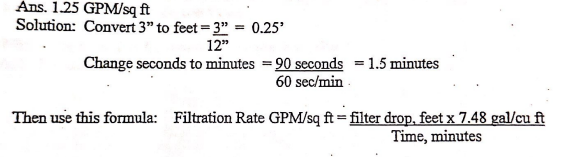 |
front 34 What is the backwash rise rate in inches/minute if the backwash flow rate is 35 GPM/sq ft? | back 34  |
front 35 What is the backwash pumping rate in GPM for a filter 20' long x 30' wide with a desired backwash rate of 25 GPM/sq ft? | back 35 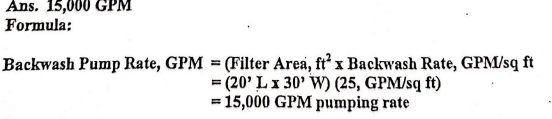 |
front 36 How much water is needed to back wash the filter in question 35 for 8 minutes? | back 36 120,000 Gallons (15,000 GPM x 8 min) |
front 37 During a filter run, flow through the filter was 12.8 MG. It took 120,000 gallons to backwash the filter. What percent of the filter's water production was used for backwashing? | back 37 1% |
front 38 What is the minimum treatment required for drinking water by the Surface Water Treatment Rule (SWTR)? | back 38 Filtration and Disinfection |
front 39 Where should you install a particle counter at a WTP? | back 39 As close as possible to the point of measurement |
front 40 The length of a sample line of a particle counter should be how long? | back 40 As short as possible |
front 41 Pumping sample water to the particle counter may cause what problem? | back 41 Air bubbles, which may be erroneously counted as particles |
front 42 What material is recommended for the sample line of a particle counter? | back 42 Black Nylon with Hytril Liner |
front 43 What is the final step for removal of suspended solids? | back 43 Filtration |