Instructions for Side by Side Printing
- Print the notecards
- Fold each page in half along the solid vertical line
- Cut out the notecards by cutting along each horizontal dotted line
- Optional: Glue, tape or staple the ends of each notecard together
B Exam
front 1 When should membranes be cleaned? | back 1 When pressure needed to operate at rated capacity increases by 15% or product water flow decreases by 15%. |
front 2 When must the Consumer Confidence Report be reported? | back 2 Delivered via mail to each billing customer by July 1". (62-550.824) |
front 3 When must the Monthly Operation Report (MOR) be submitted to the local DEP or HRS office? | back 3 Within 10 days after the month of operation. (62-550.730) |
front 4 According to Statute 62-550 what is a cross-connection? | back 4 Interconnection between two water systems is ok. Connection between an approved water source and an unapproved water system is an example of a cross-connection. Cross-connection prohibited. |
front 5 What is a sign of a cross contamination that your customers would call to complain about... | back 5 Musty Septic smell |
front 6 According to the Lead and Copper Rule what best describes the process for taking a "First draw" sample? | back 6 Take sample from bathroom sink that has been unused from 6-8 hours. |
front 7 Please describe from top to bottom the layers of a multi-media gravity filter that most often are used. | back 7 Anthracite coal, sand, garnet. |
front 8 Tuberculation in iron pipes is common example of corrosion in the distribution system. Tuberculation decreases, the carrying capacity of water mains, increases water quality complaints, and increases electric costs for pumping water due to the diminished carrying capacity of the mains. | back 8 N/A |
front 9 The greater the C-Factor... | back 9 The smoother the pipe. |
front 10 What factors are needed to calculate the Langelier Index? | back 10 Water temp, TDS, Alkalinity, Ca hardness, and PH of POE. |
front 11 How long must you keep records for? | back 11 MOR's - 10 Years, Bacteriological - 5 Years |
front 12 What is the best way to measure the effectiveness of a WTP's processes? | back 12 Turbidity |
front 13 What is most likely the cause of a medicinal taste in water? | back 13 Phenols |
front 14 A customer calls and complains that when they filled a glass at sink it is cloudy. What can you determine? | back 14 Ask customer to see if it clears up which would mean air or if particles settled at the bottom. |
front 15 What is the lowest the psi may go in distribution system? | back 15 20 PSI |
front 16 What is Thermocline? | back 16 Middle Layer of Lake or reservoir that lowers in temp as the depth |
front 17 Question regarding tube settlers and their functions in a package plant. | back 17 Installed to help in the efficiency of the sedimentation process/ |
front 18 Raw influent quality of water has diminished and beginning to see plant effluent diminishing. What can be done to correct problem. | back 18 Increase mixer speed Decrease poly dose by 1-2mg |
front 19 How long can a THM sample be held before analysis? | back 19 14 Days |
front 20 What will break down ion exchange resin? | back 20 Chlorine |
front 21 When an ion exchange resin bed is saturated with calcium & magnesium, what mineral is used to regenerate the bed? | back 21 Brine |
front 22 If thiosulfate is not added to a THM sample what could happen to the sample? All sample jars for testing Total Trihalomethanes must contain a chlorine reduction agent (Sodium Thiosulfate). To test for potential THM, you do not put a chlorine reduction agent in the sample jar. | back 22 THM formation would continue |
front 23 How often are THM samples required to be taken? | back 23 Water systems serving more that 10,000 people must test for THM once each quarter. Less then 10,000 are once a year. |
front 24 As the source water temperature and PH increase, THM formation? | back 24 Increases |
front 25 What is a valve commonly used to control flow? | back 25 Globe valve |
front 26 When analyzing a 100ml sample of water for alkalinity it took 1.3 ml of 0.02 n sulfuric acid to reach a ph of 8.3 and a total of 10.5ml of titrant to reach a ph of 4.5. What is the p and total alkalinity? | back 26 13P 105T |
front 27 The plant flow is 7.5 MGS. The treatment unit is 70' long, 20' wide, and 10' deep. What is the detention time in minutes? | back 27 20min |
front 28 Disinfection is best accomplished when what conditions exist? | back 28 High concentration and long contact time. |
front 29 A WTP using lime softening process has a finished water hardness of 82 mg/l and a +0.5 LI what is the water condition? | back 29 Finished water is scale forming |
front 30 Many samples for MCL compliance are taken in the distribution system. Which sample is taken where the water enters the distribution system? | back 30 Color |
front 31 What is the primary purpose of filters in a wtp? | back 31 Lower turbidity |
front 32 Question regarding ....To control THM formation, alternate disinfectants are used including ozone, chlorine dioxide, and chloramines. | back 32 N/A |
front 33 When taking a hardness test, the titration should be completed within 5 minutes. An inhibitor reagent should be used when metal ion interference causes an indistinct end point and a sample volume should be selected which requires less than 15 ml of EDTA titrant. | back 33 A specific question on test explains that titration is not showing an indistinct end point which the answer I chose was to use larger sample in order to show this change clearly. |
front 34 Determine break point chlorination point using the following chlorine analyses. | back 34 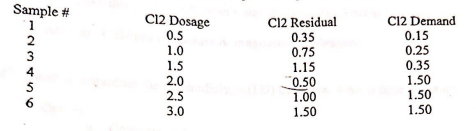 |
front 35 Which one of the following conditions will lead to a smaller number of THMS forming? | back 35 Options: |
front 36 Just changed raw water flow what should you do? | back 36 Record flow change - I answered |
front 37 To remove magnesium, a WTP is using excess lime and recarbonation. What method can you recommend to lower their treatment costs and maintain the water quality? | back 37 Split treatment |
front 38 THM precursors are? | back 38 Naturally occurring organic compounds |
front 39 Question regarding Iron and manganese react with chlorine to form insoluble compounds. | back 39 N/A |
front 40 The minerals that cause hardness in water are precipitated out as? | back 40 Calcium carbonate & magnesium hydroxide |
front 41 Question regarding the Electrodialysis (ED) treatment. What is false about it? | back 41 Most of organic compounds are removed |
front 42 To precipitate the hardness from the water, the pH must be lowered considerably or the finished water will be extremely scaling. The two most common methods of handling this problem are: | back 42 Recarbonation |
front 43 What can be said about quicklime? | back 43 Needs to be slaked |
front 44 What is the MCL for iron? | back 44 .3 |
front 45 Know the definition of tubercles | back 45  |
front 46 The filter head loss at the start of a filter run is one foot. The design head loss is 10 feet. How many additional feet would you allow before backwashing the filter? | back 46 When head loss reaches an additional 8 or 8 and half feet totaling 9 or 9.5 head loss. |
front 47 What is an example of a good preventative maintenance program? | back 47 Training program |
front 48 Question regarding what is not a purpose of a clear well or ground storage tanks? | back 48 Options: |
front 49 Question asking to what are examples of disease causing bacteria that may be transmitted in the water.... | back 49 N/A |
front 50 Question instructing you to give the average THM with eight samples given. | back 50 Add the eight samples and divide by eight |
front 51 What is the correct method to determine the hydroxide alkalinity in the lime softening process? | back 51 2P-T alk Lime also increases the alkalinity of the water. The calcium and magnesium hardness form insoluble precipitates as the pH of the water continues to increase. The slaked lime converts the bicarbonate alkalinity of the water to carbonate alkalinity and allows the insoluble calcium and magnesium hardness to precipitate of the water. |