Instructions for Side by Side Printing
- Print the notecards
- Fold each page in half along the solid vertical line
- Cut out the notecards by cutting along each horizontal dotted line
- Optional: Glue, tape or staple the ends of each notecard together
Unit 6 Fasteners
front 1 Which of the following is not a type of nail used in HVAC Carpentry Roofing Finishing | back 1 Carpentry is not a type of nail used in HVAC |
front 2 What term is used to indicate nail size? And the abbreviation Hint: coin | back 2 Penny D. for Denarius |
front 3 What tool is used to spread the ends of a staple? | back 3 Outward clinch tacker |
front 4 What are hollow rivets assembled in? | back 4 A pin called a mandrel |
front 5 What fastener is used to attach two pieces of sheet metal together? | back 5 Pin rivets |
front 6 A tapping screw that is identified as an 8-20 x 1 Type AB, slotted hex is how long? | back 6 1 in |
front 7 6-20 × 1/2 Type AB, Slotted hex has a screw number of what? | back 7 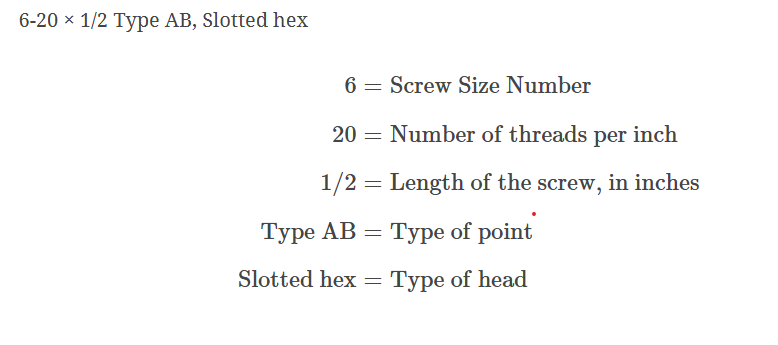 6 |
front 8 A machine screw that is identified as a 1/4–18 UNC-2 is how long? What does 18 represent? | back 8 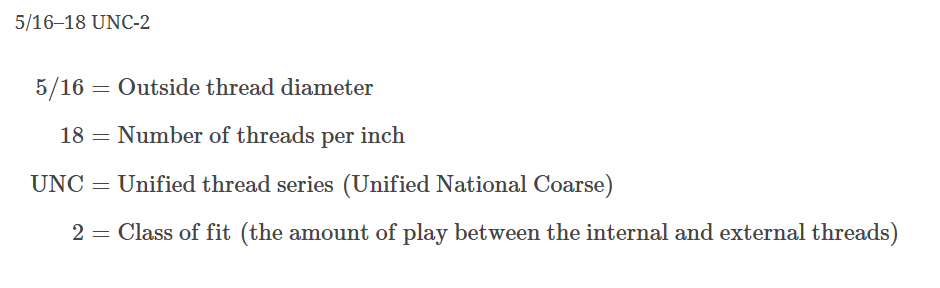 Cannot be determined from this information Number of threads per inch |
front 9 Toggle bolts are best suited for securing objects to __________. | back 9 Hollow walls |
front 10 When using a toggle bolt, it is important to make certain that _________. | back 10 The object being secured is placed on the bolt before threading the toggle onto it. |
front 11 Powder-actuated fastener systems are most commonly used to secure objects to | back 11 Concrete slabs and walls |
front 12 You must be properly trained and licensed to use which of the following:
| back 12 Powder-actuated fasteners |
front 13 What is a lag shield anchor? | back 13 A two-part shield with tapered internal threads |
front 14 Threaded rod can be attached to steel I-beams with _________. | back 14 Beam clamps |
front 15 The pipe-hanging device that is hammered or driven into a wood support is the _______. | back 15 Pipe hook |
front 16 What is perforated strapping material is used with? | back 16 With nuts and bolts to secure the piping material |
front 17 How are retaining rings typically classified? | back 17 Internal or External **Retaining rings, also referred to as snap-rings, are fasteners that hold a component either onto a shaft or inside some type of housing |
front 18 The ring tongue, hook tongue, and snap terminal are all examples of ____? | back 18 Crimped-on solderless terminals |
front 19 Which of the following is true regarding the use of screw terminals?
| back 19 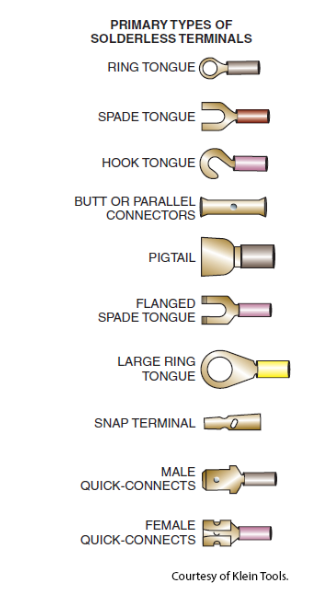 Only solid wire should be secured under screw terminals. |
front 20 Which of the following is true regarding cotter pins?
| back 20
|