Instructions for Side by Side Printing
- Print the notecards
- Fold each page in half along the solid vertical line
- Cut out the notecards by cutting along each horizontal dotted line
- Optional: Glue, tape or staple the ends of each notecard together
Neurological and Sensory Conditions Chapter 20 FA davis
front 1 A nurse in the pediatric intensive care unit is caring for a child with a suspected intracranial bleed. The nurse knows which of the following is least likely to be used to assess and monitor the child? 1.Magnetic resonance imaging (MRI) 2.Computed tomography (CT) 3.Computed tomography (CT) with contrast 4.Intracranial catheter | back 1 3.Computed tomography (CT) with contrast |
front 2 A nurse in a pediatric intensive care unit is caring for a child with hypovolemia and increased intracranial pressure. Which of the following are priority safety interventions the nurse must perform? Select all that apply. 1.Place patient in Trendelenburg position. 2.Administer isotonic fluids. 3.Maintain fluid restriction. 4.Place padding on bed rails. 5.Apply hypothermic blanket. | back 2 3.Administer isotonic fluids. 4.Place padding on bed rails. |
front 3 A nurse is caring for a child with a brain tumor in the pediatric intensive care unit. The child has a blood pressure of 110/46, heart rate of 48, and an irregular respiratory pattern on assessment. The nurse is concerned the child has which of the following that indicates possible impending herniation? 1.Cushing’s triad 2.Increased intracranial pressure 3.Cerebral damage 4.Cerebral infection | back 3 1.Cushing’s triad |
front 4 A nurse preparing to administer the ordered IV mannitol to a 2-year-old boy with increased intracranial pressure knows which of the following are anticipated nursing implications when administering this medication? Select all that apply. 1.Dilute with normal saline 2.Insert foley catheter 3.Administer corticosteroids 4.Strict I & Os 5.Monitor head circumference every shift | back 4 2.Insert foley catheter 4.Strict I & Os |
front 5 While assessing a patient's health history for risk factors associated with developing Guillain-Barré Syndrome, the nurse identifies which of the following as risk factors? Select all that apply. 1.Recent flu vaccine 2.Recent strep throat 3.Juvenile Myasthenia Gravis 4.Patient is 2 years old 5.Patient is male | back 5 1.Recent flu vaccine 2.Recent strep throat 5.Patient is male |
front 6 A newborn with a myelomeningocele is admitted to the neonatal intensive care unit. You are the nurse caring for a baby born an hour ago with myelomeningocele. The nurse providing care knows the newborn is at risk for which of the following? Select all that apply. 1.Partial paralysis 2.Infection 3.Clubfeet 4.Constipation 5.Feeding intolerance | back 6 1.Partial paralysis 2.Infection 3.Clubfeet 4.Constipation |
front 7 When caring for a child with suspected juvenile myasthenia gravis (MG), the nurse is assisting with diagnostic testing. Which test would confirm the suspected diagnosis? 1.Tensilon test 2.Lumbar puncture 3.Nerve conduction test 4.Acetylcholine antibody test | back 7 3.Nerve conduction test |
front 8 A nurse is discharging a 3-year-old with a new shunt placement. Which of the following should the nurse teach the parents that indicate a sign of increased intracranial pressure (ICP) in which the physician should be notified? Select all that apply. 1.Sunset eyes 2.Vomiting 3.Papilledema 4.Cushing’s syndrome 4.Diarrhea | back 8 1.Sunset eyes 2.Vomiting 3.Papilledema |
front 9 A student nurse enters a child’s room and observes the child beginning to have a seizure. The nursing instructor knows further remediation is not needed when she sees the student implement which seizure precautions? Select all that apply. 1.Placing a tongue blade in the child’s mouth during an active seizure. 2.Goes to get assistance with the seizure. 3.Raise all side rails during the seizure. 4.Push ordered IV seizure medication quickly. 5.Position the child in the lateral position during a seizure. | back 9 3.Raise all side rails during the seizure. 5.Position the child in the lateral position during a seizure. |
front 10 A nurse is conducting an assessment on a 12-month-old infant with suspected cerebral palsy. Which finding warrants further examination? 1.Positive Moro reflex 2.Positive Babinski reflex 3.Symmetrical spontaneous limb movement 4.Preference in handedness | back 10 1.Positive Moro reflex |
front 11 The parent of a 10-year-old girl is at the pharmacy to purchase medication to help with the child’s fever and aches associated with her diagnosis of varicella. The parent is concerned about information she read while in the pediatrician’s office at a previous visit about Reye’s syndrome. Which medications should be avoided based on the mother’s concerns? Select all that apply. 1.Excedrin 2.Acetaminophen 3.BC Powder 4.Ibuprofen 5.Anacin | back 11 1.Excedrin 3.BC Powder 5.Anacin |
front 12 A newborn infant has just been admitted to the newborn nursery with a myelomeningocele. Which nursing intervention is priority in caring for the newborn? 1.Place the infant supine and cover the defect with saline moistened gauze. 2.Place the infant prone and cover the defect with saline moistened gauze. 3.Place the infant supine and cover the defect with dry gauze. 4.Place the infant prone and cover the defect with dry gauze. | back 12 2.Place the infant prone and cover the defect with saline moistened gauze. |
front 13 When caring for a child with spina bifida, which of the following is contraindicated? 1.Rectal temperature 2.Lower limb blood pressure 3,Subcutaneous abdominal injection 4.Foley insertion | back 13 1.Rectal temperature |
front 14 The mother of a 6-year-old brings the child to the physician’s office for complaints of the child not being able to see the board at school and sitting really close to the television. The nurse suspects the child has what condition? 1.Myopia 2.Hyperopia 3.Astigmatism 4.Strabismus | back 14 1.Myopia |
front 15 A nursing instructor is teaching students about cerebral palsy (CP). What should be included in the teaching? Select all that apply. 1.CP is a progressive neurological disorder. 2.CP can occur as a result from an anoxic event up to age 2 years. 3.There are three types of cerebral palsy. 4.A child with CP can demonstrate hand preference by 6 months instead of 12 months. 5.Children with CP have prolonged infant reflexes. | back 15 2.CP can occur as a result from an anoxic event up to age 2 years. 4.A child with CP can demonstrate hand preference by 6 months instead of 12 months. 5.Children with CP have prolonged infant reflexes. |
front 16 A new pediatric nurse assessing a patient with altered level of consciousness (LOC) knows that the most common cause of altered LOC in children is: 1.Congenital anomalies 2.Cerebral palsy 3.Meningitis 4.Narcotic overdose | back 16 3.Meningitis |
front 17 Upon starting their shift, a nurse receives report on their patients, one of which has a diagnosis of Guillain-Barré Syndrome (GBS). The nurse knows this disease tends to present with which of the following? Select all that apply. 1.In more males than females 2.History of recent flu vaccine 3.History of recent gastrointestinal illness 4.Muscle weakness in upper extremities descending to lower extremities 5.Hyperreflexia | back 17 1.In more males than females 2.History of recent flu vaccine 3.History of recent gastrointestinal illness |
front 18 A child is in a car accident with his mother driving. The child was found at the site of the accident strapped in a car seat in the car. The child and mother were brought to the ER via ambulance. Upon assessment, the child is thought to have sustained a traumatic brain injury. What finding does not support this preliminary diagnosis? 1.Hemotympanum 2.Periorbital ecchymosis 3.Battle’s sign 4.Positive Kernig’s sign | back 18 4.Positive Kernig’s sign |
front 19 A 12-year-old is hospitalized with juvenile myasthenia gravis. Due to continued complications from the disease, the child had a feeding tube placed. Which of the following is priority when before administering the evening feeding? 1.Assess vital signs 2.Assess bowel sounds 3.Assess urine output 4.Assess range of motion | back 19 2.Assess bowel sounds |
front 20 When teaching a group of nursing students about causes of seizures, further remediation is needed when a student identifies which of the scenarios that may result in a seizure? Select all that apply. 1.A 5-year-old child with a blood sugar of 42 2.A 17-year-old diagnosed with spinal meningitis 3.A 2-year-old who ingested half a bottle of liquid diphenhydramine 4.A 4-year-old child with a history of atrial-venous malformation 5.A 7-year-old diagnosed with influenzae B | back 20 1.A 5-year-old child with a blood sugar of 42 2.A 17-year-old diagnosed with spinal meningitis 3.A 2-year-old who ingested half a bottle of liquid diphenhydramine 4.A 4-year-old child with a history of atrial-venous malformation |
front 21 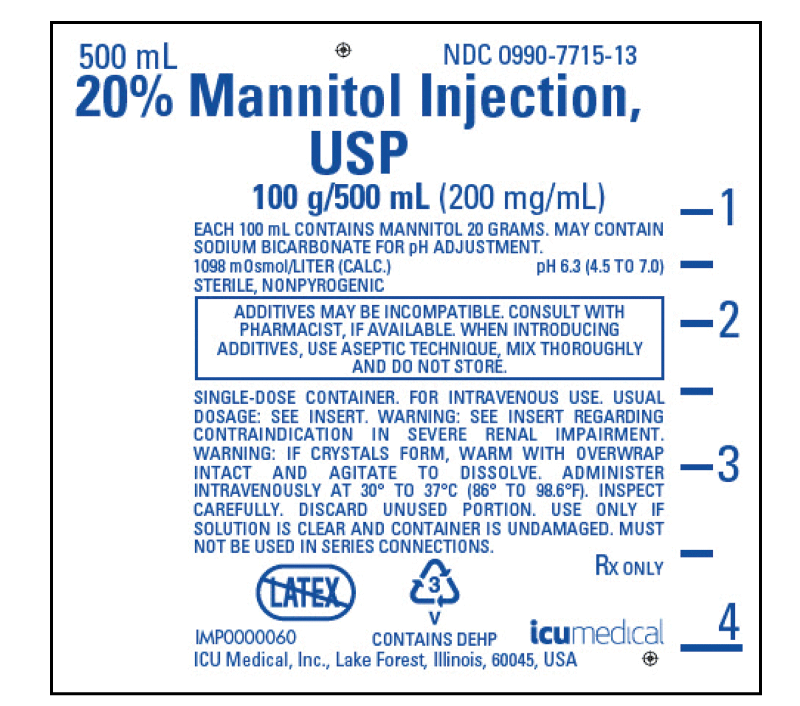 The nurse caring for Henry, a 5-year-old, with increased intracranial pressure is preparing to administer the ordered mannitol. The child weighs 42 pounds. The order states: 1.25 g per kg to be administered over 30 minutes. The label shows how the medication is prepared. How many milliliters will the nurse administer for this dose? Round to the nearest tenth. Give numeral only. Do not enter the unit. Answer: 119.3 | back 21 119.3 |
front 22 A 3-year-old girl is admitted to the intensive care unit with suspected bacterial meningitis. Which assessment findings are expected for this diagnosis? Select all that apply. 1.Negative Kernig’s sign 2.Positive Brudzinski’s sign 3.Stiff neck 4.Lethargy 5.Diarrhea | back 22 2.Positive Brudzinski’s sign 3.Stiff neck 4.Lethargy |
front 23 A family friend asks the mother of a 3-year-old boy with a history of generalized petit mal seizures, “What does it look like when he has a seizure?” Appropriate responses from the mother include: Select all that apply. 1.“He loses consciousness.” 2.“He looks like he is daydreaming.” 3.“His whole body becomes stiff like a board.” 4.“It only occurs in his face.” 5.“He drops to the floor due to loss of muscle tone.” | back 23 2.“He looks like he is daydreaming.” 5.“He drops to the floor due to loss of muscle tone.” |
front 24 When assessing a child in the hospital with bacterial meningitis, the child is sleeping, but when the nurse speaks loudly to the child, they open their eye; however, the child still appears drowsy with eyes open. When the nurse starts talking to the mother in the room, the child easily falls back to sleep. The nurse would document the child’s level of consciousness as: 1.Lethargic 2.Obtunded 3.Stuporous 4.Alert | back 24 1.Lethargic |
front 25 A teenage girl is being evaluated for migraine vs. cluster headaches. The nurse knows which of the following are indicative of a cluster headache diagnosis? Select all that apply. 1.Ptosis 2.Preceding aura 3.Pain is pulsating 4.Runny nose 5.Unilateral pain | back 25 1.Ptosis 4.Runny nose 5.Unilateral pain |
front 26 A nurse working in a physician’s office reviews the chart of a child before bringing the patient back to an exam room. The child’s chart states the child has cerebral palsy (CP) but does not specify type of CP. When the nurse brings the child back to the exam room, the nurse notices the child has uncontrolled involuntary writhing movement of extremities and has some speech difficulties. Based on this, the nurse knows the child has which type of CP? 1.Ataxic 2.Athetoid 3.Mixed 4.Spastic diplegia | back 26 2.Athetoid |
front 27 A 17-year-old male is being discharged from the hospital after a thymectomy for a thymoma that lead to myasthenia gravis. Which of the following should be included in the discharge teaching? 1.Proper anticholinesterase dosing schedule 2.Proper anticholinergic dosing schedule 3.Proper beta-blocker dosing schedule 4.Proper bronchodilator dosing schedule | back 27 1.Proper anticholinesterase dosing schedule |
front 28 Nancy is a 27-year-old female who has just given birth to a newborn with myelomeningocele. The mother did not have prenatal care and was not aware of the defect prior to giving birth. The nurse has just provided teaching to the mother about the child’s defect. Which statements by the mother indicates she needs further teaching? Select all that apply. 1.“My child may need a shunt placed at some point.” 2.“My child will have learning difficulties.” 3.“My child will not be able to feed himself.” 4.“After surgical correction of the defect, my child’s function will be restored.” 5.“My child may have problems potty-training.” | back 28 2.“My child will have learning difficulties.” 3.“My child will not be able to feed himself.” 4.“After surgical correction of the defect, my child’s function will be restored.” |
front 29 A student nurse learning about Guillain-Barré Syndrome (GBS) in children knows that the disorder progresses in an expected order. Drag and drop the following in order of expected occurrence.
| back 29 Numbness in feet. Difficulty moving legs. Difficulty breathing. Pneumonia. |
front 30 Seizures result in which of the following? Select all that apply. 1.Changes in intracranial pressure 2.Changes in motor function 3.Changes in sensation 4.Changes in cognitive ability 5.Changes in glucose level | back 30 2.Changes in motor function 3.Changes in sensation 4.Changes in cognitive ability |
front 31 When providing anticipatory guidance to parents of a 4-month-old about new intake of solids, the nurse advises the parents against giving the infant honey until after 12 months of age due to risk of botulism. All of the following are signs and symptoms of botulism except: 1.Ascending paralysis 2.Constipation 3.Weak cry 4.Drooping eyelids | back 31 1.Ascending paralysis |
front 32 A nurse preparing to administer the ordered IV mannitol to a 2-year-old boy with increased intracranial pressure knows which of the following are anticipated nursing implications when administering this medication? Select all that apply. 1.Dilute with normal saline 2.Insert foley catheter 3.Administer corticosteroids 4.Strict I & Os 5.Monitor head circumference every shift | back 32 2.Insert foley catheter 4.Strict I & Os |
front 33 A nurse working in the emergency room is assessing a 10-month-old child who has just arrived to the ER. The child has a high-pitched cry, sunsetting eyes, and bulging fontanels. The mother also reports the child has been vomiting for the last several hours. There are no other significant findings on this initial assessment. The nurse suspects the infant has: 1.Dehydration 2.Increased intracranial pressure 3.Guillain-Barré Syndrome 4.Traumatic brain injury | back 33 2.Increased intracranial pressure |