Instructions for Side by Side Printing
- Print the notecards
- Fold each page in half along the solid vertical line
- Cut out the notecards by cutting along each horizontal dotted line
- Optional: Glue, tape or staple the ends of each notecard together
Brain Disorders Chapter 36 FA Davis
front 1 Which risk factor would be associated with the development of a brain tumor? 1.Male 2.Smoking 3.Alcohol use 4.Teenager | back 1 1.Male |
front 2 Which clinical manifestation would be considered a side effect of chemotherapy for a brain tumor? Select all that apply. 1.Papilledema 2.Diarrhea 3.Mucositis 4.Facial numbness 5.Headache | back 2 2.Diarrhea 3.Mucositis |
front 3 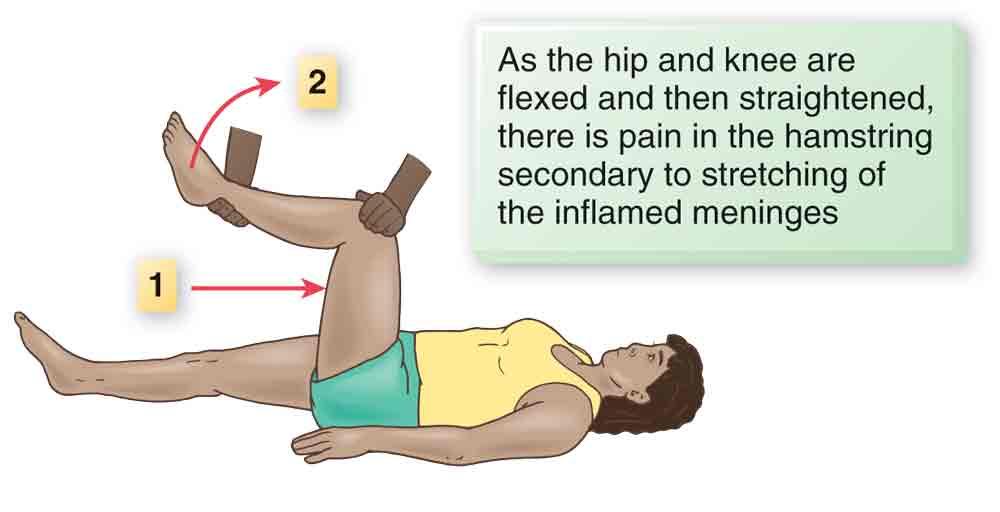 Which action should the nurse take after performing this maneuver on a patient with meningitis? 1.Assess the patient’s ability to move head sideways. Assess the patient for involuntary flexion of hips. 3.Assess the movement of the eyes on the affected side. 4.Assess the patient for pain behind the knee. | back 3 4.Assess the patient for pain behind the knee. |
front 4 The nurse is caring for a patient who is prescribed carbamazepine for complex partial seizures. Which is the most appropriate information for the nurse to teach the patient? 1.“The medication must be chewed.” 2.“This medication may cause blurred vision.” 3.“Weight gain is a side effect of the medication.” 4.“The medication may cause sedation.” | back 4 2.“This medication may cause blurred vision.” |
front 5 Which lifestyle change is appropriate for the nurse to teach the patient to prevent future headaches? Select all that apply. 1.Drink an adequate amount of fluids. 2.Perform gentle exercises of the neck. 3.Eliminate trigger foods from the diet. 4.Establish consistent sleep habits. 5.Incorporate meditation into daily routine. | back 5 1.Drink an adequate amount of fluids. 2.Perform gentle exercises of the neck. 3.Eliminate trigger foods from the diet. 4.Establish consistent sleep habits. 5.Incorporate meditation into daily routine. |
front 6 Which finding is used to diagnose the presence of Parkinson’s disease (PD)? 1.Electroencephalogram (EEG) 2.Magnetic resonance imaging (MRI) 3.Cerebrospinal fluid (CSF) testing 4.Presence of tremors and muscular rigidity | back 6 4.Presence of tremors and muscular rigidity |
front 7 The nurse is teaching a patient about seizure management. Which statement by the patient about this image demonstrates understanding? 1.“I should wear this all the time.” 2.“If I don’t have it on, I can tell people I have a seizure disorder.” 3.“I only need to wear this when I leave the house.” 4.“This will help me if I get pulled over when driving.” | back 7 1.“I should wear this all the time.” |
front 8 The nurse is caring for a patient with viral meningitis who asks what could have caused this. Which condition should the nurse include when responding to the patient? 1.Lumbar puncture 2.Intraventricular catheter 3.Traumatic injury 4.Lack of immunization against mumps | back 8 4.Lack of immunization against mumps |
front 9 The nurse is discussing treatment with a patient who has a brain tumor and is receiving chemotherapy. Which statement made by the patient indicates effective learning? 1.“I shouldn’t wear a hat while going out.” 2.“I should stop taking glucocorticoids when I feel good.” 3.“I should rinse my mouth with mouthwash containing alcohol.” 4.“I should consult my healthcare provider when a dose of antiepileptic medication is missed.” | back 9 4.“I should consult my healthcare provider when a dose of antiepileptic medication is missed.” |
front 10 A patient taking a daily dose of ibuprofen reports a severe headache every day. Which intervention will likely help in relieving the patient’s headache? 1.Increasing the dose of ibuprofen 2.Replacing ibuprofen with acetaminophen 3.Providing IV hydration treatment 4.Encouraging the patient to discontinue use of ibuprofen | back 10 4.Encouraging the patient to discontinue use of ibuprofen |
front 11 The nurse is providing postsurgical care to a patient with a brain tumor. Which action helps to prevent cerebral edema? 1.Administer glucocorticoids 2.Position the patient’s head at a 15° angle 3.Apply a sequential compression device 4.Give benzodiazepines | back 11 1.Administer glucocorticoids |
front 12 The nurse cares for a patient postoperative brain surgery. What priority action should the nurse take? 1.Request the IV fluid rate be increased 2.Request specific gravity, osmolality, and sodium levels 3.Encourage drinks of water hourly 4.Request the placement of an indwelling catheter | back 12 2.Request specific gravity, osmolality, and sodium levels |
front 13 Which statement describes the role of the speech therapist when caring for a patient diagnosed with Parkinson’s disease? 1.Maximize independence in activities of daily living (ADLs) 2.Evaluate the patient’s ability to swallow 3.Provide exercises that increase strength 4.Promote home safety | back 13 2.Evaluate the patient’s ability to swallow |
front 14 Which clinical manifestation would be associated with Alzheimer’s disease? 1.Agnosia 2.Muscle rigidity 3.Bradykinesia 4.Postural instability | back 14 1.Agnosia |
front 15 The nurse is caring for a patient with tonic-clonic seizures. Which action by the nurse is most likely to benefit the patient? 1.Encouraging the patient to eat finger foods 2.Placing the patient in a left recumbent position 3.Placing a clock and calendar in the patient’s room 4.Encouraging the patient to participate in self-care activities | back 15 2.Placing the patient in a left recumbent position |
front 16 Which is a first-line medication used in the immediate treatment of seizures and status epilepticus? Select all that apply. 1.Propofol 2.Phenytoin 3.Lorazepam 4.Midazolam 5.Levetiracetam | back 16 3.Lorazepam 4.Midazolam |
front 17 Which assessment would the nurse complete prior to administering donepezil to a patient diagnosed with Alzheimer’s disease? 1.Temperature 2.Blood pressure 3.Heart rate 4.Oxygen saturation | back 17 3.Heart rate |
front 18 Which vitamin would help decrease damage caused by free radicals in patients diagnosed with Alzheimer’s disease (AD)? 1.A 2.C 3.D 4.E | back 18 4.E |
front 19 Which intervention should the nurse implement for a patient who experienced a seizure? 1.Restrain the patient’s movements. 2.Assist the patient to a supine position. 3.Suction the oral airway. 4.Encourage the patient to drink water. | back 19 3.Suction the oral airway. |
front 20 The home healthcare nurse is caring for a patient with Alzheimer’s disease (AD). Which intervention should the nurse implement? 1.Give the patient a ketogenic diet. 2.Encourage the patient to take an afternoon nap. 3.Provide the patient with a different schedule every day. 4.Speak calmly using positive statements. | back 20 4.Speak calmly using positive statements. |
front 21 Which characteristic helps in the diagnosis of encephalitis? 1.It involves pathogens that invade the central nervous system. 2.It involves the cerebrum, brainstem, and cerebellum. 3.It can be a life-threatening emergency leading to increased cranial pressure, coma, and death. 4.It is diagnosed by examining the cerebrospinal fluid. | back 21 2.It involves the cerebrum, brainstem, and cerebellum. |
front 22 Which statement would be considered true regarding Alzheimer’s disease? 1.Individuals can experience symptoms before the age of 65. 2.Males are more likely to develop than females. 3.Average time from symptoms to death is 15 to 20 years. 4.Progression of disease escalates in those diagnosed later in life. | back 22 1.Individuals can experience symptoms before the age of 65. |
front 23 The nurse is admitting a patient with Alzheimer’s disease (AD) to a long-term care facility. Which goal is priority when planning care? Select all that apply. 1.Maintain patient safety 2.Socialize with residents 3.Improve the quality of life 4.Perform ADLs independently 5.Take medications independently | back 23 1.Maintain patient safety 3.Improve the quality of life |
front 24 Which symptom would typically occur in the early stages of Alzheimer’s disease? 1.Difficulty solving problems. 2.Unable to perform multiple tasks. 3.Problems with short-term memory. 4.Incapable of naming familiar objects. | back 24 3.Problems with short-term memory. |
front 25 The nurse provides teaching regarding performance of blood glucose monitoring to the patient following surgery for a brain tumor. Which response by the nurse is appropriate when the patient asks why this is necessary? 1.“The tumor has changed how your body responds to sugar.” 2.“The medication to decrease swelling causes blood glucose levels to rise.” 3.“High blood glucose causes the tumor to grow back.” 4.“This is a healthy lifestyle choice.” | back 25 2.“The medication to decrease swelling causes blood glucose levels to rise.” |
front 26 Which symptom should the nurse anticipate if a patient has a brain tumor in the left temporal lobe? 1.Difficulty with speech 2.Sensory loss 3.Loss of vision in one eye 4.Lack of light reflex | back 26 1.Difficulty with speech |
front 27 The nurse is teaching a patient about seizure management. Which statement made by the patient indicates the teaching was effective? Select all that apply. 1.“I should wear a medic alert bracelet.” 2.“I should refrain from driving.” 3.“I should monitor my blood glucose levels daily.” 4.“I should take short and deliberate steps while walking.” 5.“I should apply sunscreen and skin emollients when in the sunlight.” | back 27 1.“I should wear a medic alert bracelet.” 2.“I should refrain from driving.” |
front 28 The nurse is caring for a patient undergoing chemotherapy for a brain tumor. Which intervention is essential to initiate if the patient is neutropenic? 1.Suggest the use of sunscreen lotion. 2.Provide nutritional supplements. 3.Teach importance of frequent handwashing. 4.Encourage use of skin emollients. | back 28 3.Teach importance of frequent handwashing. |
front 29 For which side effect would the nurse monitor in a patient diagnosed with Alzheimer’s disease and prescribed rivastigmine? 1.Suicidal ideations 2.Dehydration 3.Muscle rigidity 4.Seizures | back 29 2.Dehydration |
front 30 In which state of a seizure is a patient most likely to have compromised airway and decreased level of consciousness? 1.After a seizure episode 2.During the preictal state 3.During the postictal state 4.Between seizure episodes | back 30 3.During the postictal state |
front 31 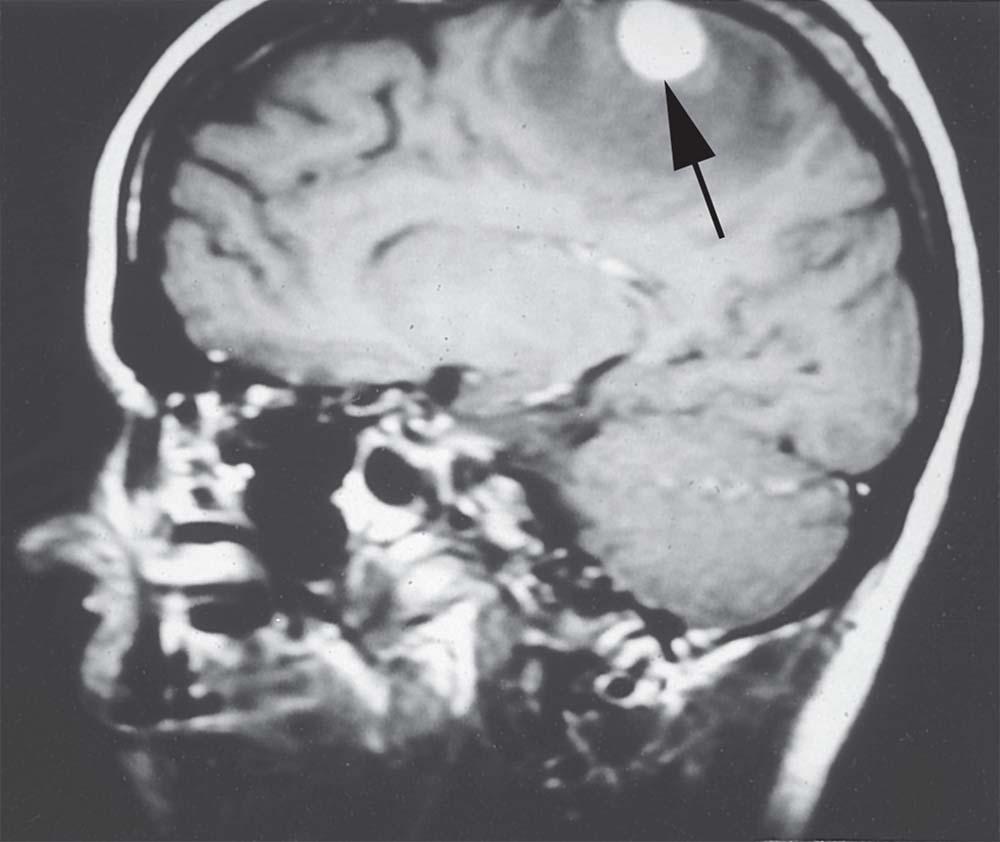 The nurse is caring for a patient with a history of lung cancer. After presenting to the clinic with headaches, the provider obtains this image. Which type of tumor is most likely the cause? 1.Primary 2.Gliomas 3.Oligodendrogliomas 4.Metastatic | back 31 4.Metastatic |
front 32 Which lifestyle change is appropriate for the nurse to teach the patient to prevent future headaches? Select all that apply. 1.Drink an adequate amount of fluids. 2.Perform gentle exercises of the neck. 3.Eliminate trigger foods from the diet. 4.Establish consistent sleep habits. 5.Incorporate meditation into daily routine. | back 32 1.Drink an adequate amount of fluids. 2.Perform gentle exercises of the neck. 3.Eliminate trigger foods from the diet. 4.Establish consistent sleep habits. 5.Incorporate meditation into daily routine. |
front 33 Which risk factor would be associated with Alzheimer’s disease? 1.Family history of dementia 2.Environmental toxins 3.Brain injury or tumor 4.Antipsychotic medications | back 33 1.Family history of dementia |
front 34 Which statement is true regarding oligodendrogliomas? Select all that apply. 1.They occur during middle age. 2.They are more common in females than in males.T 3.They arise from the fatty covering that protects nerves. 4.They arise from the cells that provide support and insulation to axons. 5.They are found in the anterior lobe of the pituitary gland and lead to the hypersecretion of hormones. | back 34 1.They occur during middle age. 3.They arise from the fatty covering that protects nerves. 4.They arise from the cells that provide support and insulation to axons. |
front 35 Which intervention should the nurse implement for the patient with increased intracranial pressure following a brain tumor resection? 1.Administer stool softeners. 2.Position the patient in a supine position. 3.Apply sequential compression devices. 4.Encourage the patient to use a non-alcohol containing mouth wash. | back 35 1.Administer stool softeners. |
front 36 Which intervention should the nurse implement when caring for the patient with bacterial meningitis? Select all that apply. 1.Ensure the patient is in a supine position except during meals. 2.Ensure the room is brightly lit and pleasant. 3.Implement droplet precautions. 4.Keep the patient warm at all times. 5.Teach the patient to take full course of antibiotics. | back 36 3.Implement droplet precautions. 5.Teach the patient to take full course of antibiotics. |
front 37 Which assessment finding corresponds with the first stage of Parkinson’s disease (PD)? 1.Upper extremity tremors 2.Muscle rigidity 3.Shuffling gait 4.Postural instability | back 37 1.Upper extremity tremors |
front 38 The nurse observes a patient experiencing a partial seizure. Which behavior does the nurse document as automatism? 1.Unilateral, rhythmic muscle movements 2.Rhythmic jerkiness of all extremities 3.Repetitive unconscious movements 4.Visualizations or hallucinations | back 38 3.Repetitive unconscious movements |
front 39 Which intervention would the nurse perform when caring for a patient diagnosed with Alzheimer’s disease? Select all that apply. 1.Provide finger foods. 2.Take to bathroom every 2 hours. 3.Place a calendar in patient’s room. 4.Engage patient in diversionary activities. 5.Maintain a clutter-free environment. | back 39 1.Provide finger foods. 2.Take to bathroom every 2 hours. 3.Place a calendar in patient’s room. 4.Engage patient in diversionary activities. 5.Maintain a clutter-free environment. |
front 40 Which assessment finding would the nurse most likely observe in a patient during the preictal phase of a seizure? 1.Loss of consciousness 2.Migraine headache 3.Hallucinations 4.Confusion | back 40 3.Hallucinations |
front 41 Which clinical manifestation would indicate the patient diagnosed with a malignant brain tumor would be experiencing increased intracranial pressure (ICP)? Select all that apply. 1.Hypoglycemia 2.Diarrhea 3.Vomiting 4.Hemiparesis 5.Ataxia | back 41 3.Vomiting 4.Hemiparesis 5.Ataxia |
front 42 After a conversation with a provider, a patient asks what a psychogenic nonepileptic attack disorder (PNES) is. Which information would the nurse provide to the patient? 1.It does not involve abnormal electrical discharges. 2.It is provoked by other disorders and conditions 3.It is a chronic disorder. 4.It is an uncontrolled, sudden, excessive discharge of electrical activity. | back 42 1.It does not involve abnormal electrical discharges. |
front 43 Which diagnostic test confirms the diagnosis of Alzheimer’s disease (AD)? 1.Neuropsychiatric testing 2.Written and oral testing 3.Examination of the brain following death 4.Examination of cerebrospinal fluid | back 43 3.Examination of the brain following death |
front 44 Which clinical manifestation is associated with meningitis? Select all that apply. 1.Fever and headache 2.Photophobia 3.Nuchal rigidity 4.Nausea and vomiting 5.Uncontrolled yawning | back 44 1.Fever and headache 2.Photophobia 3.Nuchal rigidity 4.Nausea and vomiting |
front 45 Which intervention should the nurse implement for the patient admitted to the intensive care unit with encephalitis? 1.Restrict the patient’s water intake. 2.Position the patient’s bed next to a window. 3.Allow the family to visit and talk to the patient. 4.Turn and reposition the patient every 2 hours. | back 45 4.Turn and reposition the patient every 2 hours. |
front 46 The nurse is assessing a patient who reports severe, unrelenting pain in and around the eye. The pain has occurred around the same time for several weeks, more often at night. Which kind of headache is the patient likely experiencing? 1.Cluster 2.Migraine 3.Episodic tension 4.Chronic tension | back 46 1.Cluster |
front 47 Which neurotransmitter would be increased when taking medications to treat Alzheimer’s disease? 1.Dopamine 2.Acetylcholine 3.Serotonin 4.Glutamate | back 47 2.Acetylcholine |