Instructions for Side by Side Printing
- Print the notecards
- Fold each page in half along the solid vertical line
- Cut out the notecards by cutting along each horizontal dotted line
- Optional: Glue, tape or staple the ends of each notecard together
Evolve Head Injury/Trauma questions
front 1 A client recovering from a head injury is participating in care. The nurse determines that the client understands measures to prevent elevations in intracranial pressure if the nurse observes the client doing which activity? 1.Blowing the nose 2.Isometric exercises 3.Coughing vigorously 4.Exhaling during repositioning | back 1 4.Exhaling during repositioning |
front 2 The nurse in the neurological unit is caring for a client who was in a motor vehicle crash and sustained a blunt head injury. On assessment of the client, the nurse notes the presence of bloody drainage from the nose. Which nursing action is most appropriate? 1.Insert nasal packing. 2Document the findings. 3.Contact the primary health care provider (PHCP). 4.Monitor the client's blood pressure and check for signs of increased intracranial pressure. | back 2 3.Contact the primary health care provider (PHCP). |
front 3 Members of the family of an unconscious client with increased intracranial pressure from a head injury are talking at the client's bedside. They are discussing the client's condition and wondering whether the client will ever recover. The nurse intervenes on the basis of which interpretation? 1.It is possible the client can hear the family. 2.The family needs immediate crisis intervention. 3.The client might have wanted a visit from the hospital chaplain. 4.The family could benefit from a conference with the primary health care provider. | back 3 1.It is possible the client can hear the family. |
front 4 The nurse is conducting home visits with a head-injured client with residual cognitive deficits. The client has problems with memory, has a shortened attention span, is easily distracted, and processes information slowly. The nurse plans to talk with the primary health care provider about referring the client to which professional? 1.A psychologist 2.A social worker 3.A neuropsychologist 4.A vocational rehabilitation specialist | back 4 3.A neuropsychologist |
front 5 The nurse is caring for a client who has undergone a craniotomy and has a supratentorial incision. The nurse would place the client in which position postoperatively? 1.Head of bed flat, head and neck midline 2.Head of bed flat, head turned to the nonoperative side 3.Head of bed elevated 30 to 45 degrees, head and neck midline 4.Head of bed elevated 30 to 45 degrees, head turned to the operative side | back 5 3.Head of bed elevated 30 to 45 degrees, head and neck midline |
front 6 The nurse is assessing fluid balance in a client with a head injury who has undergone a craniotomy. The nurse would assess for which finding as a sign of overhydration, which would aggravate cerebral edema? 1.Unchanged weight 2.Shift intake 950 mL, output 900 mL 3.Blood urea nitrogen (BUN) 10 mg/dL (3.6 mmol/L) 4.Serum osmolality 280 mOsm/kg H2O (280 mmol/kg) | back 6 4.Serum osmolality 280 mOsm/kg H2O (280 mmol/kg) |
front 7 The nurse is reviewing a discharge teaching plan for a postcraniotomy client that was prepared by a nursing student. The nurse would intervene and provide teaching to the student if the student included which home care instruction? 1.Sounds will not be heard clearly unless they are loud. 2.Obtain assistance with ambulation if the client is light-headed. 3Tub bath or shower is permitted, but the scalp is kept dry until the sutures are removed. 4.Use a check-off system for administering anticonvulsant medications to avoid missing doses. | back 7 1.Sounds will not be heard clearly unless they are loud. |
front 8 The nurse is caring for a client with a head injury. The client's intracranial pressure reading is 8 mm Hg. Which condition would the nurse document? 1.The intracranial pressure reading is normal. 2The intracranial pressure reading is elevated. 3The intracranial pressure reading is borderline. 4An intracranial pressure reading of 8 mm Hg is low. | back 8 1.The intracranial pressure reading is normal. |
front 9 The nurse in the neurological unit is monitoring a client with a head injury for signs of increased intracranial pressure (ICP). The nurse reviews the assessment findings for the client and notes documentation of the presence of Cushing's reflex. The nurse determines that the presence of this reflex is obtained by assessing which item? 1.Blood pressure 2.Motor response 3.Pupillary response 4.Level of consciousness | back 9 1.Blood pressure |
front 10 The nurse is assisting the neurologist in performing an assessment on a client who is unconscious after sustaining a head injury. The nurse understands that the neurologist would avoid performing the oculocephalic response (doll's eyes maneuver) if which condition is present in the client? 1.Dilated pupils 2.Lumbar trauma 3.A cervical spinal cord injury 4.Altered level of consciousness | back 10 3.A cervical spinal cord injury |
front 11 The nurse is performing the oculocephalic response (doll's eyes maneuver) on an unconscious client who sustained a head injury. The nurse turns the client's head and notes movement of the eyes in the same direction as the head. How would the nurse document these findings? 1.Normal 2.Abnormal 3.Insignificant 4.Inconclusive | back 11 2.Abnormal |
front 12 The nurse in the neurological unit is caring for a client with a supratentorial lesion from a brain injury. The nurse assesses which measurement as the most critical index of central nervous system (CNS) dysfunction? 1.Temperature 2.Blood pressure 3Ability to speak 4.Level of consciousness | back 12 4.Level of consciousness |
front 13 The nurse is caring for a client after a craniotomy and monitors the client for signs of increased intracranial pressure (ICP). Which finding, if noted in the client, would indicate an early sign of increased ICP? 1.Confusion 2.Bradycardia 3.Sluggish pupils 4.A widened pulse pressure | back 13 1.Confusion |
front 14 The nurse is planning discharge teaching for a client started on acetazolamide for a supratentorial lesion from a head injury. Which information about the primary action of the medication would be included in the client's education? 1.It will prevent hypertension. 2.It will prevent hyperthermia. 3.It decreases cerebrospinal fluid production. 4.It maintains adequate blood pressure for cerebral perfusion. | back 14 3.It decreases cerebrospinal fluid production. |
front 15 A client arrives in the hospital emergency department with a closed head injury to the right side of the head caused by an assault with a baseball bat. The nurse assesses the client neurologically, looking primarily for motor response deficits that involve which area? 1.The left side of the body 2.The right side of the body 3.Both sides of the body equally 4.Cranial nerves only, such as speech and pupillary response | back 15 1.The left side of the body |
front 16 The nurse is assisting with caloric testing of the oculovestibular reflex in an unconscious client who sustained a head injury. Cold water is injected into the left auditory canal. The client exhibits eye conjugate movements toward the left, followed by eye movement back to midline. The nurse understands that this finding indicates which situation? 1.Brain death 2.A cerebral lesion 3.A temporal lesion 4.An intact brainstem | back 16 4.An intact brainstem |
front 17 The nurse is caring for a client with a head injury who has an intracranial pressure (ICP) monitoring device. The nurse would become most concerned if the ICP readings drifted to and stayed in the vicinity of which finding? 1.5 mm Hg 2.8 mm Hg 3.14 mm Hg 4.22 mm Hg | back 17 4.22 mm Hg |
front 18 A client with a traumatic brain injury is on mechanical ventilation. The nurse promotes normal intracranial pressure (ICP) by ensuring that the client's arterial blood gas (ABG) results are within which ranges? 1.Pao2 60 to 100 mm Hg, Paco2 25 to 30 mm Hg 2.Pao2 60 to 100 mm Hg, Paco2 30 to 35 mm Hg 3.Pao2 80 to 100 mm Hg, Paco2 25 to 30 mm Hg 4.Pao2 80 to 100 mm Hg, Paco2 35 to 38 mm Hg | back 18 4.Pao2 80 to 100 mm Hg, Paco2 35 to 38 mm Hg |
front 19 The home care nurse is making extended follow-up visits to a client discharged from the hospital after a moderately severe head injury. The family states that the client is behaving differently than before the accident. The client is more fatigued and irritable and has some memory problems. The client, who was previously very even-tempered, is prone to outbursts of temper now. The nurse determines that these behaviors are indicative of which problem? 1.Intracranial pressure changes 2.A long-term sequela of the injury 3.A worsening of the original injury 4.A short-term problem that will resolve in about 1 month | back 19 2.A long-term sequela of the injury |
front 20 A client was seen and treated in the hospital emergency department for a concussion. The nurse determines that family members need further teaching if they verbalize to call the primary health care provider (PHCP) for which client sign or symptom? 1.Vomiting 2.Minor headache 3.Difficulty speaking 4.Difficulty awakening | back 20 2.Minor headache |
front 21 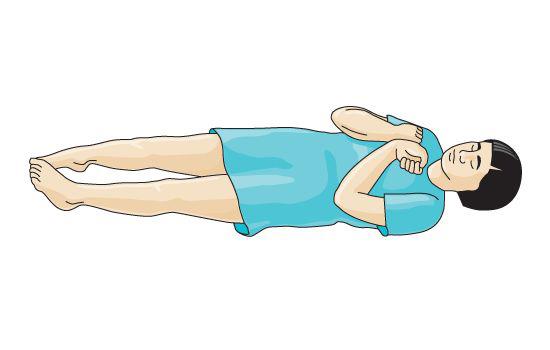 The nurse is performing an assessment on a client with a head injury and notes that the client is assuming this posture. The nurse contacts the primary health care provider and reports that the client is exhibiting which posture? Refer to figure. 1.Opisthotonos 2.Decorticate rigidity 3.Decerebrate rigidity 4.Flaccid quadriplegia | back 21 2.Decorticate rigidity |
front 22 A client with a traumatic brain injury is able, with eyes closed, to identify a set of keys placed in their hands. On the basis of this assessment finding, the nurse determines that there is appropriate function of which lobe of the brain? 1.Frontal 2.Parietal 3.Occipital 4.Temporal | back 22 2.Parietal |
front 23 A client has suffered a head injury affecting the occipital lobe of the brain. What is the focus of the nurse's immediate assessment? 1.Taste 2.Smell 3.Vision 4.Hearing | back 23 3.Vision |
front 24 The nurse notes that a client who has suffered a brain injury has an adequate heart rate, blood pressure, fluid balance, and body temperature. Based on these clinical findings, the nurse determines that which brain area is functioning properly? 1.Thalamus 2.Hypothalamus 3.Limbic system 4.Reticular activating system | back 24 2.Hypothalamus |
front 25 A client with chronic obstructive pulmonary disease who sustained a head injury has a high level of carbon dioxide (CO2) in the bloodstream, as measured by arterial blood gases. The nurse anticipates that which underlying pathophysiology can occur as a result of this elevated CO2? 1.It will cause arteriovenous shunting. 2.It will cause vasodilation of blood vessels in the brain. 3.It will cause blood vessels in the circle of Willis to collapse. 4.It will cause hyperresponsiveness of blood vessels in the brain. | back 25 2.It will cause vasodilation of blood vessels in the brain. |
front 26 To promote optimal cerebral tissue perfusion in the postoperative phase following cranial surgery, the nurse would place the client with an incision in the anterior or middle fossa in which position? 1.15 degrees of Trendelenburg's 2.Side-lying with the head of the bed flat 3.With the head of the bed elevated at least 30 degrees 4.With the head of the bed elevated no more than 10 degrees | back 26 3.With the head of the bed elevated at least 30 degrees |
front 27 The nurse is assessing a client with a brainstem injury. In addition to obtaining the client's vital signs and determining the Glasgow Coma Scale score, what priority intervention would the nurse plan to implement? 1.Check cranial nerve functioning. 2.Determine the cause of the accident. 3.Draw blood for arterial blood gas analysis. 4.Perform a pulmonary wedge pressure measurement. | back 27 3.Draw blood for arterial blood gas analysis. |
front 28 The nurse is preparing to care for a client who had a supratentorial craniotomy. The nurse would plan to place the client in which position? 1.Prone 2.Supine 3.Side-lying 4.Semi-Fowler's | back 28 4.Semi-Fowler's |
front 29 The nurse is admitting a client to the hospital emergency department from a nursing home. The client is unconscious with an apparent frontal head injury. A medical diagnosis of epidural hematoma is suspected. Which question is of the highest priority for the emergency department nurse to ask of the transferring nurse at the nursing home? 1."When did the injury occur?" 2."Was the client awake and talking right after the injury?" 3."What medications has the client received since the fall?" 4."What was the client's level of consciousness before the injury?" | back 29 2."Was the client awake and talking right after the injury?" |
front 30 The nurse has just admitted to the nursing unit a client with a basilar skull fracture who is at risk for increased intracranial pressure (ICP). Pending specific primary health care provider prescriptions, the nurse would place the client in which positions? Select all that apply. 1.Head midline 2.Neck in neutral position 3.Flat, with head turned to the side 4.Head of bed elevated 30 to 45 degrees 5.Head of bed elevated with the neck extended | back 30 1.Head midline 2.Neck in neutral position 4.Head of bed elevated 30 to 45 degrees |
front 31 The client with a head injury opens eyes to sound, has no verbal response, and localizes to painful stimuli when applied to each extremity. How would the nurse document the Glasgow Coma Scale (GCS) score? 1.GCS = 3 2.GCS = 6 3.GCS = 9 4.GCS = 11 | back 31 3.GCS = 9 |
front 32 The nurse is positioning a client who has increased intracranial pressure as a result of a head injury. Which position would the nurse plan to avoid? 1.Head midline 2.Head turned to the side 3.Neck in neutral position 4.Head of bed elevated 30 to 45 degrees | back 32 2.Head turned to the side |
front 33 A postoperative craniotomy client who sustained a severe head injury is admitted to the neurological unit. What nursing intervention is necessary for this client? 1.Take and record vital signs every 4 to 8 hours. 2Prophylactically hyperventilate during the first 24 hours. 3Treat a central fever with the administration of antipyretic medications such as acetaminophen. 4.Keep the head of the bed elevated at least 30 degrees, and position the client to avoid extreme flexion or extension of the neck and head. | back 33 4.Keep the head of the bed elevated at least 30 degrees, and position the client to avoid extreme flexion or extension of the neck and head. |
front 34 The nurse caring for a client following craniotomy who has a supratentorial incision understands that the client would most likely be maintained in which position? 1.Prone position 2.Supine position 3.Semi-Fowler's position 4.Dorsal recumbent position | back 34 3.Semi-Fowler's position |
front 35 1.Eye opening 2.Reflex response 3.Best verbal response 4.Best motor response 5.Pupil size and reaction | back 35 1.Eye opening 3.Best verbal response 4.Best motor response |
front 36 A client with a traumatic closed head injury shows signs of secondary brain injury. What are some manifestations of secondary brain injury? Select all that apply. 1.Fever 2.Seizures 3.Hypoxia 4.Ischemia 5.Hypotension 6.Increased intracranial pressure (ICP) | back 36 3.Hypoxia 4.Ischemia 5.Hypotension 6.Increased intracranial pressure (ICP) |
front 37 The nurse walking in a downtown business area witnesses a worker fall from a ladder. The nurse rushes to the victim who is unresponsive. A layperson is attempting to perform resuscitative measures. The nurse would intervene if which action by the layperson is noted? 1.Use of the head tilt–chin lift 2.Checking the scene for safety 3.Use of the jaw thrust maneuver 4.Moving the client away from traffic | back 37 1.Use of the head tilt–chin lift |
front 38 A client with a probable minor head injury resulting from a motor vehicle crash is admitted to the hospital for observation. The nurse leaves the cervical collar applied to the client in place until when? 1.The family comes to visit. 2The nurse needs to do physical care. 3.The primary health care provider makes rounds. 4.The results of spinal radiography are known. | back 38 4.The results of spinal radiography are known. |
front 39 Which interventions would be included in the care of a client with a head injury and a subarachnoid bolt? Select all that apply. 1.Monitor vital signs. 2.Monitor neurological status. 3.Monitor the dressing for signs of infection. 4.Monitor for signs of increased intracranial pressure. 5.Drain cerebrospinal fluid when the intracranial pressure is elevated. | back 39 1.Monitor vital signs. 2.Monitor neurological status. 3.Monitor the dressing for signs of infection. 4.Monitor for signs of increased intracranial pressure. |
front 40 The nurse is caring for a client in the emergency department who has sustained a head injury. The client momentarily lost consciousness at the time of the injury and then regained it. The client now has lost consciousness again. The nurse takes quick action, knowing that this sequence is compatible with which most likely condition? 1.Concussion 2.Skull fracture 3.Subdural hematoma 4.Epidural hematoma | back 40 4.Epidural hematoma |
front 41 A client has a closed head injury with increased intracranial pressure (ICP). The increased ICP is being managed by mannitol 25 g by the intravenous (IV) route every 2 hours. The nurse is planning to administer this medication via IV pump in what manner? 1.Mixed in solution with the IV antibiotics 2.Giving it slowly over 30 to 90 minutes 3.Piggybacked into the packed red blood cells 4.Giving it rapidly over 5 minutes by IV bolus | back 41 2.Giving it slowly over 30 to 90 minutes |
front 42 The nurse is monitoring ongoing care for a potential organ donor who has been diagnosed with brain death following a severe head injury. Which finding indicates to the nurse that the standard for ongoing care has been maintained? 1.Pao2 70 mm Hg 2.Urine output 100 mL/hr 3.Heart rate 52 beats/min 4.Blood pressure 90/48 mm Hg | back 42 2.Urine output 100 mL/hr |
front 43 A client who suffered a severe head injury has had vigorous treatment to control cerebral edema. Brain death has been determined. The nurse prepares to carry out which measure to maintain viability of the kidneys before organ donation? 1.Assessing lung sounds 2.Monitoring temperature 3.Administering intravenous (IV) fluids 4.Performing range-of-motion exercises to the extremities | back 43 3.Administering intravenous (IV) fluids |
front 44 The nurse is performing a neurological assessment on a client with a head injury. The nurse would use which technique to assess the plantar reflex? 1.Stroking the foot from the heel to the toe 2.Gently inserting a gloved finger in the rectum 3.Directing a flashlight onto the pupils of the eyes 4.Using a tongue depressor and stimulating the back of the throat | back 44 1.Stroking the foot from the heel to the toe |
front 45 A client has a cerebellar lesion. The nurse would plan to obtain which item for use by the client? 1.Walker 2.Slider board 3.Raised toilet seat 4.Adaptive eating utensils | back 45 1.Walker |
front 46 A client is brought to the emergency department by emergency medical services (EMS) after being hit by a car. The name of the client is unknown, and the client has sustained a severe head injury and multiple fractures and is unconscious. An emergency craniotomy is required. Regarding informed consent for the surgical procedure, which is the best action? 1.Obtain a court order for the surgical procedure. 2Ask the EMS team to sign the informed consent. 3.Transport the victim to the operating room for surgery. 4.Call the police to identify the client and locate the family. | back 46 3.Transport the victim to the operating room for surgery. |
front 47 The nurse prepares to teach a client with subarachnoid hemorrhage about the effects of nimodipine. The nurse plans to explain which information about the type and action of this medication? 1.Vasodilator that has an affinity for cerebral blood vessels 2.Beta-adrenergic blocker that will decrease blood pressure 3.Diuretic that will decrease blood pressure by decreasing fluid volume 4.Calcium channel blocker that will decrease spasm in cerebral blood vessels | back 47 4.Calcium channel blocker that will decrease spasm in cerebral blood vessels |
front 48 The client with a traumatic brain injury (TBI) has begun to excrete copious amounts of dilute urine through the Foley catheter. The client's urine output for the previous shift was 3000 mL. The nurse expects that the primary health care provider will prescribe which medication? 1.Mannitol 2.Desmopressin 3.Ethacrynic acid 4.DexamethasoneSubmit | back 48 2.Desmopressin |
front 49 A client with a subarachnoid hemorrhage needs to have surgery delayed until a stable clinical condition is achieved. The nurse prepares to administer which medication as prescribed to prevent clot breakdown and dissolution? 1.Alteplase 2.Heparin sodium 3.Warfarin sodium 4.Aminocaproic acid | back 49 4.Aminocaproic acid |
front 50 The client with a head injury is experiencing signs of increased intracranial pressure (ICP), and mannitol is prescribed. The nurse administering this medication expects which as intended effects of this medication? Select all that apply. 1.Reduced ICP 2.Increased diuresis 3.Increased osmotic pressure of glomerular filtrate 4.Reduced tubular reabsorption of water and solutes 5.Reabsorption of sodium and water in the loop of Henle | back 50 1.Reduced ICP 2.Increased diuresis 3.Increased osmotic pressure of glomerular filtrate 4.Reduced tubular reabsorption of water and solutes |
front 51 The nurse has a prescription to give dexamethasone by the intravenous (IV) route to a client with cerebral edema. How would the nurse prepare this medication? 1.Diluting the medication in 500 mL of 5% dextrose 2.Preparing an undiluted direct injection of the medication 3.Diluting the medication in 1 mL of lactated Ringer's solution for direct injection 4.Diluting the medication in 10% dextrose in water and administering it as a direct injection | back 51 2.Preparing an undiluted direct injection of the medication |
front 52 Dexamethasone intravenously is prescribed for the client with cerebral edema. The nurse prepares the medication for administration and plans to perform which action? 1.Administer the medication by direct injection. 2Mix the medication in 1000 mL of 5% dextrose. 3.Mix the medication in 100 mL of lactated Ringer's solution. 4.Dilute the medication in lactated Ringer's solution and administer as a direct injection. | back 52 1.Administer the medication by direct injection. |
front 53 A client is brought to the emergency department by emergency medical services (EMS) after being hit by a car. The name of the client is unknown, and the client has sustained a severe head injury and multiple fractures and is unconscious. An emergency craniotomy is required. Regarding informed consent for the surgical procedure, which is the best action? 1.Obtain a court order for the surgical procedure. 2.Ask the EMS team to sign the informed consent. 3.Transport the victim to the operating room for surgery. 4.Call the police to identify the client and locate the family. | back 53 3.Transport the victim to the operating room for surgery. |
front 54 The nurse is assessing the motor and sensory function of an unconscious client who sustained a head injury. The nurse would use which technique to test the client's peripheral response to pain? 1.Sternal rub 2.Pressure on nail beds 3.Pressure on the orbital rim 4.Squeezing of the sternocleidomastoid muscle | back 54 2.Pressure on nail beds |
front 55 The nurse is caring for a client with increased intracranial pressure as a result of a head injury. The nurse would note which trend in vital signs if the intracranial pressure is rising? 1.Increasing temperature, increasing pulse, increasing respirations, decreasing blood pressure 2.Increasing temperature, decreasing pulse, decreasing respirations, increasing blood pressure 3.Decreasing temperature, decreasing pulse, increasing respirations, decreasing blood pressure 4.Decreasing temperature, increasing pulse, decreasing respirations, increasing blood pressure | back 55 2.Increasing temperature, decreasing pulse, decreasing respirations, increasing blood pressure |
front 56 A client recovering from a head injury is participating in care. The nurse determines that the client understands measures to prevent elevations in intracranial pressure if the nurse observes the client doing which activity? 1.Blowing the nose 2.Isometric exercises 3.Coughing vigorously 4.Exhaling during repositioning | back 56 4.Exhaling during repositioning |
front 57 A client has clear fluid leaking from the nose following a basilar skull fracture. Which finding would alert the nurse that cerebrospinal fluid is present? 1.Fluid is clear and tests negative for glucose. 2Fluid is grossly bloody in appearance and has a pH of 6. 3.Fluid clumps together on the dressing and has a pH of 7. 4.Fluid separates into concentric rings and tests positive for glucose. | back 57 4.Fluid separates into concentric rings and tests positive for glucose. |
front 58 The nurse is monitoring a client with a head injury for signs of increased intracranial pressure. The nurse would note which trend in vital signs if the intracranial pressure is rising? 1.Increasing temperature, increasing pulse, increasing respirations, decreasing blood pressure 2.Increasing temperature, decreasing pulse, decreasing respirations, increasing blood pressure 3.Decreasing temperature, decreasing pulse, increasing respirations, decreasing blood pressure 4.Decreasing temperature, increasing pulse, decreasing respirations, increasing blood pressure | back 58 2.Increasing temperature, decreasing pulse, decreasing respirations, increasing blood pressure |