Instructions for Side by Side Printing
- Print the notecards
- Fold each page in half along the solid vertical line
- Cut out the notecards by cutting along each horizontal dotted line
- Optional: Glue, tape or staple the ends of each notecard together
econ final
front 1 1. Increase in the price of oil (an important input to production) will result in which of the following in the short run? | back 1 (B) A decrease in short-run aggregate supply |
front 2 2. An economy operating at full employment; which would result in a recessionary gap in the short run? | back 2 (A) An increase in the costs of production |
front 3 3. If the price level in Thailand decreases relative to Malaysia, what happens to Thailand’s exports and aggregate demand? | back 3 (A) Exports increase; aggregate demand increases |
front 4 4. Assuming year 1 is the base year, what is nominal and real GDP for year 2? | back 4 (D) Nominal GDP = $280; Real GDP = $200 |
front 5 5. Which is a fiscal policy action aimed at reducing unemployment? | back 5 (B) Decreasing income taxes |
front 6 6. Increases in human capital can be achieved by which of the following? | back 6 (C) Improving the quality of job-training programs |
front 7 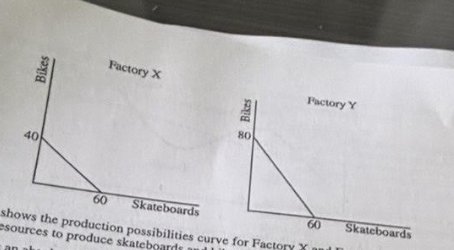 1. Based on the PPCs, which statement is true? | back 7 (E) Factory Y has an absolute advantage in producing skateboards |
front 8 1. According to the business cycle diagram, actual unemployment equals the natural rate when the economy is: | back 8 (E) On the potential line |
front 9 2. A fiscal policy action to reduce inflationary pressure would be to increase which of the following? | back 9 (E) Income tax rates |
front 10 3. Nominal GDP of China in 2010 measures the total value of: | back 10 (D) Final goods and services produced within the borders of China |
front 11 4. If the government reduces spending and raises income taxes, the most likely short-run result is an increase in: | back 11 (B) Unemployment |
front 12 5. Which statement about inflation and interest rates is true? | back 12 (B) If there is no actual or expected inflation, the nominal and real interest rates are equal |
front 13 1. Economic growth is shown by a rightward shift in the: | back 13 (C) PPC Curve |
front 14 2. During a period of stagnation, a nation is most likely experiencing: | back 14 (D) a decrease in short-run aggregate supply |
front 15 3. If businesses become optimistic about investments in an economy, which of the following will happen in the loanable funds market in the short run? | back 15 (D) the real interest rate will increase |
front 16 4. If investment demand becomes less responsive to changes in interest rates, which of the following is true? | back 16 (B) an expansionary fiscal policy will result in more crowding out |
front 17 5. Which of the following measures the opportunity cost of holding currency? | back 17 (C) the forgone interest on alternative assets |
front 18 6. A contractionary monetary policy combined with an expansionary fiscal policy will: | back 18 (D) an increase in the interest rate and a decrease in investment |
front 19 7. Ms. Smith withdraws $1,000 from her safe and deposits it in a bank. If the bank holds no excess reserves and the reserve requirement is 10 percent, how will this deposit increase the bank’s required reserves and the bank’s loans? | back 19 Required Reserves: (B) $100 Loans: (D) $1,000 |
front 20 8. A country can have an increased surplus in its balance of trade as a result of: | back 20 (B) declining imports and rising exports |
front 21 9. Country X has a budget deficit. Which of the following changes in government budget outlays and tax revenues will result in a decrease in Country X’s government budget deficit? | back 21 (D) government outlays rise by $400 million and tax revenues rise by $600 million |
front 22 1. The table shows the quantity of motorcycles and automobiles produced by two countries that use the same amount of resources. Which of the following is true? | back 22 (E) Country Y has an absolute and comparative advantage in motorcycles |
front 23 2. Which of the following is an example of how the consumer price index (CPI) exhibits bias in its estimates of changes in the cost of living? | back 23 (D) product improvements are not fully reflected in the CPI |
front 24 3. Fred Jones withdraws $1,000 in cash from his savings account. What immediate effect does this transaction have on the monetary aggregate measures of M1 and M2? | back 24 M1: (A) Increases M2: (C) No change |
front 25 4. Which of the following is true about inflationary expectations? | back 25 (D) product improvements are not fully reflected in the CPI |
front 26 5. Which of the following transactions is included in the financial account of Country X’s balance of payments accounts? | back 26 (E) residents of Country X buy foreign government bonds |
front 27 6. Assume a country’s government increases taxes and its central bank increases its administered interest rates. The actions will result in an increase in which of the following in the short run? | back 27 (E) residents of Country X buy foreign government bonds |
front 28 7. When there is excess demand in the loanable funds market, which of the following will occur? | back 28 (C) Real interest rates will increase. |
front 29 1. If the marginal propensity to save is 0.25, a $15 billion increase in government spending will lead to an increase in national income by a maximum of: | back 29 (A) $60 billion |
front 30 2. Assume the banking system has limited reserves and the economy is currently in long-run equilibrium. An increase in the money supply will affect unemployment in the short run and in the long run in which of the following ways? | back 30 D) short run - rises above natural rate long run - falls back to natural rate |
front 31 3. The term "value added" for a firm is best defined as which of the following? | back 31 (C) The firm’s sales minus its costs of inputs purchased from other firms |
front 32 4. An increase in a country’s current account surplus will result in which of the following in the short run? | back 32 (E) an increase in the country's national debt |
front 33 5. Using 2010 as the base year, the gross domestic product (GDP) deflator in 2011 was 97. Which of the following must be true? | back 33 (D) the purchasing power of the dollar decreased by 3 percent |