Instructions for Side by Side Printing
- Print the notecards
- Fold each page in half along the solid vertical line
- Cut out the notecards by cutting along each horizontal dotted line
- Optional: Glue, tape or staple the ends of each notecard together
Campbell Biology 10th Edition Flashcards Unit 7 Flashcards Flashcards
front 1 EV1C-When they were first sold, aerosol insecticides were highly effective in killing flies and mosquitoes. Now, several decades later, a much smaller proportion of these insects die when sprayed. The reason fewer insects die when they are sprayed is that _____. | back 1 many mosquitoes today are descendants of mosquitoes with insecticide-resistant characteristics |
front 2 EV1C-A farmer uses triazine herbicide to control pigweed in his field. For the first few years, the triazine works well and almost all the pigweed dies; but after several years, the farmer sees more and more pigweed. Which of these statements explains why the pigweed reappeared? | back 2 Triazine-resistant weeds were more likely to survive and reproduce. |
front 3 EV1C-Which of these conditions are always true of populations evolving due to natural selection? Condition 1: The population must vary in traits that are heritable. Condition 2: Some heritable traits must increase reproductive success. Condition 3: Individuals pass on most traits that they acquire during their lifetime. | back 3 Conditions 1 and 2 |
front 4 EV1C-Given a population that contains genetic variation, what is the correct sequence of the following events under the influence of natural selection? | back 4 2 > 4 > 1 > 3 |
front 5 EV1D, EV1E-The following question is based on information from Frank M. Frey, "Opposing Natural Selection from Herbivores and Pathogens May Maintain Floral-Color Variation in Claytonia virginica (Portulacaceae)," Evolution 58(11), 2004: 2426-37. Claytonia virginica is a woodland spring herb with flowers that vary from white to pale pink to bright pink. Slugs prefer to eat pink-flowering over white-flowering plants (due to chemical differences between the two), and plants experiencing severe herbivory are more likely to die. The bees that pollinate this plant also prefer pink to white flowers, so that Claytonia with pink flowers have greater relative fruit set than Claytonia with white flowers. A researcher observes that the percentage of different flower colors remains stable in the study population from year to year. Given no other information, if the researcher removes all slugs from the study population, what do you expect to happen to the distribution of flower colors in the population over time? | back 5 The percentage of pink flowers should increase over time. |
front 6 EV1D, EV1E-After the drought of 1977, researchers on the island of Daphne Major hypothesized that medium ground finches that had large, deep beaks, survived better than those with smaller beaks because they could more easily crack and eat the tough Tribulus cistoides fruits. If this hypothesis is correct, what would you expect to observe if a population of these medium ground finches colonizes a nearby island where Tribulus cistoides is the most abundant food for the next 1000 years? Assume that (1) even the survivors of the 1977 drought sometimes had difficulty cracking the tough T. cistoides fruits and would eat other seeds when offered a choice; and (2) food availability is the primary limit on finch fitness on this new island. | back 6 evolution of yet larger, deeper beaks over time |
front 7 EV1D, EV1E-After the drought of 1977, researchers hypothesized that on the Galápagos island Daphne Major, medium ground finches with large, deep beaks survived better than those with smaller beaks because they could more easily crack and eat the tough Tribulus cistoides fruits. A tourist company sets up reliable feeding stations with a variety of bird seeds (different types and sizes) so that tourists can get a better look at the finches. Which of these events is now most likely to occur to finch beaks on this island? | back 7 increased variation in beak size and shape over time |
front 8 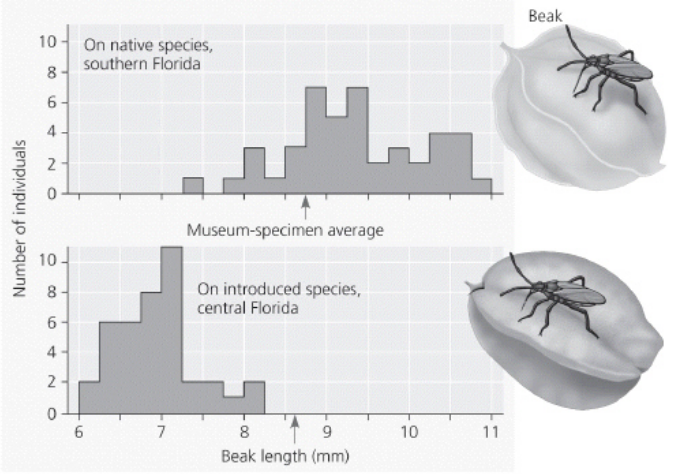 EV1D, EV1E- From a study of soapberry bugs (Jadera haematoloma), a similar theme emerges that reflects the process of natural selection that Charles Darwin observed in the Galapagos finches. In order for soapberry bugs to feed, their “beak” length must match the depth of seeds in the balloon vine fruit. In central Florida, the native balloon vine has become rare, and the Goldenrain tree, an introduced species from Asia, has become the main food source for soapberry bugs. Carroll and Boyd (1992) compared beak lengths of soapberry bug populations that fed on the native balloon vine in southern Florida with central Florida populations that fed on the Goldenrain tree, whose seeds are much closer to the fruit surface than the seeds of the plump balloon vine fruit. The researchers compared these data with the average beak length in museum specimens collected from the two areas before the Goldenrain tree was introduced (indicated by the red arrows). Which of the following suggestions is most likely true regarding the results of this study? | back 8 Soapberry bugs with shorter beaks had a selective advantage in Central Florida because they were better able to feed on Goldenrain fruits. |
front 9 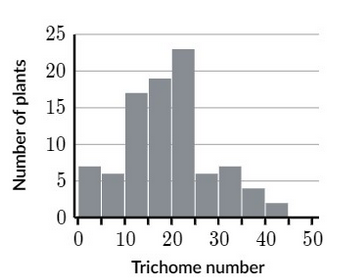 EV1F-Brassica rapa plants have small, hair-like structures called trichomes on their stems and leaves. The number of trichomes on a plant is genetically determined and can vary widely among individuals. A group of students grew a population of B. rapa plants, Generation 1, in their classroom and counted the number of trichomes on the first true leaf of each plant (Figure 1). Next, the students used the Generation 1 plants with the highest number of trichomes as parents for the next generation, Generation 2. The students grew the B. rapa plants of Generation 2 and counted the number of trichomes on the first true leaf of each plant (Figure 2). Then, the students used the Generation 2 plants with the highest number of trichomes as parents for the third generation, Generation 3. Which of the following graphs best predicts the distribution of trichome number in Generation 3? | back 9 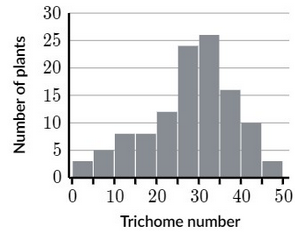 C. |
front 10 EV1F-In a large population of randomly breeding organisms, the frequency of a recessive allele is initially 0.3. There is no migration and no selection. Humans enter this ecosystem and selectively hunt individuals showing the dominant trait. When the gene frequency is reexamined at the end of the year, _____. | back 10 the frequency of the homozygous dominants will go down, the frequency of the heterozygous genotype will remain the same, and the frequency of the homozygous recessives will go up |
front 11 EV1F-Starting from the wild mustard Brassica oleracea, breeders have created the strains known as Brussels sprouts, broccoli, kale, and cabbage. Therefore, which of the following statements is correct? | back 11 In this wild mustard, there is enough heritable variation to permit these different varieties. |
front 12 EV1F-The cow Bos primigenius (which is bred for meat and milk) has a smaller brain and larger eyes than closely related wild species of ungulates. These traits most likely arose by ____. | back 12 artificial selection, because changes in these traits co-occurred with human selection for high milk output and high muscle content |
front 13 EV1G-Some beetles and flies have antler-like structures on their heads, much like male deer do. The existence of antlers in beetle, fly, and deer species with strong male-male competition is an example of ____. | back 13 convergent evolution |
front 14  EV1G- Which statement best explains the similarity in phenotypic adaptations seen in the Arctic beluga whale (left image) and Antarctic right whale (right image) below. | back 14 Streamlined bodies enabled both species to survive and thrive in aquatic environments. |
front 15 EV1G-The four-chambered hearts of birds and the four-chambered hearts of mammals evolved independently of each other. If one were unaware of this independence, then one might logically conclude that | back 15 the common ancestor of birds and mammals had a four-chambered heart. |
front 16 EV1G-Some molecular data place the giant panda in the bear family (Ursidae) but place the lesser panda in the raccoon family (Procyonidae). If the molecular data best reflect the evolutionary history of these two groups, then the morphological similarities of these two species is most likely due to ____. | back 16 possession of analogous (convergent) traits |
front 17 EV1H, EV1I-An earthquake decimates a ground-squirrel population, killing 98% of the squirrels. The surviving population happens to have broader stripes, on average, than the initial population. If broadness of stripes is genetically determined, what effect has the ground-squirrel population experienced during the earthquake? | back 17 a genetic bottleneck |
front 18 EV1H, EV1I-A population of 15 birds inhabits a fairly new island. Ten of the birds are dark brown and five of them are light brown. By chance, two of the dark brown birds and three of the light brown birds die before producing any offspring. All of the birds in the next generation are dark brown. This change in phenotypic frequency can be attributed to _____. | back 18 genetic drift |
front 19 EV1H, EV1I-The Dunkers are a religious group that moved from Germany to Pennsylvania in the mid-1700s. They do not marry with members outside their own immediate community. Today, the Dunkers are genetically unique and differ in gene frequencies, at many loci, from all other populations including those in their original homeland. Which of the following likely explains the genetic uniqueness of this population? | back 19 founder effect and genetic drift |
front 20 EV1H, EV1I-In 1983 a population of dark-eyed junco birds became
established on the campus of the University of California, San Diego
(UCSD), which is located many miles from the junco's normal habitat in
the mixed-coniferous temperate forests in the mountains. Juncos have
white outer tail feathers that the males display during aggressive
interactions and during courtship displays. Males with more white in
their tail are more likely to win aggressive interactions, and females
prefer to mate with males with more white in their tails. Females have
less white in their tails than do males, and display it less often.
(Pamela J. Yeh. 2004. Rapid evolution of a sexually selected trait
following population establishment in a novel habitat. Evolution
58[1]:166-74.) | back 20 a founder effect |
front 21 EV1J-_____ and _____ generate variation, while _____ results in an adaptation to the environment. | back 21 Mutation; sexual recombination; natural selection |
front 22 EV1J-To observe natural selection's effects on a population, which of these must be true? | back 22 The population must contain genetic variation. |
front 23 EV1J-Which of the following must exist in a population before natural
selection can act upon that population? | back 23 I and III |
front 24 EV1J-Genetic variation ____. | back 24 must be present in a population before natural selection can act upon the population |
front 25 EV1K-For biologists studying a large flatworm population in the lab, which Hardy-Weinberg condition is most difficult to meet? | back 25 no mutation |
front 26 EV1K-Cystic fibrosis is a genetic disorder in homozygous recessives that causes death during the teenage years. If 9 in 10,000 newborn babies have the disease, what are the expected frequencies of the dominant (A1) and recessive (A2) alleles according to the Hardy-Weinberg model? | back 26 f(A1) = 0.9700, f(A2) = 0.0300 |
front 27 EV1K-Suppose 64% of a remote mountain village can taste phenylthiocarbamide (PTC) and must, therefore, have at least one copy of the dominant PTC taster allele. If this population conforms to Hardy-Weinberg expectations for this gene, what percentage of the population must be heterozygous for this trait? | back 27 48% |
front 28  The following question(s) are based on information in Hopi E.
Hoekstra, Kristen E. Drumm, and Michael W. Nachman, "Ecological
Genetics of Adaptive Color Polymorphism in Pocket Mice: Geographic
Variation in Selected and Neutral Genes," Evolution 58(6), 2004:
1329-41. | back 28 Xmas-high dd frequency; Mid-high DD frequency, O'Neill-high Dd frequency |
front 29 Use the following information to answer the question(s) below. A large population of laboratory animals has been allowed to breed randomly for a number of generations. After several generations, 25% of the animals display a recessive trait (aa), the same percentage as at the beginning of the breeding program. The rest of the animals show the dominant phenotype, with heterozygotes indistinguishable from the homozygous dominants. EV1L-What is the most reasonable conclusion that can be drawn from the fact that the frequency of the recessive trait (aa) has not changed over time? | back 29 The two phenotypes are about equally adaptive under laboratory conditions. |
front 30 EV1L-You are studying three populations of birds. Population A has
ten birds, of which one is brown (a recessive trait) and nine are red.
Population B has 100 birds, of which ten are brown. Population C has
30 birds, and three of them are brown. | back 30 Population A. |
front 31 EV1L-Whenever diploid populations are in Hardy-Weinberg equilibrium at a particular locus, ____. | back 31 the allele's frequency should not change from one generation to the next |
front 32 Refer to the information below to answer the following questions. You are studying three populations of birds. Population 1 has ten
birds, of which one is brown (a recessive trait) and nine are red.
Population 2 has 100 birds. In that population, ten of the birds are
brown. Population 3 has 30 birds, and three of them are brown. Use the
following options to answer the question: EV1L-In which population would it be most likely that an accident would significantly alter the frequency of the brown allele? | back 32 A |
front 33  EV1M, EV1N-The figure below represents a cross section of the sea floor through a mid-ocean rift valley, with alternating patches of black and white indicating sea floor with reversed magnetic polarities. At the arrow labeled "I" (the rift valley), the igneous rock of the sea floor is so young that it can be accurately dated using carbon-14 dating. At the arrow labeled "III," however, the igneous rock is about one million years old, and potassium-40 dating is typically used to date such rocks. Note: The horizontal arrows indicate the direction of sea-floor spreading, away from the rift valley. If a particular marine organism is fossilized in the sediments immediately overlying the igneous rock at the arrow labeled "II," at which other location, labeled A-E, would a search be most likely to find more fossils of this organism? | back 33 C |
front 34 EV1M, EV1N-About thirteen different species of finches inhabit the Galápagos Islands today, all descendants of a common ancestor from the South American mainland that arrived a few million years ago. Genetically, there are four distinct lineages, but the thirteen species are currently classified among three genera. The first lineage to diverge from the ancestral lineage was the warbler finch (genus Certhidea). Next to diverge was the vegetarian finch (genus Camarhynchus), followed by five tree finch species (also in genus Camarhynchus) and six ground finch species (genus Geospiza). If the six ground finch species have evolved most recently, then which of these is the most logical prediction? | back 34 Their genomes should be more similar to each other than are the genomes of the five tree finch species. |
front 35 EV1M, EV1N-Many crustaceans (for example, lobsters, shrimp, and crayfish) use their tails to swim, but crabs have reduced tails that curl under their shells and are not used in swimming. This is an example of ____. | back 35 a vestigial trait |
front 36  EV1M, EV1N-A sediment core is removed from the floor of an inland
sea. The sea has been in existence, off and on, throughout the entire
time that terrestrial life has existed. Researchers wish to locate and
study the terrestrial organisms fossilized in this core. The core is
illustrated as a vertical column, with the top of the column
representing the most recent strata and the bottom representing the
time when land was first colonized by life. | back 36 core A |
front 37 EV1O-During periods of rapid environmental change, what may happen to a species that was well-suited to the former environment? | back 37 Individuals with particular traits that provide an advantage in the new environment will have higher reproductive success. |
front 38 EV1O-During drought years on the Galapagos, small, easily eaten seeds become rare, leaving mostly large, hard-cased seeds that only birds with large beaks can eat. If a drought persists for several years, what should one expect to result from natural selection? | back 38 More small-beaked birds dying than larger-beaked birds. The offspring produced in subsequent generations have a higher percentage of birds with large beaks. |
front 39 EV1O-For several years, scientists have warned doctors of the danger of overprescribing antibiotics such as penicillin. Scientists are concerned because _____. | back 39 strains of microorganisms that are resistant to these drugs will be selected for |
front 40 EV1O-Which of the following examples of an ecological effect leading to an evolutionary effect is most correct? | back 40 A few individuals with denser fur survive the coldest days of an ice age, and the reproducing survivors of the ice age will likely have more dense fur. |
front 41 EV2B-Which of the following was derived from an ancestral cyanobacterium? | back 41 chloroplast |
front 42 EV2B-All animals with eyes or eyespots that have been studied so far share a gene in common. When mutated, the gene Pax-6 causes lack of eyes in fruit flies, tiny eyes in mice, and missing irises (and other eye parts) in humans. The sequence of Pax-6 in humans and mice is identical. There are so few sequence differences with fruit fly Pax-6 that the human/mouse version can cause eye formation in eyeless fruit flies, even though vertebrates and invertebrates last shared a common ancestor more than five hundred million years ago. The appearance of Pax-6 in all animals with eyes can be explained in multiple ways. Based on the information above, which explanation is most likely? | back 42 The Pax-6 gene was an innovation of an ancestral animal of the early Cambrian period. Animals with eyes or eyespots are descendants of this ancestor. |
front 43 EV2B-All animals with eyes or eyespots that have been studied so far share a gene in common. When mutated, the gene Pax-6 causes lack of eyes in fruit flies, tiny eyes in mice, and missing irises (and other eye parts) in humans. The sequence of Pax-6 in humans and mice is identical. There are so few sequence differences with fruit fly Pax-6 that the human/mouse version can cause eye formation in eyeless fruit flies, even though vertebrates and invertebrates last shared a common ancestor more than five hundred million years ago. Fruit-fly eyes are of the compound type, which is structurally very different from the camera-type eyes of mammals. Even the camera-type eyes of molluscs, such as octopi, are structurally quite different from those of mammals. Yet, fruit flies, octopi, and mammals possess very similar versions of Pax-6. The fact that the same gene helps produce very different types of eyes is most likely due to ____. | back 43 differences in the control of Pax-6 expression among these organisms |
front 44 EV2B-Proton pumps are used in various ways by members of every domain of organisms: Bacteria, Archaea, and Eukarya. What does this most probably mean? | back 44 Proton gradients across a membrane were used by cells that were the common ancestor of all three domains of life. |
front 45 EV3A-A farmer uses triazine herbicide to control pigweed in his field. For the first few years, the triazine works well and almost all the pigweed dies; but after several years, the farmer sees more and more pigweed. Which of these explanations best explains what happened? | back 45 Triazine-resistant weeds were more likely to survive and reproduce. |
front 46  The following question refer to the figure below, which shows an outcrop of sedimentary rock whose strata are labeled A-D. EV3A-If x indicates the location of fossils of two closely related species, then fossils of their most-recent common ancestor are most likely to occur in which stratum? | back 46 C |
front 47 EV3A-The following question refers to this hypothetical situation. A female fly, full of fertilized eggs, is swept by high winds to an island far out to sea. She is the first fly to arrive on this island and the only fly to arrive in this way. Thousands of years later, her numerous offspring occupy the island, but none of them resembles her. There are, instead, several species, each of which eats only a certain type of food. None of the species can fly and their balancing organs (halteres) are now used in courtship displays. The male members of each species bear modified halteres that are unique in appearance to their species. Females bear vestigial halteres. The ranges of all of the daughter species overlap. In each fly species, the entire body segment that gave rise to the original flight wings is missing. The mutation(s) that led to the flightless condition could have ____. | back 47 altered the expression of a Hox gene |
front 48 EV3A-Why would gene duplication events, such as those seen in the Hox gene complex, set the stage for adaptive radiation? | back 48 One copy of a gene can perform the original function, while other copies are available to take on new functions. |
front 49 EV3B, EV3C-Of the following anatomical structures, which is homologous to the bones in the wing of a bird? | back 49 bones in the flipper of a whale |
front 50 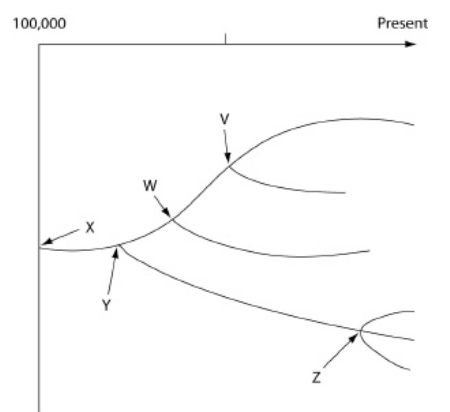 EV3B, EV3C-The horizontal axis of the cladogram depicted below is a
timeline that extends from 100,000 years ago to the present; the
vertical axis represents nothing in particular. The labeled branch
points on the tree (V-Z) represent various common ancestors. Let's say
that only since 50,000 years ago has there been enough variation
between the lineages depicted here to separate them into distinct
species, and only the tips of the lineages on this tree represent
distinct species. | back 50 Y. |
front 51 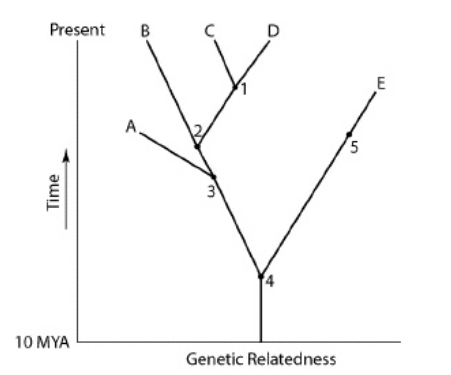 Use the figure below to answer the following question(s). | back 51 A |
front 52 EV3B, EV3C-A phylogenetic tree constructed using sequence differences in mitochondrial DNA would be most valid for discerning the evolutionary relatedness of ____. | back 52 chimpanzees and humans |
front 53 EV3D-Most causes of speciation are relatively slow, in that they may take many generations to see changes, with the exception of ____. | back 53 polyploidy |
front 54 EV3D-You want to study divergence of populations, and you need to
maximize the rate of divergence to see results within the period of
your grant funding. You will form a new population by taking some
individuals from a source population and isolating them so the two
populations cannot interbreed. What combination of characteristics
would maximize your chance of seeing divergence in this study? | back 54 2, 3, and 6 |
front 55 EV3D-What does the biological species concept use as the primary criterion for determining species boundaries? | back 55 gene flow |
front 56 EV3D-There is still some controversy among biologists about whether Neanderthals should be placed within the same species as modern humans or into a separate species of their own. Most DNA sequence data analyzed so far indicate that there was probably little or no gene flow between Neanderthals and Homo sapiens. Which species concept is most applicable in this example? | back 56 biological |
front 57 EV3E-According to the concept of punctuated equilibrium, ____. | back 57 a new species accumulates most of its unique features as it comes into existence |
front 58 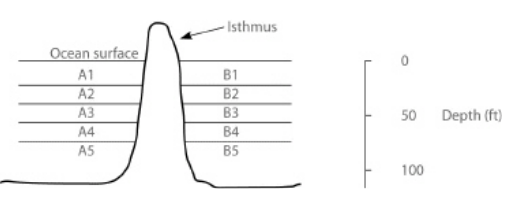 EV3E-In the ocean, on either side of the Isthmus of Panama, are
thirty species of snapping shrimp; some are shallow-water species,
others are adapted to deep water. There are fifteen species on the
Pacific side and fifteen different species on the Atlantic side. The
Isthmus of Panama started rising about ten million years ago. The
oceans were completely separated by the isthmus about three million
years ago. | back 58 A5 |
front 59 EV3E-In the ocean, on either side of the Isthmus of Panama, are thirty species of snapping shrimp; some are shallow-water species, others are adapted to deep water. There are fifteen species on the Pacific side and fifteen different species on the Atlantic side. The Isthmus of Panama started rising about ten million years ago. The oceans were completely separated by the isthmus about three million years ago. In the following figure, the isthmus separates the Pacific Ocean on the left (side A) from the Atlantic Ocean on the right (side B). The seawater on either side of the isthmus is separated into five depth habitats (1-5), with 1 being the shallowest. Why should deepwater shrimp on different sides of the isthmus have diverged from each other earlier than shallow-water shrimp? | back 59 They have been geographically isolated from each other for a longer time |
front 60 EV3E-About 3 million years ago, the Isthmus of Panama (a narrow strip of land connecting North and South America) formed, dividing marine organisms into Pacific and Caribbean populations. Researchers have examined species of snapping shrimp on both sides of the isthmus. Based on the morphological species concept, there appeared to be seven pairs of species, with one species of each pair in the Pacific and the other in the Caribbean. The different species pairs live at somewhat different depths in the ocean. Using mitochondrial DNA sequences, the researchers estimated phylogenies and found that each of these species pairs, separated by the isthmus, were indeed each other's closest relatives. The researchers investigated mating in the lab and found that many species pairs were not very interested in courting with each other, and any that did mate almost never produced fertile offspring. (N. Knowlton, L. A. Weigt, L. A. Solorzano, D. K. Mills, and E. Bermingham. 1993. Divergence in proteins, mitochondrial DNA, and reproductive incompatibility across the Isthmus of Panama. Science 260:1629-32.) Refer to the paragraph about the formation of the Isthmus of Panama. If the isthmus formed gradually rather than suddenly, what pattern of genetic divergence would you expect to find in these species pairs? | back 60 greater percentage of difference in DNA sequence between species that inhabit deep water than between species that inhabit shallow water ✅ |
front 61 EV3F-Two species of tree frogs that live sympatrically in the northeastern United States differ in ploidy: Hyla chrysoscelis is diploid, and Hyla versicolor is tetraploid. The frogs are identical in appearance, but their mating calls, which females use to find mates, differ. Which difference most likely evolved first? | back 61 polyploidy |
front 62 EV3F-Two populations of birds with somewhat different coloration live on opposite sides of a peninsula. The habitat between the populations is not suitable for these birds. When birds from the two populations are brought together, they produce young whose appearance is intermediate between the two parents. These offspring will breed with each other or with birds from either parent population, and all offspring of these pairings appear intermediate to various degrees. What keeps the two populations separate? | back 62 habitat isolation. |
front 63 EV3F-Beetle pollinators of a particular plant are attracted to its flowers' bright orange color. The beetles not only pollinate the flowers, but they mate while inside of the flowers. A mutant version of the plant with red flowers becomes more common with the passage of time. A particular variant of the beetle prefers the red flowers to the orange flowers. Over time, these two beetle variants diverge from each other to such an extent that interbreeding is no longer possible. What kind of speciation has occurred in this example, and what has driven it? | back 63 sympatric speciation; habitat differentiation |
front 64 EV3F-On the volcanic, equatorial West African island of Sao Tomé, two species of fruit fly exist. Drosophila yakuba inhabits the island's lowlands, and is also found on the African mainland, located about two hundred miles away. At higher elevations, and only on Sao Tomé, is found the very closely related Drosophila santomea. The two species can hybridize, though male hybrids are sterile. A hybrid zone exists at middle elevations, though hybrids there are greatly outnumbered by D. santomea. Studies of the two species' nuclear genomes reveal that D. yakuba on the island is more closely related to mainland D. yakuba than to D. santomea (2n = 4 in both species). Sao Tomé rose from the Atlantic Ocean about fourteen million years ago. Using only the information provided in the paragraph, which of the following is the best initial hypothesis for how D. santomea descended from D. yakuba? | back 64 habitat differentiation |
front 65 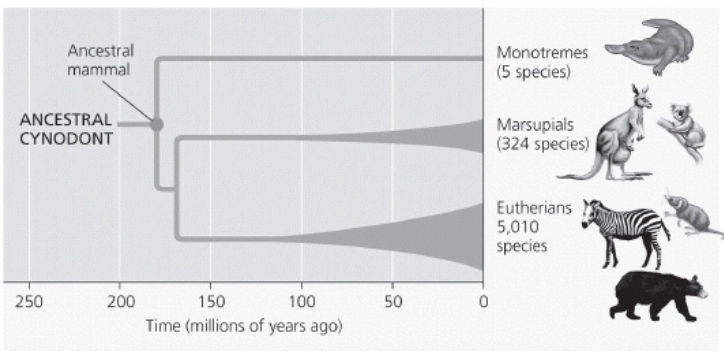 EV3I, EV3J In this figure, data from the fossil record is presented that shows the dramatic increase in number of mammal species following the Cretaceous mass extinction 66 million years ago. Evidence suggests that this mass extinction event extinguished more than half of all marine species, many animal and plant species, and all dinosaurs. Considering this evidence, which statement best explains the reason for such an increase in number of mammals during this time? | back 65 Early mammals were probably restricted in size and diversity because they were eaten and outcompeted by the larger and more diverse dinosaurs. With the extinction of the dinosaurs, mammals could expand and diversify to occupy the many new available ecological niches that were previously occupied by dinosaurs. |
front 66 EV3I, EV3J-According to the theory of seafloor spreading, oceanic
islands, such as the Hawaiian Islands, form as oceanic crustal plates
move over a stationary "hot spot" in the mantle. Currently,
the big island of Hawaii is thought to be over a hot spot, which is
why it is the only one of the seven large islands that has active
volcanoes. What should be true of the island of Hawaii? | back 66 I, II, IV and V |
front 67 EV3I, EV3J-The Permian period ended and then rapid speciation occurred as new animal and plant forms evolved. The most likely explanation for this is ____. | back 67 all of the above |
front 68 EV3I, EV3J-All of the following events can trigger an adaptive radiation EXCEPT ____. | back 68 Hox gene duplication events |
front 69 S3D-Three-spined stickleback fish (Gasterosteus aculeatus) show substantial heritable variation in gill-raker length related to differences in their diets. Longer gill rakers appear to function better for capturing open-water prey, while shorter gill rakers function better for capturing shallow-water prey. Which of the following types of selection is most likely to be found in a large lake (open water in the middle and shallow water around the sides) with a high density of these fish? | back 69 disruptive selection |
front 70 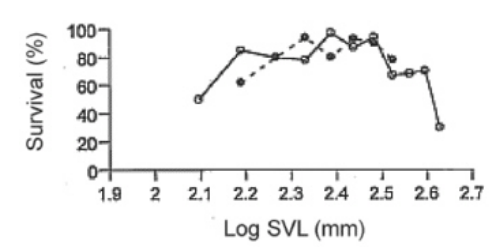 S3D-Martin Wikelski and L. Michael Romero (Body size, performance and
fitness in Galápagos marine iguanas, Integrative and Comparative
Biology 43 [2003]:376-86) measured the snout-to-vent (anus) length of
Galápagos marine iguanas and observed the percent survival of
different-sized animals, all of the same age. The graph shows the log
snout-vent length (SVL, a measure of overall body size) plotted
against the percent survival of these different size classes for males
and females. | back 70 stabilizing selection |
front 71  This graph shows the size of the finches’ bill by measuring the beak depth in millimeters. The graph shows two species of finch that live in the Galapagos Islands. The two species of finch both live on some islands (sympatric) while on other islands only one species is found (allopatric). S3D-If the finch G. fortis established a population on Los Hermanos, based on the information shown in the graph, what would you predict would happen to the beak depth of G. fuliginosa over time? | back 71 The beak depth would decrease. |
front 72 S3D-In those parts of equatorial Africa where the malaria parasite is most common, the sickle-cell allele constitutes 20% of the b hemoglobin alleles in the human gene pool. In the United States, the parasite that causes malaria is not present, but African-Americans whose ancestors were from equatorial Africa are present. What should be happening to the sickle-cell allele in the United States, and what should be happening to it in equatorial Africa? | back 72 directional selection; stabilizing selection |