Instructions for Side by Side Printing
- Print the notecards
- Fold each page in half along the solid vertical line
- Cut out the notecards by cutting along each horizontal dotted line
- Optional: Glue, tape or staple the ends of each notecard together
Ecology chapter 17
front 1 What is mutualism? | back 1 A positive interaction between two species providing something to the other species that is unique to them. |
front 2 What is the difference between a parasitic and mutualistic relationship? | back 2 Parasitic relationships involve one species taking while the other receives nothing in return. Mutualistic relationships involve both species getting something positive out of the interaction. |
front 3 Compare and contrast obligate vs. facultative mutualists | back 3 Requiring vs. not requiring the other in order to persist.. |
front 4 Compare and contrast generalist vs. specialist mutualists | back 4 A species that interacts with many other species vs only being able to interact with one or a few closely related species |
front 5 Ants and aphids have a mutualistic relationship. Does this relationship exchange resources, defense, pollination or seed dispersal? (You may choose more than one) | back 5 Resources (sugary sap for the ants) and defense (protection against predators for the aphids) |
front 6 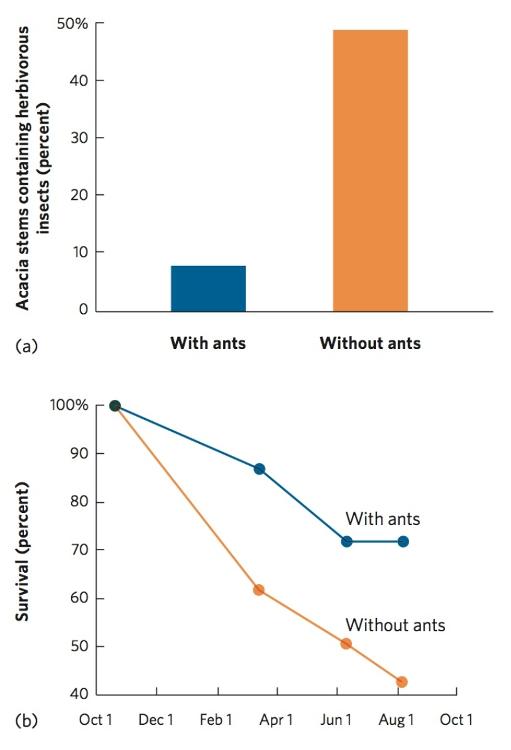 Does the presence of ants on acacia trees increase or decrease their rate of survival? | back 6 Increase |
front 7 How can mutualist partners prevent other species from "cheating"? | back 7 By removing their contribution from the relationship (i.e., not exchanging resources, defense) |
front 8 How might a change in environmental conditions cause a relationship to switch from mutualism to parasitism? | back 8 When conditions become strained or bountiful enough that one species no longer can or needs to exchange resources and yet resources continue to be given away. |
front 9 Garlic mustard (introduced to the Americas) inhibits the growth of mycorrhizal fungi. Given that certain trees depend on a mutualistic relationship with fungi how would the composition of a forest change with the presence of garlic mustard? | back 9 There would be a lower diversity of trees in forests where garlic mustard was prohibiting the growth of mycorrhizal fungi. |