Instructions for Side by Side Printing
- Print the notecards
- Fold each page in half along the solid vertical line
- Cut out the notecards by cutting along each horizontal dotted line
- Optional: Glue, tape or staple the ends of each notecard together
biotech exam 1
front 1 What is molecular biology? | back 1 The branch of biology that deals with the structure and function of molecules essential to life |
front 2 What is biotechnology? | back 2 The use of biology to create useful technologies and products |
front 3 Biotechnology in forensics | back 3 The use of techniques from molecular biology to analyze biological evidence -blood, saliva, skin cells-extract DNA profiles |
front 4 Matthias Schleiden and Theodor Schwann | back 4 all organisms are made of cells and cells are the basic unit of life |
front 5 Gregor Mendel deciphered | back 5 the genetic laws by conducting experiments on pea plants, and discovered the basic (segregation and assortment) -dominant and recessive traits |
front 6 Friedrich Miescher isolates | back 6 Nuclein from white blood cells |
front 7 Walter Sutton and Theodor Boveri proposes that hereditary factors | back 7 are located on chromosomes which segregate during cell division |
front 8 P.Levene, W.Jacobs, and others demonstrate | back 8 that RNA is composed of a sugar(ribose) plus four nitrogen bases, and that DNA contains a different sugar (deoxyribose) plus four bases |
front 9 Frederick Griffith performed | back 9 information in the bacterium Streptococcus pneumoniae -Heat killed bacteria transfer traits to live bacteria -Evidence of a transforming principle |
front 10 How did griffith perform his experiment? | back 10 Injected living S cells (in capsule) = mouse died Inject living R cells (not in capsule) = mouse alive Heat killed S cells (in capsule but non-pathogenic Mixture of heat killed S cells and living R cells= mouse dies |
front 11 Avery, MacLeod, MacCarty used a similar transformation test | back 11 injected DNase, RNase, lipase, protease, and other and determined that DNA is the transforming principle |
front 12 Hershey and Chase shows that | back 12 DNA is transferred from bacteriophages to bacteria |
front 13 Francis Crick lays out the | back 13 central dogma DNA-> RNA-> Proteins |
front 14 Two main types: of nucleic acids | back 14 DNA: carries genetic information in living organisms RNA: plays various roles in coding, decoding, regulation, and expressino of genes |
front 15 What do nucleotides contain? | back 15 - a nitrogenous base (adenine, cytosine, guanine, thymine, uracil) - phosphate group -linked to the 1C and 5C position of a (deoxy)ribose sugar |
front 16 Which nitrogenous bases are purines and pyrimidines? | back 16 -Adenine and guanine are purines -Cytosine, thymine, and uracil resemble pyrimidine |
front 17 Bond that holds the nitrogenous base | back 17 glycosidic bond |
front 18 The OH on the 3' carbon attacks | back 18 the phosphodiester bond and releases 2 phosphate groups |
front 19 DNA double helix structure | back 19 Has sugar-phosphate backbones on the outside and the bases are aligned to the interior |
front 20 When melting DNA, | back 20 The hydrogen bonds that hold the DNA strands together will weaken and break and causes denaturation |
front 21 When annealing, | back 21 DNA is cooled to allow for the strands to come back together |
front 22 Chromatin organization: the nucleosome unit | back 22 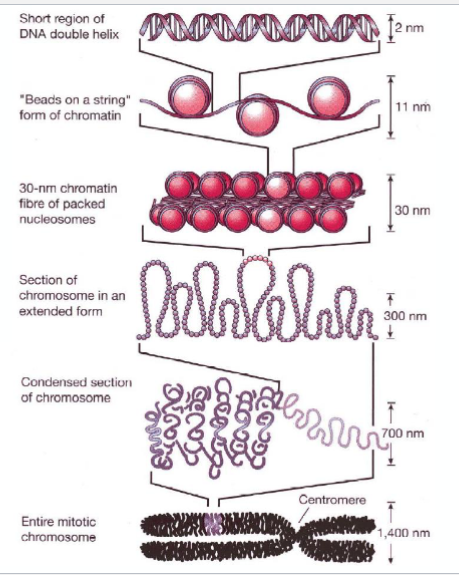 is repeated over and over and creates beads on a string |
front 23 Te way in which a cell packages its chromatin | back 23 during interphase leads to two general forms |
front 24 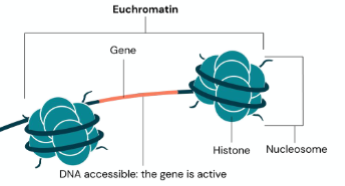 Euchromatin: | back 24 formed around sites of active genes |
front 25 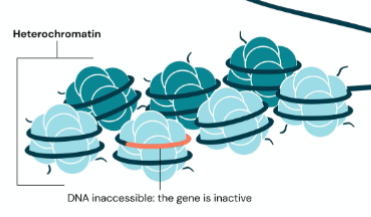 Heterochromatin | back 25 formed in regions of inactivity |
front 26 Compare and contrast of Euchromatin and heterochromatin | back 26 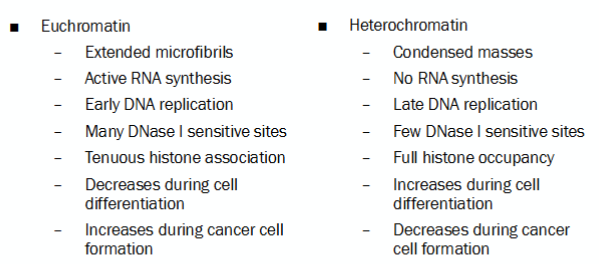 |
front 27 When handling biological evidence, avoid contamination by not | back 27 -touching, sneezing or coughing over evidence - always use clean gloves and tools -change gloves between each otem you touch |
front 28 To collct stains on a surface: | back 28 -wet stains: use sterile swabs or gauze -dry stains: use distilled water ( for rehydration) and sterile swabs, or carefully scrape/cut the stained surface |
front 29 You can locate invisible stains by: | back 29 Black light: excites proteins and metabolites in fluids, making them fluoresce Alternate light sources: provide a range of wavelengths + filters to enhance faint stains |
front 30 Biological evidence packaging: | back 30 -air dry thoroughly before packaging to prevent mold and DNA degradation - Use proper packaging materials like paper bags or envelopes - Clearly label for chain of custody by including case#, item #, date, intitals, signature -Document every transfer to maintain chain of custody records |
front 31 Biological evidence transport and storage | back 31 -Transport quickly and use secure, contamination-free evidence boxes - Store dry and cold -Short term: 4 C Long term: -20 C or -80C |
front 32 What is forensic Serology? | back 32 detection and identification of biological fluids using laboratory tests |
front 33 Presumptive tests: | back 33 -Simple, quick, low-cost tests that detect the likely presence of body fluids -use minimal material and preserve DNA integrity for further testing |
front 34 Confirmatory tests: | back 34 - Provide definitive identification of a specific biological material Designed to avoid cross-reaction with other fluids or species |
front 35 Antigens | back 35 Molecules(often proteins or carbohydrates) on the surface of cells that can trigger an immune response |
front 36 Antibodies: | back 36 -Immunoglobulins - Proteins produced by B lymphocytes in response to specific antigens - They bind to antigens, marking them for destruction or neutralization |
front 37 Antigen-antibody reaction: | back 37 -immunological specificity -essential for forensic serology tests |
front 38 What are the limitations of blood antigen typing? | back 38 -Many people share blood type - Antigens can degrade over time, especially in adverse environmental conditions |
front 39 What are immunoassays? | back 39 Analytical tests that detect or measure substances( analytes) in a sample using highly specfic antigen-antibody reaction |
front 40 Immunoassays can be aplied in | back 40 Drug screening, species identification, detection of body fluids, and hormone levels |
front 41 What is the purpose of ELISA? | back 41 Uses an enzyme attached to an antibody to produce a measurable signal (color change) when the antigen-antibody reaction occurs |
front 42 Modern role of serology: | back 42 -still crucial for initial screening, species identification, and preliminary drug testing before DNA or more advanced chemical analysis |
front 43 The advert of DNA profiling (RFLP, STR) along with biotechnology (PCR, MPS): | back 43 -Revolutionized forensic individualization by providing far greater discriminatory power, even from degraded samples |
front 44 VNTRs are | back 44 -short DNA sequences repeated consecutively at specific chromosomal locations - ideal genetic markers for individual identification - high polymorphic and distributed throughout the genome -This variation creates different allele sizes |
front 45 -Molecular scissors that cut DNA at specific sequences | back 45 Restriction Enzymes |
front 46 What is a DNA probe? | back 46 -a short, single-stranded DNA fragment that binds to a complementary sequence in the target DNA - must be labeled to make the target visible - DNA samples must be denatured to single strands so the probe can hybridize to matching targets |
front 47 What are the advantages of RFLP? | back 47 - high discriminating power: can individualize DNA to a very high degree, especially when multiple VNTR loci are analyzed. - revolutionized forensic investigations by linking biological evidence directly to individuals |
front 48 Limitations of RFLP: | back 48 -Time-consuming and labor-intensive, with multiple steps, and takes weeks for results - requires large amounts of highly quality DNA (not suitable for trace samples) - susceptible to degradation - Cannot be easily automated - paved the way for new technologies |
front 49 (PCR) DNA template: | back 49 target DNA to be amplified |
front 50 (PCR) Primers: | back 50 Short, synthetic single-stranded DNA sequences that are complementary to the ends of the target DNA region. They define what gets amplified |
front 51 (PCR) DNA polymerase: | back 51 An enzyme that synthesizes new DNA strands ( Taq polymerase, which is heat-stable) |
front 52 (PCR) Deoxyribonucleotides dNTPs: | back 52 the building blocks for new DNA strands (A,G,T,C) |
front 53 (PCR) Buffer: | back 53 provides optimal conditions (pH, salts) for the reaction |
front 54 For the visualization, nucleic acids are | back 54 stained using intercalating dyes that insert themselves and can be seen under UV or blue light, and the results are qualitative and presence/absence |
front 55 Limitations of PCR: | back 55 -Contamination risk: are highly susceptible to contamination - Inhibitor: substances in forensic samples can inhibit PCR reaction, leading to false negatives - Prior sequence knowledge: requires knowledge of target DNA sequence to design primers - Limited fragment length: PCR is best suited for amplifying relatively short DNA fragments |
front 56 Short tandem repeats: | back 56 -The current gold standard -has short repeats, which are ideal for PCR |