Instructions for Side by Side Printing
- Print the notecards
- Fold each page in half along the solid vertical line
- Cut out the notecards by cutting along each horizontal dotted line
- Optional: Glue, tape or staple the ends of each notecard together
IGCSE Physics 6 | Solar System
front 1 Orbits | back 1 Earth on axis is 24 hours, and sun in 365 days. |
front 2 moon phases | back 2 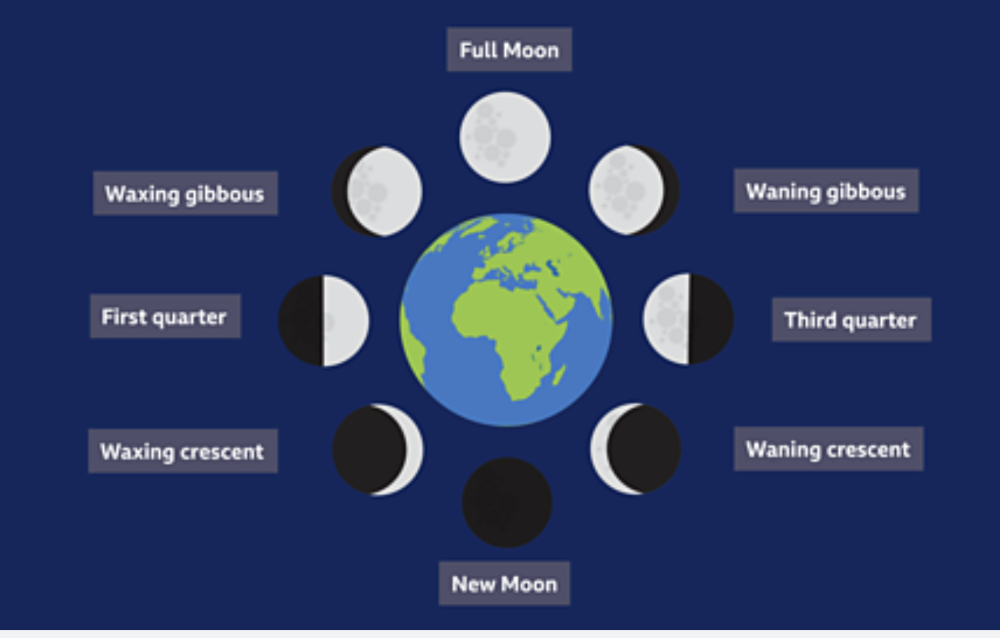 |
front 3 average orbital speed equation | back 3 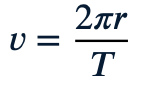 Orbital speed = 2 x pie x radius / orbital period (time taken for 1 orbit in sec) |
front 4 Describe the Solar System as containing 6 | back 4 (a) one star, the Sun (b) the eight planets (Mercury, Venus, Earth, Mars, Jupiter, Saturn, Uranus, and Neptune.) (c) minor planets that orbit the Sun, including dwarf planets such as Pluto and asteroids in the asteroid belt (d) moons, that orbit the planets (e) smaller Solar System bodies, including comets and natural satellites |
front 5 Planetary data about orbital distance, orbital duration, density, surface temperature and uniform gravitational field strength at the planet’s surface. | back 5 Density trends show rocky inner planets have higher densities than gaseous outer planets 4 rocky 4 gas. Surface temperature generally decreases with increasing distance from the Sun. A planet's surface gravitational field strength increases with its mass. Orbital duration increases as move away from sun. |
front 6 accretion model for Solar System formation | back 6 1. Gravity's Role in Accretion:
2. Composition of the Interstellar Cloud:
|
front 7 formula for the time it takes light to travel a distance and speed of light | back 7 use the formula time = distance / speed, where the speed of light is approximately 3 x 10⁸ m/s or 300,000 km/s. |
front 8 sun's gravity facts and elliptical orbit gravity and energy conversation | back 8 The Sun contains most of the mass of the Solar System and this explains why the planets orbit the Sun as highest gravitational field pull. When planet closer to sun highest gravitational pull and speed, max kinetic energy and min gravitational potential energy. When planet further from the sun lowest gravitational pull and speed, min kinetic energy and max gravitational potential energy. |
front 9 sun size, components, and what regions of the electromagnetic spectrum. | back 9 The Sun is a star of medium size, consisting mostly of hydrogen and helium, and that it radiates most of its energy in the infrared, visible and ultraviolet regions of the electromagnetic spectrum. |
front 10 How stars are powered | back 10 Stars are powered by nuclear reactions that release energy, and that in stable stars the nuclear reactions involve the fusion of hydrogen into helium. |
front 11 number of stars in galaxy and distance relative to earth and sun | back 11 Galaxies are each made up of many billions of stars. Other stars in the Milky Way are much further away from the Earth than the Sun is from the Earth. |
front 12 one light-year is equal to | back 12 9.5 × 10¹⁵m |
front 13 Describe the life cycle of a small star | back 13 (a) a star is formed from interstellar clouds of gas and dust that contain hydrogen (nebula) (b) The gravitational attraction within a nebula pulls the particles closer together until a hot ball of gas forms, known as a protostar. As the particles are pulled closer together, the density of the protostar increases. This results in more frequent collisions between the particles, which causes the temperature to increase. (c) a protostar becomes a stable star when the inward force of gravitational attraction is balanced by an outward force due to the high temperature in the centre of the star when nuclear fusion of hydrogen into helium. Gravitational forces act inwards. Thermal pressure acts outwards. (d) all stars eventually run out of hydrogen as fuel for the nuclear reaction. Fusion decreases and causes the core to shrink and heat up as the energy produced by fusion decreases, the inward force due to gravity becomes greater than the outward force due to the thermal pressure. Eventually, the star becomes a red giant when the core becomes hot enough for helium to fuse into carbon. The energy released by re-ignited fusion reactions causes the outer layers of the star to expand and cool turning red. (f) Once the helium in the core runs out, fusion reactions cannot continue. The star becomes unstable and the core collapses under its own gravity. The outer layers are ejected into space as a planetary nebula with a white dwarf star at its centre. (g) The white dwarf cools down over time and as a result, the amount of energy it emits decreases and then black dwarf. |
front 14 diameter of the Milky Way | back 14 approximately 100 000 light-years |
front 15 For stars with mass over 8 solar masses | back 15 (a) a star is formed from interstellar clouds of gas and dust that contain hydrogen (nebula) (b) The gravitational attraction within a nebula pulls the particles closer together until a hot ball of gas forms, known as a protostar. As the particles are pulled closer together, the density of the protostar increases. This results in more frequent collisions between the particles, which causes the temperature to increase. (c) a protostar becomes a stable star when the inward force of gravitational attraction is balanced by an outward force due to the high temperature in the centre of the star when nuclear fusion of hydrogen into helium. Gravitational forces act inwards. Thermal pressure acts outwards. (d) all stars eventually run out of hydrogen as fuel for the nuclear reaction. Fusion decreases and causes the core to shrink and heat up as the energy produced by fusion decreases, the inward force due to gravity becomes greater than the outward force due to the thermal pressure. (e)Eventually, the star becomes a red supergiant when the core becomes hot enough helium to fuse into carbon. This is followed by further fusion reactions in which successively heavier elements, such as nitrogen and oxygen, are formed. During this stage, the core collapses and expands repeatedly as fusion reactions start and stop. (f) Eventually, fusion reactions inside the red supergiant cannot continue once iron is formed the core of the star will collapse rapidly and initiate a gigantic explosion called a supernova. At the centre of this explosion, a dense body called a neutron star will form. The outer layers of the star are ejected into space forming new clouds of dust and gas (nebula). (g) the nebula from a supernova may form new stars with orbiting planets. (h) In the case of the most massive stars, the neutron star that forms at the centre will continue to collapse under the force of gravity until it forms a black hole. |
front 16 Define redshift | back 16 An increase in the observed wavelength of electromagnetic radiation emitted from receding stars and galaxies. *light emitted from distant galaxies appears redshifted in comparison with light emitted on the Earth. |
front 17 Know that redshift in the light from distant galaxies is evidence for... | back 17 the Universe is expanding and supports the Big Bang Theory Redshift in light from distant galaxies provides evidence for the Big Bang Theory because it indicates the universe is expanding. The light from these galaxies is stretched to longer wavelengths (shifted towards the red end of the spectrum) as they move away from us. The greater the redshift, the faster the galaxy is moving, showing that further galaxies recede more rapidly, supporting the idea that the universe began from a single point and has been expanding ever since. |
front 18 constant radiation in space | back 18 Microwave radiation of a specific frequency is observed at all points in space around us and is known as cosmic microwave background radiation (CMBR). It's residual from the Big Bang where it was filled with high-energy radiation. Redshifting, stretched the original radiation into the microwave region of the electromagnetic spectrum, which is what we observe today making it less strong. |
front 19 calculating speed v at which a galaxy is moving away from the Earth | back 19 speed is directly proportional to their distance from Earth by constant called the Hubbles constant. V = distance x Ho *distance of a far galaxy d can be determined using the brightness of a supernova in that galaxy |
front 20 Define the Hubble constant H0, equation and estimate | back 20 The ratio of the speed at which the galaxy is moving away from the Earth to its distance from the Earth. H0 = v/d current estimate for H0 is 2.2 × 10⁻¹⁸ per second |
front 21 what equation represents an estimate for the age of the Universe | back 21 d/v = 1/H0 so the age of the universe t is either t=d/v but easier to calculate by 1/H0 . Because the Universe expands at a constant rate as shown by the calculation, if we trace this expansion backward, all matter would eventually come together at one single point—the start of the Universe. |
front 22 All candidates should be able to use the following multipliers: M mega, k kilo, c centi, m milli Extended candidates should also be able to use the following multipliers: G giga, μ micro, n nano | back 22  |