Instructions for Side by Side Printing
- Print the notecards
- Fold each page in half along the solid vertical line
- Cut out the notecards by cutting along each horizontal dotted line
- Optional: Glue, tape or staple the ends of each notecard together
Safety in Medication Administration
front 1 Tall man lettering includes? | back 1 use of lowercase and uppercase letters, so that a section of the drug name is highlighted. |
front 2 A drug name is written with tall man lettering. Which statement best supports the use of tall man lettering on a drug label? | back 2 Tall man lettering consists of lowercase and uppercase letters that emphasize a section of the drug name to minimize confusion between drug names that look alike and sound alike. |
front 3 The Institute of Medicine (IOM) identified abbreviations and symbols that should not be used in writing and transcribing medication orders due to the high risk for error. Which of the following, if written in a medication order, should be questioned? Select all that apply. units µ IM mL cc | back 3 µ cc |
front 4 Patient information includes? | back 4 Patient information includes name, age, gender, date of birth, medical record number, allergies, and room number, if applicable. |
front 5 Drug name includes? | back 5 The generic (chemical or pharmacological name) or brand name (trade or proprietary name) given to the drug by the manufacturer. |
front 6 Ordered dose is? | back 6 The amount of the drug the provider has ordered. |
front 7 Route is the? | back 7 The method (oral, IM, IV, ID, SUBQ, etc.) for delivering the drug to the patient. |
front 8 Frequency of administration? | back 8 How often the drug is given to the patient. For example: Every AM |
front 9 Six Rights of Medication Administration are? | back 9 1.The right drug 2.The right dose 3.The right route 4.The right time 5.The right patient 6.The right documentation - |
front 10 Enteral/gastrointestinal drugs will pass through the digestive process of the gastrointestinal tract? | back 10
|
front 11 Parenteral drugs are absorbed outside the gastrointestinal tract are? | back 11
|
front 12 Topical drugs are applied to the surfaces of the body or mucous membranes. They commonly work at the site of administration. | back 12
|
front 13 When applying the Six Rights of Medication Administration, the nurse correctly documents the administration of the medication? | back 13 immediately after administering the drug to the patient. |
front 14 When administering medications, what are the most appropriate methods for verifying the right drug? | back 14 1.Check the drug label against the patient’s MAR after selecting it from the patient’s medication drawer. 2.Check the drug label against the MAR before putting the medication in the dispensing container. 3.Check the drug label against the MAR prior to administering the drug to the patient. |
front 15 Brand Name ? | back 15 This the name given by the manufacturer. Every manufacturer that makes the same drug assigns a brand name to the drug. A ® on the right-hand corner of the drug indicates the drug name is registered and trademark protected. |
front 16 Generic Name? | back 16 The universal name for the drug. It helps identify drugs by chemical groups or pharmaceutical properties. There is only one generic name for a drug. |
front 17 USP? | back 17 The United States Pharmacopeia (USP) sets pharmaceutical standards primarily aimed at protecting public health. The “USP” after a drug name indicates that it adheres to USP standards. |
front 18 Dosage forms? | back 18 may be solid, such as tablets or capsules, or liquid, such as solutions, syrups, and suspensions. The label for Flagyl indicates the form is a tablet. |
front 19 dosage strength are? | back 19 Dosage strength may be expressed in various forms on the label. Some examples include:
|
front 20 The route of administration | back 20 provides a method of delivery for the drug. The delivery method(s) or routes of administration are commonly written on drug labels. |
front 21 Controlled substances - | back 21 Drugs or therapeutic agents that have potential for abuse or addiction and may cause physical or mental harm. |
front 22 Single-dose containers are? | back 22 intended for single use only and should be discarded after the ordered dose is withdrawn. Single-dose vials are typically preservative free, meaning that they do not contain antimicrobial preservatives. Single-dose containers also include the prefilled syringe and the ampule. |
front 23 Multi-dose containers - | back 23 have a preservative and may be used to administer several doses of the drug. |
front 24 Dosage and administration- | back 24 The dosage and administration information on the drug label provides additional information, such as administration guidelines and indications for use. This section may be identified with the wording: “usual dosage”, “dosage and use”, “indication and use”, or “dosage and administration.” |
front 25 Storage information- | back 25 All drug labels have storage directions. To maintain drug potency, drugs should be stored according to the manufacturer’s guidelines. |
front 26 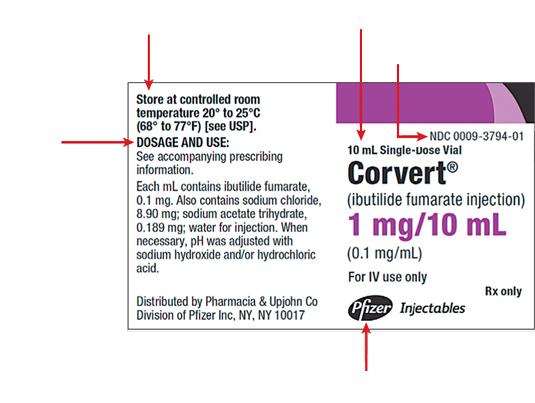 Lot number- | back 26 The lot number is found on the drug label in various places. Lot numbers contain a unique combination of letters, numbers or symbols assigned by the manufacturer to each group or batch of drug produced. |
front 27 Total amount in the package- | back 27 The total amount identified on the drug label indicates the total number or quantity contained in a bottle or package. It is not to be confused with strength. |
front 28 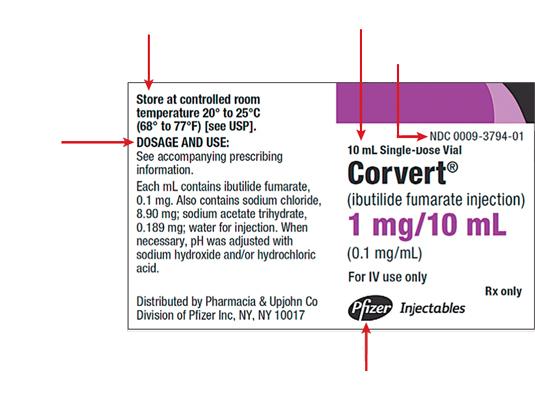 Manufacturer’s name | back 28 The manufacturer’s name will always appear on the drug label. It is important not to confuse the manufacturer’s name with the name of the drug. |
front 29 Drug names may be written with tall man lettering. Tall man lettering is used primarily to? | back 29 distinguish drugs with similar names. |
front 30 The patient is taking a medication that has a boxed warning. The nurse understands that a boxed warning on a drug label indicates the drug: | back 30 may cause a serious adverse reaction leading to death or injury. |