Instructions for Side by Side Printing
- Print the notecards
- Fold each page in half along the solid vertical line
- Cut out the notecards by cutting along each horizontal dotted line
- Optional: Glue, tape or staple the ends of each notecard together
Biology part 4 | Reproduction
front 1 Define a drug | back 1 Any substance taken into the body that modifies or affects chemical reactions in the body. |
front 2 Describe the use of antibiotics for the treatment of bacterial infections | back 2
|
front 3 Antibiotic resistance, how it works and why not overuse | back 3 The Process of Antibiotic Resistance
|
front 4 Define asexual reproduction and sexual reproduction and fertilisation. | back 4 A process resulting in the production of genetically identical offspring from one parent. A process involving the fusion of the nuclei of two gametes to form a zygote, and the production of offspring that are genetically different from each other. Fusion of the nuclei of gametes. |
front 5 How many sets of chromosomes a gamete and zygote have and what they are called. | back 5 A gamete's nucleus is haploid, meaning it contains only one set of chromosomes. A zygote has a diploid nucleus that contains two complete sets of chromosomes. |
front 6 Discuss the advantages and disadvantages of sexual reproduction and asexual reproduction. | back 6 Asexual reproduction offers rapid population growth and requires only one parent, but lacks genetic diversity, making it advantageous in stable environments but vulnerable to changing conditions; sexual reproduction, while requiring two parents and a longer process, introduces genetic variation, enhancing adaptability to changing environments. Application to Crop Production:
|
front 7 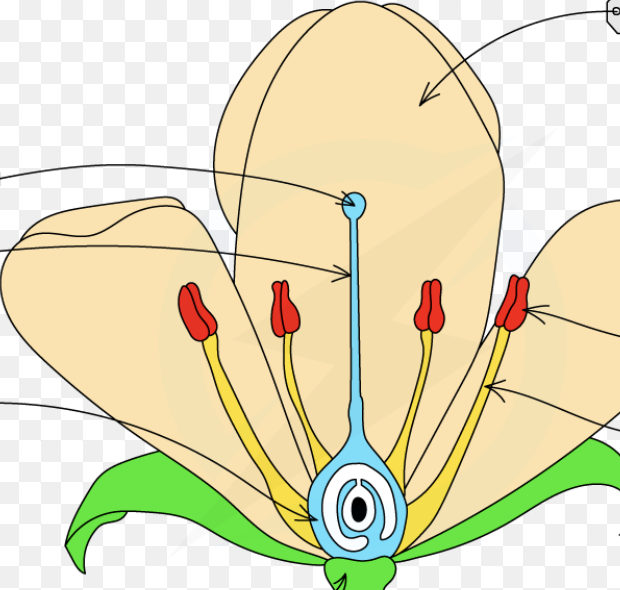 Identify in diagrams and images and draw the following parts of an insect-pollinated flower: sepals, petals, stamens, filaments, anthers, carpels, style, stigma, ovary and ovules 2 State the functions of the structures listed. | back 7 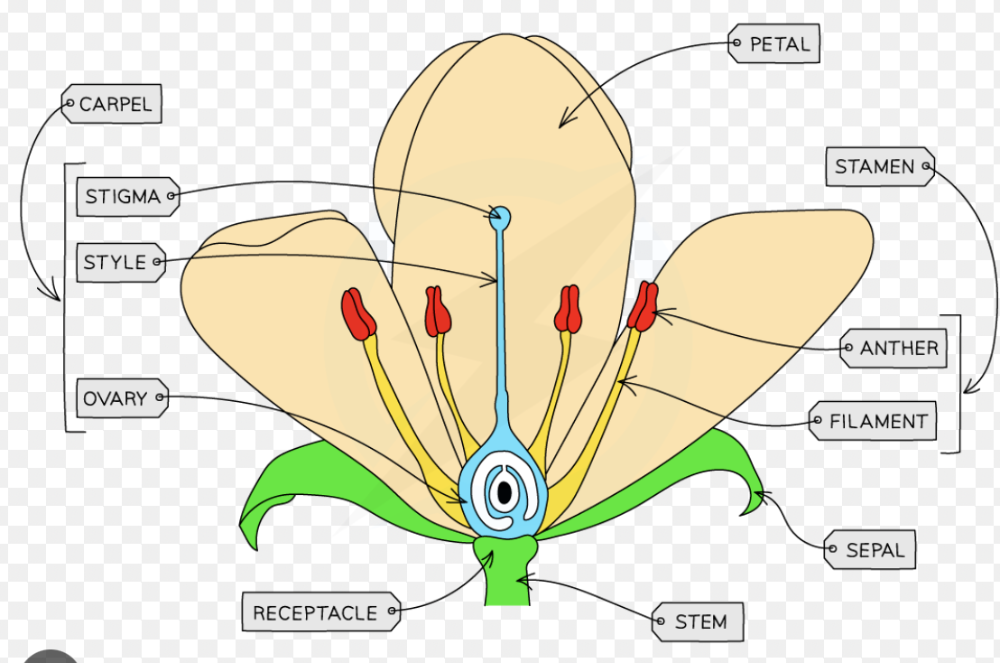 Sepals : Protect the flower bud before it opens. Petals : Attract insects for pollination using their color, scent, and sometimes nectar guides. Stamens: Produce the male gametes (pollen grains). Filaments : Supports the anther and positions it to aid in pollen transfer. Anthers : Produces and releases pollen grains, which contain the male gametes. Carpels : Contains the female gametes (ovules) and is the site of fertilisation. Stigma : The sticky tip of the carpel. Captures and holds pollen grains during pollination. Style : Provides a pathway for the pollen tube to grow down to the ovary. Ovary : Protects the ovules and develops into a fruit after fertilisation. Ovules : Structures found inside the ovary. Contain the female gametes and develop into seeds after fertilisation. |
front 8 Difference between insect and wind pollinated flowers. | back 8 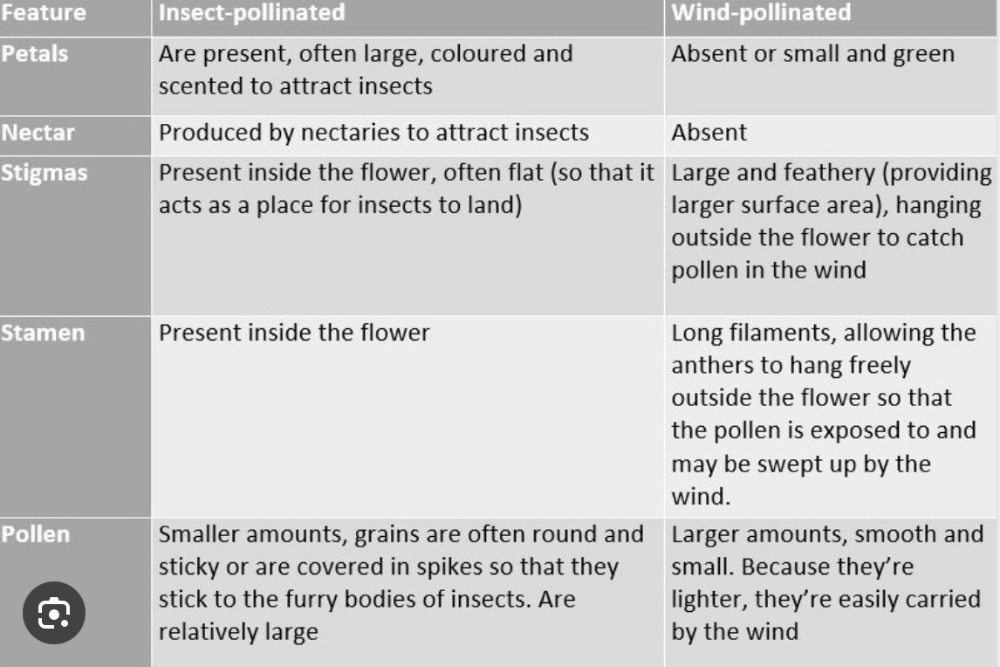 |
front 9 Define pollination in plants and fertilisation | back 9 The transfer of pollen grains from an anther to a stigma. When a pollen nucleus fuses with a nucleus in an ovule. |
front 10 Define self-pollination and cross-pollination | back 10 Self : The transfer of pollen grains from the anther of a flower to the stigma of the same flower or a different flower on the same plant. Cross : The transfer of pollen grains from the anther of a flower to the stigma of a flower on a different plant of the same species. |
front 11 Discuss the potential effects of self-pollination and cross-pollination on a population, in terms of variation, capacity to respond to changes in the environment and reliance on pollinators. | back 11 Self-pollination results in low genetic variation, reducing a population's ability to adapt to environmental changes, but it decreases reliance on pollinators. In contrast, cross-pollination leads to high genetic variation, increasing adaptability and resilience to new conditions, though it creates a greater dependence on pollinator populations. |
front 12 Investigate and describe the environmental conditions that affect germination of seeds, limited to the requirement for: water, oxygen and a suitable temperature. | back 12 For seeds to germinate, they require sufficient water, which activates enzymes and softens the seed coat, allowing the embryo to grow; sufficient oxygen for cellular respiration to provide energy for growth; and a suitable temperature to ensure enzymes function correctly. |
front 13 How pollen gets to the ovule and fertilises. | back 13 1. Pollination Occurs A pollen grain lands on the stigma of a flower (either by wind, insect, etc.). 2. Pollen Tube Formation The pollen grain germinates on the stigma and grows a pollen tube down through the style secreting enzymes to produce a pathway. 3. Pollen Tube Navigation The tube grows towards the ovary and eventually reaches the ovule inside the ovary. 4. Entry into Ovule The pollen tube enters the ovule through a small opening called the micropyle. 5. Nucleus Fusion (Fertilisation) The male nucleus from the pollen grain travels down the pollen tube. It fuses with the female nucleus (egg cell) inside the ovule. |
front 14 Define fertilisation in humans | back 14 The fusion of the nuclei from a male gamete (sperm) and a female gamete (egg cell). |
front 15 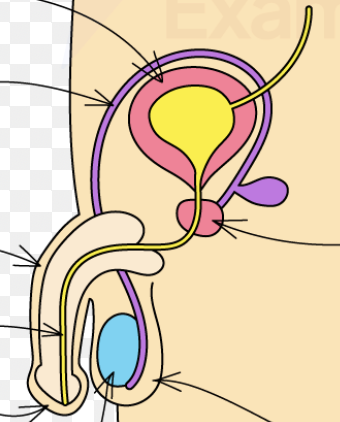 Identify on diagrams and state the functions of the following parts of the male reproductive system: testes, scrotum, sperm ducts, prostate gland, urethra and penis | back 15 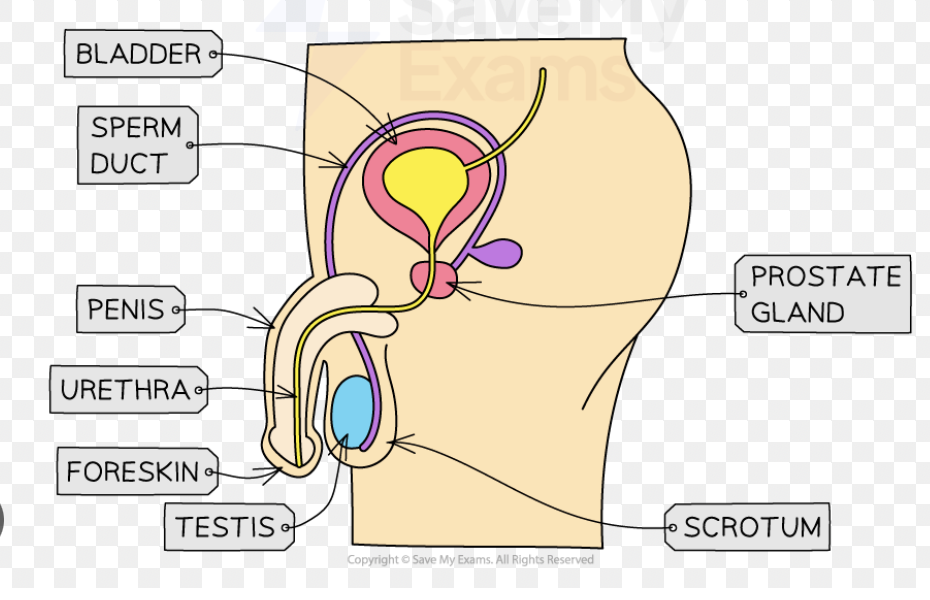 Testes : Produce sperm (male gametes) and the male sex hormone, testosterone. Scrotum : A sac of skin that protects the testes and maintains a temperature slightly lower than body temperature, which is essential for sperm production. Sperm Ducts : Carry mature sperm from the testes to the urethra for ejaculation. Prostate Gland : Produces a fluid that nourishes sperm and adds to the volume of semen. Urethra : A tube that carries urine from the bladder and semen from the reproductive system out of the body. Penis : The external male organ used for both urination and sexual intercourse, which delivers sperm into the female reproductive tract. |
front 16 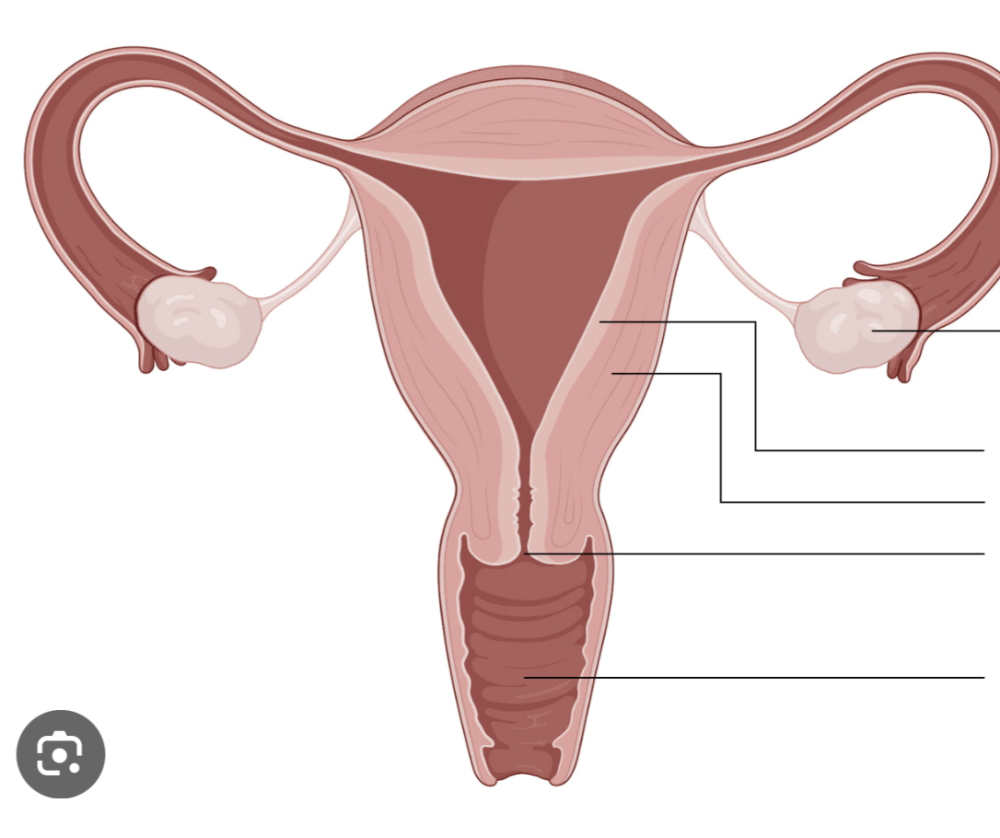 Identify on diagrams and state the functions of the following parts of the female reproductive system: ovaries, oviducts, uterus, cervix and vagina | back 16 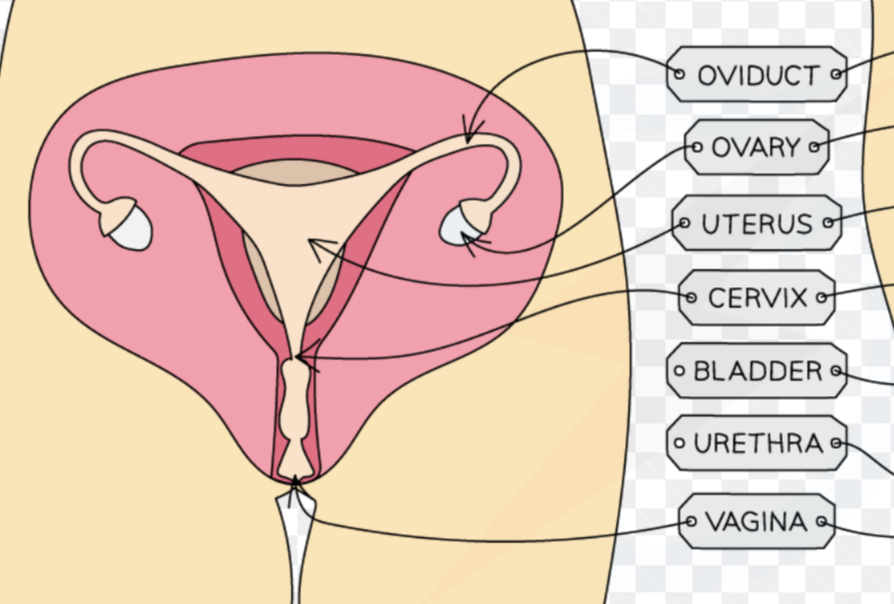 Ovaries : Produce and store ova (eggs) and female sex hormones like estrogen and progesterone. Oviducts (Fallopian Tubes) : These tubes connect each ovary to the uterus. They provide the site for fertilisation to occur and transport the egg to the uterus using cilia and muscular contractions. Uterus : muscular organ where the fertilised egg implants and develops into a fetus. It provides nourishment and protection for the growing fetus. Cervix : The narrow, lower part of the uterus that connects it to the vagina. It produces mucus that helps to block bacteria from entering the uterus and opens to allow menstrual blood to flow out or a baby to pass through during birth. Vagina : A muscular, elastic tube connecting the cervix to the outside of the body. It receives sperm during sexual intercourse and serves as the birth canal during childbirth. |
front 17 Explain the adaptive features of sperm | back 17 A flagellum (tail) for swimming towards the egg, Numerous mitochondria in the midpiece to provide the necessary energy for this movement. Enzymes within the acrosome at the head of the sperm to digest the outer layers of the egg, allowing the genetic material to penetrate and fertilize it. |
front 18 Explain the adaptive features of egg cells | back 18 A supply of energy stores in the cytoplasm to fuel the initial development of the embryo after fertilisation. A jelly coat that changes to a hard, impenetrable barrier after fertilisation, preventing multiple sperm from entering the egg and ensuring proper development of the single zygote. |
front 19 Compare male and female gametes in terms of: size, structure, motility and numbers | back 19 The male gamete (sperm) is small, motile (the ability to move spontaneously and independently), and produced in huge number. While the female gamete (egg/ovum) is large, non-motile, and produced in very small numbers.
|
front 20 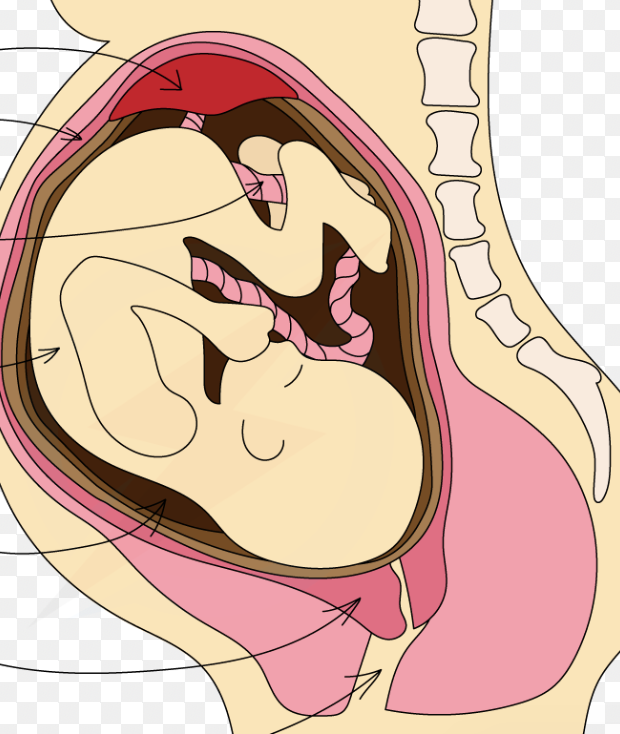 Identify on diagrams and state the functions of the following in the development of the fetus: umbilical cord, placenta, amniotic sac and amniotic fluid | back 20 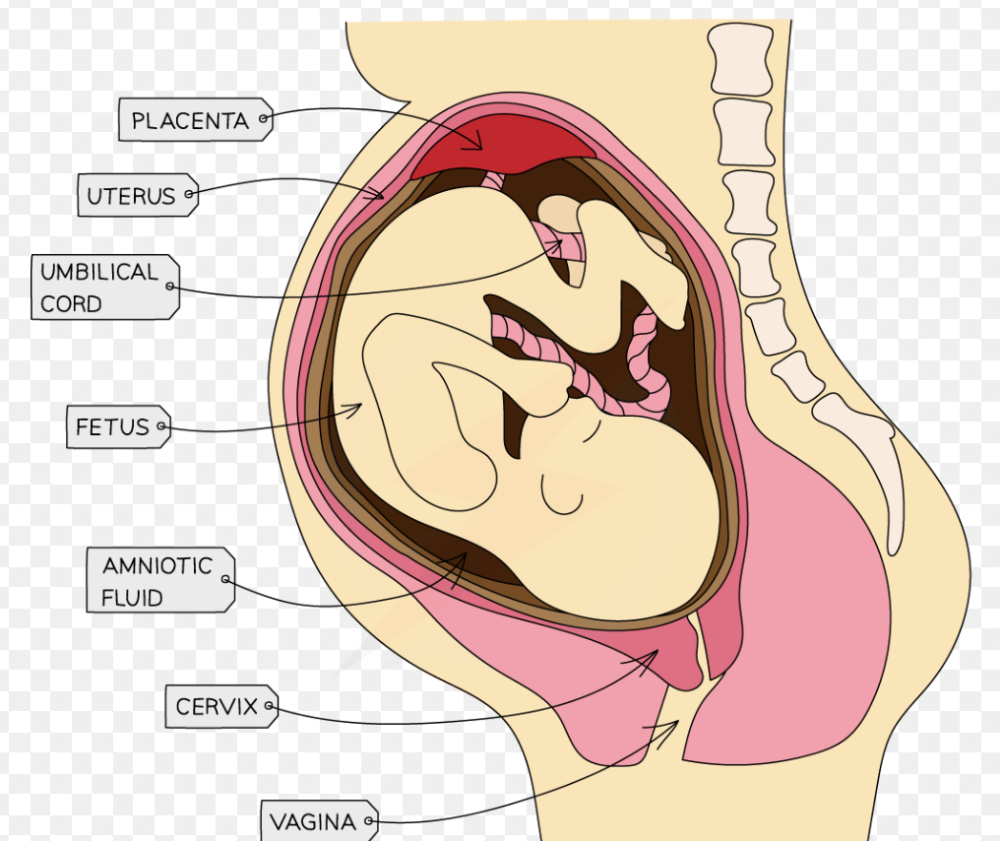
*some pathogens and toxins can pass across the placenta and affect the fetus |
front 21 Describe the roles of testosterone and oestrogen in the development and regulation of secondary sexual characteristics during puberty | back 21 Primary sexual characteristics are the reproductive organs, like testes and ovaries, present at birth and essential for reproduction. Secondary sexual characteristics are physical traits that develop during puberty under hormonal influence but are not directly involved in reproduction. Role of Testosterone in Males
Role of Oestrogen in Females
|
front 22 Describe the sites of production of oestrogen and progesterone | back 22
|
front 23 Steps of menstruation cycle | back 23
If fertilised corpus luteum remains and uterus stays, and placenta develops. Placenta takes over secreting progesterone. High progesterone levels stops production of FSH so no more follicles develop in the ovaries. |
front 24 Define a sexually transmitted infection (STI) | back 24 An infection that is transmitted through sexual contact. |
front 25 How AIDS works | back 25 State that human immunodeficiency virus (HIV) is a pathogen that causes an STI. HIV infection may lead to AIDS. |
front 26 Ways HIV is transmitted | back 26 HIV is transmitted when infected body fluids from one person enter another person's bloodstream.
|
front 27 Explain how the spread of STIs is controlled | back 27 1. Use of Condoms 2. Screening and Testing : Regular STI testing helps detect infections early, especially in sexually active individuals. Early diagnosis allows prompt treatment and reduces further transmission. 3. Treatment of Infected Individuals : Use of antibiotics (for bacterial STIs) or antiviral drugs (for viral STIs like HIV) reduces the risk of spreading infection. Treating both partners prevents reinfection. 4. Education and Awareness. 5. Contact Tracing : Identifying and informing recent sexual partners of infected individuals helps stop the spread and ensures those partners also get tested and treated. 6. Avoiding Risky Behaviours : Limiting the number of sexual partners. Avoiding sex with people who have visible symptoms. Not sharing needles or syringes 7. Prevention of Mother-to-Child Transmission
|
front 28 State what chromosomes are | back 28 Chromosomes are made of DNA, which contains genetic information in the form of genes. |
front 29 Define a gene | back 29 A length of DNA that codes for a protein. |
front 30 Define an allele | back 30 An alternative form of a gene |
front 31 how protein is made and types of proteins | back 31
* most body cells in an organism contain the same genes, but many genes in a particular cell are not expressed because the cell only makes the specific proteins it needs. |
front 32 How gender determination works. | back 32 There are 23 pairs of chromosomes in the nucleus of all diploid human cells. One of these pairs determines gender. These chromosomes are therefore called the sex chromosomes. Get one X from woman and Y or X from male. XX is girl. XY is boy. |
front 33 haploid nucleus vs diploid | back 33 I haploid nucleus is a nucleus containing a single set of chromosomes. A diploid nucleus is a nucleus containing two sets of chromosomes. |
front 34 Describe mitosis vs meiosis | back 34 Mitosis : nuclear division giving rise to genetically identical cells. Exact replication of chromosomes occurs before mitosis. During mitosis, the copies of chromosomes separate, so each daughter cell gets one complete set of chromosones. Stem cells as unspecialised cells that divide by mitosis to produce daughter cells that can become specialised for specific functions. Meiosis : a reduction division in which the chromosome number is halved from diploid to haploid resulting in genetically different cells. makes a gamete. |
front 35 Define inheritance | back 35 The transmission of genetic information from generation to generation. |
front 36 Define genotype | back 36 The genetic make-up of an organism and in terms of the alleles present. |
front 37 Define phenotype | back 37 The observable features of an organism. |
front 38 Define homozygous | back 38 Having two identical alleles of a particular gene. |
front 39 Define heterozygous | back 39 having two different alleles of a particular gene |
front 40 homozygous vs heterozygous breeding | back 40 Two identical homozygous individuals that breed together will be pure-breeding. A heterozygous individual will not be pure-breeding. |
front 41 Define a dominant allele | back 41 An allele that is expressed if it is present in the genotype. |
front 42 Define a recessive allele | back 42 An allele that is only expressed when there is no dominant allele of the gene present in the genotype. |
front 43 Explain how to use a test cross to identify an unknown genotype | back 43 In a TEST CROSS,
|
front 44 Define codominance | back 44 a situation in which both alleles in heterozygous organisms contribute to the phenotype |
front 45 Describe a sex-linked characteristic | back 45 A feature where the gene responsible is located on a sex chromosome and that this makes the characteristic more common in one sex than the other. For example colour blindness recessive gene is on X so its more common in men because they only have on X chromosome they have a 50% chance of getting it. while for women the chance is 1 in 4 and they will need both recessive together. |
front 46 Explain the inheritance of ABO blood groups: | back 46 Alleles are IA, IB and Io and the phenotypes are A, B, AB and O blood groups. IA and IB are more dominant over Io and A and B codominate. So A is AA or AO B is BB or BO AB is AB O is OO |
front 47 Define variation | back 47 The differences between individuals of the same species. |
front 48 Define continuous variation | back 48 a range of phenotypes between two extremes; examples include body length and body mass. *discontinuous variation is usually caused by genes only and continuous variation is caused by both genes and the environment |
front 49 Define discontinuous variation | back 49 a limited number of phenotypes with no intermediates; examples include ABO blood groups, seed shape in peas and seed colour in peas *discontinuous variation is usually caused by genes only and continuous variation is caused by both genes and the environment |
front 50 Describe gene mutation | back 50 A random change in the base sequence of DNA. *Mutation is the way in which new alleles are formed. Ionising radiation and some chemicals increase the rate of mutation. |
front 51 sources of genetic variation in populations | back 51 Mutation, meiosis, random mating and random fertilisation. |
front 52 Define an adaptive feature | back 52 An inherited feature that helps an organism to survive and reproduce in its environment. |
front 53 Explain the adaptive features of hydrophytes and xerophytes to their environments | back 53 Hydrophytes are water plants with adaptations like:
In contrast, xerophytes are plants adapted to dry conditions with features such as:
|
front 54 Describe natural selection | back 54 (a) genetic variation within populations (b) production of many offspring (c) struggle for survival, including competition for resources (d) a greater chance of reproduction by individuals that are better adapted to the environment than others (e) these individuals pass on their alleles to the next generation *The development of strains of antibiotic resistant bacteria as an example of natural selection. |
front 55 Define adaptation | back 55 The process, resulting from natural selection, by which populations become more suited to their environment over many generations. |
front 56 Describe selective breeding | back 56 (a) selection by humans of individuals with desirable features (b) crossing these individuals to produce the next generation (c) selection of offspring showing the desirable features |
front 57 Outline the differences between natural and artificial selection | back 57 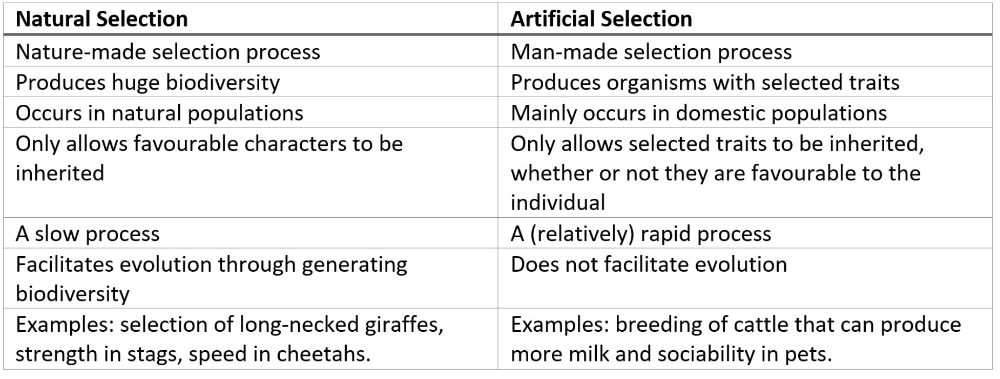 |