Instructions for Side by Side Printing
- Print the notecards
- Fold each page in half along the solid vertical line
- Cut out the notecards by cutting along each horizontal dotted line
- Optional: Glue, tape or staple the ends of each notecard together
Bio ch 33
front 1 The feeding stage of cycliophorans is best described as ________. A) autotrophic and captures food in a manner similar to gastropods B) sessile and captures food in a manner similar to that of animals with lophophores C) sessile and radially symmetric D) autotrophic and sessile | back 1 B |
front 2 Based on the information provided, to which clades should cycliophorans belong? A) Eumetazoa and Bilateria B) Eumetazoa and Lophotrochozoa C) Deuterostomia and Ecdysozoa D) Deuterostomia and Lophotrochozoa | back 2 B |
front 3 Which of the following groups of organisms has flagella associated with its method of feeding? A) annelids B) coral animals C) tapeworms D) sponges | back 3 D |
front 4 Which of the following statements describes sponges? A) they have larvae that are motile and move via the motion of flagella B) they are the simplest diploblastic animals C) they have a nerve net but not a central nervous system D) they have feeding cells called dinoflagellates | back 4 A |
front 5 Which of the following feeding strategies is most likely to be used by aquatic organisms? A) filter feeding B) mass feeding C) deposit feeding D) fluid feeding | back 5 A |
front 6 Which of the following structures can be found in the mesohyl of a sponge? A) amoebocytes and choanocytes B) spicules and choanocytes C) amoebocytes and spicules D) amoebocytes and polyps | back 6 C |
front 7 Which of the following statements describes how healthy corals appear brightly colored? A) they secrete colorful pigments to attract mates B) they host symbionts with colorful photosynthetic pigments C) they build their skeletons from colorful minerals D) they secrete colorful pigments to protect themselves from ultraviolet light | back 7 B |
front 8 Which sponge cell is most structurally and functionally similar to the cnidocyte of a cnidarian? A) amoebocyte B) choanocyte C) epidermal cell D) pore cell | back 8 B |
front 9 If coral animals are attacked by crown-of-thorns sea stars, what part of the coral actually provides nutrition to the sea star? A) medusae B) exoskeleton C) polyps D) gametes | back 9 C |
front 10 If you brush your fingers along the tentacles of a sea anemone, which of the following are you most likely to find upon microscopic examination of your fingers? A) teeth marks B) spines C) spicules D) nematocysts | back 10 D |
front 11 Which of the following characteristics is exhibited by most hydrozoans? A) polyp form only B) bilateral symmetry C) lack of symmetry D) both polyps and medusa forms | back 11 D |
front 12 If it were discovered that crown-of-thorns sea stars do not make their toxin themselves, what is the most likely alternative source? A) it is derived from the nematocysts of its prey B) it is absorbed from the surrounding seawater C) it is an endotoxin of cellulose-digesting bacteria that inhabit the sea star's digestive glands D) it is injected into individual thorns by mutualistic corals | back 12 A |
front 13 What would the presence of a lophophore in a newly discovered species suggest about that organism? A) it has an exoskeleton B) it grows by shedding its external covering C) it is motile D) it feeds by trapping food particles suspended in the water | back 13 D |
front 14 Which of the following characteristics would enable you to argue that an animal is more closely related to a nematode than to an annelid? A) It is a suspension feeder. B) It has a hemocoel. C) It is shaped like a worm. D) It has a mouth and an anus. | back 14 B |
front 15 The presence of which anatomical feature would best distinguish a gastropod from a chiton? A) presence of a muscular foot B) presence of a rasp-like feeding structure C) production of eggs D) dorsal plates | back 15 D |
front 16 Against which of the following do the circular and longitudinal muscles of annelids work? A) cuticle B) shell C) endoskeleton D) hydrostatic skeleton | back 16 D |
front 17 To which group of organisms did eggs with blastopore forming mouth and trochophore larvae most likely belong? A) echinoderms B) molluscs C) nematodes D) arthropods | back 17 B |
front 18 Which structure do sea slugs use to feed on their prey? A) nematocysts B) an incurrent siphon C) a radula D) a mantle cavity | back 18 C |
front 19 Which of the following organisms uses a lophophore for feeding? A) hydra B) sponge C) gastropod D) ectoproct | back 19 D |
front 20 What would be the most effective method of reducing the incidence of blood flukes in a human population? A) reduce the mosquito population B) reduce the population of the intermediate snail host C) avoid contact with rodent droppings D) carefully wash all raw fruits and vegetables | back 20 B |
front 21 Which of the following statements best explains how planarians can survive without respiratory or circulatory systems? A) none of their cells are far removed from the gastrovascular cavity or from the external environment B) they lack mesoderm as embryos and, therefore, lack the adult tissues derived from mesoderm C) their flame bulbs can carry out respiratory and circulatory functions D) their body cavity, a pseudocoelom, carries out these functions | back 21 A |
front 22 Which one of these mollusc groups is classified as suspension feeders? A) bivalves B) gastropods C) chitons D) cephalopods | back 22 A |
front 23 Which of the following characteristics is shared by both cnidarians and flatworms? A) dorsoventrally flattened bodies B) radial symmetry C) a digestive system with a single opening D) a distinct head | back 23 C |
front 24 Which of the following characteristics of parasites explains how parasitism has become so widespread among living organisms? A) Parasites almost always predigest their hosts' tissues. B) Parasites feed on almost all the tissues of their host. C) Parasites do not generally kill their hosts, so they can feed for the host's life span. D) Parasites generally kill their host and feed for a very long time. | back 24 C |
front 25 Our understanding of many evolutionary relationships among animals changed after phylogenies were based on molecular and morphological data. Which of the following groups represents an example of this change? A) Lophotrochozoa B) Placozoa C) Brachiopoda D) Bivalvia | back 25 A |
front 26 What do these changes in animal phylogenies indicate? A) molecular and morphological studies rarely agree B) molecular studies add information to morphological studies and improve understanding of evolutionary history C) molecular studies are less reliable than morphological studies D) molecular studies are extremely time consuming and add no additional information | back 26 B |
front 27 Why do large animals need specialized organs for gas exchange? A) they require more oxygen per unit of volume B) surface area increases more rapidly than volume as size increases C) volume increases more rapidly than surface area as size increases D) they collect more energy and therefore have more energy to allocate to specialized tissues | back 27 C |
front 28 Which organism would give you the best clue about developing a chemical adhesive that works underwater? A) sea wasps B) trematodes C) lobsters D) mussels | back 28 D |
front 29 Which of the following is correct about bdelloid rotifers? A) As we learn more about bdelloid rotifers, we find males in more and more species. B) Bdelloid rotifers gain genetic variation by absorbing DNA from the external environment. C) Protists infect bdelloids and bring DNA from other rotifers with them. D) Bdelloid rotifers have lost the ability to reproduce sexually only recently. | back 29 B |
front 30 Which of the following statements about bryozoans (ectoprocts) is correct? A) Bryozoans are colonial, build reefs, and are related to corals. B) Bryozoans are colonial and live amongst mosses. C) Adult bryozoans are sessile, but their larvae make up much of marine plankton. D) Bryozoans build reefs and have lophophores that extend through a hard exoskeleton. | back 30 D |
front 31 In a tide pool, a student encounters an organism with a hard outer covering of calcium carbonate, an open circulatory system, and gills. Which structure would allow for the most definitive identification? A) a mantle B) a heart C) a body cavity D) a filter-feeding apparatus | back 31 A |
front 32 Which of the following statements applies to both nematodes and arthropods? A) develop an anus from the blastopore in the gastrula B) are parasites C) grow in conjunction with shedding of their exoskeleton D) have ciliated larvae | back 32 C |
front 33 Which characteristic of their exoskeletons is exhibited by both arthropods and molluscs? A) they completely replace the hydrostatic skeleton B) they are secreted by the mantle C) they help retain moisture in terrestrial habitats D) they are comprised of the polysaccharide chitin | back 33 C |
front 34 Which characteristic would allow you to distinguish between a centipede and a millipede? A) presence of body segments B) poisonous claws C) egg-laying D) molting | back 34 B |
front 35 Which experimental approach is best for testing if whitefly nymphs' translucency reduces predation? A) Compare rates of predation on nymphs on plant leaves of different colors. B) Compare rates of predation on nymphs coated with nontoxic dye versus undyed nymphs. C) Compare rates of predation on nymphs versus adults. D) Compare predation on nymphs by translucent vs. non-translucent predators. | back 35 B |
front 36 Which of the following characteristics do all insects exhibit? A) they undergo complete metamorphosis and have segmented bodies B) they have jointed appendages and a radula C) they have an exoskeleton or cuticle D) they have jointed appendages and spicules | back 36 C |
front 37 Which of the following senses would be most directly affected by removing or damaging an insect's antennae? A) hearing B) mating C) seeing D) smelling | back 37 D |
front 38 To which phylum does the heartworm belong? A) Platyhelminthes B) Arthropoda C) Nematoda D) Annelida | back 38 C |
front 39 A terrestrial animal species is discovered with exoskeleton, gas exchange tubes, and modified segmentation. What other characteristic is most likely present? A) eight legs B) two pairs of antennae C) a sessile lifestyle D) an open circulatory system | back 39 D |
front 40 Which statement correctly describes one difference between nematodes and arthropods? A) nematodes have an open circulatory system and arthropods have a closed circulatory system B) nematodes shed their cuticle when they grow but arthropods do not C) arthropods have an open circulatory system while nematodes do not have a circulatory system D) arthropods shed their cuticle when they grow but nematodes do not | back 40 C |
front 41 Which of the following adaptations led to an explosion in insect evolution? A) exoskeleton B) tracheal system C) flight D) terrestrial living | back 41 C |
front 42 Which structure in insects functions in gas exchange? A) compound eyes B) spiracles C) antennae D) chelicerae | back 42 B |
front 43 The antennae of insects have a function most similar to which nudibranch structure? A) rhinophores B) dorsal plumules C) cerata D) eyes | back 43 A |
front 44 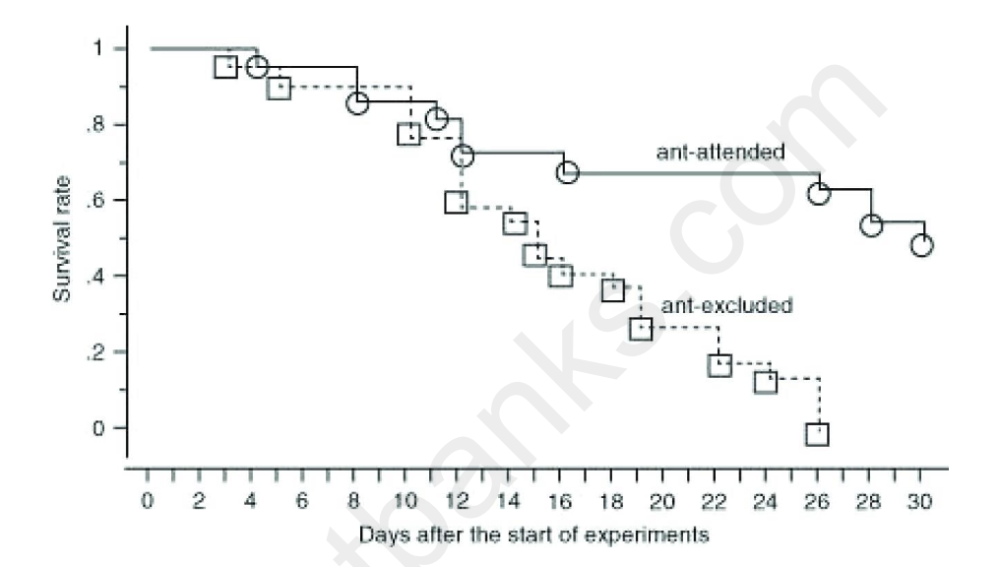 Use the following information and figure to answer the question. Aphids are hemipterans that suck phloem liquid from plants. Ants are often seen collecting the liquid off the posterior end of the aphid and collecting the liquid that is released from the aphid's digestive system. In an effort to understand this interaction, several researchers measure the survival rates of aphid populations when ants were present and when they were excluded. Their results are shown. Which of the following conclusions is most consistent with the data? A) Ants derive nourishment from the aphids. B) Ants protect the aphids from predators. C) Ants parasitize the aphids. D) Ants carry the aphids to a food source. | back 44 B |
front 45 Soft-shell crab is a prized dish in many ocean-side resorts. Which of the following statements provides the best explanation for the soft shell of the crabs? A) The crab has just molted and the new exoskeleton has not yet hardened. B) These species of crabs live under rocks and therefore have lost the hard exoskeleton over evolutionary time. C) These species have evolved a light and soft exoskeleton so that gases can diffuse directly between body of the crab and the surrounding water. D) These species have evolved a light and soft exoskeleton so that they can float in the water column. | back 45 A |
front 46 The increase in plant species diversity is correlated with which of the following events? A) the evolution of complete metamorphosis in insects B) the evolution of flight in insects C) invasion of marine habitats by insects D) a massive increase in species diversity of insects | back 46 D |
front 47 Which characteristic would support your hypothesis that an animal is a sea star and not another type of echinoderm? A) It is radially symmetric. B) It feeds on other animals. C) It has a hydrostatic skeleton formed from its water vascular system. D) it has five or more appendages. | back 47 D |
front 48 Which of the following characteristics is exhibited by the water vascular system of echinoderms? A) it functions as a circulatory system that distributes nutrients to body cells B) it functions in locomotion and feeding C) it is bilateral in organization, even though the adult animal is not bilaterally symmetrical D) it is analogous to the gastrovascular cavity of flatworms | back 48 B |
front 49 Which of the following combinations correctly matches a phylum to its description? A) Echinodermata–bilateral symmetry as a larva, water vascular system B) Nematoda–segmented worms, closed circulatory system C) Cnidaria–flatworms, gastrovascular cavity, does not have a coelom or a hemocoel D) Platyhelminthes–radial symmetry, polyp and medusa body forms | back 49 A |
front 50 Which of the following animal groups is entirely aquatic? A) Mollusca B) Crustacea C) Echinodermata D) Nematoda | back 50 C |
front 51 Which statement is correct with respect to the evolutionary relationship between chordates and invertebrates? A) Chordates are most closely related to arthropods. B) Chordates evolved from echinoderms. C) Chordates are more closely related to echinoderms than to arthropods. D) Chordates are most closely related to the tunicate-type of echinoderms. | back 51 C |
front 52 Echinoderms show enormous diversity in which of the following traits? A) body shape and food habits B) food habits and body symmetry C) body symmetry and method of food digestion D) method of food digestion and body shape | back 52 A |
front 53 A land snail, a clam, and an octopus all share ________. A) a mantle B) a radula C) gills D) distinct cephalization | back 53 A |
front 54 Which phylum is characterized by animals that have a segmented body? A) Cnidaria B) Platyhelminthes C) Arthropoda D) Mollusca | back 54 C |
front 55 The water vascular system of echinoderms ________. A) functions as a circulatory system that distributes nutrients to body cells B) functions in locomotion and feeding C) is bilateral in organization, even though the adult animal is not bilaterally symmetrical D) moves water through the animal's body during filter feeding | back 55 B |
front 56 Which of the following combinations of phylum and description is incorrect? A) Echinodermata–bilateral symmetry as a larva, coelomate B) Nematoda–roundworms, pseudocoelomate C) Platyhelminthes–flatworms, gastrovascular cavity, acoelomate D) Porifera–gastrovascular cavity, coelomate | back 56 D |
front 57 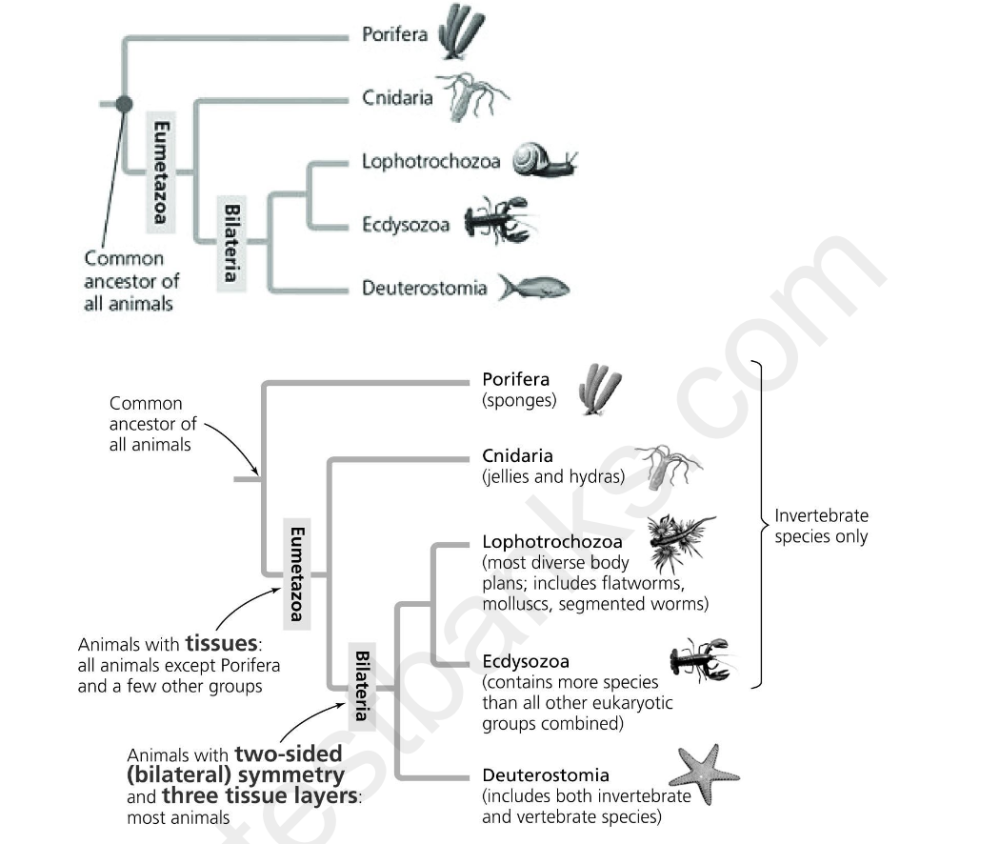 In these figures, which two main clades branch from the most recent common ancestor of the eumetazoans? A) Porifera and Cnidaria B) Lophotrochozoa and Ecdysozoa C) Cnidaria and Bilateria D) Deuterostomia and Bilateria | back 57 C |
front 58 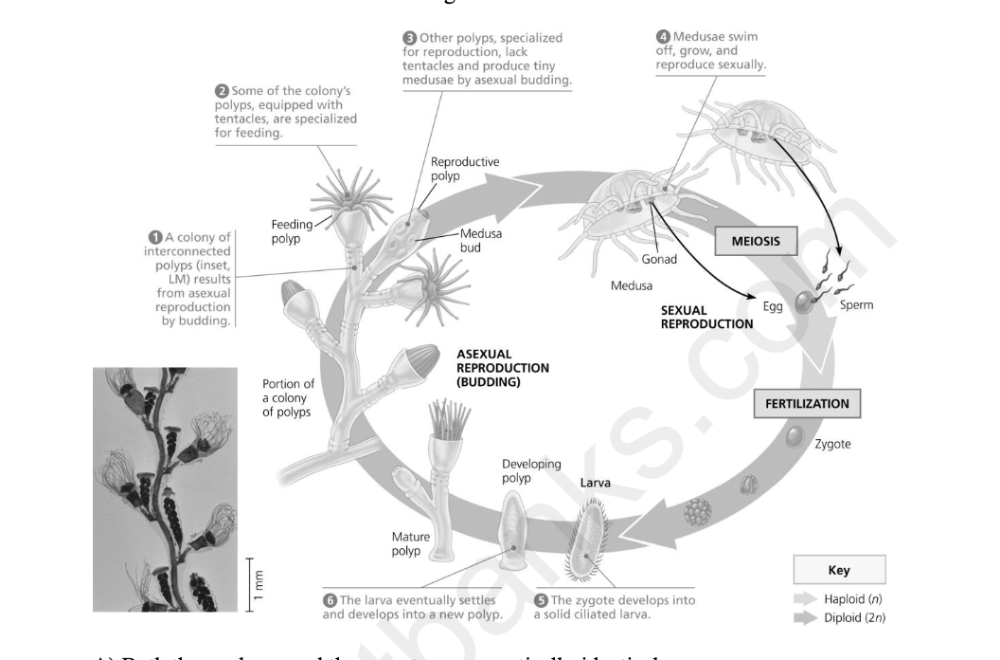 In the below figure, assume that the two medusae shown at step 4 were produced by one polyp colony. Review Concept 12.1 and Concept 13.3, and then use your understanding of mitosis and meiosis to select which of the following is true. A) Both the medusae and the gametes are genetically identical. B) Neither the medusae nor the gametes are genetically identical. C) The medusae are not genetically identical but the gametes are genetically identical. D) The medusae are genetically identical but the gametes differ genetically. | back 58 D |