Instructions for Side by Side Printing
- Print the notecards
- Fold each page in half along the solid vertical line
- Cut out the notecards by cutting along each horizontal dotted line
- Optional: Glue, tape or staple the ends of each notecard together
Ch 27 Bio
front 1 The predatory bacterium Bdellovibrio bacteriovorus is able to penetrate a gram-negative bacterium that has a slimy cell covering. What is the correct sequence of structures penetrated by B. bacteriovorus on its way to the prey's cytoplasm? A) phospholipid membrane, capsule, peptidoglycan, lipopolysaccharide membrane B) lipopolysaccharide membrane, peptidoglycan, capsule, phospholipid membrane C) lipopolysaccharide membrane, capsule, peptidoglycan, phospholipid membrane D) capsule, lipopolysaccharide membrane, peptidoglycan, phospholipid membrane | back 1 D |
front 2 Jams, jellies, preserves, honey, and other foods with high sugar content hardly ever become contaminated by bacteria, even when the food containers are left open at room temperature. Which of the following statements best explains the inability of bacteria to survive in such an environment? A) they undergo death as a result of water loss from the cell B) they are unable to metabolize the glucose or fructose, and thus starve to death C) they are obligate anaerobes D) they are unable to swim through these thick and viscous materials | back 2 A |
front 3 A bacterium has the following characteristics: ∙ It adheres to the human intestinal lining using a feature that protects it from phagocytes, bacteriophages, and dehydration. ∙ It can survive being boiled. ∙ It contains no plasmids and relatively little peptidoglycan. Which of the following characteristics allows this bacterium to survive in a human who is taking penicillin pills? A) gram-negative cell wall B) peptidoglycan in the cell wall C) lipopolysaccharides in the cytoplasm D) long polypeptides in the cell wall | back 3 A |
front 4 A bacterium has the following characteristics: ∙ It adheres to the human intestinal lining using a feature that protects it from phagocytes, bacteriophages, and dehydration ∙ It can survive being boiled ∙ It contains no plasmids and relatively little peptidoglycan Which of the following characteristics allows this bacterium to adhere to the intestinal lining? A) fimbriae B) pili C) an endospore D) a flagellum | back 4 A |
front 5 A bacterium has the following characteristics: ∙ It adheres to the human intestinal lining using a feature that protects it from phagocytes, bacteriophages, and dehydration ∙ It can survive being boiled ∙ It contains no plasmids and relatively little peptidoglycan Which of the following statements best describe the cell wall of this bacterium? A) Its innermost layer is composed of a phospholipid bilayer. B) After it has been subjected to Gram staining, the cell should remain purple. C) It has an outer membrane of lipopolysaccharide. D) It is mostly composed of a complex, cross-linked polysaccharide. | back 5 C |
front 6 In which part of a bacterium is the complete chromosome found? A) mitochondrion B) nucleoid C) nucleus D) plasmid | back 6 B |
front 7 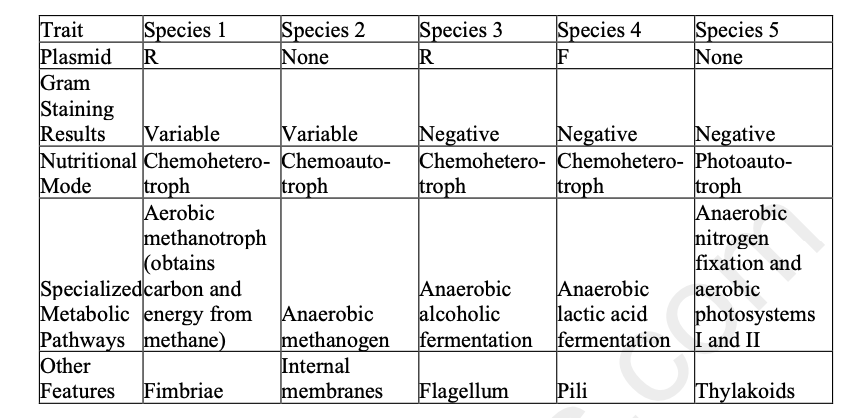 Which two species contain more cytoplasmic phospholipid membranes than the others? A) species 1 and 2 B) species 1 and 3 C) species 2 and 5 D) species 3 and 4 The following table depicts characteristics of five prokaryotic species (1-5). Use the information in the table to answer the following question. | back 7 C |
front 8 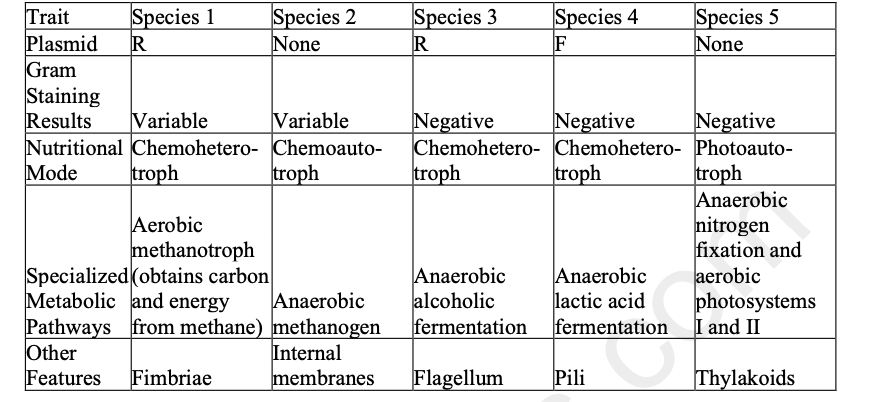 The following table depicts characteristics of five prokaryotic species (1-5). Use the information in the table to answer the following question. Which species is capable of directed movement? A) species 1 B) species 2 C) species 3 D) species 4 | back 8 C |
front 9 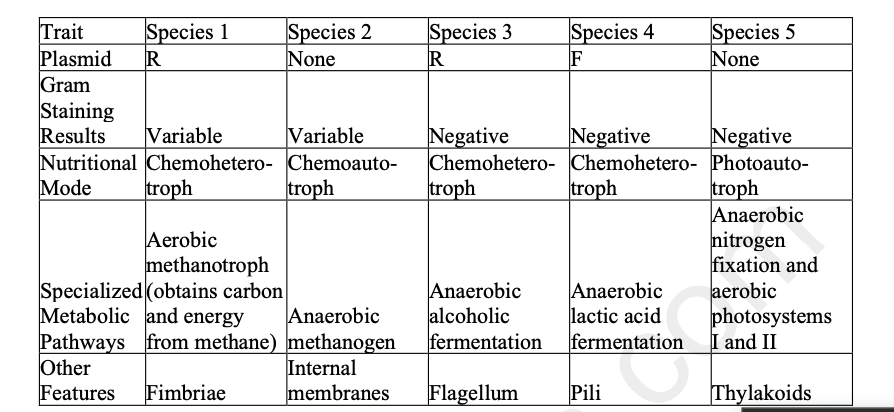 The following table depicts characteristics of five prokaryotic species (1-5). Use the information in the table to answer the following question. Which of the above species have a cell wall that consists partly of an outer membrane of lipopolysaccharide? A) species 1 only B) species 2 only C) species 3 and 4 only D) species 3, 4, and 5 | back 9 D |
front 10 Which of the following statements about flagella provides the best support for the claim that the flagella from eukaryotes and bacteria evolved independently? A) The flagella of both eukaryotes and bacteria are made of the same protein B) The mechanics of movement are the same in these flagella C) The protein that accomplishes the movement is different. D) The protein structure and the mechanism of movement in eukaryotes flagella are different from those of bacteria flagella. | back 10 D |
front 11 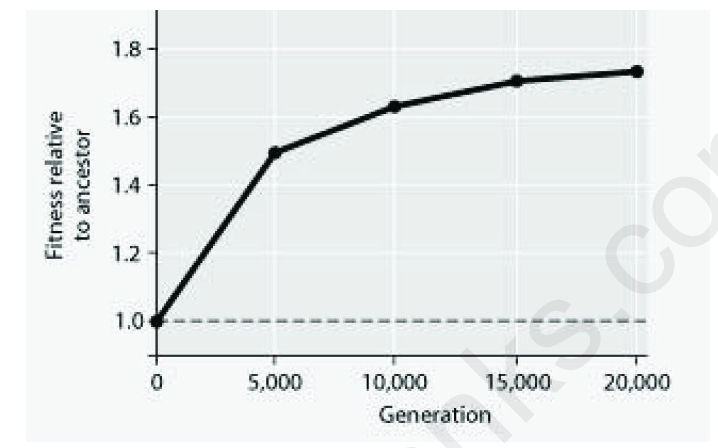 The following question refers to the figure. In an eight-year experiment, a population of E. coli, begun from a single cell, was grown in low- glucose conditions. The culture was transferred to fresh growth medium every 24 hours. Periodically, samples were removed from each population and the ability to survive in low- glucose conditions was compared with the original (ancestral) E. coli population. The cells in the cell line grown in low-glucose conditions showed the effects of which of the following processes? A) gene flow and genetic drift B) natural selection and mutation C) natural selection and gene flow D) conjugation and transformatio | back 11 B |
front 12 Which of the following statements correctly describes F- cells and F+ cells? A) Both types of cells can donate F plasmids to other cells B) Neither types of cells can donate F plasmids to other cells C) F+ cells function as DNA donors during conjugation and F- cells function as DNA recipients during conjugation D) F+ cells function as DNA recipients during conjugation and F- cells function as DNA donors during conjugation | back 12 C |
front 13 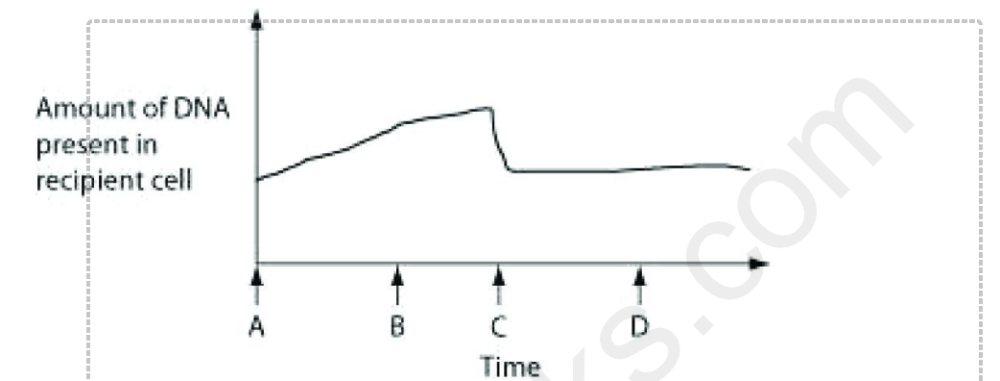 Use the following information and graph to answer the question. The figure depicts changes to the amount of DNA present in a recipient cell that is engaged in conjugation with an Hfr cell. Hfr cell DNA begins entering the recipient cell at time A. Assume that a fragment of the recipient cell's chromosome is exchanged for a homologous fragment from the Hfr cell's DNA. How is the recipient cell different at time D than it was at time A? A) It has a greater number of genes. B) It has a greater mass of DNA. C) It contains different genes. D) It contains bacteriophage DNA | back 13 C |
front 14 Some bacteria possess antibiotic resistance, as well as the ability to survive through adverse conditions. Where in this type of bacteria is the DNA located? A) nucleoid, fimbriae, and plasmids B) endospore, fimbriae, and plasmids C) fimbriae, nucleoid, and endospore D) plasmids, nucleoid, and endospore | back 14 D |
front 15 Chloramphenicol is an antibiotic that targets prokaryotic ribosomes, but not eukaryotic ribosomes. Based on an understanding of eukaryotic origins, which of these questions might be a target for research on chloramphenicol from this observation? A) Can chloramphenicol also be used to control human diseases that are caused by archaeans? B) Can chloramphenicol pass through the capsules possessed by many cyanobacteria? C) If chloramphenicol inhibits prokaryotic ribosomes, should it not also inhibit mitochondrial ribosomes? D) Can chloramphenicol be used to study ribosomal mutations in eukaryotes? | back 15 C |
front 16 Which of the following structures is most likely missing in a bacterium that regenerates from an endospore lacking any of the plasmids from the original cell? A) antibiotic-resistant genes B) a cell wall C) a chromosome D) water in its cytoplasm | back 16 A |
front 17 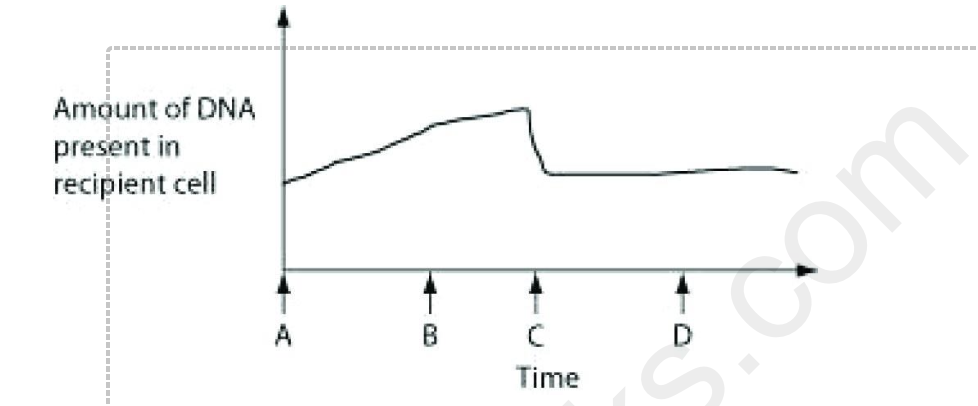 Use the following information and graph to answer the question. The figure depicts changes to the amount of DNA present in a recipient cell that is engaged in conjugation with an Hfr cell. Hfr cell DNA begins entering the recipient cell at time A. Assume that a fragment of the recipient cell's chromosome is exchanged for a homologous fragment from the Hfr cell's DNA. Which of the following processes is responsible for the shape of the curve at time B? A) transduction B) entry of Hfr DNA into the recipient cell C) transformation D) entry of DNA from the recipient cell into the Hfr cell | back 17 B |
front 18 Use the following information and graph to answer the question. The figure depicts changes to the amount of DNA present in a recipient cell that is engaged in conjugation with an Hfr cell. Hfr cell DNA begins entering the recipient cell at time A. Assume that a fragment of the recipient cell's chromosome is exchanged for a homologous fragment from the Hfr cell's DNA. At which time can the recipient cell first be described as "recombinant"? A) A B) B C) C D) D | back 18 A |
front 19 A bacterium has the following characteristics: ∙ It adheres to the human intestinal lining using a feature that protects it from phagocytes, bacteriophages, and dehydration. ∙ It can survive being boiled. ∙ It contains no plasmids and relatively little peptidoglycan. ∙ The bacterium is not susceptible to the penicillin family of antibiotics. ∙ The cell also lacks F factors and F plasmids. Which of the following statements about the bacteria is most probably accurate? A) The bacterium is unable donate DNA through conjugation with another cell. B) The bacterium cannot take up DNA from its external environment. C) The bacterium is not able to form an endospore. D) The bacterium will not reproduce. | back 19 A |
front 20 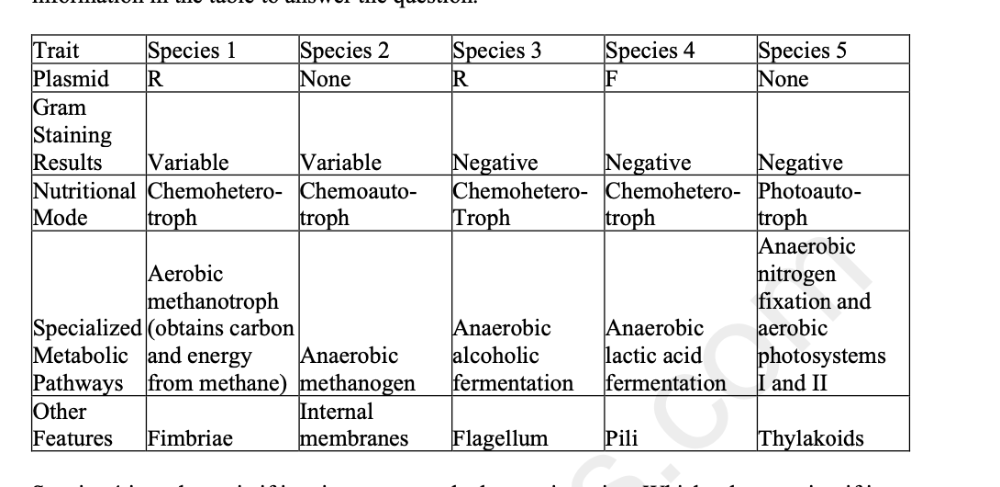 The following table depicts characteristics of five prokaryotic species (1-5). Use the information in the table to answer the question. Species 4 is pathogenic if it gains access to the human intestine. Which other species, if it coinhabited a human intestine along with species 4, is most likely to become a recombinant species that is both pathogenic and resistant to some antibiotics? A) species 1 B) species 2 C) species 3 D) species 5 | back 20 C |
front 21 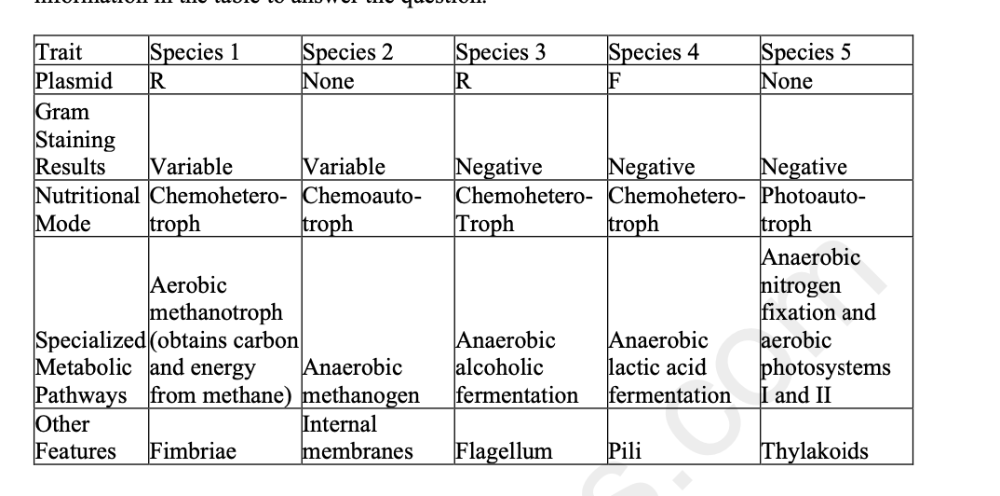 The following table depicts characteristics of five prokaryotic species (1-5). Use the information in the table to answer the question. Which species most likely includes cells that are Hfr cells? A) species 1 B) species 2 C) species 3 D) species 4 | back 21 D |
front 22 The following question refers to the figure. In this eight-year experiment, a population of E. coli, begun from a single cell, was grown in low-glucose conditions for 20,000 generations. Each culture was introduced to fresh growth medium every 24 hours. Occasionally, samples were removed from the population, and its ability to survive in low-glucose conditions was tested against that of members sampled from the ancestral E. coli population. E. coli cells typically make most of their ATP by metabolizing glucose. Under the conditions of this experiment, how would E. coli generation times in the experimental lines and low-glucose conditions be described? A) they will be the same as in the typical environment B) they will be faster than in the typical environment C) they will be slower than in the typical environment D) they will increase over time in the experimental cells | back 22 C |
front 23 The following question refers to the figure. In this eight-year experiment, a population of E. coli, begun from a single cell, was grown in low-glucose conditions for 20,000 generations. Each culture was introduced to fresh growth medium every 24 hours. Occasionally, samples were removed from the population, and its ability to grow in low-glucose conditions was tested against that of members sampled from the ancestral (common ancestor) E. coli population. If the experimental population of E. coli lacks an F factor or F plasmid, and if bacteriophages are excluded from the bacterial cultures, how would beneficial mutations be transmitted horizontally to other E. coli cells? A) sex pili B) transduction C) conjugation D) transformation | back 23 D |
front 24 Which of the following statements is the most likely result of conjugation involving a bacterium that contains a copy of a plasmid containing a gene for tetracycline resistance with one that does not? A) the temporary possession by this bacterium of a completely diploid genome B) the rapid spread of tetracycline resistance to other bacteria in the population C) the subsequent loss of tetracycline resistance from this bacterium D) the production of endospores among the bacterium's progeny | back 24 B |
front 25 Which of the following processes leads to genetic recombination by the introduction of viral DNA into a bacterium? A) horizontal gene transfer B) conjugation C) transformation D) transduction | back 25 D |
front 26 Which of the following statements correctly describes both phototrophs and chemotrophs? A) Both are also autotrophs B) Both obtain their energy from chemicals C) Both obtain their energy from light D) Chemotrophs obtain energy from chemicals and phototrophs obtain energy from light | back 26 D |
front 27 Use of synthetic fertilizers often leads to the contamination of groundwater with nitrates. Nitrate pollution is also a suspected cause of anoxic "dead zones" in the ocean. Which of the following processes is most likely to help reduce nitrate pollution? A) adding methanogens to the soil B) adding nitrifying bacteria to the soil C) adding denitrifying bacteria to the soil D) using ammonia instead of nitrate as a fertilizer | back 27 C |
front 28 Living organisms can be divided into two groups: autotrophs and heterotrophs. How do these two groups differ? A) their sources of carbon B) their electron acceptors C) their mode of inheritance D) the way that they generate ATP | back 28 A |
front 29 A bacterium that lives in the human intestine derives its nutrition by digesting the contents of the intestine. Which mode of nutrition best describes this bacterium? A) aerobic chemoheterotroph B) aerobic chemoautotroph C) anaerobic chemoheterotroph D) anaerobic chemoautotroph | back 29 C |
front 30 Anabaena is a cyanobacterium with two types of cells. One type of cell can carry out photosynthesis and the other type can carry out nitrogen fixation. However, the oxygen produced by photosynthesis inhibits the enzymes for nitrogen fixation. Which structural characteristic allows the nitrogen-fixing cells to continue to function? A) modified plasma membranes that are impermeable to both oxygen and nitrogen B) cell walls that are impermeable to both oxygen and nitrogen C) specialized cells called heterocysts, which have cell walls that restrict the entry of oxygen D) plasma membranes that are impermeable to nitrogen | back 30 C |
front 31 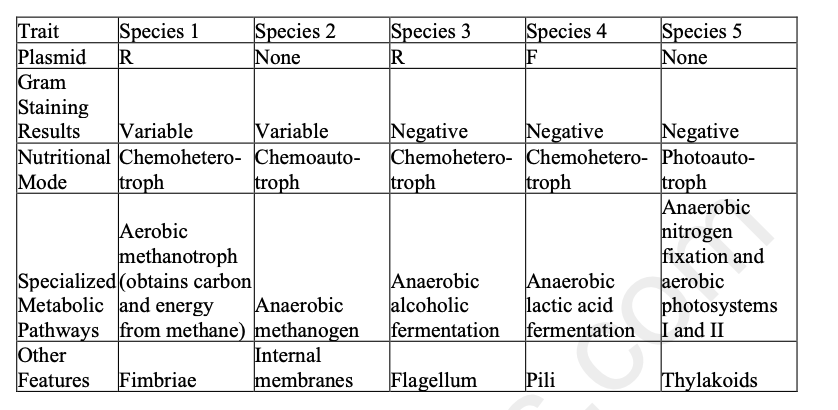 The following table depicts characteristics of five prokaryotic species (1-5). Use the information in the table to answer the question. Which two species might be expected to cooperate metabolically, perhaps forming a biofilm wherein one species surrounds cells of the other species? A) species 1 and 2 B) species 1 and 3 C) species 2 and 5 D) species 3 and 4 | back 31 A |
front 32 Which of the following characteristics is most likely found in plaque on human teeth if plaque is a biofilm? A) multiple species of bacteria, production of chemicals that attract other bacteria, and production of chemicals that allow the bacteria to adhere to enamel B) single species of bacteria, production of antibiotics, and mechanisms in the biofilm that allow inner cells to expel wastes C) multiple species of bacteria, production of antibiotics, and mechanisms in the biofilm that allow inner cells to expel wastes D) single species of bacteria, production of chemicals that attract other bacteria, and production of chemicals that allow the bacteria to adhere to enamel | back 32 A |
front 33 While examining a rock surface, you have discovered an interesting new organism. Which of the following criteria will allow you to classify the organism as belonging to Bacteria but not Archaea or Eukarya? A) Cell walls are made primarily of peptidoglycan. B) The organism does not have a nucleus. C) The lipids in its plasma membrane consist of glycerol bonded to straight-chain fatty acids. D) It can survive at a temperature over 100°C. | back 33 A |
front 34 Which of the following characteristics describe most existing bacteria? A) pathogenic, omnipresent, morphologically diverse B) extremophiles, tiny, abundant C) tiny, ubiquitous, metabolically diverse D) morphologically diverse, metabolically diverse, extremophiles | back 34 C |
front 35 What line of evidence would support a hypothesis that a newly discovered bacterium is a cyanobacterium? A) It is able to form colonies and produce oxygen. B) It is an endosymbiont. C) It forms chains called mycelia. D) It lacks cell walls. | back 35 A |
front 36 Which statement about the domain Archaea is accurate? A) Genetic prospecting has recently revealed the existence of many previously unknown archaean species. B) The genomes of archaeans are unique, containing no genes that originated within bacteria. C) No archaeans can inhabit solutions that are nearly 30% salt. D) No archaeans are adapted to waters with temperatures above the boiling point. | back 36 A |
front 37 Which of the following traits do archaeans and bacteria have in common? A) composition of the cell wall B) composition of the cell wall and lack of a nuclear envelope C) lack of a nuclear envelope and presence of circular chromosome D) presence of plasma membrane and composition of the cell wall | back 37 C |
front 38 Which of the following traits do archaeans and eukaryotes have in common? A) presence of a nuclear envelope B) presence of peptidoglycan in the cell wall C) sensitivity to streptomycin D) presence of introns | back 38 D |
front 39 Assuming that each of these prokaryotes possesses a cell wall, which ones are expected to be most strongly resistant to significant water loss in hypertonic environments? A) extreme halophiles B) extreme thermophiles C) methanogens D) cyanobacteria | back 39 A |
front 40 The thermoacidophile Sulfolobus acidocaldarius is an archaean organism that can tolerate environments that are high in temperature and low in pH. It lacks peptidoglycan, but still possesses a cell wall. Which of the following statements is likely to be an accurate description of this species? A) It is a bacterium. B) The optimal pH of its enzymes will lie above pH 7. C) It could inhabit hydrothermal springs. D) It could inhabit alkaline hot springs. | back 40 C |
front 41 A fish that has been salt-cured subsequently develops a reddish color. You suspect that the fish has been contaminated by the extreme halophile Halobacterium. Which of these features of cells removed from the surface of the fish would support your suspicion? A) the presence of the same photosynthetic pigments found in cyanobacteria and cell walls that lack peptidoglycan B) cell walls that lack peptidoglycan and are isotonic to conditions on the surface of the fish C) cells unable to survive salt concentrations lower than 9% and cells containing many ion pumps on the plasma membrane D) the presence of the same photosynthetic pigments found in cyanobacteria and cells that are isotonic to conditions on the surface of the fish | back 41 B |
front 42 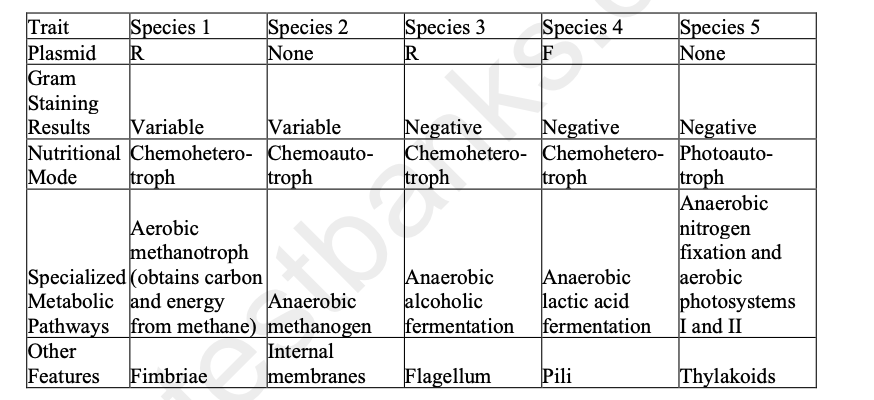 The following table depicts characteristics of five prokaryotic species (1-5). Use the information in the table to answer the question. Which species is most likely to be found in sewage treatment plants and in the guts of cattle? A) species 1 B) species 2 C) species 3 D) species 4 | back 42 B |
front 43 Which of the following extremophiles is the best model for the earliest organisms on Earth? A) a prokaryote found near hydrothermal vents B) an archaean capable of surviving in the polar ice caps C) an anaerobic archaean species D) a bacterium that thrives in a highly acidic environment | back 43 A |
front 44 Mitochondria are thought to be the descendants of certain alpha proteobacteria. They are, however, no longer able to lead independent lives because most genes originally present in their genome have moved to the nuclear genome. Which phenomenon accounts for the movement of these genes? A) recombination B) conjugation C) translation D) endosymbiosis | back 44 D |
front 45 Recently, a microbe that is able to digest cellulose was discovered in a hot spring with an average temperature of 95°C. This microbe most likely belongs to which of the following groups? A) Archaea B) Proteobacteria C) Cyanobacteria D) Spirochetes | back 45 A |
front 46 Bacteria perform a number of ecological roles. Which role typically involves symbiosis? A) skin commensalist B) decomposition C) chemical recycling D) immobilizing nutrients | back 46 A |
front 47 Most ecosystems on Earth rely on sunlight as the primary energy source for the synthesis of organic compounds that living organisms need. Sunlight does not penetrate deep enough in the ocean to provide energy for organisms living near hydrothermal vents. How can these densely populated communities survive without energy from the sun? A) chemoheterotrophic bacteria convert organic compounds into carbon dioxide which is used by other organisms as an energy source B) chemoautotrophic bacteria harvest chemical energy from hydrogen sulfide and then provide the basis of food for the vent communities C) chemoheterotrophic bacteria harvest chemical energy from hydrogen sulfide and then provide the basis of food for the vent communities D) chemoautotrophic bacteria fix nitrogen which then is used as a source of energy for other organisms | back 47 B |
front 48 If all prokaryotes on Earth suddenly vanished, which of the following would be the most likely and most direct result? A) human populations would thrive in the absence of disease B) bacteriophage numbers would dramatically increase C) the recycling of nutrients would be greatly reduced D) there would be no more pathogens | back 48 C |
front 49 A type of bacteria colonizes on the surface of a leaf, where it obtains nutrition from the leaf's nonliving, waxy covering without harming the plant, and inhibits the growth of other microbes that are plant pathogens. If this bacteria gains access to the inside of a leaf, however, it causes a fatal disease in the plant. Once the plant dies, the bacterium and its offspring decompose the plant. What is the correct sequence of ecological roles played by the bacterium in the situation described here? A) nutrient recycler, commensalist, pathogen B) mutualist, commensalist, pathogen C) mutualist, pathogen, nutrient recycler D) nutrient recycler, mutualist, primary producer | back 49 C |
front 50 What is one of the primary benefits of bioremediation? A) to improve human health with the help of living organisms such as bacteria B) to clean up areas polluted with toxic compounds by using bacteria C) to improve soil quality for plant growth by using bacteria D) to improve bacteria for production of useful chemicals | back 50 B |
front 51 Which of the following statements correctly describes exotoxins and endotoxins produced by various bacteria? A) endotoxins are secreted into the environment while the bacteria is still alive B) exotoxins are secreted into the environment while the bacteria is still alive C) exotoxins are only released into the environment when the bacteria dies and their cell walls break down D) exotoxins are components of the outer membrane of the bacteria that produce them | back 51 B |
front 52 Broad-spectrum antibiotics inhibit the growth of most intestinal bacteria. Consequently, assuming that nothing is done to counter the reduction of intestinal bacteria, a hospital patient who is receiving broad-spectrum antibiotics is most likely to exhibit which of the following characteristics? A) inability to digest any food B) inability to absorb water adequately C) inability to absorb nutrients adequately D) deficiency in certain vitamins and nutrients | back 52 D |
front 53 Which of the following types of pathogenic prokaryotes cause cholera? A) archaea that release an exotoxin B) archaea that release an endotoxin C) bacteria that release an exotoxin D) bacteria that release an endotoxin | back 53 C |
front 54 Which of the following statements correctly describes a process by which bacteria become resistant to antibiotics? A) bacteria reproduce slowly, allowing mutation to become widespread in a population. B) some bacteria produce exotoxins that breakdown antibiotics, rendering them nonfunctional. C) conjugation spreads antibiotic resistance genes rapidly in a population. D) antibiotics cause mutation in bacteria, making them resistant. | back 54 C |
front 55 The CRISPR-Cas system helps some prokaryotes defend against infection by viruses. Which of the following statements correctly describes how this system works? A) it produces RNA that is translated into proteins that attack viral DNA B) it inserts specific genes into the prokaryotic genome C) it causes proteins to synthesize proteins that are then secreted by the prokaryote and attack viruses D) it cuts DNA at specific sequences to which it is directed | back 55 D |
front 56 A process that cannot produce genetic variation in bacterial populations is ________. A) transduction B) conjugation C) mutation D) meiosis | back 56 D |
front 57 Photoautotrophs use ________. A) light as an energy source and CO2 as a carbon source B) light as an energy source and methane as a carbon source C) N2 as an energy source and CO2 as a carbon source D) CO2 as both an energy source and a carbon source | back 57 A |
front 58 Which of the following statements is true? A) Archaea and bacteria have identical membrane lipids. B) The cell walls of archaea lack peptidoglycan. C) Prokaryotes have low levels of genetic diversity. D) No archaea are capable of using CO2 to oxidize H2 releasing methane. | back 58 B |
front 59 Which of the following involves metabolic cooperation among prokaryotic cells? A) binary fission B) endospore formation C) biofilms D) photoautotrophy | back 59 C |
front 60 Which of the following describes a bacterium that lives in the human intestine and causes disease? A) commensalist B) decomposer C) gut mutualist D) symbiotic pathogen | back 60 D |
front 61 Photosynthesis that releases O2 occurs in ________. A) cyanobacteria B) archaea C) gram-positive bacteria D) chemoautotrophic bacteria | back 61 A |