Instructions for Side by Side Printing
- Print the notecards
- Fold each page in half along the solid vertical line
- Cut out the notecards by cutting along each horizontal dotted line
- Optional: Glue, tape or staple the ends of each notecard together
Ch 26 Bio
front 1 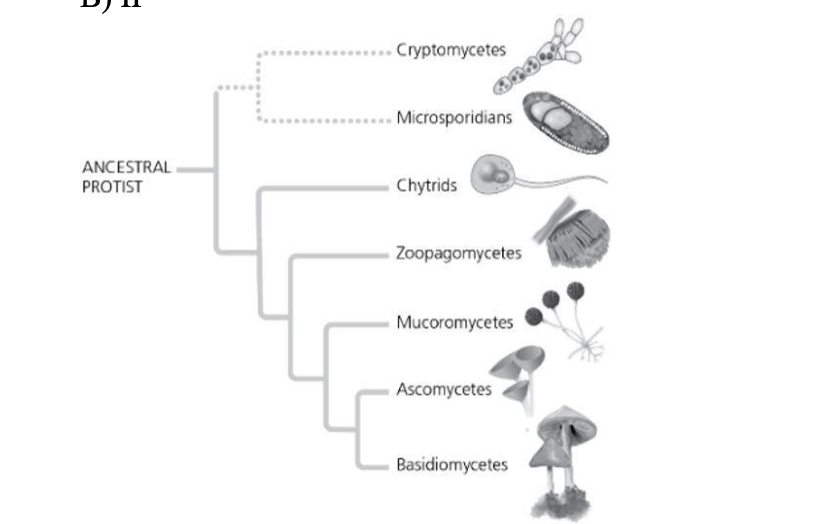 Which phylogenetic tree can best be used to support the claim that the microsporidians are a sister group of the cryptomycetes? A) I B) II (switch microsporidians and cryptomycetes) C) III (switch microsporidians and mucoromycetes) D) IV (switch cryptomycetes and chytrids | back 1 A |
front 2 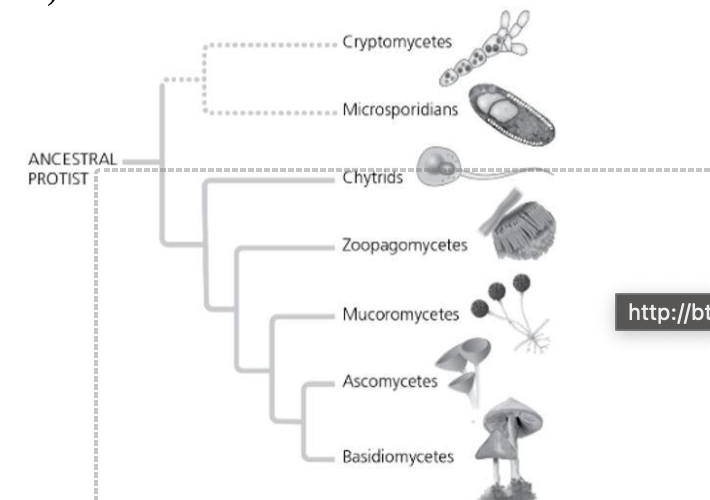 Which phylogenetic tree can best be used to show that the zygomycetes and chytrids are the most closely related? A) I (switch chytrids and mucoromycetes) B) II C) III (switch cryptomycetes and chytrids AND switch zoopagomycetes and microsporidians) D) IV (switch zoopagomycetes and chytrids) | back 2 C |
front 3 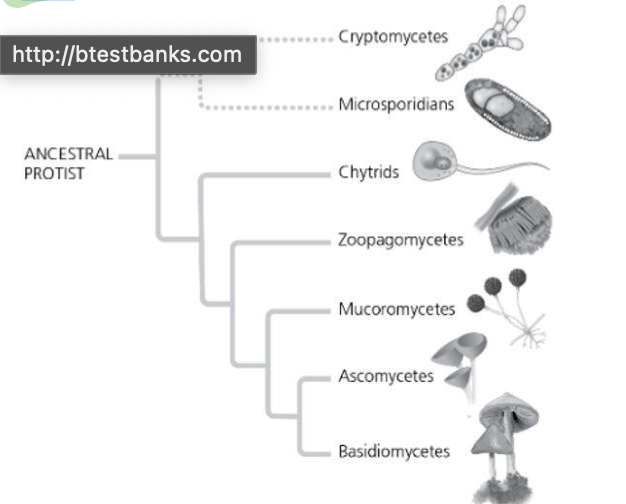 In which phylogenetic tree are the chytrids and ascomycetes shown as being more distantly related than in the other phylogenetic trees? A) I B) II (switch chytrids and mucoromycetes) C) III (switch zoopagomycetes and chytrids) D) IV (switch chytrids and basidiomycetes) | back 3 A |
front 4 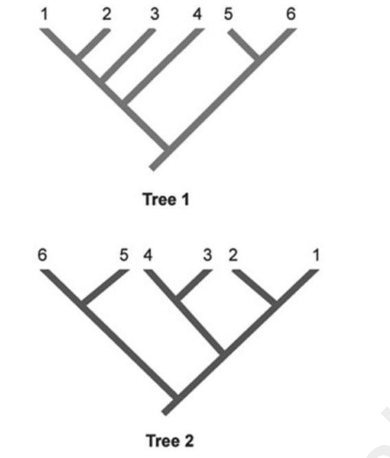 In the phylogenetic trees shown, each number represents a unique species of organisms. Which two species are represented as sister species in Tree 2 but are not represented as sister species in Tree 1? A) 1 and 2 B) 2 and 3 C) 3 and 4 D) 4 and 5 | back 4 C |
front 5 Which of the following statements describes a difference between the taxonomic levels of the hierarchical classification system? A) how widely the organisms assigned to each are distributed throughout the environment B) their inclusiveness C) the relative genome sizes of the organisms assigned to each D) morphological characters that are applicable to all organisms | back 5 B |
front 6 Carolus Linnaeus believed that species remained fixed in the form in which they had been created. Which of the following concepts are inconsistent with Linnaeus's model of classification? A) a hierarchical classification scheme B) taxonomy C) phylogenies D) nested | back 6 increasingly inclusive categories of organisms,C |
front 7 In which type of classification system are names assigned only to groups that include a common ancestor and all of its descendants? A) a system that groups organisms based solely on similar morphologies B) a system that groups organisms based on similar roles in the environment C) a system based entirely on evolutionary history D) a system based solely on cellular structures | back 7 C |
front 8 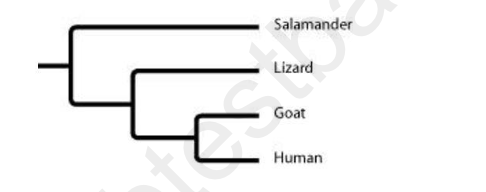 Which of the following statements is most consistent with the model of evolutionary relatedness represented in the phylogenetic tree? A) Goats and humans are the only sister group in this tree. B) Salamanders are a sister group to the group containing lizards, goats, and humans. C) Salamanders are more closely related to lizards than they are to humans. D) Goats are more closely related to salamanders than they are to humans. | back 8 B |
front 9 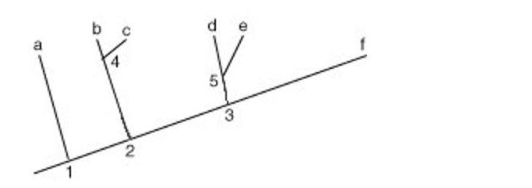 The following phylogeny shows six living species (a-f) and five ancestral (now extinct) species (1-5). If the phylogeny had been developed on the basis of similarities in bone structure, which of the following predictions would you make in terms of the structure of a particular enzyme? A) The enzymes of species b and f are very similar. B) The enzymes of species b and c are more similar to ancestor 4 than to ancestor 2 C) The enzymes of species a and b are the same as that of ancestor 2. D) The enzyme of species c is very similar to that of species d. | back 9 B |
front 10 Some beetles and flies have antler-like structures on their heads, much like male deer. The existence of antlers in beetle, fly, and deer species with strong male-male competition is an example of which of the following? A) convergent evolution B) similarity due to shared ancestry C) homology D) parsimony | back 10 A |
front 11 If organisms 1, 2, and 3 belong to the same class but to different orders and if organisms 3, 4, and 5 belong to the same order but to different families, which of the following pairs of organisms would be expected to show the greatest degree of morphological homology? A) 1 and 4 B) 2 and 4 C) 2 and 3 D) 4 and 5 | back 11 D |
front 12 The term convergent evolution is most applicable to which of the following characteristics? A) the presence of an opposable thumb in humans and chimpanzees B) the layer of fat found under the skin of mammals such as dolphins and polar bears C) the fur that covers Australian moles and North American moles D) the bones of bat forelimbs and the bones of bird forelimbs | back 12 A |
front 13 Which of the following evolutionary processes or characteristics would most likely result in an archaean species whose rRNA is more similar to that of humans or mice? A) homology B) convergent evolution C) common ancestry D) retro-evolution by humans | back 13 B |
front 14 Which of the following pairs is the best example of homologous structures? A) eyelessness in the Australian mole and eyelessness in the North American mole B) wings on an owl and wings on a hornet C) the shape of the dorsal fin in dolphins and the shape of the dorsal fin in sharks D) bones in the bat wing and bones in the human forelimb | back 14 D |
front 15 Some molecular data place the giant panda in the bear family (Ursidae) but place the lesser panda in the raccoon family (Procyonidae). If the molecular data best reflect the evolutionary history of these two groups, then the morphological similarities of these two species is most likely due to which of the following processes? A) the inheritance of acquired characteristics B) sexual selection C) possession of analogous (convergent) traits D) possession of shared primitive characters | back 15 C |
front 16 Scientists have hypothesized that the common ancestors of birds and mammals possessed three-chambered hearts (two atria, one ventricle). Birds and mammals, however, are alike in having four-chambered hearts (two atria, two ventricles). Which of the following statements best describes the four-chambered hearts of birds and mammals? A) they are morphological homologies B) they exhibit molecular homology C) they are morphological analogies D) they are the result of shared ancestry | back 16 C |
front 17 Evolutionary biologists have developed a phylogeny for a group of mammals based on bone structure. Which of the following statements best predicts the phylogeny for the same group of mammals based on similarities and differences in the structure of a particular enzyme? A) The phylogeny would be different than the phylogeny based on bone structure. B) The phylogeny would be the same as the phylogeny based on bone structure. C) No prediction regarding the phylogeny could be made. D) The amino acid sequence for this particular enzyme would be identical in all species. | back 17 A |
front 18 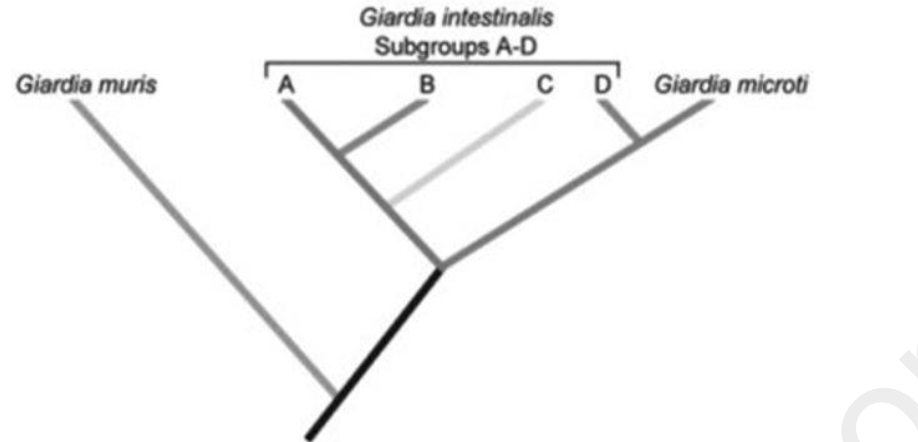 According to the phylogenetic tree in the figure above, what type of evolutionary group does G. intestinalis constitute? A) analogous B) monophyletic C) polyphyletic D) paraphyletic | back 18 D |
front 19 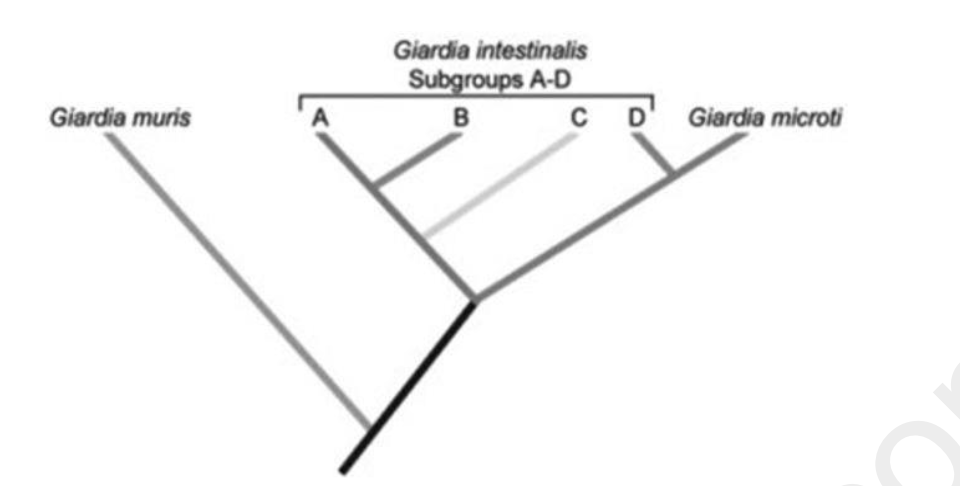 By examining the phylogenetic tree diagrammed in the figure, what conclusion can you draw about the species G. microti? A) It evolved before G. intestinalis. B) It is more closely related to G. muris than to G. intestinalis. C) It should not be labeled a species distinct from G. intestinalis. D) It is part of a monophyletic group that also includes G. intestinalis. | back 19 D |
front 20 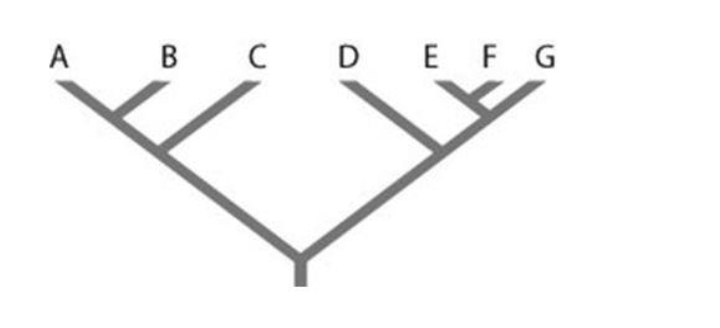 In the figure, the letters A-G represent individual species that all descended from a common ancestor. Which of the following groups of these species forms a monophyletic group? A) A, B, C, D B) C and D C) D, E, and F D) E, F, and G | back 20 D |
front 21 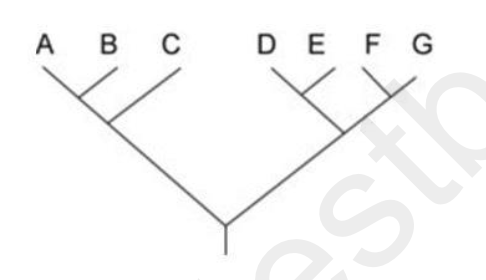 Which of the following conclusions regarding the phylogeny of these organisms can be made from this tree? A) A is more closely related to D than it is to C B) B is more closely related to G than it is to A C) D is more closely related to E than it is to G D) G is more closely related to A than it is to F | back 21 C |
front 22 Which of the following information would be most useful in creating a phylogenetic tree of a taxon? A) morphological data from fossil and living species B) a knowledge of color patterns in fossil and living species C) a knowledge of mutation rates in modern species D) morphological data from fossil species | back 22 A |
front 23 Your professor wants you to construct a phylogenetic tree of a type of plant called orchids. She gives you tissue from seven orchid species and one lily plant. What is the most likely reason she gave you the lily? A) to serve as an outgroup B) to see if the lily is an ancient orchid species C) to see if the lily and the orchids show all the same shared derived characters D) to demonstrate likely genetic similarities | back 23 A |
front 24 Which of the following statements best describes the rationale for applying the principle of maximum parsimony in constructing phylogenetic trees? A) Parsimony allows the researcher to "root" the tree. B) For trees based on morphology, the most parsimonious tree requires the fewest evolutionary events. C) The principal of analogy validates the principle of parsimony. D) The outgroup roots the tree, allowing the principle of parsimony to be applied. | back 24 B |
front 25 Which of the following statements is accurate with regard to a phylogeny, as represented by a phylogenetic tree? A) Members of the same clade likely share many derived characters. B) A monophyletic group can be properly based on convergent features. C) The ancestral group often has all the derived characters of the descendant species. D) Shared ancestral characters are excellent traits to use in developing a phylogeny. | back 25 A |
front 26 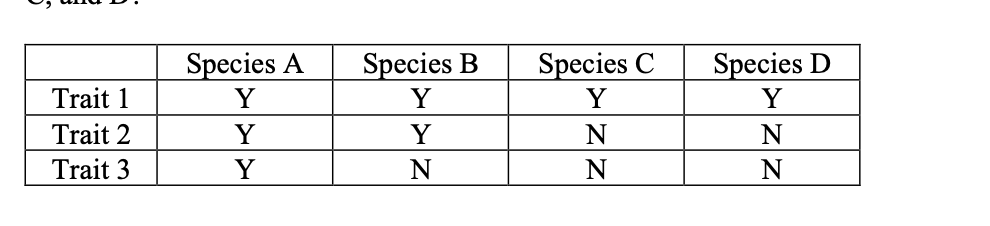 In the table, a Y indicates that the listed species possess trait 1, 2, or 3 and an N indicates that the listed species do not possess the trait. Given that phylogenies are based on shared derived characteristics, which of the following traits is useful in generating a phylogeny of species A, B, C, and D? A) Trait 1 B) Trait 2 C) Trait 3 D) Traits 1, 2, and 3 | back 26 B |
front 27 Which of the following taxa are problematic when the goal is to construct phylogenies that accurately reflect evolutionary history? A) polyphyletic taxa B) paraphyletic taxa C) monophyletic taxa D) polyphyletic taxa and paraphyletic taxa | back 27 D |
front 28 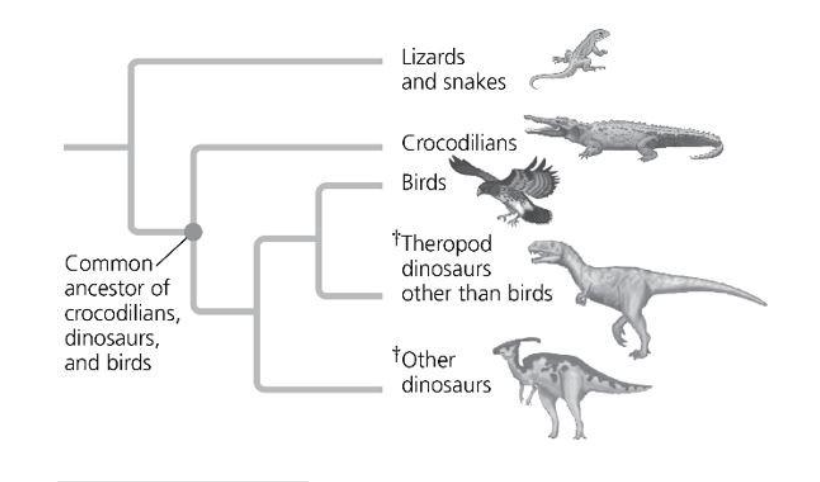 The figure represents a phylogenetic tree of birds and their closest relatives. Which group of organisms represents the outgroup in this clade? A) lizards and snakes B) crocodilians C) ornithischian dinosaurs D) birds | back 28 A |
front 29 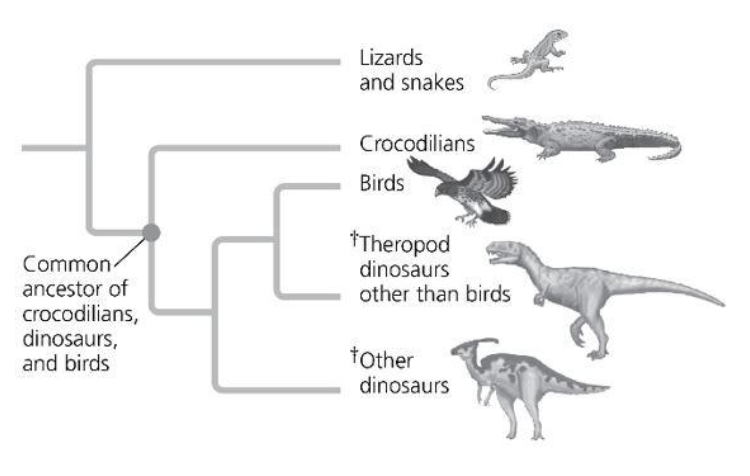 The figure represents a phylogenetic tree of birds and their closest relatives. Which group of organisms represents the outgroup in the clade that includes only crocodilians, ornithischian dinosaurs, saurischian dinosaurs, and birds? A) lizards and snakes B) crocodilians C) ornithischian dinosaurs D) birds | back 29 B |
front 30 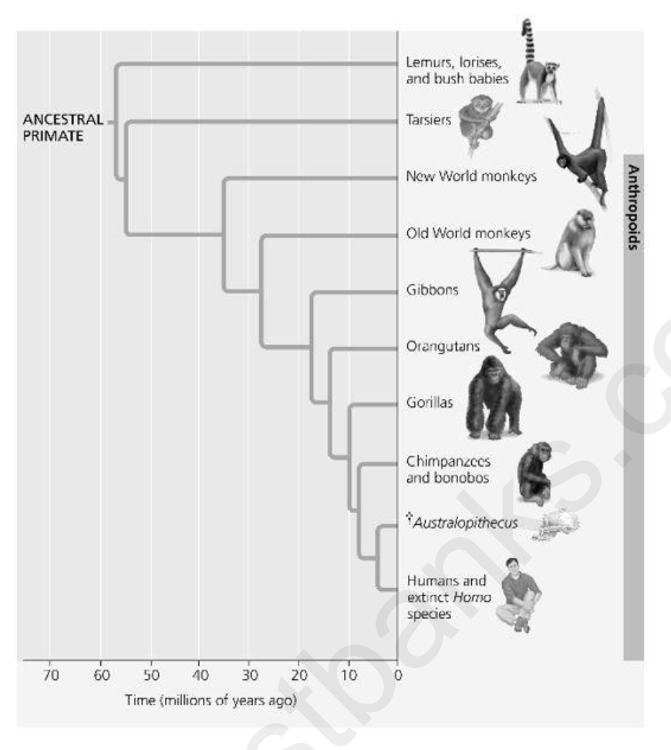 Humans, chimpanzees, gorillas, and orangutans are members of a clade called the great apes, which shared a common ancestor approximately 15 million years ago. Referring to the phylogenetic tree in the figure, which of the following pairs of apes are most closely related? A) gorillas and chimpanzees B) humans and Australopithecus C) humans and gorillas D) orangutans and chimpanzees | back 30 B |
front 31 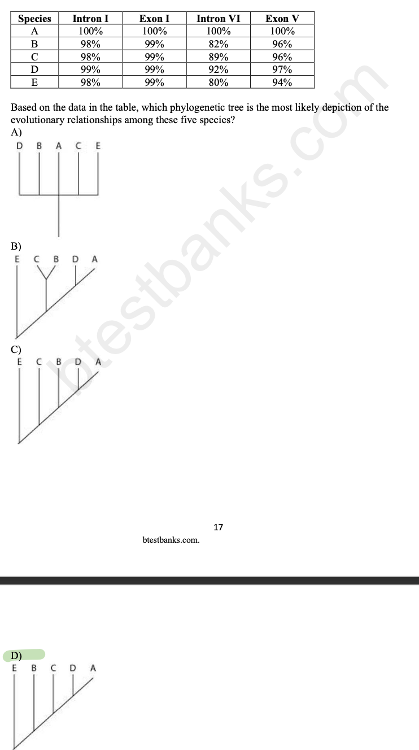 31) The question refers to the table, which compares the percent sequence homology of four different parts of a gene (two introns and two exons) that is found in five different eukaryotic species. The data show the percentage of sequence homology of each intron and exon in comparison to the sequences in species A. % Sequence Homology | back 31 D |
front 32 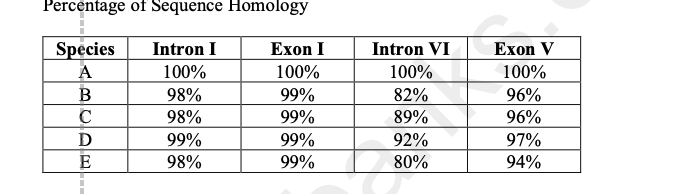 The question refers to the table, which compares the percent sequence homology of four different parts of a gene (two introns and two exons) that is found in five different eukaryotic species. The data show the percentage of sequence homology of each intron and exon in comparison to the sequences in species A. Percentage of Sequence Homology Regarding these sequence homology data, how would the principle of maximum parsimony be applicable in comparing them? A) distinguishing introns from exons B) determining degree of sequence homology C) selecting appropriate genes for comparison among species D) inferring evolutionary relatedness from the number of sequence differences | back 32 D |
front 33 Birds and mammals have four limbs. Which of the following statements describes this trait? A) the trait is a shared ancestral character B) the trait is a shared derived character C) the trait is useful for distinguishing birds from mammals D) the trait is an example of analogy rather than homology | back 33 A |
front 34 If you were using cladistics to build a phylogenetic tree of cats, which of the following organisms would be the best outgroup? A) lion B) domestic cat C) wolf D) leopard | back 34 C |
front 35 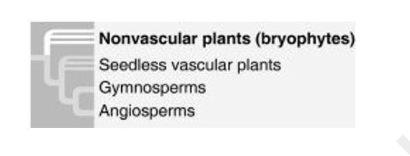 Use the figure to answer the following question. Gymnosperms and angiosperms are both types of plants that produce seeds. Which of the following claims is best supported by this phylogenetic tree? A) the tree depicts uncertainty about whether the bryophytes or the vascular plants evolved first B) the tree depicts an evolutionary hypothesis C) the tree includes evolution of convergent characteristics D) the tree indicates that seeds are a shared ancestral character of all vascular plants | back 35 B |
front 36 Which of the following statements correctly describes paralogous genes in related species? A) homology of the genes is a result of gene duplication B) homology of the genes is a result of a speciation event C) homology of the genes is due to mutation D) homology of the genes is based on the rate at which they evolve | back 36 A |
front 37 Eukaryotes that are not closely related and that do not share many anatomical similarities can still be placed together on the same phylogenetic tree. Which of the following approaches would be most appropriate for doing this? A) by comparing their plasmids B) by comparing their mitochondrial genomes C) by comparing their homologous genes that are poorly conserved D) by comparing their homologous genes that are highly conserved | back 37 D |
front 38 For which of the following organisms would a phylogenetic tree constructed using sequence differences in mitochondrial DNA be most valid for discerning their evolutionary relatedness? A) archaeans and bacteria B) fungi and animals C) chimpanzees and humans D) sharks and dolphins | back 38 C |
front 39 The lakes of northern Minnesota are home to many similar species of damselflies of the genus Enallagma. These species have apparently undergone speciation from ancestral stock since the last glacial retreat about 10 thousand years ago. Sequencing which of the following nucleic acids or proteins would probably be most useful in sorting out evolutionary relationships among these closely related species? A) conserved regions of nuclear DNA B) mitochondrial DNA C) amino acids in proteins D) ribosomal RNA | back 39 B |
front 40 Which statement represents the best explanation for the observation that the nuclear DNA of wolves and domestic dogs has a very high degree of sequence homology? A) dogs and wolves have very similar morphologies B) dogs and wolves belong to the same order C) dogs and wolves are both members of the order Carnivora D) dogs and wolves share a very recent common ancestor | back 40 D |
front 41 Which of the following statements explains why paralogous genes can diverge from each other within the same gene pool, whereas orthologous genes diverge only after gene pools are isolated from each other? A) having multiple copies of genes is essential for the occurrence of sympatric speciation in the wild B) paralogous genes can occur only in diploid species, thus they are absent from most prokaryotes C) polyploidy is a necessary precondition for the occurrence of sympatric speciation in the wild D) having an extra copy of a gene permits modifications to the copy without loss of the original gene product | back 41 D |
front 42 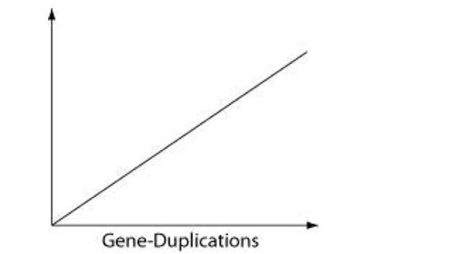 42) Which of the following items is most likely to form a simple linear relationship with the number of gene-duplication events, when placed as the label on the vertical axis of the following graph? A) number of mitochondria B) number of cells/organism C) genome size D) phenotypic complexity | back 42 C |
front 43 Which of the following features permits a gene to act as a molecular clock? A) a large number of base pairs B) being acted upon by natural selection C) a reliable average rate of mutation D) a recent origin by a gene-duplication event | back 43 C |
front 44 Which of the following statements describes a potential drawback for using molecular clocks to measure evolutionary time? A) different genes evolve at different rates B) all mutations of DNA have a functional effect C) paralogous genes evolve disproportionately with time D) many genes are acted upon by natural selection | back 44 D |
front 45 Which of the following processes would, if it had acted upon a gene, prevent this gene from acting as a reliable molecular clock? A) neutral mutations B) genetic drift C) mutations within introns D) natural selection | back 45 D |
front 46 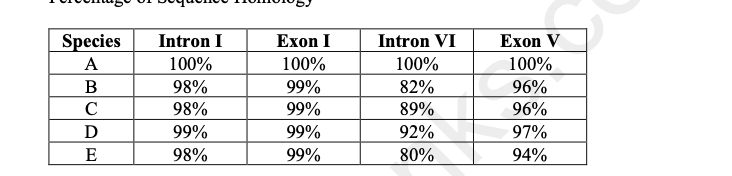 46) The question refers to the table, which compares the percent sequence homology of four different parts of a gene (two introns and two exons) that is found in five different eukaryotic species. The data show the percentage of sequence homology of each intron and exon in comparison to the sequences in species A. Percentage of Sequence Homology Which of these four gene parts should allow the construction of the most accurate phylogenetic tree, assuming that this is the only part of the gene that has acted as a reliable molecular clock? A) Intron I B) Exon I C) Intron VI D) Exon V | back 46 C |
front 47 Which eukaryotic kingdom includes members that are the result of endosymbioses that included an ancient aerobic bacterium and an ancient cyanobacterium? A) Plantae B) Fungi C) Animalia D) Protista | back 47 A |
front 48 What kind of evidence has recently made it necessary to assign the prokaryotes to either of two different domains, rather than assigning all prokaryotes to the same kingdom? A) mtDNA B) rRNA genes C) morphological D) ecological | back 48 B |
front 49 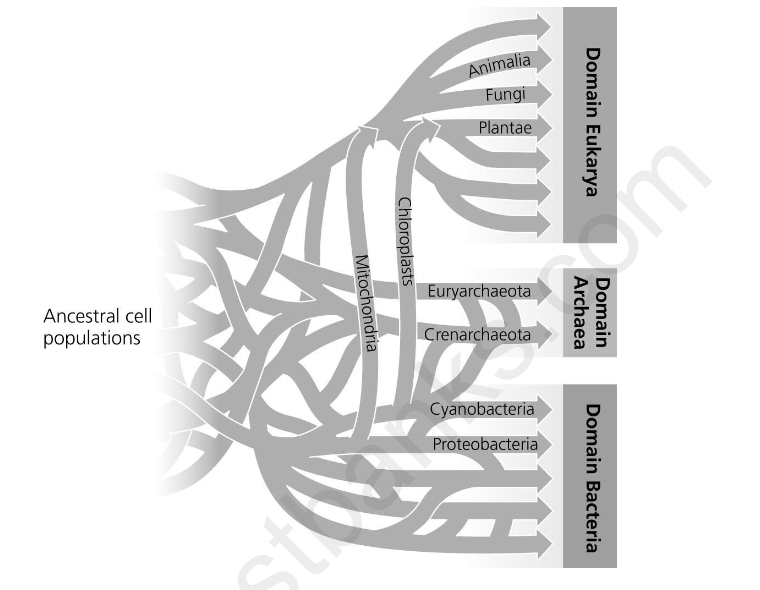 The following question refers to this phylogenetic tree, depicting the origins of life and the three domains. Connecting lines indicate instances of gene or genome transfer and time is indicated from left to right. A possible phylogenetic tree for the three domains of life. If the early history of life on Earth is accurately depicted by the figure, then which statement is most in agreement with the hypothesis proposed by this tree? A) The last universal common ancestor of all extant species is one individual species. B) A significant amount of horizontal gene transfer occurred early in the evolution of life. C) Archaean genomes should not contain genes that originated in bacteria, and vice versa. D) Eukaryotes are more closely related to archaeans than to bacteria. | back 49 B |
front 50 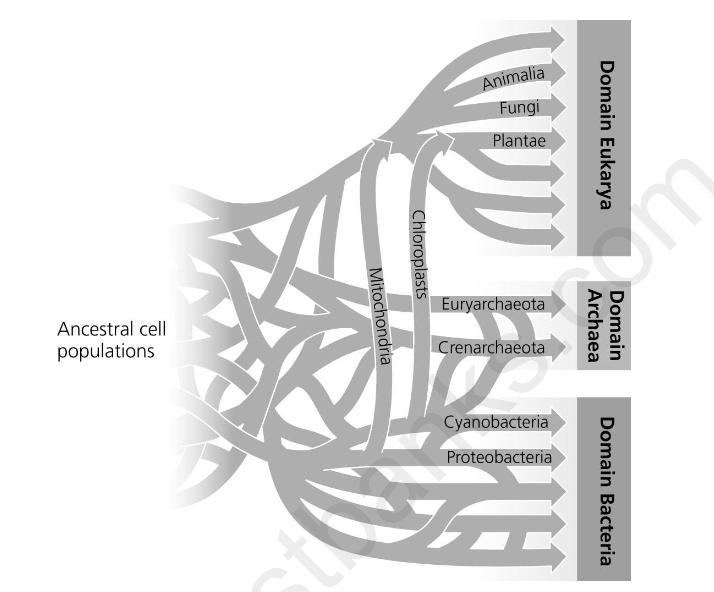 The following question refers to this phylogenetic tree, depicting the origins of life and the three domains. Connecting lines indicate instances of gene or genome transfer and time is indicated from left to right. A possible phylogenetic tree for the three domains of life. Which domains have exhibited endosymbiosis? A) Archaea, Bacteria, and Eukarya B) Archaea and Bacteria only C) Archaea and Eukarya only D) Bacteria and Eukarya only | back 50 A |
front 51 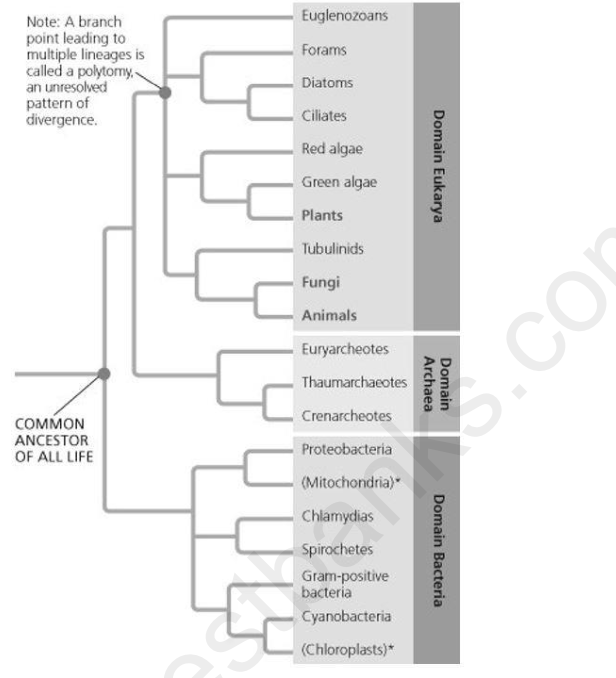 Cyanobacteria were once called blue-green algae because they are photosynthetic. According to the phylogeny shown, to which of the following organisms are the cyanobacteria more closely related? A) gram-positive bacteria B) green algae C) euglenozoans D) crenarcheotes | back 51 A |
front 52 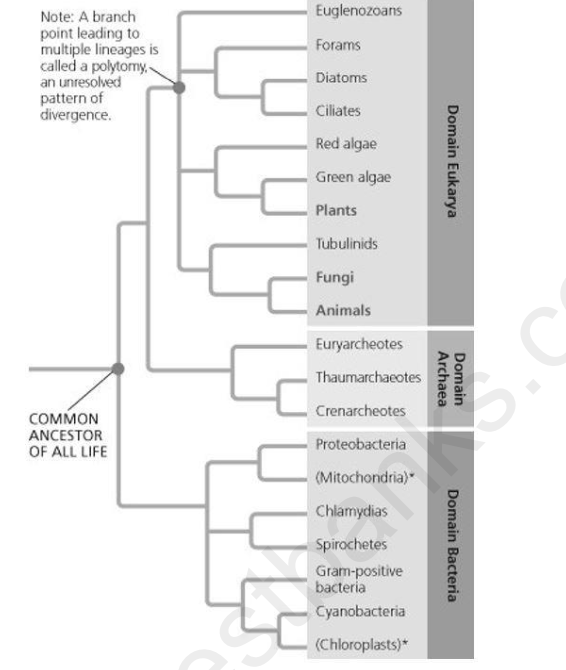 From which taxon did mitochondria evolve? A) Bacteria B) Archaea C) Eukarya D) Algae | back 52 A |
front 53 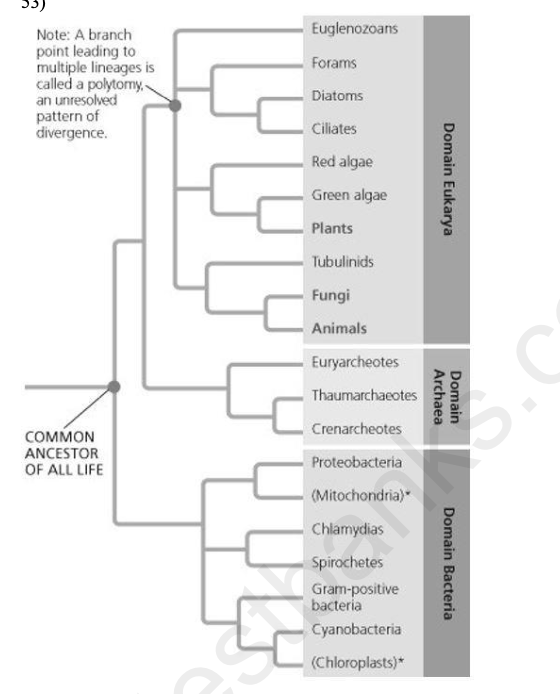 Which of the following statements most accurately describes the evolution of chloroplasts? A) Chloroplasts evolved independently in all three domains B) Chloroplasts evolved in the Archaea C) Chloroplasts evolved in Eukarya D) Chloroplasts evolved from a common ancestor of Proteobacteria | back 53 D |
front 54 Which of the following statements is accurate, at least according to our present knowledge? A) Eukaryotes acquired nuclear genes only in the distant past; these genes can allow survival in anaerobic environments. B) Genes from prokaryotes have been acquired by some eukaryotes; these genes can allow survival in extreme environments. C) Prokaryotes acquired genes from eukaryotes many times; these genes can allow survival in extreme environments. D) Prokaryotes acquired genes from fungi; these genes can allow the digestion of cellulose. | back 54 B |
front 55 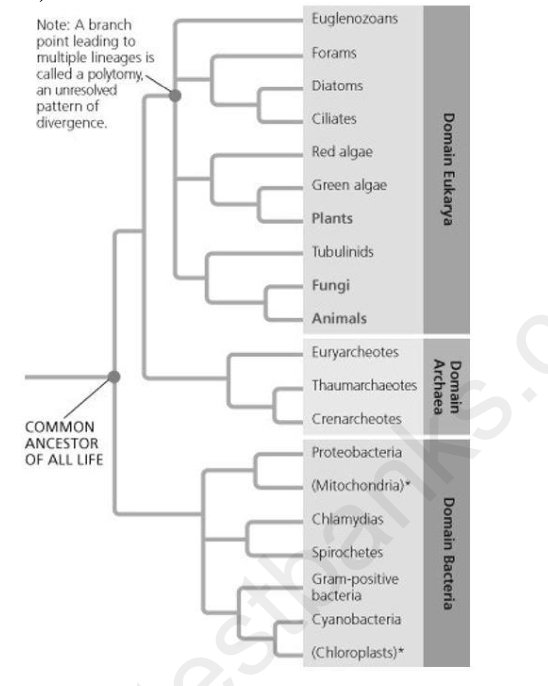 A phylogenetic tree is shown for the three domains of life (Eukarya, Archaea, and Bacteria). The tree branches in two directions from the first point, labeled Common ancestor of all life. One branch leads in the direction of Eukarya and Archaea, and the other branch leads to Bacteria. The branch leading to Eukarya and Archaea divide, one branch leading to each domain. The branch leading to Eukarya divides into four branches. One leads to Euglenozoans, and the other three lead to branching points. The first leads to Forams in one direction, and another branching point in the other that leads to Diatoms and Ciliates. The second branching point leads to Red algae in one direction, and a branching point that leads to green algae and land plants in the other direction. The third branching point leads to amoebas in one direction, and a branching point that leads to fungi and animals in the other direction. Land plants, Fungi and Animals are all highlighted. Which of the following pairs of organisms form a sister group? A) proteobacteria and cyanobacteria B) euglenozoans and gram-positive bacteria C) animals and fungi D) green algae (excluding plants) and red algae | back 55 C |
front 56 If additional DNA sequence evidence shows that yeast genes for synthesizing proteins are more similar to protein-synthesizing genes in bacteria than those in archaea, what would a systematist do with the current phylogeny? A) redraw the phylogeny to show eukaryotes sharing a more recent common ancestor with bacteria than archaea B) redraw the phylogeny to show more recent common ancestry between archaea and yeast than between eukaryotes and archaea C) retain the phylogeny that shows a more recent common ancestor between eukaryotes and archaea D) retain the phylogeny that shows a more recent common ancestor between bacteria and archaea | back 56 A |
front 57 Which of the following statements about horizontal gene transfer is accurate? A) Horizontal gene transfer is common in the evolution of life on Earth. B) Horizontal gene transfer among organisms does not occur today. C) Horizontal gene transfer moves only genes that play a role in metabolism. D) Horizontal gene transfer occurs only among closely related organisms. | back 57 A |
front 58 The kingdom Monera was dismantled because of which of the following reasons? A) Some Monera contained nuclei in their cells. B) The Monera, as originally constituted, contained both plants and animals. C) The Monera, as originally constituted, was monophyletic. D) Monera contained organisms from other domains | back 58 D |
front 59  Imagine that you discovered the following information about the three domains of life: These data would support which of the following conclusions? A) Eukaryotes share a more recent common ancestor with bacteria than with archaea. B) Bacteria are the only one of the three groups that lacks a nucleus. C) Archaea are more similar to bacteria than to eukaryotes. D) Eukaryotes are more similar to archaea than to bacteria. | back 59 D |
front 60 In a comparison of birds and mammals, the condition of having four limbs is ________. A) a shared ancestral character B) a shared derived character C) a character useful for distinguishing birds from mammals D) an example of analogy rather than homology | back 60 A |
front 61 To apply parsimony to constructing a phylogenetic tree, ________. A) choose the tree that assumes all evolutionary changes are equally probable B) choose the tree in which the branch points are based on as many shared derived characters as possible C) choose the tree that represents the fewest evolutionary changes, in either DNA sequences or morphology D) choose the tree with the fewest branch points | back 61 C |
front 62 In the below figure, which similarly inclusive taxon is represented as descending from the same common ancestor as Canidae? A) Felidae B) Mustelidae C) Carnivora D) Lutra | back 62 B |
front 63 Three living species X, Y, and Z share a common ancestor T, as do extinct species U and V. A grouping that consists of species T, X, Y, and Z (but not U or V) makes up ________. A) a monophyletic taxon B) an ingroup, with species U as the outgroup C) a paraphyletic group D) a polyphyletic group | back 63 C |
front 64 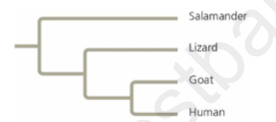 Based on the tree below, which statement is correct? A) Lizards and goats form a sister group. B) Salamanders are a sister group to the group containing lizards, goats, and humans. C) Salamanders are more closely related to lizards than to humans. D) Goats and humans are the only sister group shown in this tree. | back 64 B |
front 65 If you were using cladistics to build a phylogenetic tree of cats, which of the following would be the best outgroup? A) wolf B) domestic cat C) lion D) leopard | back 65 A |
front 66 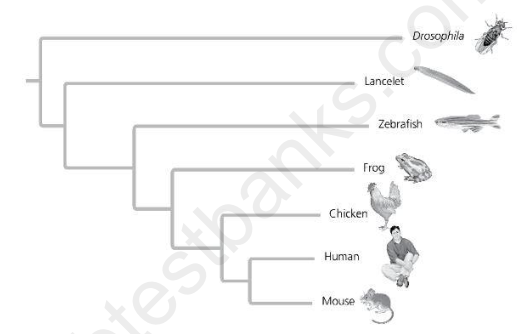 he relative lengths of the frog and mouse branches in the phylogenetic tree in the figure indicate that ________. A) frogs evolved before mice B) mice evolved before frogs C) the homolog evolved more rapidly in the mouse lineage D) the homolog evolved more slowly in the mouse lineage | back 66 D |