Instructions for Side by Side Printing
- Print the notecards
- Fold each page in half along the solid vertical line
- Cut out the notecards by cutting along each horizontal dotted line
- Optional: Glue, tape or staple the ends of each notecard together
ch 13
front 1 How do all viruses differ from bacteria? -Viruses are filterable. -Viruses are obligate intracellular parasites. -Viruses do not have any nucleic acid. -Viruses do not reproduce. | back 1 -Viruses are not composed of cells. |
front 2 A feature that may be found in viruses but never in bacteria
is | back 2 -may contain an RNA genome |
front 3 Which of the following statements about viral spikes is FALSE? -They may cause hemagglutination. -They bind to receptors on the host cell surface. -They are found only on nonenveloped viruses. -They are used for attachment. -They are composed of carbohydrate-protein complexes | back 3 -They are found only on nonenveloped viruses. |
front 4 Which of the following is NOT used as a criterion to classify
viruses? -size -morphology -nucleic acid -number of capsomeres | back 4 - biochemical tests |
front 5 Which of the following is NOT utilized to culture
viruses? -animal cell cultures -laboratory animals -culture media -bacterial cultures | back 5 -culture media |
front 6 Bacteriophages and animal viruses do NOT differ significantly in which one of the following steps -release -uncoating -penetration -attachment -biosynthesis | back 6 -biosynthesis |
front 7 The definition of lysogeny is -attachment of a phage to a cell. -phage DNA is incorporated into host cell DNA. -lysis of the host cell due to a phage. -the period during replication when virions are not present. | back 7 -phage DNA is incorporated into host cell DNA. |
front 8 A viroid is a(n) -provirus. -capsid without nucleic acid. -complete, infectious virus particle. -infectious piece of RNA without a capsid. | back 8 - infectious piece of RNA without a capsid. |
front 9 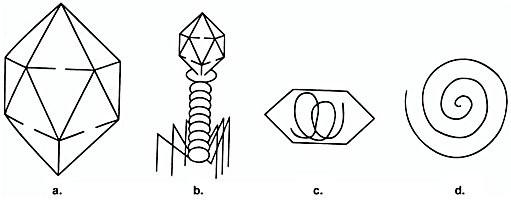 In Figure 13.1, which structure is a complex virus? -a -b -c -d -All of the structures are complex viruses. | back 9 - b |
front 10 The morphological types of viruses illustrated in Figure 13.1 are ultimately determined by the -membrane spikes. -capsomeres. -viroids. -envelope. -nucleic acid. | back 10 - nucleic acid |
front 11 A clear area against a confluent "lawn" of bacteria is
called a -cell lysis. -plaque. -pock. -phage. | back 11 - plaque |
front 12 Continuous cell lines differ from primary cell lines in
that -viruses can be grown in continuous cell lines. -continuous cell lines can be maintained through an indefinite number of generations. -continuous cell lines are from human embryos. -continuous cell lines are derived from primary cell lines. | back 12 - continuous cell lines can be maintained through an indefinite number of generations. |
front 13 Which of the following is necessary for replication of a
prion? -DNA polymerase -DNA -PrPSc -RNA | back 13 - PrPSc |
front 14 A persistent infection is one in which -host cells are gradually lysed. -the virus remains in equilibrium with the host without causing a disease. -the disease process occurs gradually over a long period. -viral replication is unusually slow. | back 14 - the disease process occurs gradually over a long period. |
front 15 An example of a persistent viral infection is -Influenza. -Herpes Simplex Virus infection. -Hepatitis A infection. -Human Immunodeficiency Virus infection | back 15 - Varicellavirus infection. |
front 16 Lysogeny can result in all of the following EXCEPT -immunity to reinfection by any phage. -acquisition of new characteristics by the host cell. -specialized transduction. -phage conversion. | back 16 - immunity to reinfection by any phage. |
front 17 Which of the following would be the first step in biosynthesis of a
virus with a - (minus) strand of RNA? -transcription of mRNA from DNA -synthesis of double-stranded RNA from an RNA template -synthesis of DNA from an RNA template -synthesis of DNA from a DNA template | back 17 - synthesis of double-stranded RNA from an RNA template |
front 18 An infectious protein is a -viroid. -papovavirus. -prion. -bacteriophage. | back 18 - prion |
front 19 An envelope is acquired during which of the following steps? -release -adsorption -penetration -uncoating | back 19 - release |
front 20 Which of the following statements is NOT true of
lysogeny? -Prophage is inserted into the host genome. -It causes lysis of host cells. -It can give infected pathogens the genetic information for toxin production. -It is a "silent" infection; the virus does not replicate. | back 20 - It causes lysis of host cells. |
front 21 An example of a latent viral infection is -cold sores. -smallpox. -influenza. -mumps. | back 21 - cold sores |
front 22 A virus's ability to infect an animal cell depends primarily upon
the -enzymatic activity of a host cell. -type of viral nucleic acid. -presence of receptor sites on the cell membrane. -presence of pili on the host cell wall. | back 22 - presence of receptor sites on the cell membrane. |
front 23 Assume you have isolated an unknown virus. This virus has a single,
positive sense strand of RNA, and possesses an envelope. To which
group does it most likely belong? -retrovirus -togavirus -picornavirus -papovavirus | back 23 - togavirus |
front 24 The mechanism whereby an enveloped virus leaves a host cell is
called - penetration. -lysogeny. -transduction. -budding. | back 24 -budding |
front 25 The most conclusive evidence that viruses cause cancers was provided
by -finding oncogenes in viruses. -cancer that developed in chickens following injection of cell-free filtrates. -treating cancer with antibodies. -some liver cancer patients having had hepatitis. | back 25 - cancer that developed in chickens following injection of cell-free filtrates. |
front 26 Bacteriophages derive all of the following from the host cell EXCEPT -amino acids. -nucleotides. -lysozyme. -tRNA. | back 26 - lysozyme |
front 27 Bacteriophage replication differs from animal virus replication
because only bacteriophage replication involves -injection of naked nucleic acid into the host cell. -assembly of viral components. -lysis of the host cell. -adsorption to specific receptors. | back 27 - injection of naked nucleic acid into the host cell. |
front 28 Generally, in an infection caused by a DNA-containing virus, the host
animal cell supplies all of the following EXCEPT -RNA polymerase. -nucleotides. -DNA polymerase. -None of the answers are correct; all of these are supplied by the host animal cell. | back 28 - DNA polymerase. |
front 29 Which of the following places these items in the correct order for
DNA-virus replication? - 3; 4; 1; 2 - 4; 1; 2; 3 -2; 3; 4; 1 -4; 3; 2; 1 | back 29 - 2; 3; 4; 1 |
front 30 A viral species is a group of viruses that -infects the same cells and cause the same disease. -has the same morphology and nucleic acid. -cannot be defined. | back 30 - has the same genetic information and ecological niche. |
front 31 Viruses that utilize reverse transcriptase belong to the virus families -Retroviridae and Picornaviridae. -Hepadnaviridae and Retroviridae. -Rhabdoviridae and Herpesviridae. -Herpesviridae and Retroviridae. -Herpesviridae and Poxviridae. | back 31 - Hepadnaviridae and Retroviridae. |
front 32 DNA made from an RNA template will be incorporated into the virus
capsid of -Retroviridae. -Hepadnaviridae. -Herpesviridae. -bacteriophage families. | back 32 - Hepadnaviridae. |
front 33 Which of the following statements about viruses is
FALSE? -Viruses use the anabolic machinery of the cell. -Viruses contain a protein coat. -Viruses contain DNA or RNA but never both. -Viruses have genes. | back 33 - Viruses use their own catabolic enzymes. |
front 34 A lytic virus has infected a patient. Which of the following would
best describe what is happening inside the patient? -The virus is incorporating its nucleic acid with that of the patient's cells. -The virus is slowly killing the patient's cells.Correct! -The virus is causing the death of the infected cells in the patient. -The virus is not killing any cells in the host. | back 34 - The virus is causing the death of the infected cells in the patient. |