front 1 What atom is the site of covalent attachment of AMC to the model
tetrapeptide used in the studies?
| back 1
Solution: The correct answer is A.
-
In the studies, one can reason from the passage that the
chymotrypsin-like activity of proteasome releases AMC and produces
a fluorescent signal. The passage states that chymotrypsin cleaves
peptide bonds after aromatic residues, which have the structure
–(C=O)–NH–. Thus, the chymotrypsin-like proteasome should
hydrolyze the corresponding amide bond connecting the
C-terminus of the model tetrapeptide and the
NH2 group of AMC.
- This oxygen atom
cannot be part of an amide bond, which is the type of bond cleaved
by the chymotrypsin-like activity of proteasome.
- The amide
bond cleaved by the chymotrypsin-like activity of proteasome has the
structure –(C=O)–NH–, not –(C=O)–+O=CR2.
- The substrate for the proteasome is succinyl–LLVY–AMC. By
peptide structure interpretation, only the C=O in tyrosine (Y) is
being used to make a bond to AMC, and an amide bond is required.
This carbon atom is C=O and cannot make an amide bond to the
C-terminus of the model tetrapeptide; an amine nitrogen
atom is needed.
|
front 2 Text: The general experimental procedure was as follows: (1) purified
rabbit proteasome (2 nM) was incubated in the presence of porphyrin at
37°C for 30 minutes; (2) the reaction was initiated by addition of the
peptide (100 μM); and (3) intensity of fluorescence emission at 440 nm
(excitation at 360 nm) was monitored for 20 minutes.
Compared to the concentration of the proteasome, the concentration
of the substrate is larger by what factor?
- A.5 × 101
- B.5 × 102
- C.5 × 103
- D.5 × 104
| back 2
Solution: The correct answer is D.
- The value for this option was due to an incorrect conversion
of 100 µM to 1 × 10⁻⁷ M.
- If 200 nM was used
instead of 2 nM, this value would be calculated.
- This is
the value if 10 µM was used instead of 100 µM and converted to
M.
-
The passage states that the proteasome concentration was 2
nM, and the substrate concentration was 100 µM. The proteasome
concentration can be converted to molarity via (2
nmol•L–1) × (1 mol/1 × 109 nmol) = 2 ×
10–9 mol•L–1, and the substrate is (100
µmol•L–1) × (1 mol/1 × 10–6 µmol) = 1 ×
10–4 mol•L–1. The ratio of the substrate to
the proteasome concentration is (1 × 10⁻⁴
mol•L–1) / (2 × 10⁻⁹ mol•L–1) = 5
× 104.
|
front 3 What is the conversion for nM to M? | |
front 4 What is the conversion from uM to M? | |
front 5 Four organic compounds: 2-butanone, n-pentane, propanoic
acid, and n-butanol, present as a mixture, are separated by
column chromatography using silica gel with benzene as the eluent.
What is the expected order of elution of these four organic compounds
from first to last?
- A.n-Pentane → 2-butanone → n-butanol →
propanoic acid
- B.n-Pentane → n-butanol →
2-butanone → propanoic acid
- C.Propanoic acid →
n-butanol → 2-butanone → n-pentane
- D.Propanoic acid → 2-butanone → n-butanol →
n-pentane
| back 5
Solution: The correct answer is A.
-
The least polar compound, capable on only London dispersion
forces, will elute first because it has the weakest attraction to
the polar stationary phase (n-pentane). The second compound to
elute will be a slightly polar compound that can accept but not
donate hydrogen bonds (2-butanone). The third compound to elute
will be a more polar compound that can both accept and donate
hydrogen bonds via 1 OH group (n-butanol). The fourth compound to
elute will be a compound that can both accept and donate hydrogen
bonds via 1 OH group and accept hydrogen bonds to C=O (propanoic
acid).
- n-Butanol and 2-butanone are reversed in
their elution order. As 2-butanone is less polar than n-butanol, it
should elute before n-butanol.
- This is the reverse elution
order. The order of elution on silica gel is least polar (first) to
most polar (last), but this order is most polar (first) to least
polar (last).
- The elution positions of propanoic acid and
n-pentane should be switched.
|
front 6 What is the order of polarity between the following functional
groups? From highest to lowest? Aldehyde, Ketone, Carboxylic Acid, and Alcohol? | back 6 The order of polarity between carboxylic acid, ketone, aldehyde, and
alcohol, from highest to lowest polarity, is typically as follows:
- Carboxylic Acid: The -COOH group in carboxylic acids is highly
polar due to both the carbonyl group (C=O) and the hydroxyl group
(O-H) capable of forming hydrogen bonds. This gives carboxylic acids
their high polarity.
- Alcohol: Alcohols (-OH group) are also
highly polar because of the ability of the hydroxyl group to form
hydrogen bonds. However, they are slightly less polar than
carboxylic acids because they lack the additional polar carbonyl
group.
- Aldehyde: Aldehydes have a polar carbonyl group (C=O)
that makes them polar, but they do not have the ability to form
hydrogen bonds like alcohols and carboxylic acids. Their polarity is
less than that of alcohols and carboxylic acids.
- Ketone:
Ketones also contain a carbonyl group (C=O) and are polar. However,
because they have two alkyl groups attached to the carbonyl, which
are less polar than the -OH or -COOH groups, ketones are less polar
than aldehydes.
In summary, the order of polarity is:
Carboxylic Acid > Alcohol > Aldehyde > Ketone. |
front 7 The half-life of a radioactive material is:
- A.half the time it takes for all of the radioactive nuclei to
decay into radioactive nuclei.
- B.half the time it takes for
all of the radioactive nuclei to decay into their daughter
nuclei.
- C.the time it takes for half of all the radioactive
nuclei to decay into radioactive nuclei.
- D.the time it
takes for half of all the radioactive nuclei to decay into their
daughter nuclei.
| back 7
Solution: The correct answer is D.
C. Because the daughter nuclei that result from the radioactive
decay of the parent nuclei may or may not be also radioactive, this
time might be infinite in case there are no radioactive daughter
nuclei. However, the half-life is always a finite amount of time
D. The half-life of a radioactive material is defined as the
time it takes for half of all the radioactive nuclei in a sample to
decay into their daughter nuclei, which may or may not be radioactive. |
front 8 A person is sitting on a chair as shown.
Why must the person either lean forward or slide their feet under
the chair in order to stand up?
- A.To increase the force required to stand up
- B.To use
the friction with the ground
- C.To reduce the energy
required to stand up
- D.To keep the body in equilibrium
while rising
| back 8
Solution: The correct answer is D.
- The magnitude of the force required to stand up needs not be
increased beyond the weight of the person as long as the person
stands up gradually.
- The friction with the ground is used
at all times as long as the soles of the feet are in contact with
the ground.
- The energy required to stand up is fixed, being
equal to the weight of the person multiplied by the distance over
which the center of mass of the person moves upwards.
-
As the person is attempting to stand, the only support comes
from the feet on the ground. The person is in equilibrium only
when the center of mass is directly above their feet. Otherwise,
if the person did not lean forward or slide the feet under the
chair, the person would fall backward due to the large torque
created by the combination of the weight of the body (applied at
the person’s center of mass) and the distance along the horizontal
between the center of mass and the support point.
**
When a person sits on a chair, their center of mass is lower and
their body is in a stable position. To stand up, they need to shift
their center of mass over their feet in a way that maintains balance.
Leaning forward or sliding the feet under the chair helps the person
bring their center of mass over their feet, ensuring they stay
balanced as they push themselves upward. Without this movement, the
person might lose balance and fall backward.
So, leaning forward or adjusting the feet is necessary to maintain
equilibrium during the transition from sitting to standing. |
front 9 Text:
Asymmetry resulting from tertiary structural features causes the
largest increase in CD signal intensity in the near UV region (250–290
nm) of peptides. The side chains of aromatic amino acid residues
absorb in this region. The asymmetry of the α-carbon atom does not
impact the CD signal of the aromatic side chain nor do elements of
secondary structure.
The peptide bond absorbs in the far UV region (190–250 nm). The CD
signals of these bonds are dramatically impacted by their proximity to
secondary structural elements (Figure 1).
Based on the relative energy of the absorbed electromagnetic
radiation, which absorber, a peptide bond or an aromatic side chain,
exhibits an electronic excited state that is closer in energy to the
ground state?
- A.An aromatic side chain; the absorbed photon energy is
higher.
- B.An aromatic side chain; the absorbed photon energy
is lower.
- C.A peptide bond; the absorbed photon energy is
higher.
- D.A peptide bond; the absorbed photon energy is
lower.
| back 9
Solution: The correct answer is B.
- Because an aromatic ring absorbs photons in the longer
wavelength, near UV region, and ΔE = hc/λ, the absorbed photon
energy is lower, not higher.
-
The near UV region where an aromatic ring absorbs
electromagnetic radiation is lower in energy than the far UV
region where peptide bonds absorb electromagnetic radiation. Thus,
the excited state of the electrons in the aromatic ring will be
closer to the ground state energy.
- Although it
is true that the absorbed photon energy is higher for a peptide
bond, that indicates that the electronic excited state that is
farther from the energy of the ground state.
- Because a
peptide bond absorbs photons in the shorter wavelength, far UV
region, and ΔE = hc/λ, the absorbed photon energy is higher, not
lower.
*
Higher frequencies/shorter wavelengths have more energy. Lower
frequencies/longer wavelengths have less energy.
So the part that absorbs light with less energy will be less
excited, i.e. closer to the ground state, than the part that absorbs
higher energy light. |
front 10 Text: A synthetic peptide with the amino acid sequence KTFCGPEYLA was
generated as a mimic of the T-loop. This synthetic T-loop (sT-loop)
What is the net charge of sT-loop at pH 7.2?
| back 10
Solution: The correct answer is C.
**You add up the charges of the basic/acidic amino acids. Only basic
and acidic amino acids are either protonated (+ charge) or
deprotonated (- charge) at physiological pH.
- This charge counts negative charges from the
C-terminus and the glutamate (E) side chain and ignores the
positive charges from the N-terminus and the lysine (K)
side chain.
- This charge ignores the contribution of +1
charge from lysine (K).
-
The sT-loop contains 1 positively charged side chain on K
and 1 negatively charged side chain for E, making the net charge
zero.
- This charge ignores the contribution of –1
charge from glutamate (E).
|
front 11 Text: This experiment was repeated in the presence of a synthetic
peptide that mimics the HM domain (sHM) of Ser/Thr kinases with the
amino acid sequence FLGFTY. Phosphorylated sHM (spHM) was also used in
place of sHM.
When used in place of spHM, which peptide would be most likely to
achieve the same experimental results?
- A.FLGFAY
- B.FLGFQY
- C.FLGFGY
- D.FLGFEY
| back 11
Solution: The correct answer is D.
- Replacing phosphothreonine with alanine (A) will replace a
phosphate side chain with a methyl side chain, which does not have
the appropriate size or charge.
- Replacing phosphothreonine
with glutamine (Q) will replace a phosphate side chain with an amide
chain, which does not have the appropriate size or charge.
- Replacing phosphothreonine with glycine (G) will replace a
phosphate side chain with a hydrogen atom side chain, which does not
have the appropriate size or charge.
-
The phosphorylated threonine (T) would most likely be
mimicked by glutamate (E) in terms of size and charge. The
carboxylate side chain of glutamate has a negative charge like
phosphate and multiple oxygen atoms, also like
phosphate.
|
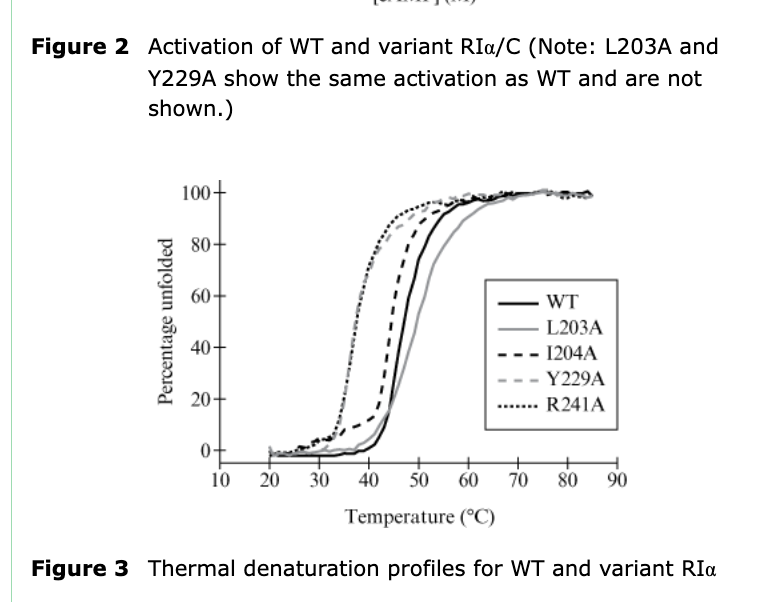
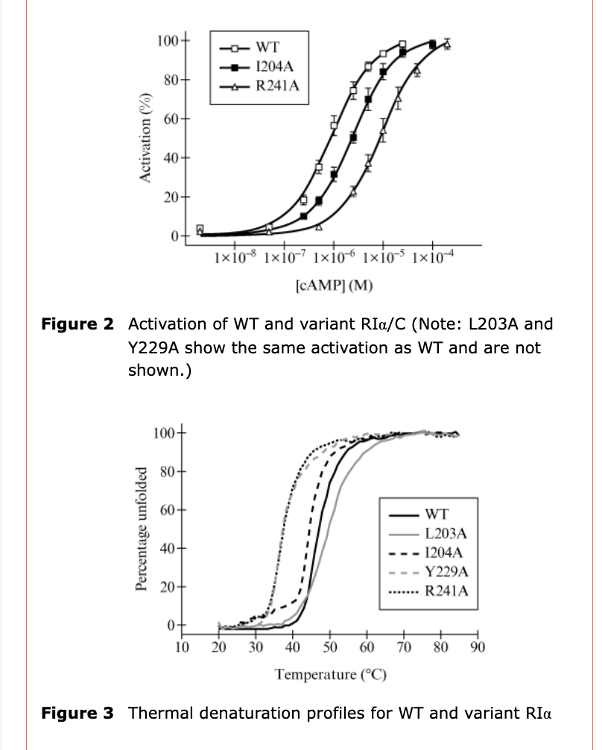
front 12 Which statement about the cooperativity of RIα/C activation and RIα
protein folding is supported by the data in figures 2 and 3?
- A.Both activation and folding are cooperative.
- B.Activation is cooperative, but folding is not.
- C.Folding is cooperative, but activation is not.
- D.Neither activation nor folding is cooperative.
| back 12 ** All sigmoidal curves suggest that its a cooperative process
Solution: The correct answer is A.
-
Because both curves have a sigmoidal shape, these are
indicative of cooperative processes.
- To NOT be
cooperative, the folding curve would have to have a hyperbolic
instead of a sigmoidal shape. Its sigmoidal shape makes it
cooperative.
- To NOT be cooperative, the activation curve
would have to have a hyperbolic instead of a sigmoidal shape. Its
sigmoidal shape makes it cooperative.
- To NOT be
cooperative, both the activation and folding curves would require a
hyperbolic instead of a sigmoidal shape. Their sigmoidal shapes make
them cooperative.
|
front 13 From the data presented in Figure 3, which RIα variant is the most stable?
- A.L203A
- B.I204A
- C.Y229A
- D.R241A
| back 13
Solution: The correct answer is A.
-
A higher melting temperature is indicative of a more stable
protein, as more energy is needed to unfold the protein. L203A has
an approximate T
m of 50°C; therefore, it is the most stable and even
more stable than the WT protein.
- With a T
m of approximately 42°C, I204A is not the most stable and
less stable than the WT protein.
- With a T
m of approximately 34°C, Y229A is tied for the least
stable variant with R241A.
- With a T
m of approximately 34°C, R241A is tied for the least
stable variant with Y229A.
|
front 14 Based on the data presented in figures 2 and 3, what is the most
likely role of Y229 in protein stability and cAMP activation?
- A.Y229 is important for protein stability but not critical for
cAMP activation.
- B.Y229 is important for cAMP activation
but not critical for protein stability.
- C.Y229 is important
for protein stability and critical for cAMP activation.
- D.Y229 is not important for protein stability and not critical
for cAMP activation.
| back 14
Solution: The correct answer is A.
-
Based on the cAMP activation information given in the note
in Figure 2, changing Y229 to A229 has no effect on kinetics.
However, based on the data in Figure 3, Y229A is less stable than
the WT protein, indicating that Y229 is essential for protein
stability.
- Based on the data in figures 2 and 3, the
opposite is true. The Y229A variant has lower protein stability, but
the same cAMP activation.
- Although the data in Figure 3
confirms that Y229 is important for protein stability (Y22A has a
much lower T
m than WT protein), the note in Figure 2 states that
Y229A has the same cAMP activation as WT protein.
- Although
the note in Figure 2 confirms that replacing Y229 with alanine has
no effect on cAMP activation, the data in Figure 3 shows that Y229A
is much less stable than WT protein.
|
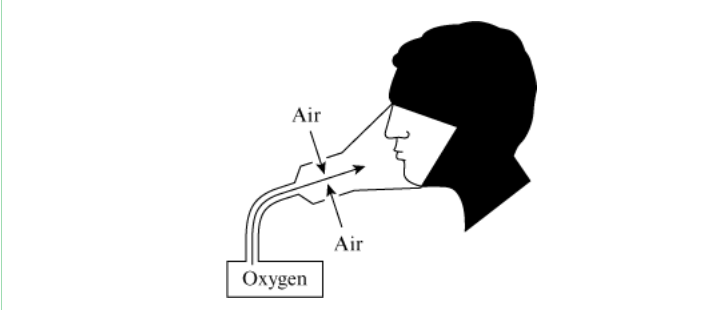
front 15 A patient puts on a mask with lateral openings and inhales oxygen
from a tank as shown.
What phenomenon causes static air to be drawn into the mask when
oxygen flows?
- A.Doppler effect
- B.Venturi effect
- C.Diffusion
- D.Dispersion
| back 15
Solution: The correct answer is B.
- The Doppler effect describes the relationship between the
frequency of a wave emitted by a source and the frequency of the
same wave as it is perceived by an observer due to the relative
motion between the source and the observer.
-
The oxygen pressure is the sum of the oxygen static pressure
P and the oxygen flow pressure ½ ρv
2. In the area of the mask openings, P
air = P + ½ ρv
2, thus P
air > P. Air enters the mask because the
static pressure of the air is larger than the static pressure of
the oxygen that flows in the mask. This is the Venturi effect, and
the mask is called the Venturi mask.
- Diffusion
is caused by a difference in concentration, whereas the
concentration of oxygen in the tank is the same as in the air;
otherwise, the breathing process could be affected.
- Dispersion is an optical effect that does not apply to the flow
of gases.
|
front 16 What causes duplex DNA with a certain (A + T):(G + C) ratio to melt
at a higher temperature than comparable length duplex DNA with a
greater (A + T):(G + C) ratio?
- A.Stronger van der Waals forces of pyrimidines
- B.Stronger van der Waals forces of purines
- C.Increased
π- stacking strength
- D.Reduced electrostatic repulsion of
phosphates
| back 16
Solution: The correct answer is C.
- There is the same 50% pyrimidine percentage in AT as GC base
pairs, so there is no binding advantage for pyrimidines between
these base pairs.
- There is the same 50% purine percentage
in AT as GC base pairs, so there is no binding advantage from
purines between these base pairs.
-
Duplex DNA with a lower (A + T):(G + C) ratio melts at a
higher temperature than comparable length duplex DNA with a
greater (A + T):(G + C) ratio because GC base pairs create
stronger pi-stacking interactions in the duplex than AT base
pairs.
- Both AT and GC base pairs have the same
number of phosphate groups.
|
front 17 The lone pair of electrons in ammonia allows the molecule to:
- A.assume a planar structure.
- B.act as an oxidizing
agent.
- C.act as a Lewis acid in water.
- D.act as a
Lewis base in water.
| back 17
Solution: The correct answer is D.
- The lone pair of electrons in ammonia allows the molecule to
adopt a trigonal pyramidal molecular geometry, not a planar
structure based on VSEPR (Valence Shell Electron Pair Repulsion)
theory.
- Oxidizing agents accept electrons in redox reactions.
Nitrogen cannot expand its octet and ammonia's lone pair of
electrons typically form a covalent bond, preventing the central
nitrogen from accepting more electrons.
- The lone pair of
electrons in ammonia does not act as a Lewis acid, an electron pair
acceptor, in water. Ammonia’s lone pair of electrons generally form
a bond with the central nitrogen atom, making it a Lewis base.
-
A Lewis base is a chemical species that donates a pair of
electrons, which ammonia does to form a covalent bond with a
hydrogen atom.
|
front 18 It is possible to design a reactor where the SCY conductor and the
nitrogen/ammonia electrode operate at different temperatures. Which
combination of temperatures is expected to give the best results?
- A.SCY temperature higher than electrode temperature
- B.SCY temperature lower than electrode temperature
- C.SCY temperature the same as electrode temperature
- D.The temperature of the components does not make a
difference.
| back 18
Solution: The correct answer is A.
-
The passage states that the SCY conductors are favored
because their proton conductivities substantially increase with
temperature. The last paragraph states that the “decomposition of
ammonia, is insignificant below 300°C but increases dramatically
thereafter.” This indicates that the proton conductivity of SCY
increases with increasing temperature, while the favorability of
reaction decreases with overall temperature. It is beneficial to
maintain the SCY conductor at a higher temperature than the
electrode temperature.
- While the SCY can
generate protons at a lower temperature, it will not produce the
best results as the proton conductivities substantially increase
with increasing temperatures.
- The SCY conductor can be
maintained at the same temperature as the electrode temperature, but
it will not produce the best results as higher temperatures will
increase the proton conductivities.
- The passage states that
higher temperatures will increase the proton conductivities with the
SCY conductor, and the nitrogen/ammonia electrode will see the
decomposition of ammonia at temperatures above 300°C.
|
front 19 If K
eq > 1, then ΔG° _________________ | back 19 < 0 because ΔG° = –RT(lnK). |
front 20 In the stepwise formation of
[Cu(NH3)4]2+ from
[Cu(H2O)4]2+, which of the following
ions would form in the second step?
- A.[Cu(H2O)2(NH3)2]2+
- B.[Cu(H2O)2(NH3)3]2+
- C.[Cu(H2O)3(NH3)]2+
- D.[Cu(H2O)3(NH3)2]2+
| back 20
Solution: The correct answer is A.
-
The passage notes that the formation of
[Cu(NH3)4] 2+ takes place
stepwise, with an ammonia molecule replacing one water molecule in
each step. The second step would have an additional water molecule
replaced by an ammonia molecule to make
[Cu(H2O)2(NH3)2]
2+ through the following steps: Step 1)
[Cu(H2O)4] 2+(aq) +
NH3(aq) ⇌
[Cu(H2O)3(NH3)]
2+(aq) + H2O(l) Step 2)
[Cu(H2O)3(NH3)]
2+(aq) + NH3(aq) ⇌
[Cu(H2O)2(NH3)2]
2+(aq) + H2O(l)
- This is not an intermediate in forming the
[Cu(NH3)4] 2+ complex because there
are five ligands around copper, not four.
- This is the
product that forms after the third step in the reaction. Step 3)
[Cu(H2O)2(NH3)2]
2+(aq) + NH3(aq) ⇌
[Cu(H2O)(NH3)3]
2+(aq) + H2O(l)
- This complex is not an intermediate in the formation of
[Cu(NH3)4] 2+(aq) as water
molecules are replaced by ammonia molecules in a stepwise manner.
This option indicates that the ammonia molecule adds to the copper
complex, and the water molecule is not displaced in the same
step.
|
front 21 In a covalent bond, both atoms contribute electrons to be shared
between the nuclei of the two atoms. In a coordinate covalent bond,
both electrons are contributed by __________________________ | back 21 one donor atom while the other atom acts as an acceptor to receive
the electron pair. |
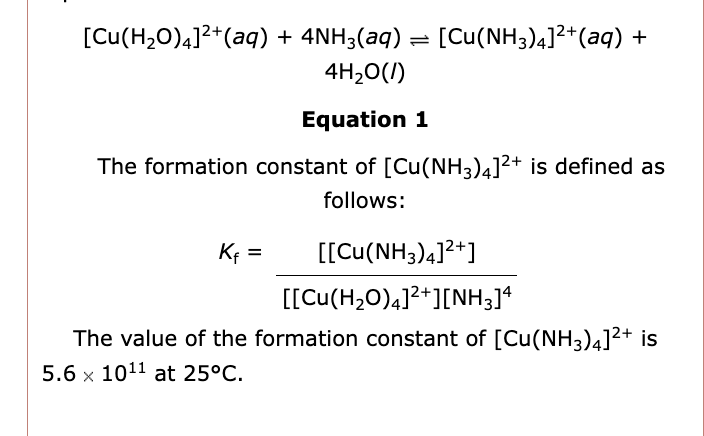
front 22 Consider the reaction shown in Equation 1 at equilibrium. Would the
concentration of [Cu(NH3)4]2+
increase if the equilibrium were disturbed by adding hydrochloric acid?
- A.Yes, because the equilibrium in Equation 1 would shift to
the left
- B.No, because the equilibrium in Equation 1 would
shift to the left
- C.Yes, because the equilibrium in
Equation 1 would shift to the right
- D.No, because the
| back 22
Solution: The correct answer is B.
- If hydrochloric acid is added to the reaction, ammonia will be
protonated and converted to ammonium, thus decreasing the ammonia
concentration. This will cause the equilibrium to shift to the left
to accommodate the disruption and make less
[Cu(NH3)4] 2+, not more.
-
According to Le Chȃtelier’s principle, this disruption to
the equilibrium causes the reaction to shift in response to
produce more ammonia. The shift will cause the equilibrium to
shift to the left, decreasing the amount of
[Cu(NH3)4] 2+
formed.
- The acid would react with the ammonia
in the solution, and the equilibrium would shift to the left to
increase the ammonia concentration, thus decreasing the amount of
[Cu(NH3)4] 2+ formed.
- Ammonia will be converted to ammonium and will be removed from
the solution. Equilibrium would shift to the left, decreasing the
amount of [Cu(NH3)4] 2+
formed.
|
front 23 In [Cu(NH3)4]2+, the subscript 4
indicates which of the following?
- A.The oxidation number of Cu only
- B.The coordination
number of Cu2+ only
- C.Both the oxidation number
of Cu and the coordination number of Cu2+
- D.Neither the oxidation number of Cu nor the coordination number
of Cu2+
| back 23
Solution: The correct answer is B.
- That value is the oxidation number of Cu, not the number of
ligands bound to the copper.
-
The subscript 4 indicates the number of neutral ammonia
ligands directly bonded to the central Cu2+
cation.
- The subscript 4 does not represent both
oxidation and coordination numbers of the copper ion. The oxidation
number is determined by the overall charge of the complex, which is
+2 in this case, while the coordination number is 4 due to the
presence of neutral ammonia molecules in the complex.
- Although the 4 does not correspond to the oxidation number of
copper, which is +2, it does correspond to the number of ammonia
ligands bound to the copper.
|
front 24 Why does NH3 displace H2O in the formation of [Cu(NH3)4]2+?
- NH3 contains more lone pairs of electrons than
H2O.
- NH3 is a stronger Lewis base than
H2O.
- NH3 donates a lone pair of
electrons more readily than does H2O.
- A.I and II only
- B.I and III only
- C.II and
III only
- D.I, II, and III
| back 24
Solution: The correct answer is C.
- Although NH3 is a stronger Lewis base than
H2O, Option I is incorrect because H2O has two
lone pairs of electrons, whereas NH3 has one pair of
electrons.
- Although NH3 donates a lone pair of
electrons more readily than does H2O, Option I is
incorrect because H2O has two lone pairs of electrons,
whereas NH3 has one pair of electrons.
-
NH3 is a stronger Lewis base than H2O
because the nitrogen atom is less electronegative than the oxygen
atom. This results in the oxygen atom having a stronger attraction
for its lone pairs of electrons, making them less available for
donation and H2O less Lewis basic than
NH3.
- Only options II and III are correct.
Option I is incorrect as NH3 has fewer lone pairs of
electrons than H2O.
|
front 25 What is the pH of a buffer solution that is 0.2 M in HCO3
– and 2 M in H2CO3? (Note: The first pK
a of carbonic acid is 6.37.)
- A.4.37
- B.5.37
- C.6.37
- D.7.37
| back 25
Solution: The correct answer is B.
- The value for this option only occurs when the ratio of [base]
/[acid] is 1:100.
-
To find the pH of a solution, use the Henderson-Hasselbalch
equation: pH = pKa + log([base] /[acid] ). The pH = 6.37
+ log(0.2/2) = 5.37 because the log(0.1) is -1.
- The value for this option is obtained if the ratio of [base]
/[acid] is incorrectly set to 1 and is used in the
Henderson-Hasselbalch equation. Since the log(1) is equal to 0, that
makes the pH of the solution equal to the pK
a.
- The value for this option is obtained if the
[base] /[acid] ratio is inverted to [acid] /[base] and used in the
Henderson-Hasselbalch equation. This would make the pH = 6.37 +
log(2/0.2) = 7.37 since the log (10) is 1.
|
front 26 What is the trick with log(1x10^#)? | back 26 The # after the exponent, as long as the front is 1x, is what the log
is equal to...
log(1x10^-6) = -6
log(1x10^8) = 8 |
front 27 What is the concentration of Ca2+(aq) in a
saturated solution of CaCO3? (Note: The solubility product
constant K
sp for CaCO3 is 4.9 × 10⁻⁹.)
- A.2.4 × 10–4 M
- B.4.9 × 10–5
M
- C.7.0 × 10–5 M
- D.4.9 × 10–9
M
| back 27
Solution: The correct answer is C.
- Based on this value, the K
sp value would be 5.8 × 10⁻⁸ instead of 4.9 ×
10–9.
- Using this concentration, the K
sp value of CaCO3 would be 2.4 ×
10–9 instead of 4.9 × 10⁻⁹.
-
The dissolution of CaCO3 is
CaCO3(s) ⇌ Ca2+(aq) + CO3
2–(aq) and the solubility product constant
expression is K
sp = [Ca2+] [CO3
2–] . Equal amounts of Ca2+ and CO3
2– are produced when CaCO3 dissolves in
solution, so the expression reduces to x2 = 4.9 ×
10–9, which is equal to 49 × 10–10. Taking
the square root, x = 7.0 × 10⁻⁵ M.
- This value would indicate that CaCO3 has a K
sp value of 2.4 × 10⁻¹⁷
, not 4.9 × 10⁻⁹.
|
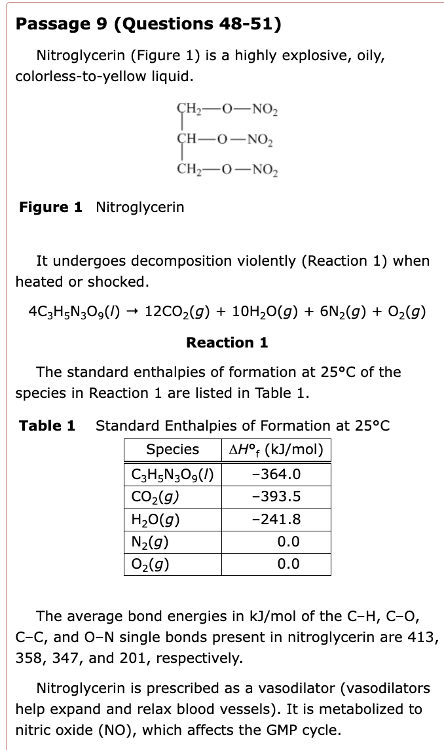
front 28 Text:
The average bond energies in kJ/mol of the C–H, C–O, C–C, and O–N
single bonds present in nitroglycerin are 413, 358, 347, and 201, respectively.
Nitroglycerin is prescribed as a vasodilator (vasodilators help
expand and relax blood vessels). It is metabolized to nitric oxide
(NO), which affects the GMP cycle.
Which single bond present in nitroglycerin is most likely the shortest?
| back 28
Solution: The correct answer is A.
-
The passage provides the average bond energies in kJ/mol of
the C–H, C–O, C–C, and O–N single bonds. The strength of a bond is
directly proportional to its bond energy, with shorter bonds being
stronger than longer bonds. Based on the data provided in the
passage, the C–H bond has the largest bond energy and, thus, the
shortest bond length.
- The C–O bond has the
second highest bond energy, which makes it the second shortest bond
length.
- The C–C bond has the second lowest bond energy, which
indicates that it is the second longest bond in the series.
- The O–N bond length has the lowest bond energy indicating that
it is the longest bond of the series.
|
front 29 Based on the passage, the magnitude of ΔH° (in kJ) for the
decomposition of 2 moles of nitroglycerin at 25°C is closest to which
of the following? | back 29
Solution: The correct answer is D.
- This ΔH°f value is obtained by adding the
ΔH°f
C3H5N3O9 and
ΔH°f CO2 together and subtracting
ΔH°f H2O, without multiplying each
value by the coefficients in the balanced equation: [(–364.0) +
(–393.5)] – (–241.8) = –515.7 kJ, which is approximately –500
kJ.
- If the ΔH°f for
C3H5N3O9(l),
CO2(g) and H2O(g) are added
together instead of using Hess’s law, this value is obtained via:
(–364.0 + –393.5 + –241.8) = –998 kJ, which is approximately –1000
kJ.
- If incorrect coefficients are used when calculating
ΔH°, a value near this option is obtained via: [6(–393.5) +
5(–241.8)] – [4(–364)] = –2107 kJ, which is approximately –2000
kJ.
-
The value of ΔH° can be calculated using the data
provided in Table 1 using Hess’s Law, (the sum of
ΔH°f products) – (the sum of
ΔH°f reactants). The amount of nitroglycerin
(in kJ) decomposed is calculated by: [12(–393.5) + 10(–241.8)] –
[4(–364.0)] = –5684 kJ/4 moles; therefore, the value of 2 moles of
nitroglycerin is –2842 kJ, which is approximately –3000
kJ.
|
front 30 At STP, the volume of N2(g) produced by the
complete decomposition of 1 mole of nitroglycerin would be closest to
which of the following?
- A.5 L
- B.10 L
- C.20 L
- D.30 L
| back 30
Solution: The correct answer is D.
- This calculated volume value is the result of using 1/6 of the
correct number of moles to calculate the overall volume of
N2(g).
- This is the value if 1/3 of the
number of moles was used to calculate the total volume of
N2(g).
- This value is obtained if the mole
ratio is inverted to 2/3 instead of 3/2 when determining the correct
amount of N2(g).
-
According to the balanced reaction given in the passage, for
every 4 moles of nitroglycerin consumed, 6 moles of
N2(g) are produced. Therefore, for every 1
mole of nitroglycerin, 1.5 moles of N2(g) are
produced. At STP, the molar volume of an ideal gas is 22.4
L•mol–1, which means that 1.5 moles of N2
will occupy 33.6 L.
|
front 31 Which single bond present in nitroglycerin is the LEAST polar?
| back 31
Solution: The correct answer is C.
- The C–H bond has a slight electronegativity difference between
the two atoms, but it is not the least polar bond in
nitroglycerin.
- The O–C bond is the most polar bond because of
the greatest difference in electronegativities between the two
atoms.
-
The C–C bond is considered the least polar as there is no
difference in electronegativity between the identical
atoms.
- The O–N is a polar bond because the
difference in electronegativities is greater than not zero.
|
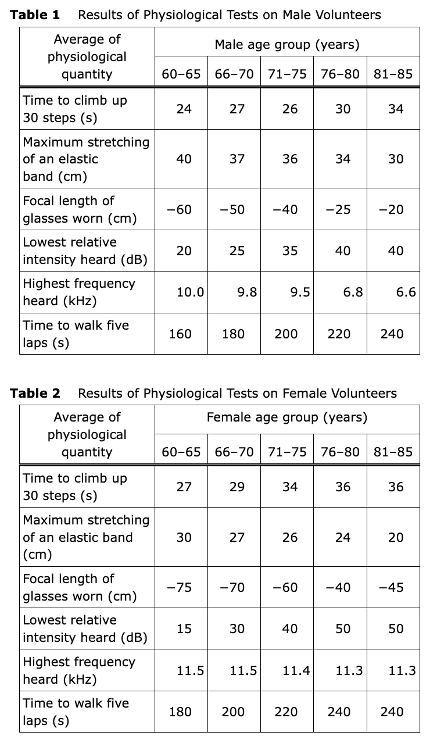
front 32 What is the average power consumed by a 64-year-old woman during the
ascent of the 15-cm-high steps, if her mass is 54 kg?
- A.10 W
- B.20 W
- C.40 W
- D.90 W
| back 32
Solution: The correct answer is D.
- This result is consistent with using a weight of 60 N instead
of 540 N for the woman.
- This result is consistent with
climbing only 6 steps.
- This is the power consumed by the
person climbing 27 steps of height 7 cm.
-
The power consumed is P = ΔPE /time =
mgh/Δt. From Table 1, there are 30 steps and
Δt = 27 s. Then P = (54 kg × 10 m/s2
× 30 steps × 0.15 m/step) / (27 s) = 90 W.
|
front 33 How much work did an 83-year-old female do while stretching the
rubber band to the limit of her strength?
| back 33
Solution: The correct answer is A.
-
The work done is defined as W = 0.5kx
2, where x = 0.20 m for an 83-year-old female.
Solving for W yields W = 0.5 ⋅ 200 (N/m) ⋅ (0.2
m)2 = 4.0 J.
- This implies the elastic
constant is 160 N/m instead of 200 N/m.
- This is the work
done by a female in the 76−80 age group.
- This is the work
done by a female in the 71−75 age group.
|
front 34 What is the ratio of the minimum sound intensities heard by a
64-year-old male and a 74-year-old female?
| back 34
Solution: The correct answer is D.
- This is the algebraic difference between the minimum sound
intensities heard by a 64-year-old male and a 74-year-old
female.
- If the ratio of the intensities is 40, then the
decimal log of the ratio of their intensities is x = log 40
= 1.6. Consequently, the difference between the relative intensities
of the two sound waves would be 1.6 B = 16 dB. This represents the
approximate difference between the minimum sound intensities heard
by a 67-year-old male and a 72-year-old female.
- If the
ratio of the intensities is 50, then the decimal log of the ratio of
their intensities is x = log 50 = 1.7. Consequently, the
difference between the relative intensities of the two sound waves
would be 1.7 B = 17 dB. This represents the approximate difference
between the minimum sound intensities heard by a 74-year-old male
and a 77-year-old female.
-
The relative intensities of the two sound waves are 20 dB
and 40 dB, respectively. Their difference is 20 dB, meaning that
the decimal log of the ratio of their intensities is 2, which
means that the ratio of their intensities is 102 =
100.
Here's how I did it:
Bf = Bi + 10 log (If / Ii)
The B will always be decibels, and the I will always be intensity.
So it would be:
40 dB = 20 dB + 10 log (If / Ii)
---- subtract 20 -------
20 dB = 10 log (If / Ii)
------ divide by 10 -------
2 = log (If / Ii)
------ take 10 to the power on both sides so log gets cancelled out --------
10^2 = If / Ii |
front 35 What kind of image is formed by the lenses of the glasses worn by a
68-year-old male who sees an object 2 m away?
- A.Real and enlarged
- B.Real and reduced
- C.Virtual and enlarged
- D.Virtual and reduced
| back 35 - This implies the lenses have a positive focal length and the
object is located very far away from the lenses, whereas the lenses
have a negative focal length.
- This implies the lenses have
a positive focal length and the object is located close to the focal
point, whereas the lenses have a negative focal length.
- This implies the lenses have a positive focal length and the
object is located between the focal point and the lens, whereas the
lenses have a negative focal length.
-
The lenses have a negative focal length, which means they
are diverging lenses. Such lenses form virtual and reduced images
of objects situated at distances larger than the focal
length.
|
front 36 -
Convex lenses (used for farsightedness) form a
__________ image when viewing distant objects,
since they bring light rays together.
-
Concave lenses (used for nearsightedness) form a
_________ image, making it easier to focus on
distant objects.
| back 36
real, reduced
virtual, reduced
-
Nearsightedness (Myopia): Can see near objects clearly,
distant objects are blurry. Corrected with concave
lenses.
-
Farsightedness (Hyperopia): Can see far objects clearly,
near objects are blurry. Corrected with convex
lenses.
|
front 37 What is the approximate percentage of a 10C sample left
after the time it took a 75-year-old male to walk one lap around the
gym? (Note: The half-life of 10C is 20 seconds.)
| back 37
Solution: The correct answer is C.
- Given that 5% = 0.05 = 1/20 = 1/(2
x), solving for x yields . This means
the time it takes the 10C sample to decay is equal to 4.3
half-lives, that is 4.3 × 20 s = 86 s. The 75-year-old male takes
200 s to walk 5 laps, which is on average 40 s per lap. Therefore,
he should walk about (86/40) × 1 lap = 2.1 laps until 5% of the
sample is left.
- Because 10% = 1/10 = 1/(2
x), solving for x yields . This means
the time it takes the 10C sample to decay is equal to 3.3
half-lives, that is 3.3 × 20 s = 66 s. The 75-year-old male takes
200 s to walk 5 laps, which is on average 40 s per lap. Therefore,
he should walk about (66/40) × 1 lap = 1.6 laps until 10% of the
sample is left.
-
The 75-year-old person takes 200 s to walk 5 laps, which is
on average 40 s per lap. This time represents two half-lives of
10C, so the ratio of 10C sample left is
1/(22) = 0.25, or 25%.
- Using 75% =
0.75 = 1/1.33 = 1/(2
x), solving for x yields . This means
the time it takes the 10C sample to decay is equal to 0.4
half-lives, that is 0.4 × 20 s = 8 s. The 75-year-old male takes 200
s to walk 5 laps, which is on average 40 s per lap. Therefore, he
should walk about (8/40) × 1 lap = one-fifth of a lap until 75% of
the sample is left.
|
front 38 Which of the following energy conversions best describes what takes
place in a battery-powered resistive circuit when the current is flowing?
- A.Electric to thermal to chemical
- B.Chemical to
thermal to electric
- C.Electric to chemical to thermal
- D.Chemical to electric to thermal
| back 38
Solution: The correct answer is D.
- A battery uses chemical energy to set the electric charges in
motion; therefore, electric energy is not the source for chemical
energy.
- If chemical energy was converted to thermal energy,
then only a small fraction could have been reconverted into
electrical energy and this would require another specialized device
besides the battery itself.
- The primary energy of a battery
is chemical, not electrical, because electrical energy requires that
electric charges be kept separated in order to create an
electrostatic field.
-
The chemical energy of the battery elements is used as
electrical energy to set the charge carriers in motion through the
resistor, where they experience drag from the crystal lattice of
the resistive conductor and dissipate their energy as heat from
the resistor.
|
front 39 Protein secondary structure is characterized by the pattern of
hydrogen bonds between:
- A.backbone amide protons and carbonyl oxygens.
- B.backbone amide protons and side chain carbonyl oxygens.
- C.side chain hydroxyl groups and backbone carbonyl oxygens.
- D.side chain amide protons and backbone carbonyl oxygens.
| back 39
Solution: The correct answer is A.
-
Secondary structure includes turns, helices, and beta
sheets, all of which are established by hydrogen bonds between
backbone amide protons and carbonyl oxygens.
- These interactions may exist for tertiary structure, but they
are not characteristic of secondary structure.
- Although
side chain hydroxyl groups can hydrogen bond to backbone carbonyl
oxygens, this is not characteristic of secondary structure.
- Side chain amide protons and backbone carbonyl oxygens may
hydrogen bond in tertiary structure, but this is not characteristic
of secondary structure.
|
front 40 Which cells harvested from adult mice were most likely used as the
highly proliferative benchmark in the experiment that generated the
data shown in Figure 3?
- A.Adipocytes
- B.Cardiac muscle cells
- C.Gastrointestinal epithelial cells
- D.Neurons
| back 40 - During adulthood, adipocytes are unlikely to undergo mitosis.
While there is a limited replicative capacity of adipocytes under
certain conditions, adipocytes typically respond to changing
conditions by altering their size.
- Early in development,
cardiac muscle cells are proliferative. However, as an organism
reaches adulthood, mitotic capacity of such cells is decreased.
-
Gastrointestinal epithelial cells exhibit mitotic activity
throughout adulthood. Specifically, this epithelium possesses stem
cells that continuously proliferate. As such, gastrointestinal
epithelial cells may have been used by the researchers to assess
proliferative activity.
- Neurons are post-mitotic
cells that do not typically undergo cell division in adult
mammals.
|
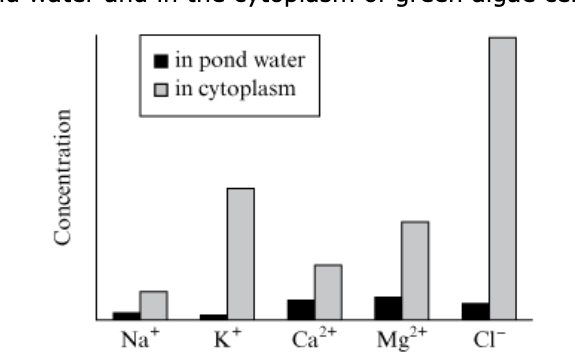
front 41 The graph shows the average relative concentration of ions in pond
water and in the cytoplasm of green algae cells.
Figure adapted from H. Curtis, S. Barnes, Invitation to Biology
5th Ed. ©1994 W.H. Freeman and Company.
Which process moves chlorine ions into the cells of the green algae?
- A.Osmosis
- B.Diffusion
- C.Active
transport
- D.Facilitated diffusion
| back 41
Solution: The correct answer is C.
- Osmosis refers to the movement of water, not ions such as
chlorine, from a low solute to a high solute solution.
- Diffusion refers to the movement of a solute from an area of
high concentration to an area of low concentration. However, when
chlorine moves from pond water into the algae cell, it is moving
from an area of low concentration to an area of high
concentration.
-
Active transport mechanisms use energy in the form of ATP to
transport solutes such as chlorine from an area of low
concentration to an area of high concentration. In this instance,
chlorine is being transported from the pond water, where it has a
low concentration, to the cytoplasm of an algae cell, where it has
a high concentration.
- Facilitated diffusion
utilizes transport proteins to promote the diffusion of a solute
like chlorine from an area of high concentration to an area of low
concentration. However, when moving from the pond water into an
algae cell, chlorine is moving from an area of low concentration to
an area of high concentration.
|
front 42 During an action potential, voltage-gated sodium channels are
initially active and are responsible for neuron depolarization. After
this, voltage-gated potassium channels are activated, allowing for
repolarization back to a resting membrane potential. Consequently,
inhibiting voltage-gated potassium channels with dendrotoxin would
delay the repolarization phase of the action potential. This would
lead to __________ | back 42
prolongation of the action potential. |
front 43 Text: Cardiac fibroblast differentiation is thought to be regulated
by the Wnt/Frizzled signaling pathway. Wnt proteins are a family of
palmitoylated secretory proteins with isoelectric points around 9 that
bind and activate the G protein-coupled receptor Frizzled, whose
structure includes seven transmembrane α-helical domains.
Based on the passage, which statement describes Wnt proteins?
- A.They are composed of multiple subunits.
- B.They have
a positive charge.
- C.They are synthesized in the smooth
endoplasmic reticulum.
- D.They fold into their tertiary
structure in the cytoplasm.
| back 43
Solution: The correct answer is B.
- The passage does not contain any information about the
quaternary structure of Wnt proteins.
-
The passage notes that Wnt proteins have an isoelectric
point of 9 and therefore they are charged positively at
physiological pH range.
- Secretory proteins such
as Wnt are synthesized on the rough endoplasmic reticulum, not the
smooth endoplasmic reticulum.
- As secretory proteins, Wnt
proteins are folded in the rough endoplasmic reticulum, not the
cytoplasm.
|
front 44 Text: Additional proteins in this pathway include the enzyme casein
kinase-1 (CK1), glycogen synthase kinase-3 (GSK3), and β-catenin,
which activates expression of Wnt target genes. In the absence of
Frizzled activation, CK1 and GSK3 sequentially phosphorylate
β-catenin, which targets it for ubiquitination.
Based on the passage, β-catenin most likely has:
- A.multiple subunits.
- B.very few disulfide bonds.
- C.a nuclear localization sequence.
- D.a high proportion
of surface-exposed nonpolar residues.
| back 44
Solution: The correct answer is C.
- The passage does not provide insight on the structure of
β-catenin, such as its subunit composition.
- The passage
indicates that β-catenin can be phosphorylated. Phosphorylation,
however, is not related to the number of disulfide bonds in a
protein. Therefore, based on the information in the passage, one
cannot conclude whether β-catenin has a high or low number of
disulfide bonds.
-
The passage indicates that β-catenin can activate expression
of Wnt target genes. To do this, Wnt target genes need to be
transcribed. The figure also shows that β-catenin activates
transcription factors for Wnt target genes. This suggests that
β-catenin acts in the nucleus. Typically, proteins that act in the
nucleus contain a nuclear localization sequence, which is one
possible mechanism by which proteins can enter the nucleus. Thus,
according to the passage, β-catenin could contain a nuclear
localization sequence.
- The passage indicates
that β-catenin can be both phosphorylated, which primarily occurs at
serine, threonine, and/or tyrosine residues, and ubiquitinated,
which primarily occurs at lysine residues. To be modified, these
residues must be surface exposed. However, all these residues are
polar, not nonpolar.
|
front 45 Text: Additional proteins in this pathway include the enzyme casein
kinase-1 (CK1), glycogen synthase kinase-3 (GSK3), and β-catenin,
which activates expression of Wnt target genes. In the absence of
Frizzled activation, CK1 and GSK3 sequentially phosphorylate
β-catenin, which targets it for ubiquitination. When Frizzled is
activated, CK1 and GSK3 activity is inhibited, and Wnt target genes
are transcribed (Figure 1). In healthy adult cardiac tissue, the Wnt
signaling pathway is silent; however, it is reactivated by cardiac
tissue injury.
In the absence of Frizzled activation, β-catenin is covalently
modified and:
- A.bound by a proteasome to initiate degradation into short
peptides.
- B.translocated into the Golgi body for secretion
through exocytosis.
- C.engulfed by a lysosome where it is
hydrolyzed by proteases.
- D.stored in vesicles until the
signaling pathway is activated.
| back 45
Solution: The correct answer is A.
-
In the absence of Frizzled activation, β-catenin is
phosphorylated and ubiquitinated. Ubiquitination marks proteins
for degradation by a proteasome.
- The Golgi
apparatus is responsible for the packaging and transport of proteins
to a location where they will be active. However, in the absence of
Frizzled activation, β-catenin is ubiquitinated, meaning that it
will be degraded.
- The passage indicates that β-catenin is
ubiquitinated. Thus, it will be degraded in the proteasome, not the
lysosome.
- β-catenin is ubiquitinated in the absence of
Frizzled activation. Ubiquitinated proteins are actively degraded,
not stored for later use.
|
front 46 Since DPC is a detergent, it cannot ____________
The passage notes that upon binding to hydrophobic surface residues,
ANS exhibits increased fluorescence. Because Figure 2 shows that after
DPC treatment the fluorescence of Protein X is increased, it follows
that the protein has adopted a conformation that exposes its
hydrophobic residues. | |
front 47 What event will most likely occur if Protein X is
inserted into the inner membrane of mitochondria?
- A.The citric acid cycle will cease to function.
- B.The
electron transport chain will cease to function.
- C.The
proton gradient across the inner membrane will dissipate.
- D.The pH of the intermembrane space will decrease.
| back 47
Solution: The correct answer is C.
- Protein X can form a channel across the
mitochondrial inner membrane, but this will not directly interfere
with the functioning of the citric acid cycle, as the citric acid
cycle occurs within the mitochondrial matrix.
- Formation of
a channel by Protein X across the mitochondrial
inner membrane will not directly affect the functioning of the
electron transport chain, as the electron transport chain can bypass
the channel.
-
The gradual release of dye from liposome when Protein X is
added indicates that the protein can form a channel, thus making
the mitochondrial inner membrane permeable, which causes the
dissipation proton gradient across the membrane.
- Insertion of a channel across the mitochondrial inner membrane
will most likely increase, not decrease, the pH of intermembrane
space by the dissipation of the proton gradient across the
membrane.
|
front 48 What is the best experimental method to analyze the effect of
tdh2 gene deletion on the rate of histone acetylation?
Comparing histone acetylation in wild-type and Δtdh2 cells by:
- A.Western blot
- B.Southern blot
- C.Northern
blot
- D.RT-PCR
| back 48 -
Histone acetylation is a post-translational modification and
therefore it can be detected by western blots.
- Southern blots are not an appropriate method to study
post-translational modifications such as protein acetylation. They
are primarily utilized to study DNA molecules.
- Northern
blots are used to study RNAs, not protein modifications.
- RT-PCR is a method to analyze changes in protein expression at
transcriptional levels and are not appropriate for studies of
protein modification.
|
front 49 ______ are misfolded variants of a protein that can cause misfolding
when interacting with normally folded variants of the same protein.
Upon infection, prions lead to disease in a host organism. | back 49
Prions;
Prions, however, lack nucleic acid such as DNA or RNA. |
front 50 An __________ is a membrane-bound compartment inside
a cell that forms during endocytosis, which is the process by which
the cell engulfs extracellular material, such as nutrients, pathogens,
or other particles.
When a cell takes in substances from the outside, the plasma
membrane forms a vesicle around the material, and that vesicle becomes
an endosome. ____________ are involved in sorting and processing the
material that has been internalized. | |
front 51 _________ degrade proteins, such that CatB and CatL will likely
digest EGP into smaller protein fragments. | |
front 52 The precursor of EGP is translated from a transcript that has had one
nontemplated nucleotide added to the open reading frame. This change
does not create or eliminate a stop codon. Compared with the protein
sGP, which is produced from the unedited transcript, EGP most likely
has the same primary:
- A.amino-terminal sequence as sGP, but a different primary
carboxy-terminal sequence.
- B.carboxy-terminal sequence as
sGP, but a different primary amino-terminal sequence.
- C.sequence as sGP except that EGP has one additional amino
acid.
- D.sequence as sGP except that EGP has one less amino
acid.
| back 52 Solution: The correct answer is A.
- Compared to sGP, EGP contains an inserted nucleotide, which
will produce a frameshift mutation. Frameshift mutations often alter
the codon in which they were introduced, along with downstream
codons. This will retain the same amino acid sequence from the amino
terminus up to the point of the mutation. By contrast, the amino
acid sequence from the point of the mutation through the
carboxy-terminus will be altered, although the stop codon is
maintained.
- EGP contains an inserted nucleotide in its open
reading frame. This will alter both the codon in which the
nucleotide was inserted, as well as all downstream codons. However,
downstream codons encode the carboxy-terminal sequence of the
protein. Therefore, it is unlikely that EGP and sGP will possess the
same carboxy-terminal sequences.
- EGP contains an inserted
nucleotide in its open reading frame. However, an inserted
nucleotide is not associated with an additional amino acid, but
instead produces a frameshift mutation. In a frameshift mutation,
not only is the codon in which the nucleotide has been inserted
altered, but all downstream codons are also altered.
- Compared to sGP, EGP contains an inserted nucleotide. This
insertion will produce a frameshift mutation, in which sGP and EGP
will likely have an altered amino acid in both the codon in which
the nucleotide was added, as well as all downstream codons. Removal
of a single amino acid is not likely to be caused by this
change.
|
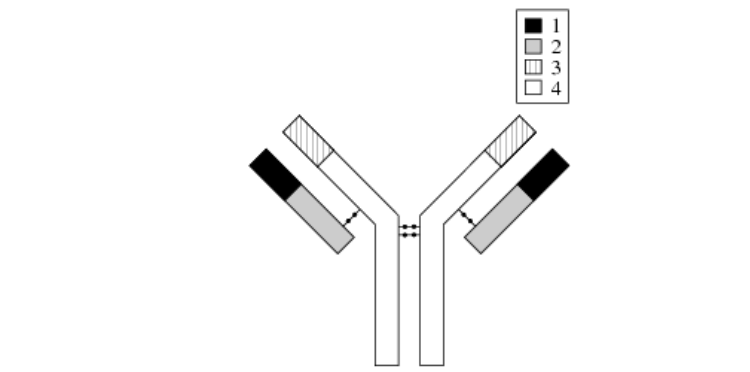
front 53 Human breast cancer patients whose tumors overexpress HER2, the human
homolog of ErbB2, may be treated with trastuzumab, an antibody that
was developed to be highly specific for the extracellular domain of
HER2. Given this, which of the regions of trastuzumab shown in the
figure is(are) most likely highly specific for the extracellular
domain of HER2?
- A.Regions 1 and 2 only
- B.Regions 1 and 3 only
- C.Regions 3 and 4 only
- D.Region 4 only
| back 53
Solution: The correct answer is B.
- Regions 1 and 2 correspond to the variable and constant
regions of the light chain of the antibody, respectively. However,
only variable regions can target specific antigens. Instead, region
3 represents the variable region of the heavy chain, which can also
be used to specifically target the HER2 antigen.
-
Regions 1 and 3 correspond to the variable regions of the
antibody light and heavy chains, respectively. The variable
regions of an antibody are responsible for detecting specific
antigens, such as HER2.
- Regions 3 and 4
correspond to the variable and constant regions of the antibody
heavy chain. While the variable region of the heavy chain is
involved in the recognition of specific antigens, such as HER2, the
constant region is not. Instead, the variable region of the light
chain is also involved in the detection of specific antigens.
- Region 4 represents the constant region of the antibody heavy
chain. However, constant regions of an antibody are not responsible
for the detection of specific antigens.
|
front 54 According to the cross-bridge model of muscle contraction, the
muscles stiffen after death because ATP is unavailable to bind and
directly release:
- A.ADP from the actin head.
- B.ADP from the myosin
head.
- C.the actin head from the myosin filament.
- D.the myosin head from the actin filament.
| back 54
Solution: The correct answer is D.
- During the cross-bridge cycle, ADP is bound to myosin, not
actin.
- ADP is released from the myosin head during the “power
stroke” of the cross-bridge cycle. This is when the myosin head
bends, pulling on an actin filament. However, this occurs prior to
ATP binding to myosin, and will not be directly affected by lack of
ATP.
- During the cross-bridge cycle, ATP binds to myosin, not
actin. When this occurs, this allows for myosin to detach from
actin, not the other way around.
-
During the cross-bridge cycle, ATP is needed to allow myosin
detachment from an actin filament. Consequently, when ATP is
unavailable, the myosin head remains attached to an actin
filament. This maintains the muscle in a contracted
state.
|
front 55 Which schedule of reinforcement is used in the color-matching task?
- A.Fixed ratio
- B.Variable ratio
- C.Fixed
interval
- D.Variable interval
| back 55
Solution: The correct answer is A.
-
The passage states, “[The baboons’] task was to tap on the
option that matched the target color. When a correct response was
produced, the subject received a banana chip.” A fixed ratio
schedule of reinforcement provides the reinforcer after a
consistent number of target behaviors. In the color-matching task,
baboons received the reinforcer (the banana chip) after each
target behavior (providing the correct response).
- A variable ratio schedule of reinforcement provides the
reinforcer after a varying number of target responses, which varies
around a predetermined average. This is not the schedule of
reinforcement described by the passage.
- A fixed interval
schedule of reinforcement provides the reinforcer when the target
behavior is performed for the first time after a consistent interval
of time has elapsed. This is not the schedule of reinforcement
described by the passage.
- A variable interval schedule of
reinforcement provides the reinforcer when the target behavior is
performed for the first time after a varying interval of time has
elapsed. This is not the schedule of reinforcement described by the
passage.
|
front 56 What are the different type of reinforcement schedules? | back 56 Yes, reinforcement schedules refer to when the
reinforcer is provided following a specific behavior.
These schedules dictate how and when reinforcement (the reward) is
given, which affects how the behavior is learned and maintained. There
are two main types of reinforcement schedules:
continuous reinforcement and partial (or
intermittent) reinforcement. Each of these has different
subtypes based on the timing and frequency of reinforcement.
1. Continuous Reinforcement (CRF):
-
When it's provided: A reinforcer is given
every time the behavior occurs.
-
Effect on behavior: This is typically used when
first teaching a behavior because it leads to rapid learning.
However, it can be less effective in maintaining the behavior over
time once the reinforcement stops.
2. Partial (Intermittent) Reinforcement:
This type involves reinforcement being given only some of
the time the behavior is performed. There are four main
types based on timing and frequency:
a. Fixed-Ratio (FR) Schedule:
-
When it's provided: Reinforcement is given after a
set number of responses.
-
Example: A worker is paid after completing 10 units
of work. The reinforcer (payment) comes after a fixed number of
responses (10 units).
-
Effect on behavior: Produces a high rate of
response, but there may be pauses after reinforcement (called a
"post-reinforcement pause").
b. Variable-Ratio (VR) Schedule:
-
When it's provided: Reinforcement is given after a
variable number of responses, on average.
-
Example: Slot machines in casinos. You don't know
exactly when the next win will come, but over time, it's around
every X number of plays.
-
Effect on behavior: Leads to a high and
steady rate of responding, because the person can’t
predict when the reinforcement will occur.
c. Fixed-Interval (FI) Schedule:
-
When it's provided: Reinforcement is given after a
set amount of time has passed, and the behavior
occurs.
-
Example: A person receives a paycheck every two
weeks. The reinforcer (paycheck) is delivered after a fixed interval
of time, regardless of the number of responses in that time.
-
Effect on behavior: Leads to a pattern of behavior
where responses increase as the time for reinforcement approaches
(called the "scalloping effect").
d. Variable-Interval (VI) Schedule:
-
When it's provided: Reinforcement is given after a
variable amount of time has passed.
-
Example: Checking for emails, where you don't know
exactly when you'll receive one, but on average, emails come at
random intervals.
-
Effect on behavior: Produces a moderate but steady
rate of responding. It's harder to predict when the next
reinforcement will happen.
Summary of Reinforcement Schedules:
-
Continuous: Reinforcer is given every time the
behavior occurs.
-
Partial: Reinforcer is given only some of the time,
and it can be based on the number of responses or
the amount of time passed. The subtypes are:
-
Fixed-Ratio (FR): Reinforcer after a fixed
number of responses.
-
Variable-Ratio (VR): Reinforcer after a
variable number of responses.
-
Fixed-Interval (FI): Reinforcer after a fixed
amount of time.
-
Variable-Interval (VI): Reinforcer after a
variable amount of time.
Each of these schedules affects how quickly the behavior is learned,
how resistant the behavior is to extinction, and the rate at which the
behavior is performed. Let me know if you'd like more details or examples! |
front 57 Which historical factor primarily accounts for the projected increase
in the population aged 65 and older in the United States?
- A.The increased immigration rate since the 1950s
- B.The increased fertility rate after World War II
- C.The
sexual revolution of the 1960s and 1970s
- D.The relative
deprivation of the Great Depression
| back 57
Solution: The correct answer is B.
- Immigration in the United States was not a major factor in the
increase of the population because the share of the immigrants in
the population declined significantly in the post-WWII era until the
1970s.
-
Demographers define the baby boom generation as those
individuals born between approximately 1946 and 1964. The
projected increase in the share of the population over the age of
65 primarily stems from the baby boomers, the post-World War II
generation in the United States and Canada. Birth rates were
relatively high for almost two decades after World War II because
of the fast economic growth experienced in the society. Therefore,
the baby boom generation is the main sociohistorical factor that
explains the projection in the passage about the increasing share
of the population over 65 years of age.
- The
sexual revolution of the 1960s and 1970s was a cultural movement
that challenged the traditional gender roles and understanding of
sexuality. This movement is connected to feminist and LGBTQ
movements and is not associated with an increase in the population
of the baby boom generation.
- The Great Depression
experienced in the 1930s led to a significant decline in living
standards and is not associated with the population boom experienced
in the post-WWII era.
|
front 58 ______________ broadly calls attention to competition among social
groups at a macro level, including generational conflict. Conflict
theory draws attention to social inequalities | |
front 59 Social gradient in health refers to the _____________________ | back 59 difference in health outcomes by social status |
front 60 The life course perspective focuses on how __________________________ | back 60 early life events influence health outcomes in later life. |
front 61 Intersectionality refers to how intersections of different _________________________ | back 61 social backgrounds (such as race/ethnicity, gender, and class)
produce differential outcomes for an individual. |
front 62 What is the difference between conversion disorder and dissociative disorder? | back 62 - Conversion disorder is characterized by impairments to
voluntary motor or sensory function which are not due to a
recognized neurological or medical condition. The symptoms described
do not support a conversion disorder diagnosis.
-
Dissociative amnesia is a dissociative disorder where
individuals cannot recall important autobiographical information,
usually related to a trauma or stressor. This is most consistent
to the symptoms described.
|
front 63 Meritocracy is a system where people are ______________. In simple
terms, it means that the more effort and talent you put in, the more
you can succeed, regardless of where you come from. | back 63 rewarded or given opportunities based on their abilities, skills, and
achievements rather than their background, wealth, or social status |
front 64 Text: Similarly, the United States tends to have less social mobility
than peer countries. These findings from comparative research have led
some scholars to question assumptions about opportunity in American society.
Based on the passage, findings from comparative studies of social
mobility have led some scholars to question which aspect of U.S. society?
- A.Meritocracy
- B.Socialization
- C.Social
identity
- D.Cultural capital
| back 64
Solution: The correct answer is A.
-
According to the passage, the United States tends to have
less social mobility than its peer countries. This empirical
finding from comparative research had led some scholars to
question assumptions about opportunity in American society. Such
questioning of opportunity would be relevant to the concept of
meritocracy, which assumes that opportunity is based on a
combination of talent and effort.
- Socialization
refers to the learning of socially acceptable values and behaviors.
The passage discussion does not refer to socialization.
- Social identity refers to how someone defines themselves based
on their social background. Social identity is not discussed in the
passage in regard to social mobility.
- Cultural capital
refers to how someone’s cultural background might provide certain
advantages to individuals to distinguish themselves from the rest of
the society. Cultural capital is not discussed in the passage in
regard to social mobility.
|
front 65 Which type of poverty is referenced in the passage?
- A.Absolute poverty
- B.Marginal poverty
- C.Relative poverty
- D.Structural poverty
| back 65
Solution: The correct answer is C.
- Absolute poverty is an economic condition in which individuals
cannot meet their basic needs. Absolute poverty is not discussed in
the passage.
- Marginal poverty stems from unstable
employment conditions for an individual in which they cannot achieve
minimum standards of living. Employment conditions are not discussed
in the passage.
-
Relative poverty refers to social disadvantage by income or
wealth as compared to the social advantages linked to income or
wealth in a society. The passage discussion about social
structural factors pertains to the median income in the United
States and high levels of inequality, which is most consistent
with the phenomenon of relative poverty.
- Structural poverty is related to a lack of economic
opportunities for individuals to leave poverty. A structural lack of
economic opportunities is not discussed in the passage.
|
front 66 Text: Strong social support in local immigrant communities may partly
explain the relatively good health of individuals from some immigrant
groups in the United States, when compared to U.S.-born individuals
with otherwise similar demographic characteristics.
Which hypothesis of cultural assimilation, social support, and
health outcomes is best supported by the passage information about
immigrant groups? More assimilated groups will have:
- A.lower levels of support and better overall health.
- B.higher levels of support and worse overall health.
- C.lower levels of support and worse overall health.
- D.higher levels of support and better overall health.
| back 66 ** Assimilated (adjusted) vs immigrant groups are two different people....
Solution: The correct answer is C.
- The passage suggests that more assimilated groups would have
less social support; however, lower levels of support are associated
with worse health outcomes.
- The passage suggests that more
assimilated groups would have worse health outcomes, but this would
not be due to a higher level of social support.
-
The passage suggests that strong social support in local
immigrant communities may partly explain the relatively good
health of individuals from some immigrant groups in the United
States (when compared to U.S.- born individuals with otherwise
similar demographic characteristics). Immigrant groups that are
more assimilated (or as they become assimilated) tend to have
worse health outcomes (or lose their previous health advantages)
than less assimilated immigrant groups. Thus, the correct response
reflects the hypothesis that more assimilated groups are likely to
have less social support over time. Reducing that protective
factor could lead to worse health overall.
- The
passage suggests that more assimilated groups would not have a
higher level of social support.
|
front 67 Text: Interventions that target substance use in adolescents are
often designed to prevent or delay risky behaviors that could lead to
dependence. Although psychoactive drugs vary in terms of their risk of
dependence, one of the factors associated with substance use disorders
(SUD) in adolescents is the strong desire to ingest a drug (or other substance)
The description of dependence and substance use disorders in the
passage suggests which type of drug-related symptom?
- A.Habituation
- B.Tolerance
- C.Withdrawal
- D.Craving
| back 67
Solution: The correct answer is D.
- The passage states, “Although psychoactive drugs vary in terms
of their risk of dependence, one of the factors associated with
substance use disorders (SUD) in adolescents is the strong desire to
ingest a drug (or other substance).” Habituation refers to reduced
responsiveness to a repeating stimulus, which is not relevant to the
symptom described by the passage.
- Tolerance refers to when
increasing amounts of a substance is required to receive the desired
effect from it. This is not relevant to the symptom described by the
passage.
- Withdrawal refers to the symptoms experienced when a
person stops using or reduces the dose of a substance. This is not
relevant to the symptom described by the passage.
-
Craving refers to a strong desire to ingest a substance.
Craving is the symptom described in the passage.
|
front 68 Which type of psychoactive drug has the lowest risk of dependence?
- A.Stimulants
- B.Hallucinogens
- C.Alcohol
- D.Sedatives
| back 68
Solution: The correct answer is B.
- Stimulants, such as cocaine and amphetamines, have a
relatively high risk of dependence (defined as an ever-increasing
tolerance for the substance and the experience of withdrawal when
substance use is reduced or ceased).
-
Relative to the other types of psychoactive drugs,
hallucinogens have the lowest risk of dependence.
- Alcohol, which functions as a sedative on the central nervous
system, has a relatively high risk of dependence.
- Given
their impact on the central nervous system, sedatives have a
relatively high risk of dependence.
|
front 69 A conflict theorist is most likely to reference which concept in
order to explain the causes of access disparities for SUD treatment?
- A.Stratification
- B.Racialization
- C.Socialization
- D.Gentrification
| back 69
Solution: The correct answer is A.
-
Conflict theory focuses on social inequalities.
Stratification indicates that certain communities experience
unequal access to resources and opportunities in a society.
Therefore, disparities in access to SUD treatment among different
social groups as discussed in the passage would be most consistent
with a conflict perspective.
- Racialization
refers to the identification of certain behaviors with a racial
category regardless of the consent of the members of that community.
Racialization is not relevant to disparities in access to SUD
treatments.
- Socialization refers to the learning of social
values and expected behaviors. This factor would not be relevant to
disparities in access to SUD treatments.
- Gentrification
refers to the displacement of low-income residents in a neighborhood
due to increasing property value. This phenomenon would not be
directly relevant to disparities in access to SUD treatments.
|
front 70 A physician approaches a new patient with the assumption that the
patient is not well educated and thus less knowledgeable about health
issues. Does this scenario illustrate discrimination?
- A.Yes; the scenario illustrates a judgment that is not based
on supporting evidence.
- B.No; the scenario identifies a
bias directed at an individual rather than at a group.
- C.Yes; the scenario suggests that a negative evaluation could
affect the interaction.
- D.No; the scenario describes an
attitude but does not specify differential treatment.
| back 70
Solution: The correct answer is D.
- A judgement based on incorrect assumptions would be best
described as bias. However, discrimination has to be based on
differential treatment.
- The physician’s bias would not
directly indicate discriminatory behavior; therefore, this
explanation would not be relevant to the behavioral aspect of
discrimination.
- A negative evaluation could affect the
interaction, but such an interaction is not discussed in the
question prompt.
-
The hypothetical physician displays a biased attitude, and
thus a prejudice potentially based on a stereotype. However, no
action or behavior is specifically identified with the scenario in
the question. Without a description of differential treatment or
behavior, discrimination is not identified.
|
front 71 To determine the effectiveness of brainstorming, a researcher designs
a study in which participants are asked to produce alternatives to an
existing marketing strategy on their own or with a group. Which
pattern of results is most likely based on research on group processes?
- A.Groups arrive at the improved alternatives more often than
individuals.
- B.Groups are more likely to critically evaluate
alternatives than individuals.
- C.On average, participants
generate more alternatives alone than in a group.
- D.On
average, participants produce more alternatives in a group than
alone.
| back 71
Solution: The correct answer is C.
- Social loafing refers to the fact that people are more
productive alone than in a group. Research also suggests that
individuals are less critical and less creative in groups. Thus,
research indicates participants in groups will be less likely to
arrive at the improved alternatives than participants working
alone.
- Groupthink occurs when members of a group prioritize
agreement over critical thinking when coming to a decision. Due to
groupthink, participants in groups are less likely to critically
evaluate alternatives than those working alone.
-
Research on social loafing and related phenomenon support
that participants working alone will generate more alternatives
than those working in groups.
- Given social
loafing, participants in groups are likely to produce fewer
alternatives than participants working alone.
|
front 72 Groupthink occurs when ___________________ | back 72 situational pressures hinder groups from critically evaluating
relevant information. |
front 73 Although the study examines a specific bias in group decision-making,
similar biases can influence individual decision-making. Which of the
following individual-level effect is most similar to groupthink?
- A.Self-serving bias
- B.Confirmation bias
- C.Hindsight bias
- D.Response bias
| back 73
Solution: The correct answer is B.
- Self-serving bias refers to the tendency to attribute one’s
own successes to internal, stable attributes and failures to
situational factors. This is not relevant to groupthink.
-
Confirmation bias is the tendency to put more weight on
information that confirms one’s pre-existing attitudes. As with a
group affected by groupthink, an individual’s confirmation bias
causes the person to seek, and attend to, only information that
confirms their existing point of view and to ignore disconfirming
evidence.
- Hindsight bias is the tendency to
overestimate one’s ability to predict an outcome after it has
already occurred. This is not relevant to groupthink.
- Response bias is the tendency for research participants to
respond inaccurately or falsely to self-report questions. This is
not relevant to groupthink.
|
front 74 Individuals who have the ability to delay gratification in pursuit of
long-term rewards are most likely to be categorized as having which
type of intelligence?
- A.Analytical
- B.Creative
- C.Interpersonal
- D.Emotional
| back 74
Solution: The correct answer is D.
- Analytical intelligence is the ability to succeed at
problem-solving tasks, such as using deductive reasoning. It is not
directly relevant to the ability to delay gratification.
- Creative intelligence is the ability to generate multiple, novel
solutions to a problem. It is not directly relevant to the ability
to delay gratification.
- Interpersonal intelligence is the
ability to understand other people’s emotions, connect with others,
and manage relationships. It is not directly relevant to the ability
to delay gratification.
-
Emotional intelligence refers to the ability to perceive,
express, understand, and manage one’s emotions. Emotionally
intelligent people are self-aware and can delay gratification in
pursuit of long-term rewards, rather than being overtaken by
immediate impulses.
|
front 75 How would a structural functionalist interpret the efficacy of yoga
as part of a smoking cessation therapy?
- A.Yoga provides an alternate understanding of healthful
practices that enables the individual to better understand his or
her personal needs and motives.
- B.Yoga provides an
inexpensive therapy option for those lacking the financial resources
necessary for more expensive medical interventions.
- C.The
utility of yoga as an effective smoking cessation therapy stems from
the transformation of the individual’s self-concept as a
nonsmoker.
- D.The utility of yoga as an effective smoking
cessation therapy is an unintended, though beneficial, outcome of a
yoga practice.
| back 75
Solution: The correct answer is D.
- This option offers an explanation at an individual level which
is not consistent with a functionalist approach.
- This
option refers to social inequalities. Functionalism does not focus
on social inequalities. focuses on conflict theory
- This
option describes dynamics at an individual level which is not
consistent with a functionalist perspective.
-
Functionalism makes a distinction between manifest, or
intended, and latent, or unintended, functions of social practices
which sustain social stability. The option describes a latent, or
unintended, function. Because the expected function of yoga is not
specifically smoking cessation, its utility as a cessation therapy
is a latent function of the social activity.
|
front 76 Symbolic interactionism is a theory in psychology (and sociology)
that focuses on _____________ It suggests that our behaviors,
thoughts, and identities are shaped by the symbols (like language,
gestures, and objects) we use to communicate and the social
interactions we have. | back 76 how people create and interpret meaning through their interactions
with others.
Sure! Here are a few examples of symbolic interactionism in action:
- Language and Communication:
- When we greet someone
with a "hello" or shake hands, those actions hold
symbolic meaning. In one culture, a handshake might represent
respect, while in another, it could be a formal greeting. The
meaning we attach to these actions depends on the social context
and our shared understanding.
- Self-Identity:
- If someone is constantly praised for being a great
student, they might start seeing themselves as "smart"
or "capable." Their sense of identity is shaped by the
way others view and interact with them. Over time, this
influences how they see themselves and behave in future
situations.
- Social Roles:
- Think of
the roles of "parent" and "child." A parent
might provide care and discipline, while a child might be
expected to obey and learn. The behavior of both individuals is
shaped by the symbolic meanings attached to their roles in
society. If the parent starts treating the child as an equal,
their relationship and interactions might change based on how
they redefine their roles.
- Fashion and
Appearance:
- People often make judgments based on how others
dress or present themselves. A person wearing a suit might be
perceived as professional, while someone in casual clothing
might be seen as more laid-back. These assumptions are based on
the symbols we attach to certain clothes or appearances.
In each of these cases, the symbols (like language, roles, or
appearance) carry meanings that we learn through social interactions,
and these meanings shape our thoughts, behaviors, and relationships. |
front 77 A researcher conducts observational research on the study habits of
college students. When students are aware of the researcher’s
presence, they are more attentive, focused, and structured. When
students are not aware of the researcher’s presence, they are
inattentive, unfocused, and distracted. Which concept best describes
this phenomenon?
- A.Impression management
- B.The Hawthorne effect
- C.Self-fulfilling prophecy
- D.The Thomas theorem
| back 77
Solution: The correct answer is B.
- Impression management refers to direct attempts by an
individual to control how they are perceived by others. This is not
the best description of what is occurring in the prompt, because
typically observational research participants are not directly
trying to control the researchers’ perceptions.
-
The Hawthorne effect, named after an observational study of
workers in the Hawthorne factory, refers to the tendency for
observational research participant behavior to change when they
know they are being observed. This best describes the phenomenon
described in the prompt.
- Self-fulfilling
prophecy is the tendency to behave in ways that confirm
expectations. Although observational research participants may be
aware that they are being observed, it is unlikely that they would
be aware of the specific expectations or hypotheses of the
researchers.
- The Thomas theorem argues that individual
beliefs have real consequences. This phenomenon is not relevant to
the study discussed in the question prompt.
|