Instructions for Side by Side Printing
- Print the notecards
- Fold each page in half along the solid vertical line
- Cut out the notecards by cutting along each horizontal dotted line
- Optional: Glue, tape or staple the ends of each notecard together
Principles of Eco (Lec 4)
front 1 Each Species has a range of | back 1 environmental tolerances that determines its potential geographic distrubution |
front 2 The temperature of an organism is determined by | back 2 exchanges of energy with the external environment. |
front 3 Organisms have two options for coping with environmental variation, which are? | back 3 Tolerance and Avoidance |
front 4 Potential geographic range of a species is determined by | back 4 the physical environment |
front 5 Physical environment influences an organisms ecological success in two ways? | back 5 1. Availability of energy and resources 2. Extreme conditions can exceed tolerance limits |
front 6 Actual geographic distribution of a species is Ex. Dispersal, competition, etc | back 6 related to other factors as well * Differs from its potential Distribution |
front 7 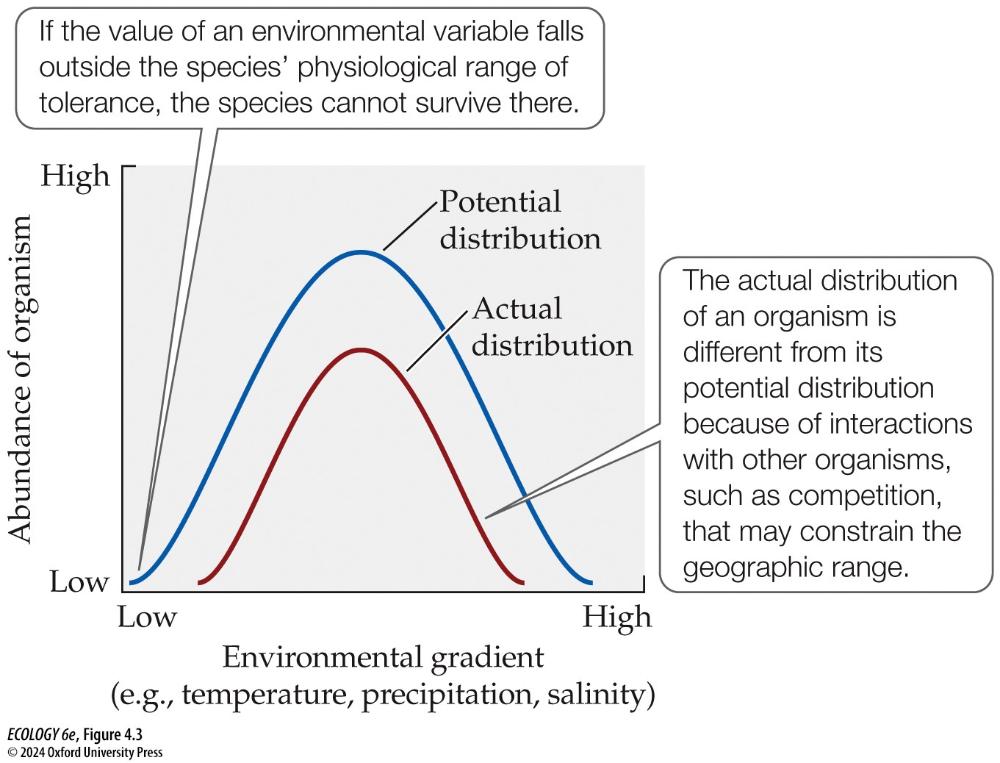 Most likely to differ bc of geologic differences | back 7 no data |
front 8 Terrestrial biomes are categorized on the basis of | back 8 growth forms of dominant plant species |
front 9 What are good indicators of the physical enviroment? | back 9 Plants because they do not move. * ability to tolerate the full range of env conditions |
front 10 Climate envelope | back 10 range of conditions over which a species occurs. |
front 11 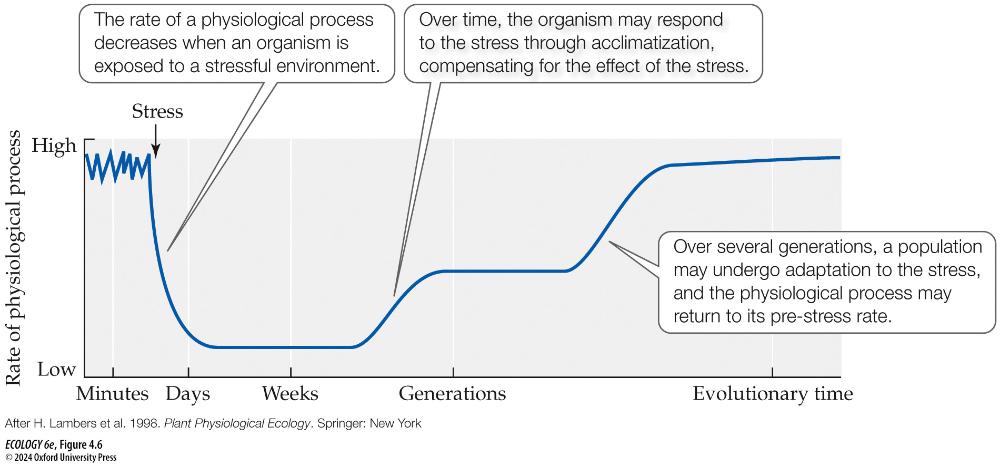 | back 11 - Acclimatization can lead to a high breathing rate - Acclimatization and adaptation may require an investment of Energy & Resources by the organism) |
front 12 Adaptation is a transgenerational | back 12 genetic response of the population |
front 13 Acclimatization is | back 13 short term reversible |
front 14 Ecotypes are | back 14 Populations with adaptations to unique env. - In both Abiotic and Biotic environmental factors |
front 15 Andean Pop. have high rbc concentrations Tibetans have faster breathing rates and | back 15 and large lung capacity higher blood flows |
front 16 Internal temp. influences | back 16 - rates of all rate processes - cell membrane fluidity - water turnover |
front 17 Organisms temp. is determined by | back 17 the balance of gains and losses of energy to the external env. |
front 18 Some organisms use behavior to | back 18 control exchange of energy with the environment |
front 19 Behavioral thermoregulation | back 19 predominant mechanism of temp regulation in ectotherms |
front 20 Heat exchange occurs across surfaces and | back 20 relative surface area decreases as organisms get bigger Surface area:volume ratio decreases as organisms get bigger |