Instructions for Side by Side Printing
- Print the notecards
- Fold each page in half along the solid vertical line
- Cut out the notecards by cutting along each horizontal dotted line
- Optional: Glue, tape or staple the ends of each notecard together
BICH 411 EXAM 1
front 1 Fat soluble vitamins are not readily secreted but | back 1 stored in fat |
front 2 What vitamins are fat soluble | back 2 vitamin A,D,E, and K |
front 3 If you are lacking vitamins, | back 3 no reaction takes place |
front 4 Purpose of these elements: Mg2+: Ca2+: Zn2+: | back 4 -stabilize ATP -signal transduction -cofactor of rxns |
front 5 A metabolic pathway is a series of_______reactions, often located in a specific part of the cell. | back 5 enzyme-catalyzed |
front 6 Without enzymes, | back 6 reactions would be too slow for cells to survive |
front 7 Enzymes provide a way to couple energetically ___________reactions with______. | back 7 -unfavorable -favorable reactions |
front 8 Catabolic reactions go through_________where it takes electrons and breaks bonds | back 8 degradation |
front 9 Degradation breaks_______to_________ | back 9 -complex metabolites -simple products |
front 10 Anabolism reactions go through______where_______ turn to _______ | back 10 -biosynthesis -simple products -complex metabolites |
front 11 What macromolecules are broken down in catabolism? | back 11 proteins, polysaccharides, triglycerols |
front 12 The end goal of catabolism | back 12 CO2 |
front 13 _____is the electron carrier produced by glycolysis | back 13 NADH |
front 14 Catabolism is____, and anabolism is____ | back 14 oxidative, reductive |
front 15 When the energy state of the cell is LOW, we would expect to see reactions taking place with end product such as? | back 15 CO2 |
front 16 If, in the course of a reaction, NAD+ goes to NADH, then the reaction is____ | back 16 oxidative |
front 17 Metabolic pathways are localized within different cellular compartments | back 17 Compartmentalization |
front 18 What mechanisms occur in the cytosol? | back 18 glycolysis, PPP, fatty acid biosynthesis, many GNG reactions |
front 19 What mechanisms occur in the mitochondrion? | back 19 Citric acid cycle, oxidative phosphorylation, fatty acid oxidation, amino acid breakdown, and electron transport |
front 20 What are the four strategies to control enzymes? | back 20 -allosteric control -covalent modification -substrate cycles -genetic control |
front 21 Allosteric control includes substrates, products, and coenzymes of the pathway. This is ______feedback regulation | back 21 negative |
front 22 covalent modification is a | back 22 global response |
front 23 Enzymes that control flux of a pathway have specific sites that can be _______ | back 23 covalently modified |
front 24 Covalent modifications are_______ such as hormones | back 24 controlled by signals |
front 25 In substrate cycles, the foward reaction is________while the reverse reaction is______ | back 25 - accelerated -slowed down |
front 26 In genetic control, altering the concentration of enzymes can lead to | back 26 altering enzyme activity |
front 27 ATP-->(ADP+Pi) doesn't have the highest free energy because | back 27 it needs time to replenish |
front 28 ATP--->(ADP+Pi) has a free energy charge of_____ and needs______to make more ATP. | back 28
|
front 29 Hydrolysis increases _____ and _______ | back 29 -resonance stabilization -energy of solvation |
front 30 Hydrolysis decreased_____ | back 30 -electrostatic interaction |
front 31  | back 31 -Phosphoenolpyruvate, 1,3-bisphosphoglycerate, phosphocreatine transfer to make ATP - ATP helps in the production of Glucose-6-phosphate and glycerol-3-phosphate |
front 32 NAD+ and FAD _____electrons | back 32 accept |
front 33 Reduction___electrons | back 33 gain |
front 34 Oxidation___electrons | back 34 loses |
front 35 Electron transfer can be | back 35 -directly as e- -As H+ atom: 1e- transferred -As hydride ion (H-): 2e- transferred |
front 36 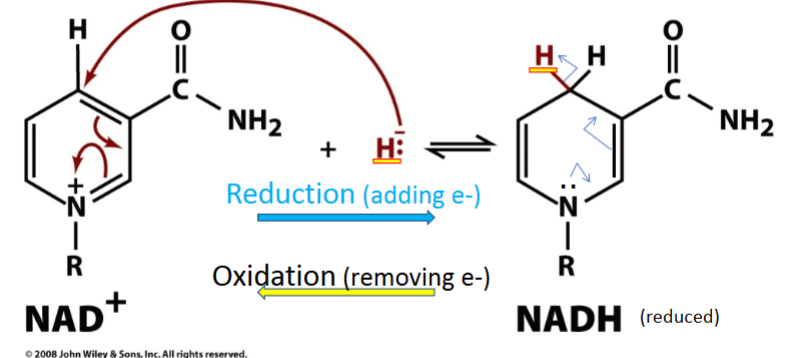 NADH is a common electron carrier and always transfers_____ | back 36 two e-at a time |
front 37 what does biosynthesis rely on? | back 37 reducing equivalents from NADH |
front 38 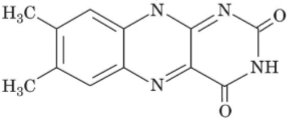 What structure is this? | back 38 flavin(FAD) |
front 39 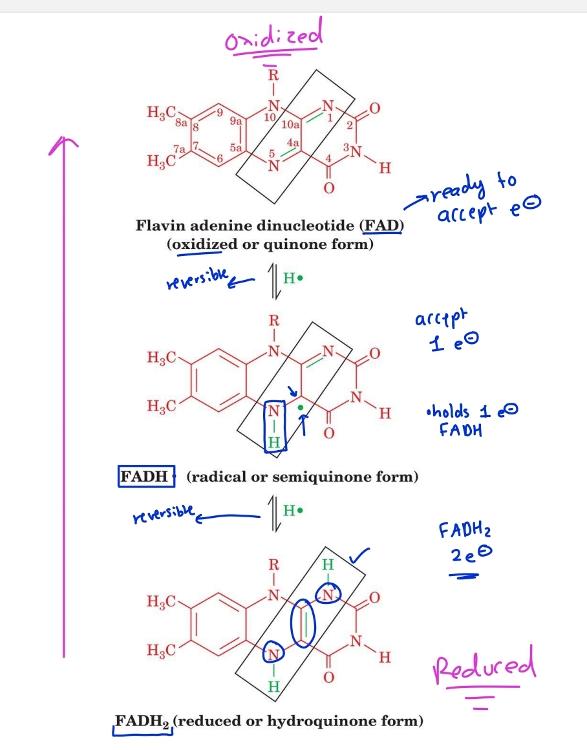 | back 39 reduced: FADH2 oxidized: FAD |
front 40 Mg2+interacts with the negative charges on the phosphate group to shield negative charges, | back 40 making the molecule more stable |
front 41 Pentose phosphate pathway is an alternative pathway that allows for____production and provides biosynthetic precursors | back 41 NADH |
front 42 GNG is a pathway in the _____and_____ that allows for biosynthesis of glucose from pyruvate, lactate, and amino acids. | back 42 -liver -kidney |
front 43 Glycolysis and GNG are reciprocally regulated by allosteric effects, _______ and _______ | back 43 -covalent modification -changes in enzyme synthesis rates |
front 44 Low affinity transporter in hepatocytes (liver) and pancreatic cells | back 44 GLUT2 |
front 45 Higher affinity transporter in adipose tissue and muscle cells | back 45 GLUT4 |
front 46 Is driven by concentration and hormones, independent of Na+ | back 46 GLUT1-4 |
front 47 GLUT2 has about a Km=15mM and captures excess glucose primary for | back 47 Storage |
front 48 GLUT2 is considered to be first order kinetics because______. | back 48 -transport is directly dependent on glucose concentration |
front 49 low affinity= | back 49 fast chemistry |
front 50 GLUT4 has about a Km=5mM which means transport is saturated with slightly | back 50 high blood glucose levels |
front 51 GLUT4 is considered to be | back 51 zeroth order of kinetics because its constant rate. |
front 52 After a meal, glucose is____. Before a meal, glucose is______ | back 52 -very high -very low |
front 53 high affinity= | back 53 slow chemistry |
front 54 A stimulated cell of insulin causes for localization of _______to plasma to boost glucose uptake in cell | back 54 glucose receptors |
front 55 Glycolysis occurs in the____ and doesn't require | back 55 -cytoplasm -oxygen |
front 56 The products of glycolysis are | back 56 ATP, pyruvate, NADH |
front 57 The three fates of pyruvate are | back 57 -TCA cycle, Lactic acid fermentation(muscles), alcohol fermentation in yeast |
front 58 Investing ATP allows for glucose uptake to be____. Utilizing ATP to irreversibly convert glucose to G6P allows for____ | back 58 -controlled -the regulation uptake in glucose |
front 59 G6P is not allowed to cross the plasma membrane due to____ | back 59 phosphorylation |
front 60 What sugars can hexokinase be used for? | back 60 -glucose -fructose -mannose |
front 61 Hexokinase has high affinity, and provides_____ | back 61 direct feedback regulation by G6P. |
front 62 The liver stores extra___ and doesn't compete with other tissues | back 62 glucose |
front 63 What sugars can glucokinase be used for? | back 63 glucose only!! |
front 64 Due to the poor affinity of glucokinase, it allows for the liver | back 64 to get what is left over |
front 65 Glucokinase has a | back 65 different regulatory mechanism |
front 66 What substrate is the branch point for several metabolic pathways? | back 66 G6P |
front 67 How does hexokinase and glucokinase prevent ATP from reacting with water? | back 67 glucose binding (conformational change that orients glucose and ATP and excludes water) |
front 68 What intermediate is formed when making G6P to F6P? | back 68 enediol intermediate |
front 69 In phosphofructokinase, a decrease in ATP and an increase in AMP causes for | back 69 PFK to respond to cells energy demands and turn glycolysis on and off. |
front 70 The R-state(high affinity) of PFK allows for the _____ | back 70 stabilization of AMP |
front 71 The T-state(low-affinity) of PFK allows for the_____ | back 71 stabilization of ATP |
front 72 Positive allosteric effectors shift equilibrium to favor | back 72 r-state |
front 73 Negative allosteric effectors shift equilibrium to favor | back 73 t-state |
front 74 PFK is first | back 74 committed step in glycolysis |
front 75 PFK activity_____ when the energy status of cell is low, and _____-when the energy status is high. | back 75 -increases -decreases |
front 76 Is PFK tightly regulated? | back 76 YES |
front 77 F-2,6-BP stimulates PFK by decreasing | back 77 inhibitory effects of ATP |
front 78 In aldolase, each end is phosphorylated before | back 78 cleaving because its trapped |
front 79 What does the aldolase enzyme found in animal tissues form into? | back 79 -covalent Schiff base E-S intermediate |
front 80 What does the aldolase enzyme found in bacterial and fungi form into? | back 80 -doesn't form E-S intermediate but contains a Zn2+to help shield the oxyanion intermediate |
front 81 Which carbon in glucose becomes C=O in DHAP after both aldolase and triose P isomerase? | back 81 C#2 or C#5 |
front 82 TPI is a near perfect enzyme because it has | back 82 high affinity/fast chemistry |
front 83 In glycolysis first phase, ___ATPs are consumed. In the second phase,____ATPs are produced. Which results in a net ATP yield of __ATPs per glucose. | back 83 -2, 4, 2 |
front 84 Glyceraldehyde 3-phosphate dehydrogenase uses_______ as a cosubstrate which involves the exchange of electrons. | back 84 NAD+ |
front 85 Gly-3P is oxidized to | back 85 1,3-BPG |
front 86 Phosphoglycerate kinase transfers a phosphoryl group from 1,3-bisphosphoglycerate to ADP to ATP | back 86 substrate-level phosphorylation |
front 87 A___is an enzyme that catalyzes the migration of a function group within the substrate molecule | back 87 mutase |
front 88 The enolase reaction in glycolysis is a | back 88 dehydration reaction, not a redox reaction |
front 89 Pyruvate Kinase irreversible in vivo | back 89 . |
front 90 ATP production via glycolysis doesn't require____ | back 90 oxygen |
front 91 What are the key regulatory steps (irreversible)? | back 91 -hexokinase/glucokinase -phosphofructokinase -pyruvate kinase |
front 92 Flexible loop closes over TIM active site and creates | back 92 Methylglyoxal formation |
front 93 What other substrates can be used for glycolysis? | back 93 fructose, galactose, and mannose |
front 94 Fructose (muscle) requires____ | back 94 hexokinase |
front 95 A tagged glucose (UDP) must occur to | back 95 enter glycolysis |
front 96 What enzymes are needed for galactose to go through glycolysis? | back 96 galactokinase, galactose-1-phosphate uridylyl transferase, UDP-galactose-4-epimerase, phosphoglucomutase |
front 97 What enzymes are needed for mannose to go through glycolysis? | back 97 hexokinase and phosphomannose isomerase |
front 98 What enzyme is needed for fructose to go through glycolysis in the muscle? | back 98 hexokinase |
front 99 What enzymes are needed for fructose to go through glycolysis in the liver? | back 99 -fructokinase -fructose-1-phosphate aldolase, -glyceraldehyde kinase, -alcohol dehydrogenase -glycerol kinase, -glycerol phosphate dehydrogenase, -triose phosphate isomerase |
front 100 Activators: | back 100 AMP, F16BP (more pyruvate, more ATP) |
front 101 Inhibitors: | back 101 ATP(stabilize t-state), Acetyl-CoA (less pyruvate), and Alanine (carbon skeleton) |
front 102 Important regulation steps in glycolysis in liver | back 102 1. glucokinase 2. PFK 3. Pyruvate kinase |
front 103 Fructose only metabolizes in excess amounts by_____ and excess sugar become____ | back 103 -the liver -fat |
front 104 Glycerol is produced in the decomposition of____. | back 104 -triacylglycerols |
front 105 In the ethanol endpoint of glycolysis, is a 2 step process catalyzed by | back 105 -pyruvate decarboxylase -alcohol dehydrogenase |
front 106 In the lactate endpoint of glycolysis, pyruvate is reduced by _____ and is reversible | back 106 lactate dehydrogenase (larger amounts of ATP generated) |
front 107 Aerobic glycolysis generates more ATP but has a ______ | back 107 much slower rate |
front 108 Anaerobic glycolysis generates less ATP but has a | back 108 much faster rate |
front 109 What is the Cori cycle? | back 109 liver and muscle work together to keep sprinting |
front 110 What type of twitch muscles do these characteristic represent? -dark in color -has endurance -is aerobic | back 110 slow twitch |
front 111 What type of twitch muscles do these characteristic represent? -is anaerobic -light in color -fatigues easily | back 111 fast-twitch |
front 112 Humans do not have_____, but they do have_____ | back 112 -PDC -ADH |
front 113 Humans do not have pyruvate carboxylase, but they do use______ | back 113 thiamine pyrophosphate(TPP) |
front 114 Does TPP allow for a better reaction pathway? | back 114 YES |
front 115 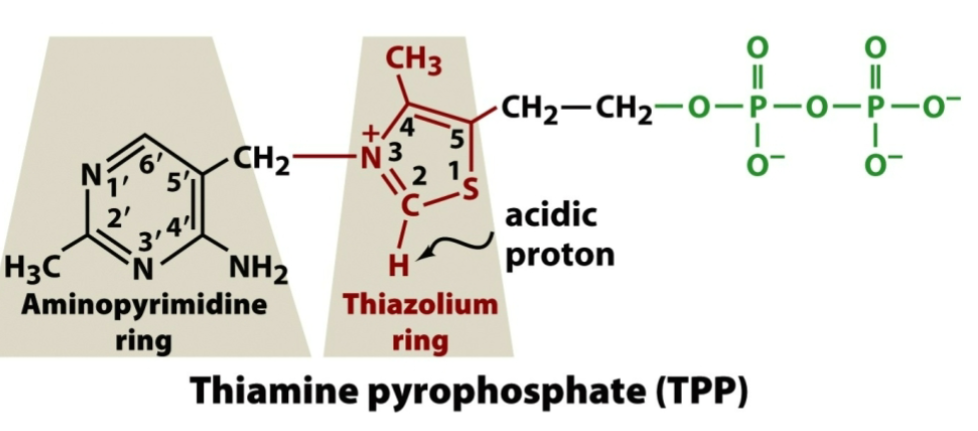 | back 115 .. |
front 116  Mechanism of pyruvate decarboxylase | back 116 look at the mechanism |
front 117 The body has enough glucose to supply for one day, so it must be made from | back 117 non-carbohydrate precursors |
front 118 The brain functions on glucose and accounts for 75% of | back 118 daily consumption of glucose |
front 119 Muscles also require______ | back 119 glycolysis |
front 120 GNG meets the body's glucose needs under_____ | back 120 fasting conditions |
front 121 Our brains cease to function when blood glucose concentration is_____ | back 121 <2.5 mM. |
front 122 Humans consume about___per day | back 122 160 g |
front 123 The reactions that goes from pyruvate to TCA, occur in the | back 123 mitochondria |
front 124 Body fluids contain only ___ of glucose. Glycogen stores yield____of glucose. | back 124 -20g -180-200g |
front 125 What are the substrates for GNG? | back 125 pyruvate, lactate, glycerol, amino acids and all TCA intermediates |
front 126 Acetyl-CoA cannot provide for | back 126 net synthesis of sugars |
front 127 GNG has four different enzymes from glycolysis because | back 127 the conversion of Pyruvate to PEP requires two steps |
front 128 Acetyl CoA is a main carbon source for TCA cycle where an increase in acetyl-coA means | back 128 cell has plenty of "fuel" |
front 129 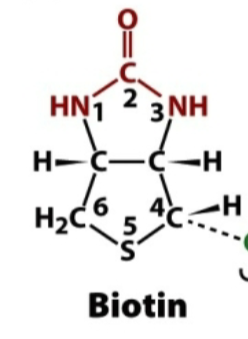 Biotin is a vitamin that serves as a | back 129 mobile CO2 carrier |
front 130 Pyruvate carboxylase uses ATP to load CO2 onto ____then delivers it to ______ | back 130 -biotin -pyruvate |
front 131 PEP carboxykinase uses | back 131 GTP rather than ATP |
front 132 Why does cell add CO2 with pyruvate carboxylase and then take it back off with PEPCK? | back 132 decarboxylation drives the formation of the enol that GTP phosphorylates |
front 133 Fructose-1,6-bisphosphatase allosteric regulation: | back 133 -citrate simulates(makes glucose) -fructose-2,6-bisphosphate inhibits(activates PFK (glycolysis on)) -AMP inhibits (low energy) |
front 134 F1,6BPase: What gets inhibited vs. activated? | back 134 -AMP inhibit (GNG off) +ATP(allosteric site) +Citrate (allosteric site) -F2,6P(turns GNG off) |
front 135 PFK1: What gets inhibited vs. activated? | back 135 +AMP(low energy) -ATP (allosteric sites)(high energy) -citrate(allosteric site)(high energy) +F2,6P(turns GNG on) |
front 136 PFK-2 domain | back 136 production |
front 137 F2,6BPase domain | back 137 breakdown |
front 138 the presence of G-6-Pase in ER of the ____and______ cells makes GNG possible | back 138 -kidney -liver |
front 139 Muscles and brains DO NOT do______ | back 139 GNG |
front 140 Glucose-6-phosphatase reaction involves_____by a histidine nitrogen and formation of a_________ | back 140 -nucleophilic attack - phosphohistidine intermediate |
front 141 Vigorous exercise lead to the build up of__________due to O2 shortage and the need for more glycolysis | back 141 lactate and NADH |
front 142 NADH is reoxidized during the reduction of | back 142 pyruvate to lactate |
front 143 Lactate is then reduced to the liver where it can be reoxidized to | back 143 pyruvate by liver LDH |
front 144 GNG is driven by the consumption of___- | back 144 6 nucleosides triphosphates |
front 145 When glycolysis is turned on, GNG should be | back 145 turned off |
front 146 When cell's energy status is high, glycolysis should be off and should be used for | back 146 synthesis and storage of glucose |
front 147 When cells energy status is low, glucose should be rapidly | back 147 degraded to provide energy(needs ATP) |
front 148 An individual is sprinting, what type of regulation is going on in terms of glycolysis and GNG? IN THE MUSCLE | back 148 -glycolysis is on, production of ATP is critical, so anaerobic glycolysis is occurring -ATP is being generated as quickly as possible |
front 149 An individual is sprinting, what type of regulation is going on in terms of glycolysis and GNG? IN THE LIVER | back 149 -GNG is on, production of NADH and glucose for use in muscles is critical |
front 150 Pentose phosphate pathway has 2 phases: | back 150 oxidative phase and nonoxidative phase |
front 151 The oxidative phase of PPP uses glucose metabolism to | back 151 help supply NADH for reductive reactions |
front 152 The nonoxidative phase of PPP uses glucose metabolism to supply | back 152 ribose-5-phosphate |
front 153 The first 4 substrates makes | back 153 2NADPH G6P--->5C sugar-P |
front 154 The bottom substrates interconvert | back 154 3C,4C,5C,6C,7C sugars |
front 155 NADH is mainly in______form and removes 2e- during fuel metabolism | back 155 oxidized |
front 156 NADPH is mainly in _______form and adds 2e- during biosynthesis and detox of free radicals | back 156 reduced |
front 157 PPP operates mostly in | back 157 cytoplasm of liver and adipose cells(fat) |
front 158 G6P dehydrogenase is regulated by NADPH levels -NADPH is a _____, cytosolic levels of NADP+/NADPH dictate enzymes activity | back 158 inhibitor |
front 159 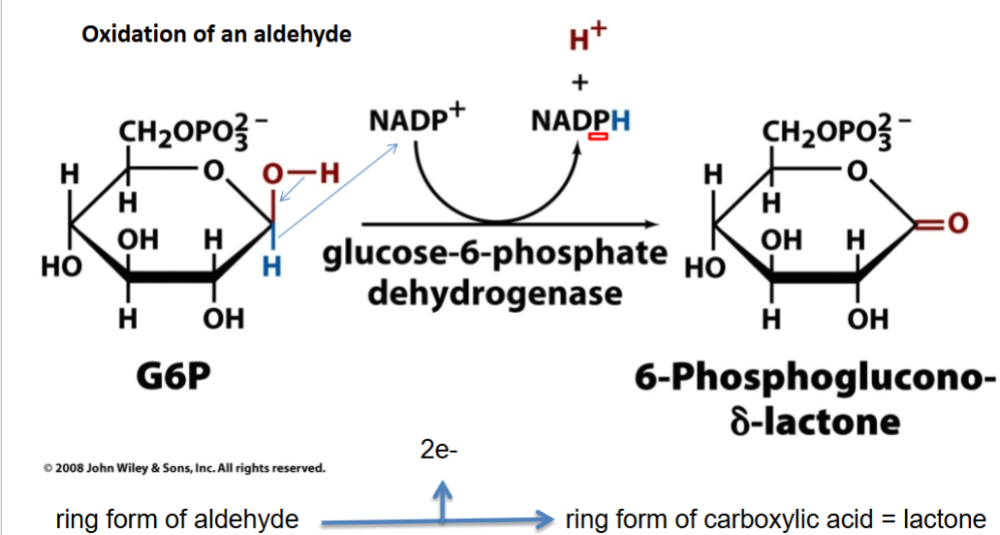 | back 159 oxidation of an aldehyde |
front 160 Hyrdolysis of lactone occurs both | back 160 enzymatically and non-enzymatically |
front 161 6-phosphoglucono8-lactone is hydrolytically unstable, so it readily undergoes | back 161 spontaneous ring opening hydrolysis |
front 162 reaction 2: gluconolatonase accelerates the spont. ring opening hydrolysis in order to | back 162 prevent the accumulation of 6-phosphogluconolactone which is toxic |
front 163 The 2 phases of oxidative decarboxylation: | back 163
|
front 164 Phosphopentose isomerase has an | back 164 enediol intermediate |
front 165 Ribose-5-phosphate is used in biosynthesis of | back 165 coenzymes, nucleotides, and nucleic acids |
front 166 Phosphopentose Epimerase change in position of acidic proton and has a | back 166 enediolate intermediate |
front 167 Transketolase is the transfer of _____ from ketose(donor) to aldose(acceptor) and utilizes _____ | back 167 -2-C -TPP |
front 168 Although reaction is called transketolase, the group that is transferred is a_____ | back 168 aldol |
front 169 Transaldolase converts ___skeleton to a useful______skeleton, and it transfers_____ | back 169
|
front 170 The transaldolase mechanism involves attack on the substrate by | back 170 an active-site lysine |
front 171 The nonoxidative steps consists of | back 171 -phosphopentose isomerase -phosphopentose epimerase -transketolase (TPP-dependent) -transaldolase (Schiff base mechanism) |
front 172 What does phosphopentose isomerase do? | back 172 coverts ketose to aldose |
front 173 What does phosphopentose epimerase do? | back 173 epimerizes at C-3 |
front 174 What does transketolase(TPP-dependent) do? | back 174 transfer of two-carbon units |
front 175 What does transaldolase do? | back 175 transfers a 3 carbon unit |
front 176 What are the 5 variations of PPP? | back 176
|
front 177 1) More ribose-5-P than NADPH is needed What types of situations would call for this? | back 177 rapidly dividing cells that are synthesizing DNA |
front 178 3) more NADPH than ribose-5-P is needed: when fatty acids are being synthesized, | back 178 NADPH is consumed rapidly |
front 179 4) NADPH and ATP are needed, but ribose-5-P is not Generate intermediates for glycolysis, | back 179 producing pyruvate that can go through TCA |
front 180 More than likely the goal will be_____ in PPP | back 180 ribose-5-phosphotate |
front 181 Is a multi-branched polysaccharide of glucose | back 181 glycogen |
front 182 What is glycogen used for? | back 182 -degraded when glucose is needed -it is synthesized for energy |
front 183 Glycogen is the readily mobilized storage form of_____ | back 183 glucose |
front 184 The liver has higher concentrations of glycogen stored due to controlling | back 184 blood and glucose levels (must react quickly to glucose and blood changes) |
front 185 ______is where most of the glycogen is stored | back 185 Muscle |
front 186 The muscle consists of_____glycogen, triggers fight or flight, and quickly mobilized | back 186 1-2% |
front 187 The liver is up to______glycogen. | back 187 10% |
front 188 the liver must maintain about ______blood glucose. The liver also has a 12 hour supply of_____ | back 188 -5mM -glucose |
front 189 Glycogen has_____and linkages | back 189 alpha(1->6) and alpha(1->4) |
front 190 Amylase is a saliva enzyme that hydrolysis the alpha(1->4) glycosidic bond of_____ | back 190 starch |
front 191 An enzyme that hydrolysis one glucose residue at a time and is capable of alpha(1->6) glycosidic bonds and leaves glycogen with one less point | back 191 alpha(1->6) glucosidase |
front 192 An enzyme that transfers trisaccharide unit and converts it to a alpha(1->4) bond | back 192 Oligo(alpha(1->4), alpha(1->6))glucanotransferase |
front 193 α-amylase is found in_____ and β-amylase is found in____ | back 193 -animals -plants |
front 194 Endoglycosidase hydrolysis α(1->4) linkages which produces a | back 194 mixture of limit dextrin |
front 195 Starch digestion is highly efficient and almost 100% of digested food is____ and ____- | back 195 -absorbed -metabolized |
front 196 How is degradation achieved? | back 196 by a heavily regulated enzyme (glycogen phosphorylase) |
front 197 Glycogen degradation in muscles and liver indicate important energy reservoirs stored in the | back 197 -cytosol |
front 198 Allows for the breakdown of glycogen into glucose1-P | back 198 glycogen phosphorylase |
front 199 Glycogen phosphorylase is activated by: | back 199 -Allosteric control (local control) -covalent modification(global control) |
front 200 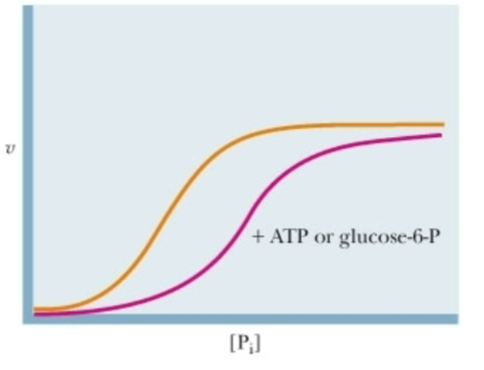 Glycogen phosphorylase: ATP and glucose-6-phosphate is a________ | back 200 feedback inhibitor |
front 201 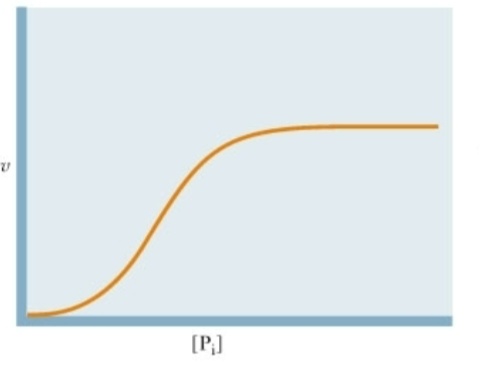 Glycogen phosphorylase: The response to the concentration of the substrate_____- | back 201 -(Pi) |
front 202 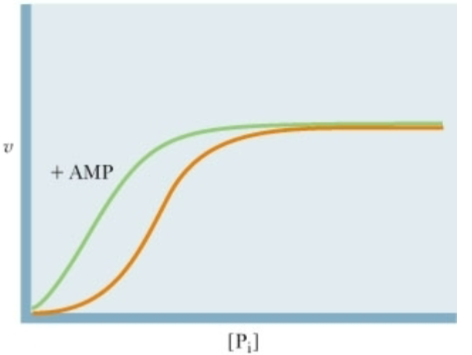 Glycogen phosphorylase: ____is a positive effector that binds at the same site as ATP | back 202 AMP |
front 203 T-state is stabilized by____ and ________. (high ATP signals no need for energy) | back 203 ATP and G6P |
front 204 R-state: stabilized by______. (low ATP signals a need for energy) | back 204 AMP |
front 205 The breakdown of a molecule directly using phosphate | back 205 Phosphorolysis |
front 206 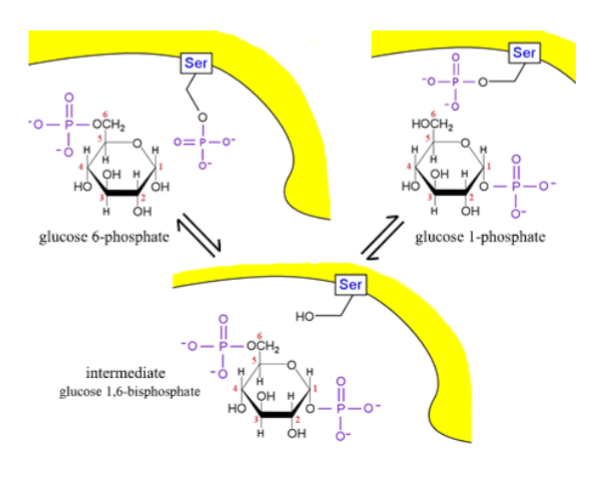 What type of reaction is this? | back 206 Isomerization because a phosphate group is being relocated from C1 to C6 |
front 207 Glucose units are activated for transfer by formation of sugar nucleotides | back 207 Glycogen synthesis-I |
front 208 What are other examples of activation? | back 208 aminoacyl-AMP, Fatty acyl-AMP, etc. |
front 209 Glycogenin is a protein that | back 209 forms the core of a glycogen particle |
front 210 In glycogen synthase, what gets kicked off? | back 210 the tag (UDP) |
front 211 Glycogen synthase is allosterically regulated by: increase in G6P, when G6P is high, | back 211 ATP levels are high, and AMP is low |
front 212 Glycogen synthase is less active in the______form and more active in the______form | back 212 -phosphorylated -dephosphorylated |
front 213 90% of glycogen cleaved into G1P which is | back 213 isomerized into glucose-6-phosphate |
front 214 10% are the branched residues that are hydrolyzed into glucose can than be | back 214 phosphorylated into G6P |
front 215 The complete oxidation of G6Pvia glycolysis, TCA cycle and oxidative phosphorylation yields 38 molecules of ATP which means its effciency of storage is | back 215 97% |
front 216 what are the 3 fates of G6P? | back 216 -glycolysis -conversion to free glucose into blood stream (liver) |
front 217 Glucose-1-phosphate cannot escape the cell because | back 217 it allows cell time to determine needed conversion |
front 218 Why galactose and glycogen metabolism involve UDP? | back 218 UDP: conenzyme-like carrier of hexose groups |
front 219 If O2 levels are reestablished in the muscle, | back 219 lactate can be converted to pyruvate |
front 220 What are the three important hormones? | back 220
|
front 221 What is the allosteric regulation for glycogen synthase? | back 221 G6P(makes glycogen) |
front 222 What is the allosteric regulation for glycogen phosphorylase? | back 222 ATP (breakdown glycogen) |
front 223 If there is excess sugar and energy, there is an increase in G6P, ATP, and a decrease in AMP. This result in | back 223 making glycogen |
front 224 If there is low sugar but a energy demand, there is a decrease of G6P, ATP, and an increase in AMP. This cause the | back 224 breakdown of glycogen |
front 225 Insulin (high blood sugar) cAMP________ and stores glycogen and fat | back 225 decreases |
front 226 Epinephrine(adrenalin)_______cAMP and give fight or flight signals as well as mobilizing glycogen | back 226 increases |
front 227 Glucagon(low blood sugar) cAMP is ______ in the ______, and it mobilizes liver glycogen and sends glucose to brain | back 227 -increased -liver |
front 228 Insulin is secreted as a response to | back 228 increased glucose levels in blood |
front 229 Is a peptide hormone produced from beta-cells in the pancreas | back 229 Insulin |
front 230 The body utilizes different pathways that use glucose to | back 230 deplete the high concentration of glucose |
front 231 When lots of glucose is about to be needed, what can aid in producing it? | back 231 epinephrine |
front 232 Where is glucagon released from? | back 232 α-cells in the pancreas and travels to liver |
front 233 Where is epinephrine released from? | back 233 adrenal gland |
front 234 Glucagon and epinephrine inhibit glycogen synthase and activate | back 234 glucogen phosphorylase |
front 235 The end goal of hormone -activated enzymatic cascade has an end goal of | back 235 activation of glycogen phosphorylase |
front 236 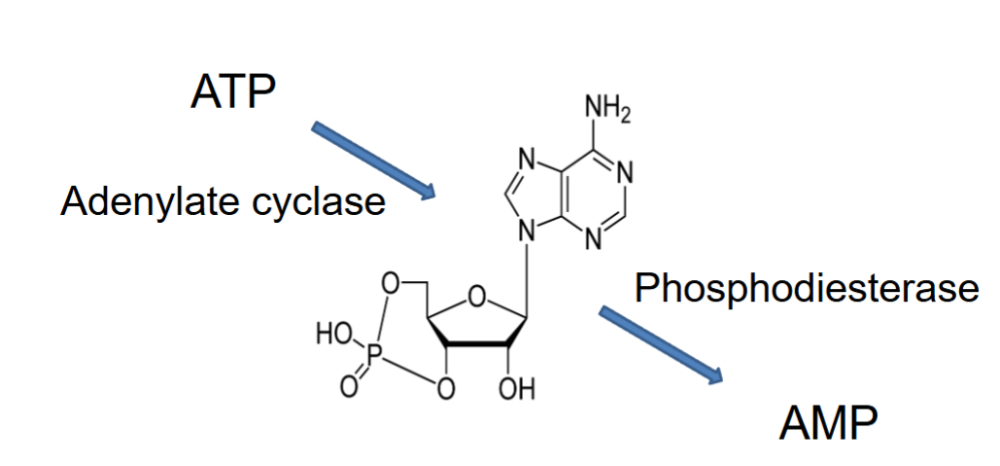 What structure is this? | back 236 cAMP |
front 237 Epinephrine activates glycogen_____ and inhibits glycogen_______. | back 237 -breakdown -synthesis |
front 238 Glucogen stimulates liver to release glucose from | back 238 glycogen stores into the blood stream |
front 239 Exercise--> low blood glucose-> | back 239 high cAMP |
front 240 exercise requires lots of | back 240 ATP |
front 241 Glucagon specifically targets the | back 241 liver |
front 242 Low blood sugar-->glucagon secreted by pancreas--> | back 242 cAMP levels increase in liver |
front 243 Liver's response to LBG:
| back 243 5. Activation of FBPase-2 and inactivation of PFK-2 6. Decreased F2,6P 7. inhibition of PFK and activation of FBpase 8. Increased GNG |
front 244 Excess food+ no exercise--> | back 244 high blood glucose |
front 245 Some glucose will be retained as glycogen but only 1-2% is stored, the rest must be dealt by the | back 245 liver |