Instructions for Side by Side Printing
- Print the notecards
- Fold each page in half along the solid vertical line
- Cut out the notecards by cutting along each horizontal dotted line
- Optional: Glue, tape or staple the ends of each notecard together
GENERAL PHYSICS #2 LAB FINAL
front 1 How many locations can you place a lens between the object and a screen to create a focused image? | back 1 Two |
front 2 How many different lenses did you use in the lab? | back 2 Two: Concave/Convex |
front 3 Faraday's law of induction tells us that the EMF induced in a circuit is proportional to the: | back 3 Rate of change of magnetic flux through the circuit |
front 4 Lenz's Law tells us that the induced current in the wire loop is such to produce a magnetic field which: | back 4 opposes the change in the magnetic source which caused the induced current |
front 5 In this Lab 3 we will be looking at standing waves on a string, what property are we changing to change the number of nodes in the standing wave? | back 5 We change the frequency of the oscillator |
front 6 In last week's lab we made 3 graphs with period (T) and length (L) of the pendulum. Which graph shows a proportional relationship? | back 6 T2 vs L |
front 7 Which variable had a large effect on the period of a pendulum? | back 7 length |
front 8 Which picture shows a second harmonic standing wave on a string? | back 8 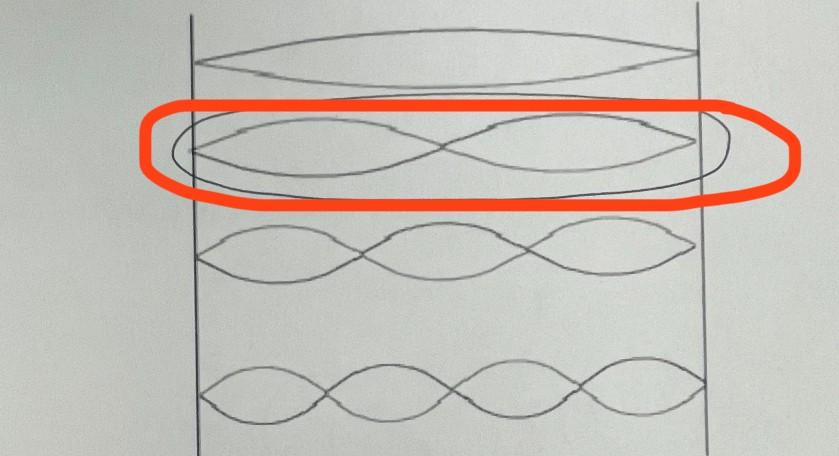 Two loops |
front 9 Higher frequency sound waves will have __________ velocity compared to lower frequency sound waves. | back 9 the same |
front 10 To measure the wavelength of sound waves we will: | back 10 Move the microphone back and forth |
front 11 In last week's lab (Week 2) when we doubled the tension in the string. | back 11 The wave velocity approximately went up by 40% |
front 12 Other than tension, what determines the speed of a wave on a string? | back 12 string density |
front 13 In today's lab (Week 5) we will investigate electric field-lines and Gauss' Law using: | back 13 A computer program |
front 14 For the Gauss' law part of the lab we will | back 14 Count the number of field lines entering and exiting a "loop" |
front 15 If a pair of charges gets 4 times closer than they were before (say, from 80 cm apart to 20 cm apart), by what factor does the force increase? | back 15 16 |
front 16 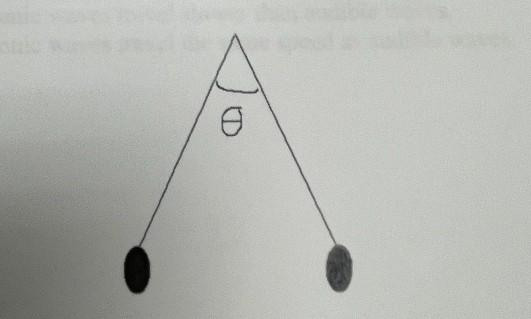 What can you definitely conclude must be true about the charges balls shown in the diagram? | back 16 They have like sign charges |
front 17 According to the lab manual, the prelab will investigate the charge on | back 17 Scotch Tape |
front 18 In the last part of this lab we will test Coulomb's law in a simulation by: | back 18 Determining the force between two charged balls |
front 19 Roughly speaking, how long is the wavelength of a 40 kHz sound wave? | back 19 8.5 mm |
front 20 How does the speed of sound coming out of the 40 kHz transducers differ from the velocity of audible sound frequencies? | back 20 The ultrasonic waves travel the same speed as audible waves |
front 21 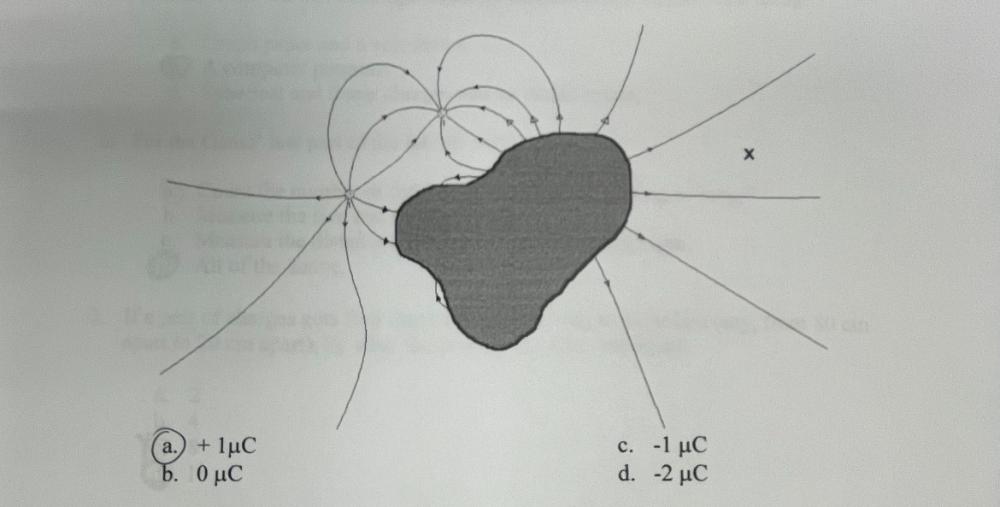 Charges shown have +/- μC of charge. How much charge is hidden behind the locked out region? | back 21 + 1 μC |
front 22 How would the total number of field lines entering the blocked out region (that is number entering minus number exiting) change if another positive charge was placed at the position marked with a "X?" | back 22 The total number of field lines would remain the same |
front 23 What analogy is used to describe charge leaving a capacitor in the preliminary questions? | back 23 candy in a candy jar |
front 24 The function that describes the discharge of a capacitor is _______ with time. | back 24 exponential |
front 25 Which analogy was used in the Ohm's Law lab report to describe voltage, current and resistance: | back 25 Water flowing through a pipe |
front 26 What type of relationship does Ohm's Law predict for voltage and current through a resistor? | back 26 Proportional |
front 27 You have 2 capacitors each of which is hooked up to a different resistor. The first capacitor discharges in 5 seconds when hooked up to the first resistor. The second capacitor discharges in 1 second when hooked up the second resistor. Which scenario is NOT possible? | back 27 The second resistor is larger and the second capacitor is smaller, τ =Rc |
front 28 A capacitor is being discharged through a resistor. After one second, half of the charge is left in the capacitor. How much of the charge is left after 2 seconds. | back 28 1/4 of it |
front 29 Which of the following materials is "ohmic" (obeys Ohm's Law), based on your laboratory results? | back 29 a resistor |
front 30 A light bulb heats up as current is passing through it. Compared to its resistance when cold, the resistance when hot is | back 30 greater |
front 31 In this lab, the ultimate objective is to measure the magnetic field of | back 31 the Earth |
front 32 When the magnetic field of the Earth and the coil cancel out, the compass needle will | back 32 point halfway between north and south |
front 33 The horizontal component of the magnetic field of the Earth (what we measured) inside the physics labs is about: | back 33 0.25 G |
front 34 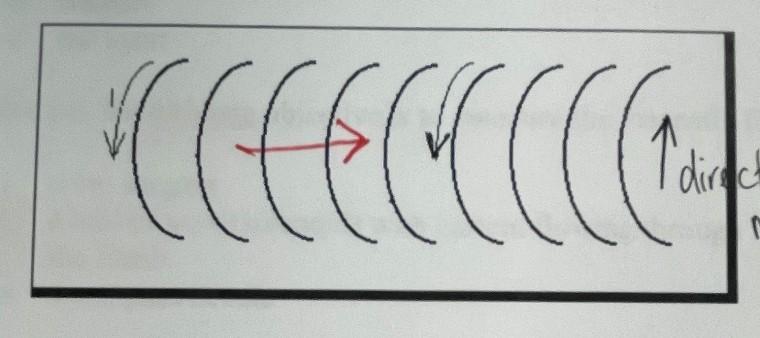 Indicate the direction of the magnetic field inside the solenoid (The heads of the arrows shown below and the part of the circular wires next to them are "closer" to you than the top and bottom parts of the circular wires shown.) | back 34 -----------> |
front 35 In today's lab (Week 9) we will study how the magnetic field inside a "long" Slinky depends on: (circle all that apply) | back 35 the current in the Slinky the density of turns in the Slinky |
front 36 In today's lab (Week 9) we will determine the value of which constant? | back 36 μ0 |
front 37 Which law describes only the direction of an induced current? | back 37 Lenz's Law |
front 38 Which law describes the magnitud e of an induced electric potential? | back 38 Faraday's Law |
front 39  According to the textbook the magnetic field inside a slinky is B = μ0 n I. If you take measurements of magnetic field at various turn densities (always using two amperes of current) and get the following graph and fit equation: What is your experimentally measured μ0 based on the fit equation (y = 0.00224*x + 0.0141)? | back 39 1.12 x 10-6 = μ0 Divide the slope of the line (00.224) by the current (2) to find μ0 |
front 40 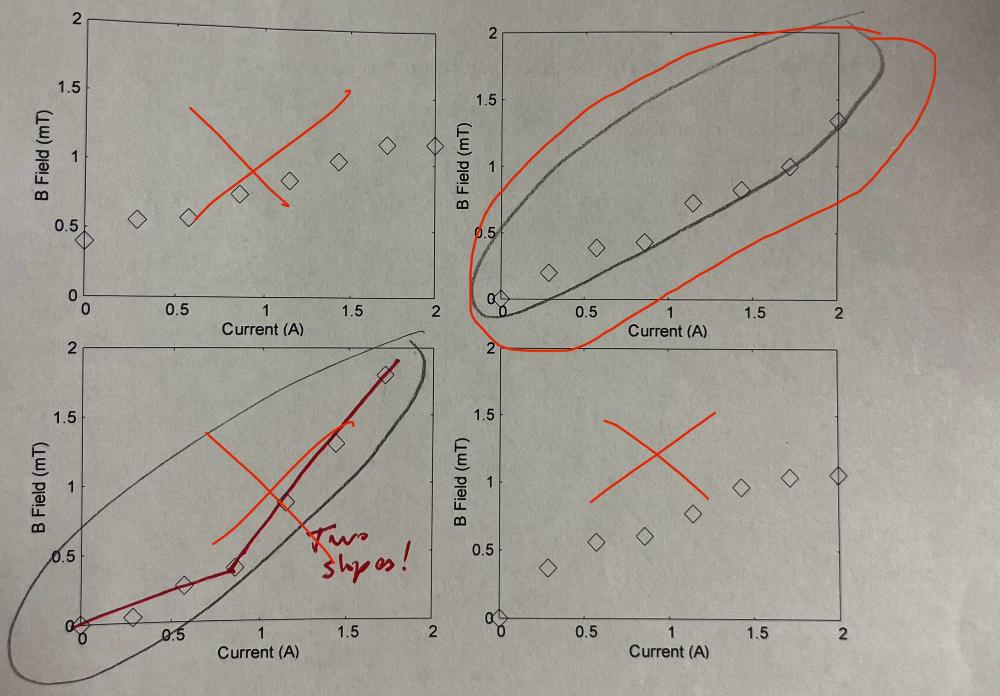 According to the textbook the magnetic field inside a slinky is B = μ0 n I. Which graph(s) support(s) this claim, based on their slope and intercept values? (Pick as many as you like) | back 40 ONLY THE 1 LINEAR GRAPH (top right hand corner) |