Print Options

Card layout: ?

← Back to notecard set|Easy Notecards home page

Instructions for Side by Side Printing
  1. Print the notecards
  2. Fold each page in half along the solid vertical line
  3. Cut out the notecards by cutting along each horizontal dotted line
  4. Optional: Glue, tape or staple the ends of each notecard together
  1. Verify Front of pages is selected for Viewing and print the front of the notecards
  2. Select Back of pages for Viewing and print the back of the notecards
    NOTE: Since the back of the pages are printed in reverse order (last page is printed first), keep the pages in the same order as they were after Step 1. Also, be sure to feed the pages in the same direction as you did in Step 1.
  3. Cut out the notecards by cutting along each horizontal and vertical dotted line
To print: Ctrl+PPrint as a list

115 notecards = 29 pages (4 cards per page)

Viewing:

genetics test 7-9

front 1

1) The process by which Pneumococcus transfers DNA between living type RII and heat-killed type SIII cells is known as

  1. A) transduction
  2. B) ligation
  3. C) conjugation
  4. D) replication
  5. E) transformation

back 1

transformation

front 2

2) Avery, Macleod, and McCarty expanded on Griffith's experiment to prove that DNA is the hereditary molecule required for transformation. What treatment of the heat-killed SIII bacteria

extract resulted in the mouse LIVING?

  1. A) Use of the control group (null treatment), in which all components are intact B) Destruction of type SIII proteins with protease
  2. C) Destruction of type SIII DNA with DNase
  3. D) Destruction of type SIII RNA with RNase
  4. E) Destruction of type SIII lipids and polysaccharides

back 2

Destruction of type SIII DNA with DNase

front 3

3) In the Hershey-Chase experiment, bacteriophages were produced in either 32P-containing or 35S-containing medium. Where were these isotopes eventually detected when the radioactively-labeled bacteriophages were introduced to a fresh bacterial culture?

  1. A) The 32P was associated with the culture medium and 35S was associated with the phage

particles.

  1. B) Both 32P and 35S were associated with the bacterial cells.
  2. C) Both 32P and 35S were associated with the phage particles.
  3. D) The 32P was associated with the bacterial cells and 35S was associated with the phage particles.
  4. E) The 32P was associated with the culture medium and 35S was associated with the bacterial cells.

back 3

D) The 32P was associated with the bacterial cells and 35S was associated with the phage particles.

front 4

4) Which of the following are classified as pyrimidines?

  1. A) adenine and guanine
  2. B) adenine and uracil
  3. C) guanine and cytosine
  4. D) adenine and thymine
  5. E) thymine and cytosine

back 4

E) thymine and cytosine

front 5

5) What type of bond is formed between the hydroxyl group of one nucleotide and the phosphate group of an adjacent nucleotide, forming the sugar-phosphate backbone of DNA?

  1. A) hydrogen bond
  2. B) glycosidic bond
  3. C) phosphodiester bond
  4. D) ionic bond
  5. E) ester linkage

back 5

C) phosphodiester bond

front 6

6) What is the difference between a nucleotide and a nucleoside?

  1. A) Nucleosides contain only deoxyribose sugars.
  2. B) Nucleotides are involved in eukaryotic DNA replication, while nucleosides are used in bacterial DNA replication.
  3. C) A nucleoside with a phosphate ester linked to the sugar is a nucleotide.
  4. D) Nucleotides are found in DNA, while nucleosides are found in RNA.
  5. E) Nucleosides are purines, while nucleotides are pyrimidines.

back 6

C) A nucleoside with a phosphate ester linked to the sugar is a nucleotide.

front 7

7) What is the difference between a ribonucleic acid and a deoxyribonucleic acid?

  1. A) Deoxyribonucleic acids have a 2'H instead of the 2'OH found in ribonucleic acids.
  2. B) Deoxyribonucleic acids have fewer oxygen groups and so are found only in monophosphate form in the cell, while ribonucleic acids have more oxygen groups and are found only in triphosphate forms.
  3. C) Deoxyribonucleic acids are used to build nucleic acid strands, while ribonucleic acids are used exclusively in enzymatic reactions.
  4. D) Ribonucleic acid include A, T, G, and C, while deoxyribonucleic acids include A, U, G, and C.
  5. E) Ribonucleic acids have a 3'OH, while deoxyribonucleic acids have a 3'H.

back 7

A) Deoxyribonucleic acids have a 2'H instead of the 2'OH found in ribonucleic acids.

front 8

8) What types of bonds are formed between complementary DNA bases?

  1. A) phosphodiester bonds
  2. B) hydrogen bonds
  3. C) ionic bonds
  4. D) covalent bonds
  5. E) glycosidic bonds

back 8

B) hydrogen bonds

front 9

9) If there is 24% guanine in a DNA molecule, then there is cytosine.

  1. A) 48%
  2. B) 52%
  3. C) 24%
  4. D) 26%
  5. E) Not possible to determine

back 9

C) 24%

front 10

10) In a single strand of DNA, what fraction of the nucleotides in a molecule are cytosine and thymine (% C and % T added together)?

  1. A) 25%
  2. B) 75%
  3. C) 100%
  4. D) 50%
  5. E) It depends on the DNA sequence

back 10

E) It depends on the DNA sequence

front 11

11) If complementary DNA strands were arranged in a parallel manner, what would you expect to see?

  1. A) Complementary nucleotides would line up normally; but fewer hydrogen bonds would form,

so the strands could be more easily pulled apart.

  1. B) The phosphodiester backbones would be too close and repel one another.
  2. C) There would be no discernable difference between DNA strands aligned in a parallel versus

an antiparallel manner.

  1. D) Complementary nucleotides would be attracted to each other, forming ionic bonds that

would make the helix stable but not uniform in width.

  1. E) Some regions of the two strands may form atypical hydrogen bonds, but the overall structure

of the two DNA strands would not be stable.

back 11

E) Some regions of the two strands may form atypical hydrogen bonds, but the overall structure of the two DNA strands would not be stable.

front 12

12) In their famous experiment, which of the following would Meselson and Stahl have observed after one cycle of replication in 14N medium if DNA replication were CONSERVATIVE?

  1. A) An equal number of DNA molecules containing two 15N-DNA strands and DNA molecules containing two 14N-DNA strands
  2. B) DNA molecules containing one strand of 15N-DNA and one strand of 14N-DNA
  3. C) A mix of DNA molecules corresponding to A and B
  4. D) DNA molecules containing two 14N-DNA strands only
  5. E) DNA molecules containing two 15N-DNA strands only

back 12

A) An equal number of DNA molecules containing two 15N-DNA strands and DNA molecules containing two 14N-DNA strands

front 13

13) A portion of one strand of DNA has the sequence 5′ AATGGCTTA 3′. If this strand is used as a template for DNA replication, which of the following correctly depicts the sequence of the newly synthesized strand in the direction in which it will be synthesized?

  1. A) 5′ TAAGCCATT 3′
  2. B) 5′ TTACCGAAT 3′
  3. C) 3′ TTACCGAAT 5′
  4. D) 5′ AATGGCTTA 3′
  5. E) 3′ AATGGCTTA 5′

back 13

C) 3′ TTACCGAAT 5′

front 14

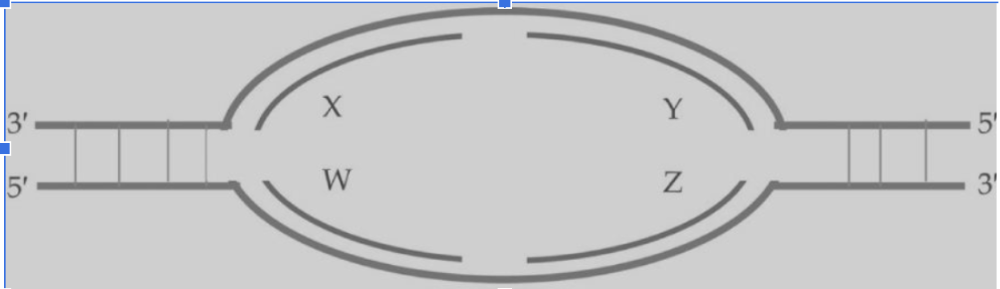
14) Based on the following replication bubble, which of these statements is true?

  1. A) W and Z are leading strands, X and Y are lagging strands
  2. B) X and Y are leading strands, W and Z are lagging strands
  3. C) W and Y are leading strands, X and Z are lagging strands
  4. D) X and Z are leading strands, W and Y are lagging strands
  5. E) X and W are leading strands, Y and Z are lagging strands

back 14

C) W and Y are leading strands, X and Z are lagging strands

front 15

15) The following represents a DNA strand in the process of replication. The bottom sequence is that of DNA strand with polarity indicated and the top sequence represents the RNA primer.

GGGGCCUUU

5′ AAATCCCCGGAAACTAAAC 3′

Which of the following will be the first DNA nucleotide added to the primer?

  1. A) A
  2. B) T
  3. C) C
  4. D) G
  5. E) U

back 15

A) A

front 16

16) What is one difference between DNA replication in bacteria versus eukaryotes?

  1. A) Eukaryotic chromosomes have many origins of replication, while bacteria have only one

origin of replication.

  1. B) Bacterial chromosomes are replicated bi-directionally, while eukaryotic chromosomes are

replicated in one direction.

  1. C) The process is identical in bacterial and eukaryotic DNA replication.
  2. D) Eukaryotic chromosomes have many origins of replication and replicate bi-directionally,

while bacteria have only one origin of replication and replicate uni-directionally.

  1. E) Eukaryotic chromosomes are replicated bi-directionally, while bacterial chromosomes are

replicated in one direction.

back 16

A) Eukaryotic chromosomes have many origins of replication, while bacteria have only one

origin of replication.

front 17

17) What is the DNA replication fork?

  1. A) It is the DNA bound inside the DNA polymerase active site.
  2. B) It is the site where the DNA helix opens to two single DNA strands.
  3. C) It is the DNA strand that wraps around DNA polymerase and serves as the template for the

lagging strand.

  1. D) It is the binding site on the chromosome for DNA polymerase.
  2. E) It is the site where the leading and lagging strands meet on chromosome.

back 17

B) It is the site where the DNA helix opens to two single DNA strands.

front 18

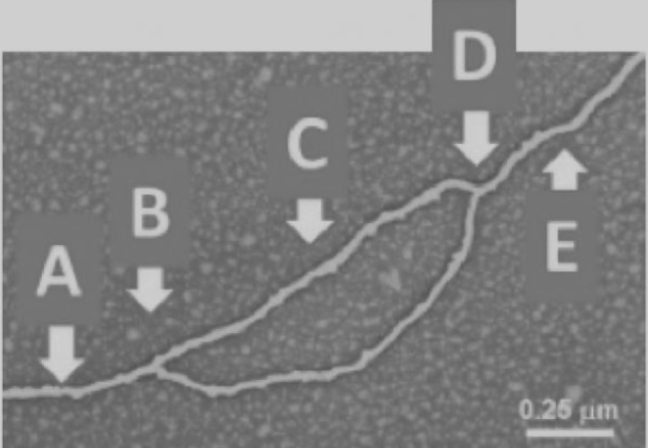
18) Which arrow(s) point(s) to the location of helicase in the diagram shown?

    1. A
    2. B
    3. C
    4. A and E
    5. B and D

back 18

B and D

front 19

19) Why would DNA synthesis occur in both directions from an origin of replication?

  1. A) DNA is a double helix and DNA synthesis is 5' to 3'.
  2. B) Leading strands extend from one side of the origin while lagging strand extends from the other side of the origin.
  3. C) It allows DNA strands to overlap when reaching another origin of replication.
  4. D) Replication-associated proteins bind at two replication forks.
  5. E) DNA direction synthesis is random and sometimes extends in one direction from an origin of replication and sometimes in the other direction.

back 19

D) Replication-associated proteins bind at two replication forks.

front 20

20) Why do origins of replication in various bacteria have conserved DNA consensus sequences?

  1. A) The consensus sequence allows the origin to wrap into a circle and recruit replication

initiation proteins.

  1. B) Origins need to be recognized by replication initiation proteins to open up their AT-rich

regions.

  1. C) It is more efficient to use the same sequence multiple times in different genomes than to

change it.

  1. D) Consensus sequences are found throughout bacterial genomes and so would be found at the

origin as well.

  1. E) Fewer mutations in the DNA occur at the very beginning of replication at the origin, hence

why they are conserved as consensus sequences.

back 20

B) Origins need to be recognized by replication initiation proteins to open up their AT-rich regions.

front 21

21) If Single-Stranded Binding protein (SSB) is NOT present during DNA replication, what would you expect to see?

  1. A) SSB carries the helicase protein to the open region of DNA, so hydrolysis and strand separation will not occur.
  2. B) Helicase activity is inhibited, so DNA strands cannot be separated.
  3. C) SSB prevents reannealing of the separated strands, so strands would quickly reanneal and

DNA replication cannot proceed.

  1. D) The DNA cannot bend, so hydrogen bonds in the 13-mer region of oriC remain intact.
  2. E) The replisome complex would not assemble on the oriC region.

back 21

C) SSB prevents reannealing of the separated strands, so strands would quickly reanneal and DNA replication cannot proceed.

front 22

22) DNA helicase inhibitors are well studied as potential drug targets. What would you expect to see if DNA helicase activity is inhibited?

  1. A) The replisome complex would not assemble on the oriC region.
  2. B) Helicase prevents reannealing of the separated strands, so strands would quickly reanneal

and DNA replication cannot proceed.

  1. C) Helicase catalyzes ATP hydrolysis and DNA strands separation, so the helix cannot be

unwound and strands will not separate.

  1. D) Helicase carries the SSB protein to the open region of DNA, so hydrolysis and strand

separation will not occur.

  1. E) The DNA cannot bend, so hydrogen bonds in the 13-mer region of oriC remain intact.

back 22

C) Helicase catalyzes ATP hydrolysis and DNA strands separation, so the helix cannot be unwound and strands will not separate.

front 23

23) What is required for DNA polymerase to initiate DNA strand synthesis?

  1. A) a short DNA primer synthesized by the enzyme primase
  2. B) ATP and a short RNA primer synthesized by the enzyme topoisomerase
  3. C) a short RNA primer synthesized by the enzyme primase
  4. D) ATP and a short DNA primer synthesized by the enzyme topoisomerase
  5. E) DNA polymerase initiates DNA strand synthesis without requiring any additional enzymes.

back 23

C) a short RNA primer synthesized by the enzyme primase

front 24

24) Why are leading and lagging strand primers removed rather than joined with Okazaki fragments?

  1. A) They lack the 3' OH that would permit them to be covalently linked to the Okazaki fragments.
  2. B) The primers do not hydrogen bond to the template strand correctly.
  3. C) They have to be removed for leading and lagging strand synthesis to begin.
  4. D) Primers are too short to efficiently bind to Okazaki fragments.
  5. E) They contain nucleotides with 2'OH groups, and are targeted for excision by DNA

Polymerase.

back 24

E) They contain nucleotides with 2'OH groups, and are targeted for excision by DNA Polymerase.

front 25

25) You identify a cell in which DNA polymerase III is functional, but it seems to exhibit extremely low processivity. This is likely a defect in what structure?

  1. A) the t proteins
  2. B) the pol III holoenzyme
  3. C) the topoisomerase enzyme
  4. D) the clamp loader
  5. E) the sliding clamp

back 25

E) the sliding clamp

front 26

26) The extraordinary accuracy of the DNA polymerase III enzyme lies in its ability to "proofread" newly synthesized DNA, a function of the enzyme's _____.

  1. A) 3′-to-5′ polymerase activity
  2. B) 5′-to-3′ polymerase activity
  3. C) 3′-to-5′ exonuclease activity
  4. D) 3′-to-5′ helicase activity
  5. E) 5′-to-3′ exonuclease activity

back 26

C) 3′-to-5′ exonuclease activity

front 27

27) What is the purpose of the 3'-to-5' exonuclease activity of DNA Polymerase?

  1. A) Removing mismatched nucleotides at the polymerase active site increases the rate of

synthesis in the 5' to 3' direction.

  1. B) Remove mismatched nucleotides in the newly synthesized strand.
  2. C) Degrade excessive nucleotides on Okazaki fragments.
  3. D) Some polymerases do not have exonuclease activity.
  4. E) Remove mismatched nucleotides in the template strand.

back 27

B) Remove mismatched nucleotides in the newly synthesized strand.

front 28

28) Where would you expect to find telomerase activity?

  1. A) On the lagging strand of DNA in a normal bacterial cell.
  2. B) At the end of a chromosome in a normal healthy eukaryotic body (somatic) cell.
  3. C) At the end of a chromosome in a cancerous eukaryotic body cell.
  4. D) On the leading strand of DNA in a normal bacterial cell.
  5. E) At the centromere of a chromosome in a healthy eukaryotic reproductive cell.

back 28

C) At the end of a chromosome in a cancerous eukaryotic body cell.

front 29

29) Why are telomeres problematic for eukaryotic chromosome replication?

  1. A) The T loop blocks formation of primers on the lagging strand.
  2. B) They are highly repetitive and thus hard to replicate correctly.
  3. C) Telomerase is more error-prone than the normal DNA Polymerase.
  4. D) Maintaining very long telomeres promotes cancer cell formation.
  5. E) Removal of the lagging strand primer leaves a gap in the one of the strand's DNA sequences.

back 29

E) Removal of the lagging strand primer leaves a gap in the one of the strand's DNA sequences.

front 30

30) Which of the following would you find in a Sanger sequencing reaction but not in a polymerase chain reaction?

  1. A) DNA template
  2. B) DNA primer
  3. C) dNTPs
  4. D) DNA polymerase
  5. E) ddNTPs

back 30

E) ddNTPs

front 31

31) Which functional groups have been altered in a ddNTP compared to a dNTP?

  1. A) The ddNTPs have a 2′ OH and a 3′ OH, while dNTPs have a 2′ H and a 3′ H.
  2. B) The ddNTPs have a 2′ H and a 3′ OH, while dNTPs have a 2′ H and a 3′ H.
  3. C) The ddNTPs have a 2′ OH and a 3′ H, while dNTPs have a 2′ H and a 3′ OH.
  4. D) The ddNTPs have a 2′ H and a 3′ H, while dNTPs have a 2′ OH and a 3′ OH.
  5. E) The ddNTPs have a 2′ H and a 3′ H, while dNTPs have a 2′ H and a 3′ OH.

back 31

E) The ddNTPs have a 2′ H and a 3′ H, while dNTPs have a 2′ H and a 3′ OH.

front 32

32) Which of the following temperature cycles would you expect to see in a standard polymerase chain reaction (from denaturation to annealing to extension)?

  1. A) 75°→ 95° → 45°
  2. B) 95°→ 72° → 95°
  3. C) 95° → 55° → 72°
  4. D) 45°→ 72° → 95°
  5. E) 95°→ 72° → 55°

back 32

C) 95° → 55° → 72°

front 33

33) Why are next generation DNA sequencing technologies known as sequencing-by-synthesis?

  1. A) The complete DNA strands are synthesized then sequenced.
  2. B) Incorporated nucleotides are determined while they are being added to a growing DNA strand.
  3. C) Numerous synthesized fragments of DNA are sequenced to determine which nucleotides were incorporated.
  4. D) RNA molecules are synthesized off of the DNA templates and the incorporated nucleotides are then determined.
  5. E) The sequencing occurs during S phase of the cell cycle.

back 33

B) Incorporated nucleotides are determined while they are being added to a growing DNA strand.

front 34

1) What are two distinguishing features of RNA?

  1. A) RNA contains phosphodiester bonds as part of its sugar backbone.
  2. B) RNA has a ribose sugar and uracil nitrogenous base.
    C) RNA contains a pyrophosphate group bound to the ribose
  3. D) RNA forms a double helix of reverse complementary strands.

E) RNA contains a methylated form of thymine.

back 34

B

front 35

2) Which type of research technique was used to track newly synthesized RNA within a eukaryotic cell?

  1. A) in situ hybridization
    B) DNA footprint protection assay
  2. C) pulse-chase
    D) band shift assay
  3. E) Southern blotting

back 35

C

front 36

3) Prokaryotes and eukaryotes produce which of the following types of RNA?

  1. A) siRNA, tRNA, miRNA
    B) mRNA, tRNA, rRNA
  2. C) rRNA, siRNA, snRNA
  3. D) mRNA, gRNA, siRNA
  4. E) miRNA, rRNA, snRNA

back 36

B

front 37

4) You wish to create a mutation that prevents access of RNA polymerase to the gene. Which region of a gene would you mutate?

  1. A) stop codon
    B) promoter sequence
  2. C) start codon
    D) terminator sequence

E) coding region

back 37

B

front 38

5) A gene has acquired a mutation in which the protein product has 50 additional amino acids at the end. Which region of the gene was likely mutated?

  1. A) terminator sequence
  2. B) stop colon
    C) start codon
  3. D) coding region
    E) promoter sequence

back 38

B

front 39

6) What is the role of a promoter region of a gene?

  1. A) Serve as the original region of transcription of a gene.
  2. B) Recruit transcription factors that form the initiation complex.
  3. C) Recruit RNA Polymerase to the transcriptional start site.
    D) Protect the gene from mutations in intergenic regions.
    E) Recruit rho protein to assist in transcription.

back 39

B

front 40

7) Which region(s) of a gene are NOT found within the mRNA transcript?
A) promoter region
B) stop codon
C) termination region

D) promoter and stop codon
E) promoter and termination region

back 40

E

front 41

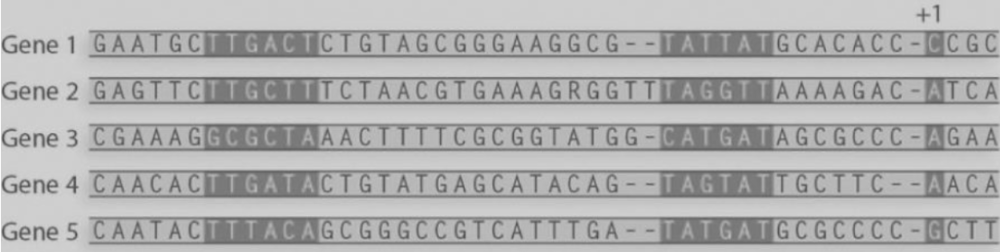
8) What is the consensus sequence for the Pribnow box from these sequences?

  1. A) TTGATA
  2. B) TAGTAT
  3. C) ACCA
  4. D) TATTAT

E) TATGAT

back 41

E

front 42

9) What is the -35 consensus sequence for the following sequences?

  1. A) TTGATA
  2. B) TATTAT
  3. C) ACAA
  4. D) TAGTAT
  5. E) TATGAT

back 42

A

front 43

10) In a given bacterium, transcription of housekeeping genes is normal, but genes involved in nitrogen metabolism, stress, and chemotaxis are disrupted. Which sigma subunit is INTACT?

  1. A) σ28
  2. B) σ32
  3. C) σ54
  4. D) σ70
  5. E) σ35

back 43

D

front 44

11) What is the significance of the open complex when the RNA Polymerase binds the DNA?

A) The RNA Polymerase binds the single-stranded template strand in its active site. B) The RNA Polymerase binds the single-stranded coding strand in its active site.
C) It permits transcription factors to bind to the RNA Polymerase.
D) It assists with propagation of the RNA Polymerase along the DNA helix.
E) The growing RNA molecule can now fit inside the active site of the RNA Polymerase.

back 44

A

front 45

12) Why does rho-dependent transcriptional termination in bacteria require the rho protein?

A) RNA Polymerase stalls at various sites in the gene and rho helps push RNA Polymerase to the end of the gene.
B) The rho protein assists in formation of the termination stem-loop that pauses the RNA Polymerase. C) RNA Polymerase stalls on the termination stem-loop and rho is needed to displace the RNA Polymerase.
D) The rho protein helps unwind the stem-loop structure after the RNA has been released by RNA Polymerase. E) The stem-loop is insufficiently stable to displace the RNA Polymerase by itself and needs rho protein to assist.

back 45

C

front 46

13) You want to design a drug that prevents transcription of eukaryotic mRNAs but does not affect 13) transcription of other RNAs. What enzyme would you target?
A) methyl transferase

  1. B) RNA polymerase II
  2. C) ribozyme
    D) RNA polymerase I
  3. E) RNA polymerase III

back 46

B

front 47

14) What is the type of each eukaryotic protein that primarily transcribes mRNA, tRNA, and rRNA, 14) respectively?

  1. A) RNA Polymerase II, I, III
  2. B) RNA Polymerase III, II, I
  3. C) RNA Polymerase I, II, III
  4. D) RNA Polymerase II, III, I
  5. E) RNA Polymerase I, III, II

back 47

A

front 48

15) What must eukaryotes do to initiate transcription of a gene?

  1. A) Bind RNA Polymerase to displace histone proteins that binding DNA in the promoter region.
  2. B) Bind transcription factors from enhancer sequences to the RNA Polymerase.
  3. C) Recruit general transcription factors to produce an open complex and then recruit RNA

D) Recruit the transcription factors and RNA Polymerase that compose the pre-initiation complex.
E) Open the DNA template and then bind RNA Polymerase at the transcriptional initiation site.

back 48

D

front 49

16) Which assay allows you to identify the exact location of the protein-binding sequence within a promoter?
A) western/immuno blotting

  1. B) in situ hybridization
    C) DNA footprint protection assay
  2. D) Southern blotting

E) pulse-chase assay

back 49

C

front 50

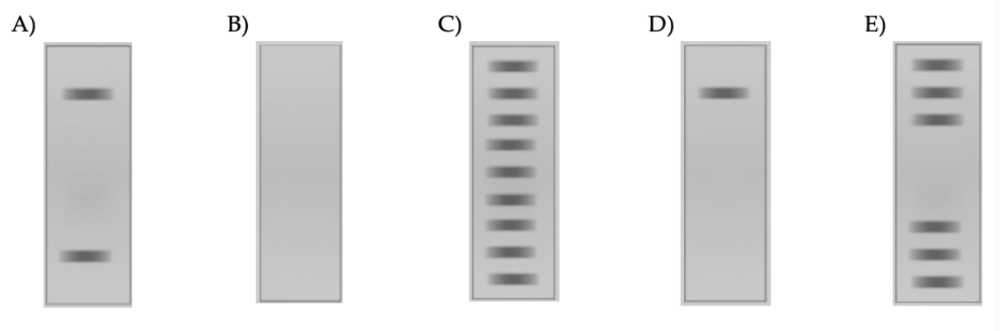
17) Following a DNA footprint protection assay, which banding pattern would you expect to see if you identify a potential promoter region?

back 50

E

front 51

18) RNA polymerase I transcribes which tandem-repeat genes in nucleoli?

A) tRNA
B) rRNA
C) mRNA
D) siRNA
E) all types of RNA

back 51

B

front 52

19) Which of the following is part of a DNA molecule?

  1. A) activator
    B) transcription factor
  2. C) sigma
    D) RNA polymerase

E) promoter

back 52

E

front 53

20) Which of the following statements accurately describes tRNA?

  1. A) Amino acids are bound to the 5' end of the tRNA.
    B) All organisms produce tRNAs corresponding to the 61 amino-acid coding codons.
  2. C) Wobble in the anticodon allows a single tRNA to bind to multiple codons.
    D) Post-transcriptional modifications of tRNAs are not necessary for their function.

E) tRNAs are a variety of lengths and fold into a variety of shapes.

back 53

C

front 54

21) Which of the following are present in your liver cells?

A) promoters of genes expressed in the kidney
B) promoters of genes expressed in the liver
C) enhancers of genes expressed in the liver
D) enhancers of genes expressed in the kidney
E) All enhancers and promoters are present in liver cells

back 54

E

front 55

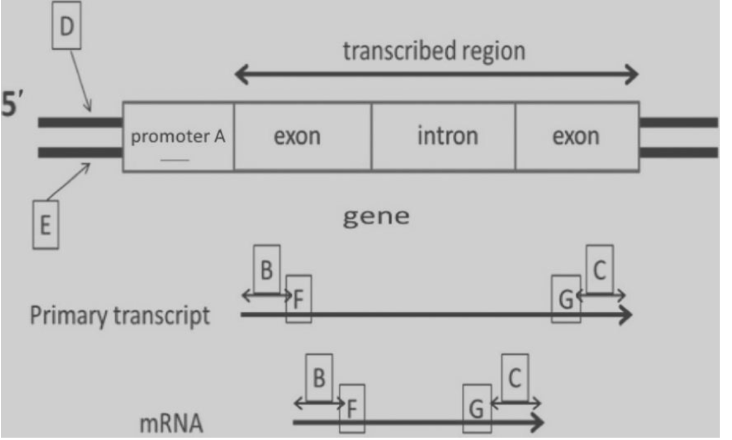
22) If transcription of this gene occurs from left to right in the accompanying diagram, which DNA strand is the CODING (non-template) strand?

  1. A) impossible to determine
  2. B) B
    C) C
  3. D) D
  4. E) E

back 55

D

front 56

23) Using the accompanying diagram, which of the following corresponds to the 3' untranslated region?

  1. A) A
  2. B) B
  3. C) C
  4. D) G
  5. E) F

back 56

C

front 57

24) Which enzyme is required to initiate 5′ capping of eukaryotic mRNA transcripts by removing the terminal phosphate group?

  1. A) phosphodiesterase
  2. B) adenylyl cyclase
    C) guanylyl transferase

D) ribozyme
E) methyl transferase

back 57

C

front 58

25) What defines the end of a eukaryotic gene?

  1. A) Presence of a stop codon leads to RNA polymerase stalling and ceasing transcription. B) A 3' UTR of at least 25 nucleotides recruits an RNase that cleaves the pre-
    C) There is no clearly defined end to eukaryotic genes, unlike for bacterial genes.
    D) A stem-loop structure in the transcriptional terminator region stalls the RNA polymerase.

E) Presence of a polyadenylation signal sequence leads to cleavage of the pre-mRNA.

back 58

E

front 59

26) A cell has a defect in polyadenylation of mRNA. The RNA transcripts encoding which type of protein would NOT be affected by this defect because they are not polyadenylated?

  1. A) transcription factors
  2. B) histone proteins
    C) DNA binding proteins
  3. D) SR proteins
    E) transmembrane proteins

back 59

B

front 60

27) What is the general name for the components of the spliceosome, which removes introns from mRNAs?

  1. A) lariat intronic nucleolar proteins
  2. B) small nuclear ribonucleoproteins
  3. C) small interfering RNA enhancers
    D) branch point adenine recognition proteins
  4. E) microRNA activators

back 60

B

front 61

28) What is the purpose of alternative splicing in eukaryotic cells?

  1. A) Produce multiple polypeptide sequences from a single primary transcript.
  2. B) Increase the number of genes that do not have to contain introns.
    C) Regulate the quantity of any single protein being produced in the cell.

D) Improve the efficiency of transcription and translation.
E) Produce multiple types of tRNAs that can bind to different codons.

back 61

A

front 62

29) The rat α-tropomyosin (α-Tm) gene produces nine different mature mRNA proteins from a single gene using which three "alternative" mechanisms?

  1. A) splicing, promoters, and polyadenylation
  2. B) splicing, start codon, stop codon
    C) 5' cap, self-splicing, polyadenylation
    D) promoters, start codon, poly(A) signal sequences
  3. E) 5' cap, branch points, polyadenylation

back 62

A

front 63

30) What are catalytically active RNAs that can activate processes such as self-splicing?

  1. A) rnzymes

    B) snRNAs
    C) pre-mRNAs
  2. D) ribosomes

E) ribozymes

back 63

E

front 64

31) In humans, the 30S pre-RNA transcript yields three rRNA segments following transcription 31) and RNA cleavage. Which RNA transcripts are generated by the 30S pre-RNA transcript in
E. coli?

  1. A) three rRNAs (5S, 16S, and 23S) and two tRNA transcripts
  2. B) three rRNAs (5.8S, 18S, and 28S) and two tRNA transcripts
  3. C) three rRNAs (5S, 16S, and 23S)
    D) two rRNAs (15S each)
  4. E) two tRNA transcripts

back 64

A

front 65

32) One type of RNA editing involves inserting uracils into edited mRNA with the assistance of which 32) type of specialized RNA?

  1. A) transposon RNA
    B) telomerase RNA
    C) post-transcriptional editor RNA
    D) small nucleolar RNA

E) guide RNA

back 65

E

front 66

1) What features of proteins does two-dimensional gel electrophoresis exploit in order to separate proteins?

  1. A) charge and pH
  2. B) size and charge
  3. C) charge and shape
  4. D) pH and polarity
  5. E) shape and size

back 66

B

front 67

2) The Shine-Dalgarno sequence in bacteria .

  1. A) is a purine-rich consensus sequence found in the 16S rRNA subunit
  2. B) is a pyrimidine-rich consensus sequence found in the 3′ UTR of the mRNA
  3. C) is a region of the tRNA molecule involved in formation of charged tRNAs
  4. D) is a consensus sequence involved in the termination of translation
  5. E) is a purine-rich consensus sequence found in the 5′ UTR of the mRNA

back 67

E

front 68

3) During translation initiation in bacteria, the amino acid on the initiator tRNA is .

  1. A) methionine (Met)
  2. B) IF-1
  3. C) acetylated
  4. D) N-formylmethionine (fMet)
  5. E) added using ATP as the energy source

back 68

D

front 69

4) Identification of ribosomal proteins involves two-dimensional gel electrophoresis, which separates the proteins on the basis of .

  1. A) folded shape
  2. B) mass and charge
  3. C) mass
  4. D) mass, charge, and folded shape
  5. E) charge

back 69

B

front 70

5) How does the eukaryotic initiation complex locate the correct start codon?

  1. A) The initiation complex moves the small ribosomal subunit through the 5′ UTR, scanning for

the start AUG.

  1. B) The pre-initiation complex moves the ribosome through the 3′ UTR, scanning for the Kozak

sequence.

  1. C) The correct start codon is the first ATG encountered downstream of the Kozak sequence.
  2. D) The correct start codon is the formyl-ATG, which will encode for fMet in the protein.
  3. E) The true start codon is the first ATG encountered downstream of the Shine-Dalgarno

Sequence.

back 70

A

front 71

6) What is the cellular location of the stages of translation in bacteria and eukaryotes?

  1. A) nucleoid for bacteria and rough ER for eukaryotes
  2. B) cytosol for bacteria and cytosol, mitochondrion, and plastid for eukaryotes
  3. C) cytosol for bacteria and nucleus for eukaryotes
  4. D) cytosol for bacteria and eukaryotes
  5. E) membrane for bacteria and cytosol and rough ER for eukaryotes

back 71

B

front 72

7) How does the eukaryotic ribosomal small subunit recognize the start codon on the mRNA?

  1. A) It binds an Met-tRNA to the first AUG codon after the Kozak sequence.
  2. B) It undergoes a conformational charge that recruits other proteins when it hydrogens bonds to the correct tri-nucleotide sequence.
  3. C) It binds an Met-tRNA to the first AUG codon it encounters.
  4. D) It wraps the mRNA strand to bring initiation enhancer proteins into the vicinity of the start

codon.

  1. E) It performs an ATP hydrolysis within the small subunit once it encounters a Met-tRNA

already bound to the AUG.

back 72

A

front 73

8) A tRNA in the P site of the ribosome will enter the site after translocation of the ribosome.

A. 3'

B. E

C. A

D. initiation

E. 5’

back 73

B

front 74

9) A portion of an mRNA attached to a ribosome reads:

5′ GACCAUUUUUGA 3′

If a tRNA with a Phenylalanine amino acid attached is in the P site of the ribosome, an empty tRNA present in the E site that delivered which amino acid?

  1. A) aspartic acid
  2. B) tyrosine
  3. C) proline
  4. D) histidine
  5. E) serine

back 74

D

front 75

10) A portion of mRNA attached to a ribosome reads:

5′ GACCAUUUUUGA 3′

In the polypeptide produced, what amino acid will be attached to the amino group of the histidine encoded by this mRNA?

  1. A) proline
  2. B) phenylalanine
  3. C) serine
  4. D) aspartic acid
  5. E) tyrosine

back 75

D

front 76

11) What would you expect to find bound to the stop codon at the A site?

  1. A) an uncharged tRNA
  2. B) a charged tRNA with the anticodon ATC
  3. C) a charged tRNA with the anticodon TAG
  4. D) a translation release factor
  5. E) Nothing binds to a stop codon, which is why the peptide is released.

back 76

D

front 77

12) ) What is necessary for a eukaryotic RNA to be recognized and bound by the small subunit of the ribosome?

  1. A) Formation of the pre-initiation complex before ribosome binding.
  2. B) Sufficiently large 5' UTR for ribosome scanning.
  3. C) Presence of 5' methyl-G cap on the mRNA.
  4. D) Presence of an AUG start codon near the 5' end of the mRNA.
  5. E) Formation of the initiation complex before ribosome binding.

back 77

C

front 78

13) Elongation factors translocate the ribosome in the 3′ direction by a distance of .

  1. A) two codons
  2. B) one codon
  3. C) one nucleotide
  4. D) three codons
  5. E) two nucleotides

back 78

B

front 79

14) A polycistronic mRNA contains multiple .

  1. A) mRNAs
  2. B) Kozak sequences
  3. C) promoters
  4. D) polypeptide-encoding sequences
  5. E) Shine-Dalgarno sequences

back 79

D

front 80

15) Why are eukaryotic mRNAs not polycistronic, unlike some bacterial transcripts?

  1. A) The eukaryotic ribosome must bind to the 5' end of the mRNA and scan, while the bacterial

ribosome can bind to a Shine-Delgarno sequence anywhere in the mRNA.

  1. B) Bacteria couple their translation with transcription, while eukaryotes do not.
  2. C) Eukaryotes have more complex translational machinery than bacteria that is also less efficient

in initiating translation.

  1. D) Eukaryote's genetic code is non-overlapping, and so coding sequences cannot overlap on the

same mRNA.

  1. E) Eukaryotic mRNAs are generally shorter than bacteria mRNAs, and so do not contain

sufficient information to encode additional polypeptides.

back 80

A

front 81

16) What does it mean for two codons to be synonymous?

  1. A) They share two of the same nucleotides in their codon sequence.
  2. B) They occur in equal abundance in an mRNA sequence.
  3. C) They are adjacent on the mRNA.
  4. D) They share one of the same nucleotides in their codon sequence.
  5. E) They encode the same amino acid.

back 81

E

front 82

17) What result would you expect if a mutation eliminates one of the four arms of a tRNA?

  1. A) The tRNA will fit into the A site but will not release the peptide at the P site.
  2. B) The tRNA will be charged with the wrong amino acid.
  3. C) The tRNA will not be recognized by tRNA synthetase and cannot be charged.
  4. D) The tRNA will not be able to undergo traditional complementary base pairing.
  5. E) There will be no effect on function, so long as the anticodon region is intact.

back 82

C

front 83

18) How many different aminoacyl-tRNA synthetases can be found in a given organism's cells?

  1. A) 61
  2. B) 16
  3. C) 20
  4. D) At least 20, or more depending on the organism
  5. E) The number varies greatly depending on the organisms type.

back 83

D

front 84

19) If a tRNA anticodon were mutated such that it no longer performed wobble, what would be the effect on encoded proteins?

  1. A) Many proteins would be truncated.
  2. B) Many proteins would have several mutated amino acids throughout their sequence.
  3. C) The ribosome would be unable to translate proteins.
  4. D) The rate of protein synthesis would be slowed.
  5. E) A different amino acid would consistently replace the amino acid whose tRNA was mutated.

back 84

A

front 85

20) A mutagen has introduced a frame-shift mutation by adding one nucleotide base. Which of the following could be a reversion mutation for this particular mutant?

  1. A) deleting 1 base or adding 3 bases
  2. B) adding 1 base only
  3. C) deleting 1 base or adding 1 base
  4. D) deleting 1 base or adding 2 bases
  5. E) deleting 2 bases only

back 85

D

front 86

21) Which of these choices represents one possible corresponding mRNA sequence that can be transcribed from the following DNA template?

5′ - CTGTATCCTAGCACCCAAATCGCATTAGGAC - 3′

  1. A) 5′ - CTA GCA CCC AAA TCG CAT TAG - 3′
  2. B) 5′ - AUG CGA UUU GGG UGC - 3′
  3. C) 3′ - GGA CAU AGG UAC GUG GGU UUA GCG UAA UCC UG - 5′
  4. D) 5′ - AUG CGA UUU GGG UGC UAG - 3′
  5. E) 5′ - ATG CGA TTT GGG TGC TAG - 3′

back 86

D

front 87

22) Given the following mRNA sequence, what is the amino acid sequence for the corresponding polyp

5′ - AUG CGA UUU GGG UGC UAG - 3′

  1. A) N–Met-Asp-Phe-Gly-Trp–C
  2. B) N–Arg-Phe-Gly-Stop–C
  3. C) 5′-Met-Arg-Phe-Gly-Stop-3′
  4. D) C–Met-Arg-Leu-Glu–N
  5. E) N–Met-Arg-Phe-Gly-Stop–C

back 87

E

front 88

23) Given the following mRNA sequence, which of the following mRNAs would encode a protein with a different sequence of amino acids?

5′ - AUG CAG UUA GCG UGC UAG - 3′

  1. A) 5′ - AUG CAG UUA GCA UGC UAG - 3′
  2. B) 5′-AUGCACUUAGCAUGCUAG-3′
  3. C) 5′ - AUG CAG UUG GCG UGC UAG - 3′
  4. D) 5′ - AUG CAA UUA GCG UGC UAG - 3′
  5. E) 5′ - AUG CAA UUA GCG UGU UAG - 3′

back 88

B

front 89

24) Which mRNA below would code for a premature stop codon from the following amino acid sequence

N—Met-Gln-Leu-Arg-Cys—C

  1. A) 5′ - AUG CAG UUA GCG UGC AAG - 3′
  2. B) 5′ - AUG CAG AUA GCG UGC UAG - 3′
  3. C) 5′ - AUG AAG UUA GCG UGC UAG - 3′
  4. D) 5′ - AUG CAG UAA GCG UGC UAG - 3′
  5. E) 5′ - AUG CAG UUA UUG UGC UAG - 3′

back 89

D

front 90

25) How might a single base INSERTION into the second codon of the coding sequence of a gene affect the amino acid sequence of a protein encoded by the gene?

  1. A) The amino acid sequence would be changed.
  2. B) The mutation may have no effect on amino acid sequence. C) A single extra amino acid would be present in the protein.
  3. D) A single amino acid could change.
  4. E) All of the above are possible outcomes.

back 90

A

front 91

26) You have identified a bacterial protein that has retained the starting fMet in its protein sequence. Which of the following is likely true of this protein?

  1. A) It will be a functional bacterial protein, since all functional proteins must begin with fMet.
  2. B) It will show improper protein sorting and will likely remain in the ER.
  3. C) It is likely nonfunctional, since bacteria use posttranslational cleavage of fMet to make

functional proteins.

  1. D) It will likely form a disulfide bond with a second peptide chain, forming a protein complex.
  2. E) It will be not be able to be chemically modified, so it will be sent to the Golgi for secretion.

back 91

C

front 92

27) How is a tRNA able to recognize its proper mRNA codon?

  1. A) Hydrogen bonding between the ribosomal subunits and the mRNA creates the proper active

site conformation to allow tRNA binding.

  1. B) Ionic bonds between the tRNA and the active site of the ribosomal subunits promote binding

to the mRNA.

  1. C) Appropriate shape of the tRNA allows it to fit onto the extended mRNA strand.
  2. D) Complementary hydrogen bonding between tRNA and mRNA promote binding.
  3. E) The amino acid on the tRNA recognizes the mRNA codon through hydrogen and ionic

bonding.

back 92

D

front 93

28) If the first nucleotide in a codon is mutated to a different nucleotide, what would be the effect on the encoded protein?

  1. A) A silent mutation and no change in the encoded amino acid.
  2. B) No effect as the problem nucleotide would be corrected by RNA editing mechanisms.
  3. C) A missense mutation from one encoded amino acid changing to another.
  4. D) It depends on what the changed nucleotide is.
  5. E) A frameshift mutation for all of the subsequent amino acids in the protein.

back 93

D

front 94

29) In the unlikely event that a tRNA has been charged with the wrong amino acid, which high-fidelity enzyme most likely caused the incorrect charging?

  1. A) aminoacyl synthetase
  2. B) aminoacyl peptidase
  3. C) peptidyl transferase
  4. D) DNA polymerase I
  5. E) DNA polymerase III

back 94

A

front 95

30) If the genetic code were overlapping, how many complete codons would the following sequence en before encountering a stop codon?

5′ - AUGCGAUUAAAGUGC - 3′

  1. A) 10
  2. B) 8
  3. C) 6
  4. D) 13
  5. E) 4

back 95

B

front 96

1) Studies of gene mutation frequencies have shown that

A) mutation are common and adaptive
B) mutations occur only at certain nucleotides and not others
C) mutations affect RNA, but do not change DNA sequence
D) mutation frequencies are consistent between organisms, and each region of DNA is equally susceptible to random mutations
E) mutations are rare, and genomes are generally stable

back 96

E) mutations are rare, and genomes are generally stable

front 97

2) Which type of mutation is possible due to the redundant nature of the genetic code?

  1. A) missense
  2. B) frameshift
  3. C) nonsense
  4. D) splice site
  5. E) silent

back 97

E) silent

front 98

3) Given the sequence of triplet codons: 5′-TAC AAA ATA CAG CGG-3′, which of these sequences represents a nonsense mutation?

  1. A) 5′-TAC AAA ATA CAG AGG-3′
  2. B) 5′-TAC AAG ATA CAG CGG-3′
  3. C) 5′-TAC AAA TAC AGC GGG-3′
  4. D) 5′-TAC AAA ATA CAC CGG-3′

E) 5′-TAG AAA ATA CAG CGG-3′

back 98

5′-TAG AAA ATA CAG CGG-3′

front 99

4) Given the sequence of triplet codons: 5′-TAC AAA ATA CAG CGG-3′, which of these sequences 4) represents a missense mutation?

  1. A) 5′-TAC AAA ATA CAG AGG-3′
  2. B) 5′-TAC AAA ATA CAC CGG-3′
  3. C) 5′-TAC AAG ATA CAG CGG-3′
  4. D) 5′-TAG AAA ATA CAG CGG-3′
  5. E) 5′-TAC AAA TAC AGC GGG-3′

back 99

B) 5′-TAC AAA ATA CAC CGG-3′

front 100

5) Which of the following is able to cause a change in a reading frame?

A) transversion

B) transition
C) missense
D) deletion
E) transversion or missense

back 100

D) deletion

front 101

6) What type of mutation is seen here?
Wild type: 5′-TAC AAA ATA CAG CGG-3′

Mutation: 5′-TAC AAG ATA CAG CGG-3′

  1. A) transversion
  2. B) nonsense
    C) deletion
  3. D) transition
  4. E) insertion

back 101

D) transition

front 102

7) A mutant DNA polymerase that increases the frequency of strand slippage would increase the frequency of which type of mutation?

A) splice site
B) missense
C) transposition
D) transition
E) triplet-repeat expansion

back 102

E) triplet-repeat expansion

front 103

8) Which type of mutation converts a nucleotide to an alternative structure with the same composition but a slightly different placement of rare, less stable hydrogen bonds that cause base-pair mismatch?

  1. A) tautomeric shift
  2. B) deamination
  3. C) transition
  4. D) depurination

E) transversion

back 103

A) tautomeric shift

front 104

9) The fluctuation test allowed Luria and Delbruck to conclude that

A) mutations are common and thus allow natural selection

B) mutations occur in the absence of environmental challenges

C) mutations occur at random in response to environmental challenges

D) chemical mutagens are present even in drinking water

E) none of the above

back 104

  1. B) mutations occur in the absence of environmental challenges

front 105

10) You would like to induce a transversion mutation into a sequence of DNA. Which type of chemical mutagen would give you the best chance of inducing the correct mutation without causing
transition mutations as well?

A) intercalating agent

B) base analog
C) alkylating agent
D) oxidative agent
E) deaminating agent

back 105

D) oxidative agent

front 106

11) Transposons can integrate into the promoters of genes, what is the most likely outcome of such an event?

A) amino acid substitution

B) deamination

C) point mutation

D) altered gene expression

E) frame shift

back 106

D) altered gene expression

front 107

12) You have conducted an Ames test on a given compound. Which of the following would be classified as a positive result on the Ames test?

A) his- strain grows on an his+

B) his+ strain grows on either an his- or an his+ plate.

C) his- strain grows on an his-

D) his+ strain grows on an his-

E) his+ strain grows on an his+ plate.

back 107

C) his- strain grows on an his-

front 108

13) A strain of E. coli is unable to use the UV repair pathway because of an apparent absence of DNA helicase activity. Which UV repair gene is likely mutated in this strain?

A) uvr-B

B) uvr-A

C) uvr-C

D) uvr-D

E) pol I

back 108

D) uvr-D

front 109

14) What phenotype would you expect to see in a strain of E. coli with a mutation in the phr gene?

A) decrease in UV-induced mutations

B) decrease in reversion of base-pair substitution mutations

C) increase in UV-induced mutations

D) increase in the methylation of nucleotide bases

E) decrease in the methylation of nucleotide bases

back 109

C) increase in UV-induced mutations

front 110

15) Which pathway is affected by an inherited mutation in the ATM gene?

A) nucleotide excision repair pathway
B) photoreactivation
C) p53 repair pathway
D) UV repair pathway
E) reactivation repair pathway

back 110

C) p53 repair pathway

front 111

16) Which of these statements best describes gene expression in a damaged cell?

A) In a damaged cell, p53 is high and BAX transcription is active, so Bcl-2 is repressed and apoptosis is induced.
B) In a damaged cell, p53 is low and BAX transcription is inactive, so Bcl-2 represses apoptosis.
C) In a damaged cell, p53 is low and BAX transcription is active, so Bcl-2 is repressed and apoptosis is induced.
D) In a damaged cell, p53 is low and BAX transcription is active, so Bcl-2 represses apoptosis.

E) In a damaged cell, p53 is high and BAX transcription is inactive, so Bcl-2 is activated and apoptosis is induced.

back 111

A) In a damaged cell, p53 is high and BAX transcription is active, so Bcl-2 is repressed and
apoptosis is induced.

front 112

17) Which of the following statements is true of non-homologous end joining (NHEJ)? 17)

A) it is both error-prone and is a double-strand repair pathway
B) it is error-prone
C) it is error-free
D) it is a double-strand repair pathway
E) it utilizes the sister chromatid as a template for repair

back 112

A) it is both error-prone and is a double-strand repair pathway

front 113

18) In eukaryotes, homologous recombination is initiated by

A) Rad51 generating double-stranded DNA breaks

B) ATM signaling double-stranded DNA breaks

C) p53 generating single-stranded DNA breaks

D) RecA, RecB, and RecC generating single-stranded DNA breaks

E) Spo11 generating double-stranded DNA breaks

back 113

E) Spo11 generating double-stranded DNA breaks

front 114

19) If one Holliday junction region is resolved by an NS cut and the other by an EW cut, the resulting chromosomes .

A) are recombinant and carry the combinations A1 and B1 or A2 and B2

B) are nonrecombinant and carry the combinations A1 and B2 or A2 and B1

C) are nonrecombinant and carry the combinations A1 and B1 or A2 and B2

D) areA1 andA2 or B1 andB2

E) are recombinant and carry the combinations A1 and B2 or A2 and B1

back 114

E) are recombinant and carry the combinations A1 and B2 or A2 and B1

front 115

20) Which enzyme is required to mobilize transposons of any type?

A) RNA helicase

B) terminal inverted repeats

C) reverse transcriptase
D) transposase
E) telomerase

back 115

D) transposase