front 5 5) Which of the following provides the best evidence of a
biodiversity crisis?
A) the incursion of a non-native
species
B) increasing pollution levels
C) decrease in
regional productivity
D) high rate of extinction
E) climate change | |
front 6 6) Although extinction is a natural process, current extinctions are
of concern to environmentalists because
A) more animals than ever
before are going extinct.
B) most current extinctions are caused
by introduced species.
C) the rate of extinction is higher than
background extinction rates.
D) current extinction is primarily
affecting plant diversity.
E) None of the options are correct. | |
front 7 7) Which of the following terms includes all of the others?
A)
species diversity
B) biodiversity
C) genetic
diversity
D) ecosystem diversity
E) species richness | |
front 8 8) According to the U.S. Endangered Species Act (ESA), the difference
between an endangered species and a threatened one is that
A) an
endangered species is closer to extinction.
B) a threatened
species is closer to extinction.
C) threatened species are
endangered species outside the U.S. borders.
D) endangered
species are mainly tropical.
E) only endangered species are vertebrates. | |
front 9 9) What term did E. O. Wilson coin for our innate appreciation of
wild environments and living organisms?
A) bioremediation
B)
bioethics
C) biophilia
D) biophobia
E) landscape ecology | |
front 10 10) We should care about loss in biodiversity in the populations of
other species because of
A) biophilia.
B) potential loss of
medicines and other products yet undiscovered from threatened
species.
C) potential loss of genes, some of which may code for
proteins useful to humans.
D) the risk to global ecological
stability.
E) All of the options are correct. | |
front 11 11) The most serious consequence of a decrease in global biodiversity
would be the
A) increase in global warming and thinning of the
ozone layer.
B) potential loss of ecosystem services on which
people depend.
C) increase in the abundance and diversity of
edge-adapted species.
D) loss of sources of genetic diversity to
preserve endangered species.
E) loss of species for use as crops. | |
front 12 12) Which of the following is the most direct threat to
biodiversity?
A) increased levels of atmospheric carbon
dioxide
B) the depletion of the ozone layer
C)
overexploitation of selected species
D) habitat
destruction
E) zoned reserves | |
front 13 13) According to most conservation biologists, the single greatest
threat to global biodiversity is
A) chemical pollution of water
and air.
B) stratospheric ozone depletion.
C)
overexploitation of certain species.
D) alteration or destruction
of the physical habitat.
E) global climate change resulting from
a variety of human activities. | |
front 14 14) What is the biological significance of genetic diversity between
populations?
A) Genes for adaptive traits to local conditions
make microevolution possible.
B) The population that is most fit
would survive by competitive exclusion.
C) Genetic diversity
allows for species stability by preventing speciation.
D)
Isolated populations become more fit.
E) Diseases and parasites
are not spread between separated populations. | |
front 15 15) Introduced species can have deleterious effects on biological
communities by
A) preying on native species.
B) competing
with native species for food or light.
C) displacing native
species.
D) competing with native species for space or
breeding/nesting habitat.
E) All of the options are correct. | |
front 16 16) Overexploitation encourages extinction and is most likely to
affect
A) animals that occupy a broad ecological niche.
B)
large animals with low intrinsic reproductive rates.
C) most
organisms that live in the oceans.
D) terrestrial organisms more
than aquatic organisms.
E) edge-adapted species. | |
front 17 17) How might the extinction of some Pacific Island bats called
"flying foxes" threaten the survival of over 75% of the tree
species in those islands?
A) wetland and riparian
B) open
and benthic ocean
C) desert and high alpine
D) taiga and
second-growth forests
E) tundra and arctic | |
front 18 18) Of the following ecosystem types, which have been impacted the
most by humans?
A) wetland and riparian
B) open and benthic
ocean
C) desert and high alpine
D) taiga and second-growth
forests
E) tundra and arctic | |
front 19 19) The introduction of the brown tree snake in the 1940s to the
island of Guam has resulted in
A) eradication of non-native rats
and other undesirable/pest species.
B) the extirpation of many of
the island's bird and reptile species.
C) a good lesson in
biological control.
D) a new species of hybrids from
crossbreeding with a native snake species.
E) its failure to
compete with native species and its quick elimination from the island. | |
front 20 20) Which of the following examples poses the greatest potential
threat to biodiversity?
A) replanting, after a clear cut, a
monoculture of Douglas fir trees on land that consisted of old-growth
Douglas fir, western cedar, and western hemlock
B) allowing
previously used farmland to go fallow and begin to fill in with weeds
and then shrubs and saplings
C) trapping and relocating large
predators, such as mountain lions, that pose a threat as they move
into areas of relatively dense human populations
D) importing an
Asian insect into the United States to control a weed that competes
with staple crops
E) releasing sterilized rainbow trout to boost
the sport fishing of a river system that contains native brook trout | |
front 21 21) Which of the following is a type of research in which a
conservation biologist would be involved?
A) reestablishing
whooping cranes in their former breeding grounds in North
Dakota
B) studying species diversity and interaction in the
Florida Everglades, past and present
C) studying the population
ecology of grizzly bears in Yellowstone National Park
D)
determining the effects of hunting white-tailed deer in
Vermont
E) All of the options are correct. | |
front 22 22) Which of the following species was driven to extinction by
overexploitation by hunters/fishermen?
A) African
elephant
B) the great auk
C) North American bluefin
tuna
D) flying foxes
E) American bison | |
front 23 23) Which of the following conditions is the most likely indicator of
a population in an extinction vortex?
A) The population is
geographically divided into many populations.
B) The species in
question is found only in small, stable pockets of its former
range.
C) The effective population size of the species falls
below 500.
D) Genetic measurements indicate a loss of genetic
variation over time.
E) The population is connected only by corridors. | |
front 24 24) Review the formula for effective population size. Imagine a
population of 1,000 small rodents. Of these, 300 are breeding females,
300 are breeding males, and 400 are nonbreeding juveniles. What is the
effective population size?
A) 1,000
B) 1,200
C)
600
D) 400
E) 300 | |
front 25 25) If the sex ratio in a population is significantly different from
50:50, then which of the following will always be true?
A) The
population will enter the extinction vortex.
B) The genetic
variation in the population will increase over time.
C) The
genetic variation in the population will decrease over time.
D)
The effective population size will be greater than the actual
population size.
E) The effective population size will be less
than the actual population size. | |
front 26 26) Which of the following life history traits can potentially
influence effective population size (Ne)?
A) maturation
age
B) genetic relatedness among individuals in a
population
C) population size
D) gene flow between
geographically separated populations
E) All of the options are correct. | |
front 27 27) The word triage originated during World War I and was first used
by French doctors in prioritizing patients based on the severity of
their wounds, because there were more wounded soldiers in need of
urgent care than there were resources to treat them. Conservation
biologists have to make similar determinations with degraded
ecosystems. Which of the following is the most important consideration
when it comes to managing for maintenance of biodiversity?
A)
identifying large, high-profile vertebrates first, because steps to
saving them would be most recognized by the public
B) determining
which species is most important for conserving biodiversity as a
whole
C) replanting suitable habitat for fauna
D) assessing
the economic costs and the gains for society
E) maintaining
optimum size of all populations in the ecosystem | |
front 28 28) The primary difference between the small-population approach
(S-PA) and the declining-population approach (D-PA) to biodiversity
recovery is
A) S-PA is interested in bolstering the genetic
diversity of a threatened population rather than the environmental
factors that caused the population's decline.
B) S-PA kicks in
for conservation biologists when population numbers fall below
500.
C) D-PA would likely involve bringing together individuals
from scattered small populations to interbreed in order to promote
genetic diversity.
D) S-PA would investigate and eliminate all of
the human impacts on the habitat of the species being studied for
recovery.
E) D-PA would use recently collected population data to
calculate an extinction vortex. | |
front 29 29) The long-term problem with red-cockaded woodpecker habitat
intervention in the southeastern United States is
A) the only
habitat that can support their recovery is large tracts of mature oak
forest.
B) the mature pine forests in which they live cannot ever
be subjected to forest fire.
C) all of the appropriate
red-cockaded woodpecker habitat has already been logged or converted
to agricultural land.
D) the social organization of the
red-cockaded woodpecker precludes the dispersal of reproductive
individuals.
E) what habitat remains for the red-cockaded
woodpecker does not contain trees suitable for nest-cavity construction. | |
front 30 30) Managing southeastern forests specifically for the red-cockaded
woodpecker
A) required the growth of a dense understory of trees
and shrubs.
B) contributed to greater abundance and diversity of
other forest bird species.
C) caused other species of songbird to
decline.
D) involved strict fire-suppression measures.
E)
involved the creation of fragmented forest habitat. | |
front 31 31) Which of the following is true about the current research
regarding forest fragmentation?
A) Fragmented forests support a
greater biodiversity because they result in the combination of
forest-edge species and forest-interior species.
B) Fragmented
forests support a lesser biodiversity because the forested-adapted
species leave, and only the edge and open-field species can occupy
fragmented forests.
C) Fragmented forests are the goal of
conservation biologists who design wildlife preserves.
D)
Harvesting timber that results in forest fragmentation results in less
soil erosion.
E) The disturbance of timber extraction causes the
species diversity to increase because of the new habitats created. | |
front 32 32) According to the small-population approach, what would be the
best strategy for saving a population from extirpation?
A)
determining the minimum viable population size by taking into account
the effective population size
B) establishing a nature reserve to
protect its habitat
C) introducing individuals from other
populations to increase genetic variation
D) determining and
remedying the cause of its decline
E) reducing the population
size of its predators and competitors | |
front 33 33) Relatively small geographic areas with high concentrations of
endemic species and a large number of endangered and threatened
species are known as
A) endemic sinks.
B) critical
communities.
C) biodiversity hot spots.
D) endemic
metapopulations.
E) bottlenecks. | |
front 34 34) How is habitat fragmentation related to biodiversity
loss?
A) Less carbon dioxide is absorbed by plants in fragmented
habitats.
B) In fragmented habitats, more soil erosion takes
place.
C) Populations of organisms in fragments are smaller, and
thus more susceptible to extinction.
D) Animals are forced out of
smaller habitat fragments.
E) Fragments generate silt that
negatively affects sensitive river and stream organisms. | |
front 35 35) Brown-headed cowbirds utilize fragmented forests effectively
by
A) feeding on the fruits of shrubs that tend to grow at the
forest/open-field interface.
B) parasitizing the nests of forest
birds, and feeding on open-field insects.
C) roosting in forest
trees, and nesting in grassy fields.
D) outcompeting other
songbird species in fragmented communities.
E) using forest cover
to escape from predators in their normal grassland habitat. | |
front 36 36) Which of the following is consistent with forest fragmentation
research?
A) Productivity is the same in both fragmented forests
and forest interiors.
B) Edge communities consistently have low
species diversity.
C) Forest-interior species show declines in
small patch communities.
D) New-edge species that migrate in do
not seem to compete with forest species and often increase
biodiversity in fragmented forests.
E) Species diversity is
always lower in fragmented forests when compared to forest interiors
in the same region. | |
front 37 37) How are movement corridors potentially harmful to certain
species?
A) They increase inbreeding.
B) They promote
dispersion.
C) They spread disease and parasites.
D) They
increase genetic diversity.
E) They allow seasonal migration. | |
front 38 38) Biodiversity hot spots are not necessarily the best choice for
nature preserves because
A) hot spots are situated in remote
areas not accessible to wildlife viewers.
B) their ecological
importance makes land purchase very expensive.
C) a hot spot for
one group of organisms may not be a hot spot for another
group.
D) hot spots are designated by the abiotic factors
present, not the biotic factors.
E) designated hot spots change
on a daily basis. | |
front 39 39) The success with which plants extend their range northward
following glacial retreat is best determined by
A) whether there
is simultaneous migration of herbivores.
B) their tolerance to
shade.
C) their seed dispersal rate.
D) their size.
E)
their growth rate. | |
front 40 40) As the climate changes because of global warming, species' ranges
of plants in the Northern Hemisphere may move northward, using
effective reproductive adaptations to disperse their seeds. The trees
that are most likely to avoid extinction in such an environment are
those that
A) have seeds that are easily dispersed by wind or
animals.
B) have thin seed coats.
C) produce
well-provisioned seeds.
D) have seeds that become viable only
after a forest fire.
E) disperse many seeds in close proximity to
the parent tree. | |
front 41 41) If global warming continues at its present rate, which biomes
will likely take the place of the coniferous forest (taiga)?
A)
tundra and polar ice
B) temperate broadleaf forest and
grassland
C) desert and chaparral
D) tropical forest and
savanna
E) chaparral and temperate broadleaf forest | |
front 42 42) Which of the following investigations would shed the most light
on the future distribution of organisms in temperate regions that are
faced with climate change?
A) Remove, to the mineral soil, all of
the organisms from an experimental plot and monitor the colonization
of the area over time in terms of both species diversity and
abundance.
B) Look at the climatic changes that occurred since
the last ice age and how species redistributed as glaciers melted,
then make predictions on future distribution in species based on past
trends.
C) Compare and contrast the flora and fauna of
warm/cold/dry/wet climates to shed light on how they evolved to be
suited to their present-day environment.
D) Quantify the impact
of humankind's activities on present-day populations of threatened and
endangered species to assess the rate of extirpation and
extinction.
E) There is no scientific investigation that can help
make predictions on the future distribution of organisms. | |
front 43 43) Burning fossil fuels releases oxides of sulfur and nitrogen.
These air pollutants can be responsible for
A) the death of fish
in lakes.
B) precipitation with a pH as low as 3.0.
C)
calcium deficiency in soils.
D) direct damage to plants by
leaching nutrients from the leaves.
E) All of the options are correct. | |
front 44 44) What is the biggest problem with selecting a site for a
preserve?
A) There is always a conflict about use of land set
aside for preservation.
B) Making a proper selection is difficult
because the current environmental conditions of almost any site may
change in the future because of climate change or other
factors.
C) Keystone species are difficult to identify in
potential preserve sites.
D) Only lands that are not useful to
human activities are available for preserves.
E) Most of the best
sites are inaccessible by land transportation, so making roads to them
is often prohibitively expensive. | |
front 45 45) What is a critical load?
A) the amount of nutrient
augmentation necessary to bring a depleted habitat back to its former
level
B) the level of a given toxin in an ecosystem that is
lethal to 50% of the species present
C) the maximum abundance
level of a particular species, beyond which additional numbers will
degrade a habitat
D) the amount of added nutrient that can be
absorbed by plants without damaging ecosystem integrity
E) the
number of predators an ecosystem can support that effectively culls
prey populations to healthy levels | |
front 46 46) The use of DDT as an insecticide in the United States has been
outlawed since 1971, yet is still a problem for certain top-level
carnivores in the United States. Which of the following choices best
explains this apparent incongruity?
A) DDT is still used for
mosquito control in tropical countries, and certain migratory
predators can be affected by a seasonal biomagnification.
B) DDT
is persistent in the environment, and all of the pre-1971 DDT is still
available in toxic form to poison top-level carnivores.
C)
Pre-1971 DDT has been deposited in certain habitats, particularly
wetlands and estuaries, so predators in these ecosystems are
vulnerable to biomagnifications of DDT.
D) Whereas most
DDT-susceptible species have become resistant to persistent DDT,
others are still vulnerable.
E) All of the options are correct. | |
front 47 47) Agricultural lands frequently require nutrient augmentation
because
A) nitrogen-fixing bacteria are not as plentiful in
agricultural soils because of the use of pesticides.
B) the
nutrients that become the biomass of plants are not cycled back to the
soil on lands where they are harvested.
C) land that is available
for agriculture tends to be nutrient-poor.
D) grains raised for
feeding livestock must be fortified, and thus require additional
nutrients.
E) cultivation of agricultural land inhibits the
decomposition of organic matter. | |
front 48 48) Which of the following refers to the reflecting and absorption of
infrared radiation by atmospheric methane, carbon dioxide, and
water?
A) depletion of ozone layer
B) acid
precipitation
C) biological magnification
D) greenhouse
effect
E) eutrophication | |
front 49 49) What is caused by excessive nutrient runoff into aquatic
ecosystems?
A) depletion of ozone layer
B) acid
precipitation
C) biological magnification
D) greenhouse
effect
E) eutrophication | |
front 50 50) What causes extremely high levels of toxic chemicals in
fish-eating birds?
A) depletion of ozone layer
B) acid
precipitation
C) biological magnification
D) greenhouse
effect
E) eutrophication | |
front 51 51) The biggest challenge that Costa Rica will likely face in its
dedication to conservation and restoration in the future is
A)
the pressures of its growing population.
B) its small size (as a
country), which may not be able to maintain large enough
reserves.
C) the potential for disturbance of sensitive species
in reserves by ecotourists.
D) spread of disease and parasites
via corridors from neighboring countries.
E) the large number of
Costa Rican species already in the extinction vortex. | |
front 52 52) Which of the following nations has become a world leader in the
establishment of zoned reserves?
A) Costa Rica
B)
Canada
C) China
D) United States
E) Mexico | |
front 53 53) Which of the following is most key to understanding the
demographic transition in human population growth?
A) education
on global famine
B) improved worldwide health care
C)
voluntary reduction of family size
D) improved sanitary
conditions in the world's hospitals
E) reduction of casualties of war | |
front 54 54) Which statement is true with regard to human population
growth?
A) It is at a zero reproduction rate.
B) Its rate of
increase continues to grow at an exponential rate.
C) Its rate of
growth is slowing.
D) Its rate of growth is increasing.
E)
There is no scientific prediction that can be made about human
population growth. | |
front 55 55) The main goal of sustainable development is to
A) involve
more countries in conservation efforts.
B) use only natural
resources in the construction of new buildings.
C) use natural
resources such that they do not decline over time.
D) reevaluate
and re-implement management plans over time. | |
front 56 56) Which of the following best illustrates human efforts to improve
environmental sustainability?
A) rerouting major highways around
cities to avoid traffic congestion
B) increasing our reliance on
renewable sources of energy
C) upgrading computers every few
years to improve performance
D) converting automobiles from
gasoline to natural gas as a new source of fuel | |
front 57 57) Which of the following best illustrates the sustainable use of a
resource?
A) Coal mines in West Virginia remove the tops of
mountains to extract large amounts of coal.
B) Fishing industries
improve their methods and now remove more than 90% of the fish in a
region.
C) Huge windmills in Texas are able to capture 50% of the
wind energy in a specific region.
D) Corporations are converting
their company automobiles from gasoline to cheaper natural gas. | |
front 58 58) The concept of sustainable development emphasizes
A) the
needs of future generations.
B) trade between all nations of the
world.
C) the importance of developing the arts.
D) the
fastest ways to economic prosperity.
E) the need for national
government action. | |
front 59 59) Which one of the following is the most sustainable source of
energy?
A) natural gas used to heat homes
B) gasoline used
to run cars
C) hydroelectric dams
D) a coal power plant | |
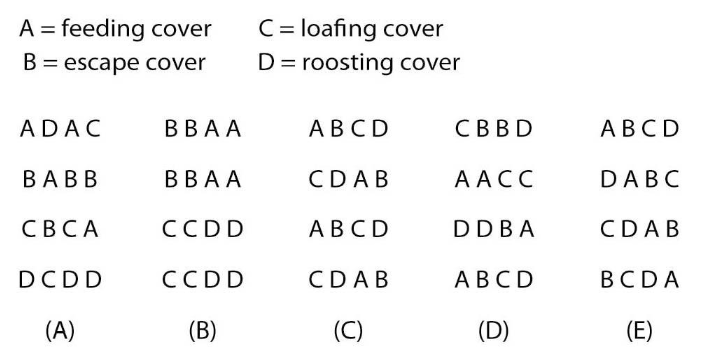
front 60 1) Study the information in Figure 43.1 about quail habitats.
Assuming that only one quail can occupy a habitat where all cover
requirements are met, what is the maximum number of quail that could
inhabit any of the hypothetical plots shown?
A) 1
B)
2
C) 4
D) 6
E) 9 | |
front 61 Flycatcher birds that migrate from Africa to Europe feed their
nestlings a diet that is almost exclusively moth caterpillars. The
graph in Figure 43.2 shows the mean dates of arrival, bird hatching,
and peak caterpillar season for the years 1980 and 2000.
2) The shift in the peak of caterpillar season is most likely due
to
A) pesticide use.
B) earlier migration returns of
flycatchers.
C) an innate change in the biological clock of the
caterpillars.
D) global warming.
E) acid precipitation in Europe. | |
front 62 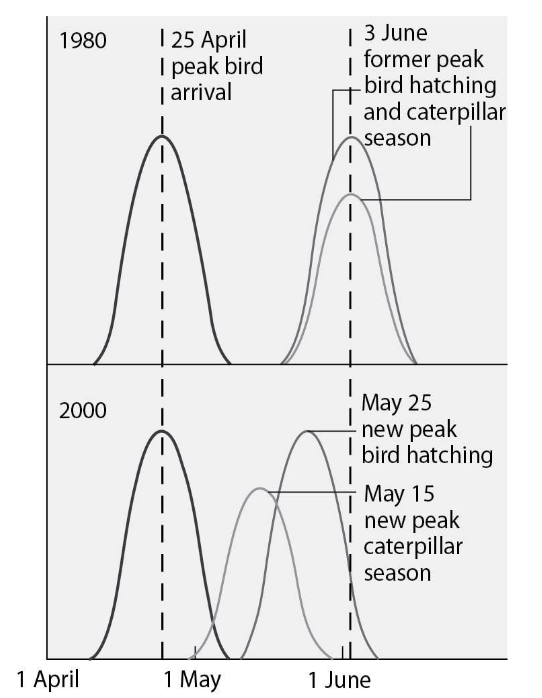 Flycatcher birds that migrate from Africa to Europe feed their
nestlings a diet that is almost exclusively moth caterpillars. The
graph in Figure 43.2 shows the mean dates of arrival, bird hatching,
and peak caterpillar season for the years 1980 and 2000.
3) Why
were ecologists concerned about the shift in the peak caterpillar
season from June 3, 1980, to May 15, 2000?
A) The caterpillars
would have eaten much of the foliage of the trees where flycatchers
would have nested, rendering their nests more open to
predation.
B) The earlier hatching of caterpillars would compete
with other insect larval forms that the flycatchers would also use to
feed their young.
C) The 2000 flycatcher nestlings would miss the
peak caterpillar season and might not be as well fed, leading to
population reductions.
D) The flycatchers would have to migrate
sooner to match their brood-rearing to the time of peak caterpillar
season.
E) Pesticides, which have a negative effect on the
ecosystem, would have to be used to control the earlier outbreak of
caterpillar hatching. | |
front 63 1) Suppose you attend a town meeting at which some experts tell the
audience that they have performed a cost-benefit analysis of a
proposed transit system that would probably reduce overall air
pollution and fossil fuel consumption. The analysis, however, reveals
that ticket prices will not cover the cost of operating the system
when fuel, wages, and equipment are taken into account. As a
biologist, you know that if ecosystem services had been included in
the analysis the experts might have arrived at a different answer. Why
are ecosystem services rarely included in economic analyses?
A)
Their cost is difficult to estimate and people take them for
granted.
B) They are not worth much and are usually not
considered.
C) There are no laws that require investigation of
ecosystem services in environmental planning.
D) There are too
many variables to ecosystem services, making their calculation
impossible.
E) Ecosystem services only take into account abiotic
factors that affect local environments. | |
front 64 2) Your friend is wary of environmentalists' claims that global
warming could lead to major biological change on Earth. Which of the
following statements can you use in response to your friend's
suspicions?
A) We know that atmospheric carbon dioxide has
increased over the past 150 years.
B) Through measurements and
observations, we know that CO2 levels and temperature fluctuations are
directly correlated, even in prehistoric times.
C) Global warming
could have significant effects on agriculture in the United
States.
D) Sea levels will likely rise, displacing as much as 50%
of the world's human population.
E) All statements listed could
be used. | |
front 65 1) One characteristic that distinguishes a population in an
extinction vortex from most other populations is that
A) its
habitat is fragmented.
B) it is a rare, top-level
predator.
C) its effective population size is much lower than its
total population size.
D) its genetic diversity is very
low.
E) it is not well adapted to edge conditions. | |
front 66 2) The main cause of the increase in the amount of CO2 in Earth’s
atmosphere over the past 150 years is
A) increased worldwide
primary production.
B) increased worldwide standing crop.
C)
an increase in the amount of infrared radiation absorbed by the
atmosphere.
D) the burning of larger amounts of wood and fossil
fuels.
E) additional respiration by the rapidly growing human population. | |
front 67 3) What is the single greatest threat to biodiversity?
A)
overharvesting of commercially important species
B) introduced
species that compete with native species
C) pollution of Earth’s
air, water, and soil
D) disruption of trophic relationships as
more and more prey species become extinct
E) habitat alteration,
fragmentation, and destruction | |
front 68 4) Which of the following is a consequence of biological
magnification?
A) Toxic chemicals in the environment pose greater
risk to toplevel predators than to primary consumers.
B)
Populations of top-level predators are generally smaller than
populations of primary consumers.
C) The biomass of producers in
an ecosystem is generally higher than the biomass of primary
consumers.
D) Only a small portion of the energy captured by
producers is transferred to consumers.
E) The amount of biomass
in the producer level of an ecosystem decreases if the producer
turnover time increases. | |
front 69 5) Which of the following strategies would most rapidly increase the
genetic diversity of a population in an extinction vortex?
A)
Capture all remaining individuals in the population for captive
breeding followed by reintroduction to the wild.
B) Establish a
reserve that protects the population’s habitat.
C) Introduce new
individuals transported from other populations of the same
species.
D) Sterilize the least fit individuals in the
population.
E) Control populations of the endangered population’s
predators and competitors. | |
front 70 6) Of the following statements about protected areas that have been
established to preserve biodiversity, which one is not
correct?
A) About 25% of Earth’s land area is now protected.
B) National parks are one of many types of protected
areas.
C) Most protected areas are too small to protect
species.
D) Management of a protected area should be coordinated
with management of the land surrounding the area.
E) It is
especially important to protect biodiversity hot spots. | |