Instructions for Side by Side Printing
- Print the notecards
- Fold each page in half along the solid vertical line
- Cut out the notecards by cutting along each horizontal dotted line
- Optional: Glue, tape or staple the ends of each notecard together
Biological Evidence and the Fossil Record
front 1 Which of these statements best sums up evolution? | back 1 change in a population through genetic variation over time |
front 2 Biology shows us the fossil record and comparative anatomies. Chemistry shows us that organic molecules can come from inorganic matter. Geology shows us that organisms that used to live together are found on separate continents due to continental drift. Which fields of science provide evidence for evolution? | back 2 biology, chemistry, and geology |
front 3 Siblings have similar traits because they inherit those traits from a common ancestor. How is this similar to some evidence for evolution? | back 3 Similarities can be seen among related organisms, which shows common ancestry. |
front 4 A scientist makes the argument that she has found DNA evidence that shows that evolution does not exist. What would her evidence have to show for her to be correct? | back 4 Weak genetic similarities in closely related organisms and strong genetic similarities in distantly related organisms. |
front 5 Which structures are similar in function, but do not indicate that the organisms are related? | back 5 analogous structures |
front 6 Studying the anatomy of different organisms allows scientists to determine how different species have evolved over time. Which type of anatomic structure are bird wings and butterfly wings when compared to each other? | back 6 Analogous |
front 7 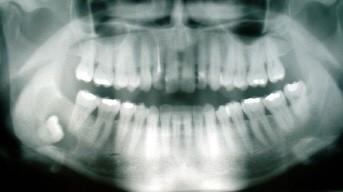 Which type of anatomic structure are wisdom teeth? Wisdom teeth are the third and final set of human molars that come in during the late teens or early twenties. In some cases, these teeth come in without problems, but they often have to be removed due to misalignment in the jaw, as shown below. Removal of the teeth does not cause any long-term complications in regard to eating. | back 7 Vestigial |
front 8 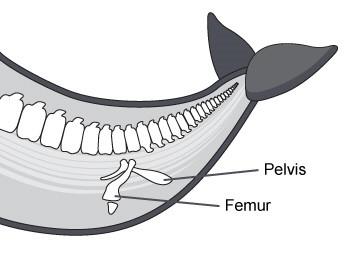 Whales have what seem like remnants of a pelvis and femur, as shown here. What are these structures an example of? | back 8 vestigial structures |
front 9 Dogs have a reduced nonfunctional digit on their paws known as a dewclaw. What is this an example of? | back 9 vestigial structure |
front 10 What is the most likely reason that horses and mountain goats have hooves? | back 10 They have homologous structures because they have a common ancestor. |
front 11 Which lists the correct order of evolutionary history? | back 11 jellyfish, reptiles, mammals |
front 12 What is the value of a transitional fossil? | back 12 Transitional forms show the evolutionary steps between species. |
front 13 Australopithecus is an ape that lived in trees, but could walk on two feet. How might fossils from Australopithecus provide evidence for evolution? | back 13 Australopithecus is a transitional form between apes and humans. |
front 14 Marsupials are found in North America and Australia, but they would not have been able to swim across the ocean. According to scientists, how did this group of organisms come to live on two separate continents? | back 14 The continents were once connected, and marsupials were able to migrate over the land. |
front 15 What do gradualism and punctuated equilibrium have in common? | back 15 What do gradualism and punctuated equilibrium have in common? |
front 16 What do scientists need to look at before developing an argument? | back 16 The validity of data, claims, hypotheses, and observations. |
front 17 Which kind of evidence studies mineralized bone, footprints, or organisms trapped in amber to determine common ancestry? | back 17 Fossils |