Instructions for Side by Side Printing
- Print the notecards
- Fold each page in half along the solid vertical line
- Cut out the notecards by cutting along each horizontal dotted line
- Optional: Glue, tape or staple the ends of each notecard together
Postlab for Determination of an Ionic Compound SD
front 1 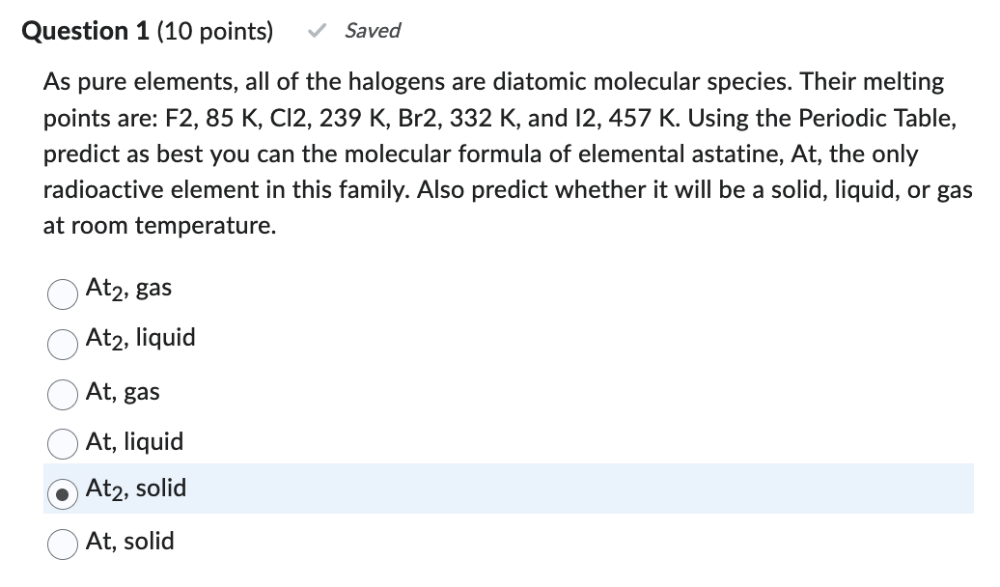 As pure elements, all of the halogens are diatomic molecular species. Their melting points are: F2, 85 K, Cl2, 239 K, Br2, 332 K, and I2, 457 K. Using the Periodic Table, predict as best you can the molecular formula of elemental astatine, At, the only radioactive element in this family. Also predict whether it will be a solid, liquid, or gas at room temperature. | back 1 At2, solid |
front 2 Substances A, B, and C can all act as oxidizing agents. In solution, A is green, B is yellow, and C is red. In the reactions in which they participate, they are reduced to A minus, B minus, and C minus ions, all of which are colorless. When a solution of C is mixed with one containing B minus ions, the color changes from red to yellow. Which species is more active? Hint: For X2 + 2 Y 1 minus ---> Y2 + 2 X 1 minus If a reaction occurs, X is more active than Y. If a reaction does not occur, Y is more active than X.
| back 2 C |
front 3 Substances A, B, and C can all act as oxidizing agents. In solution, A is green, B is yellow, and C is red. In the reactions in which they participate, they are reduced to A minus, B minus, and C minus ions, all of which are colorless. When a solution of C is mixed with one containing B minus ions, the color changes from red to yellow. When a solution of C is mixed with one containing A minus ions, the color remains red. Is C more active than A? _____________ Hint: For X2 + 2 Y 1 minus ---> Y2 + 2 X 1 minus If a reaction occurs, X is more active than Y. If a reaction does not occur, Y is more active than X.
| back 3 No |
front 4 Substances A, B, and C can all act as oxidizing agents. In solution, A is green, B is yellow, and C is red. In the reactions in which they participate, they are reduced to A minus, B minus, and C minus ions, all of which are colorless. When a solution of C is mixed with one containing B minus ions, the color changes from red to yellow. When a solution of C is mixed with one containing A minus ions, the color remains red. Is C more active than B? _____________ Hint: For X2 + 2 Y 1 minus ---> Y2 + 2 X 1 minus If a reaction occurs, X is more active than Y. If a reaction does not occur, Y is more active than X.
| back 4 Yes |
front 5 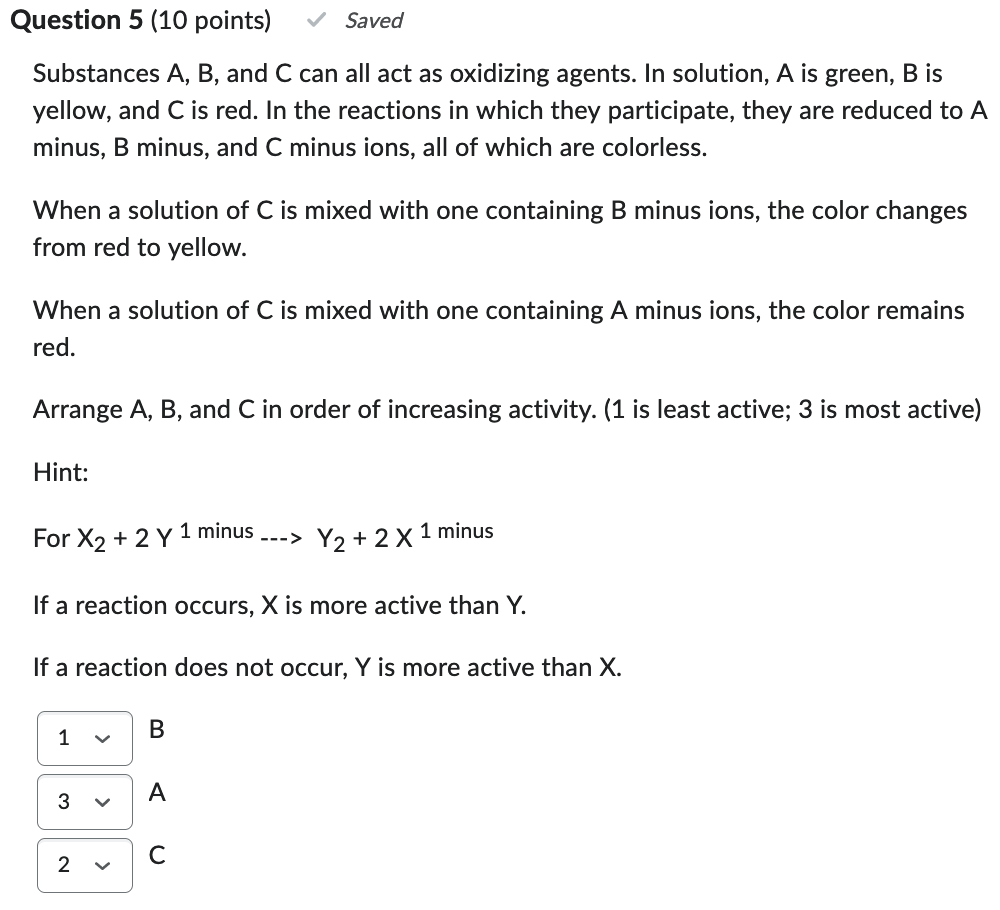 Substances A, B, and C can all act as oxidizing agents. In solution, A is green, B is yellow, and C is red. In the reactions in which they participate, they are reduced to A minus, B minus, and C minus ions, all of which are colorless. When a solution of C is mixed with one containing B minus ions, the color changes from red to yellow. When a solution of C is mixed with one containing A minus ions, the color remains red. Arrange A, B, and C in order of increasing activity. (1 is least active; 3 is most active) Hint: For X2 + 2 Y 1 minus ---> Y2 + 2 X 1 minus If a reaction occurs, X is more active than Y. If a reaction does not occur, Y is more active than X. | back 5 A - 3 B - 1 C - 2 |
front 6 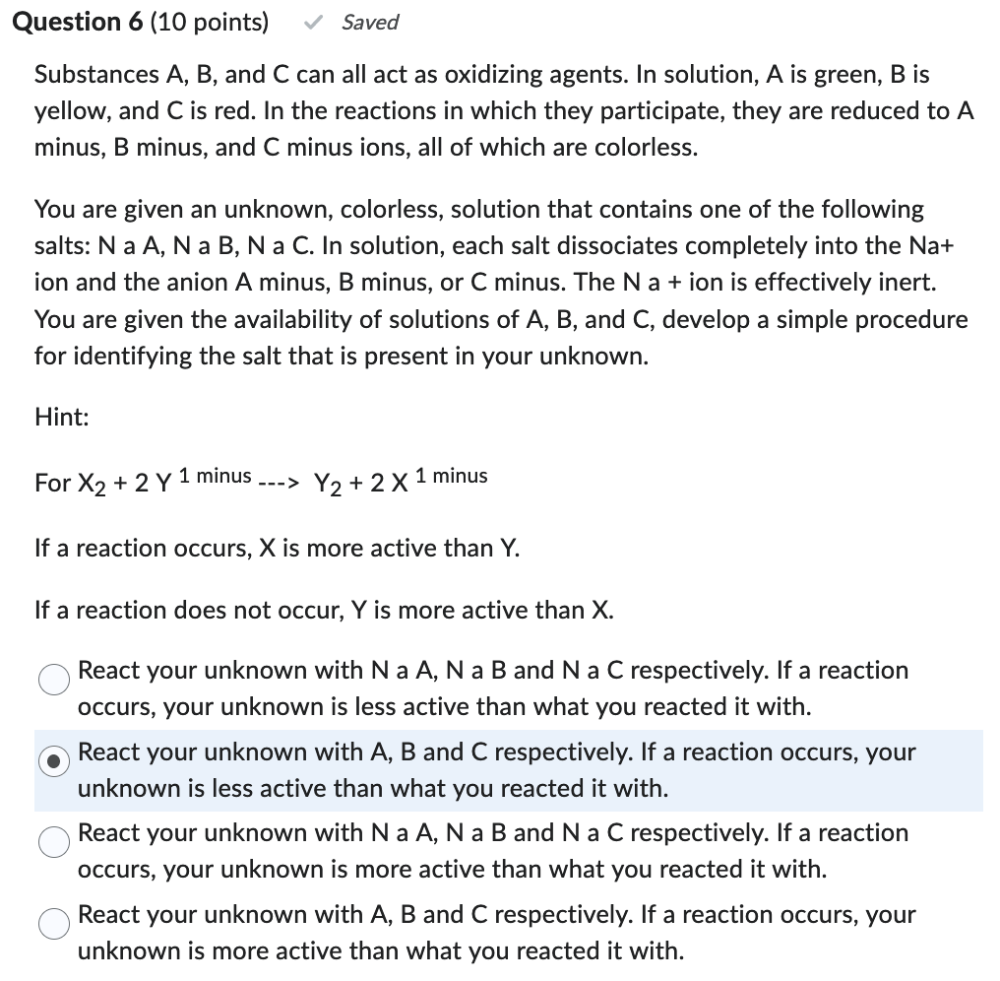 Substances A, B, and C can all act as oxidizing agents. In solution, A is green, B is yellow, and C is red. In the reactions in which they participate, they are reduced to A minus, B minus, and C minus ions, all of which are colorless. You are given an unknown, colorless, solution that contains one of the following salts: N a A, N a B, N a C. In solution, each salt dissociates completely into the Na+ ion and the anion A minus, B minus, or C minus. The N a + ion is effectively inert. You are given the availability of solutions of A, B, and C, develop a simple procedure for identifying the salt that is present in your unknown. Hint: For X2 + 2 Y 1 minus ---> Y2 + 2 X 1 minus If a reaction occurs, X is more active than Y. If a reaction does not occur, Y is more active than X. | back 6 React your unknown with A, B and C respectively. If a reaction occurs, your unknown is less active than what you reacted it with. |
front 7 Instructor use only. 5% = 3.5 | back 7 no data |