Instructions for Side by Side Printing
- Print the notecards
- Fold each page in half along the solid vertical line
- Cut out the notecards by cutting along each horizontal dotted line
- Optional: Glue, tape or staple the ends of each notecard together
Integrated Physical Science
front 1 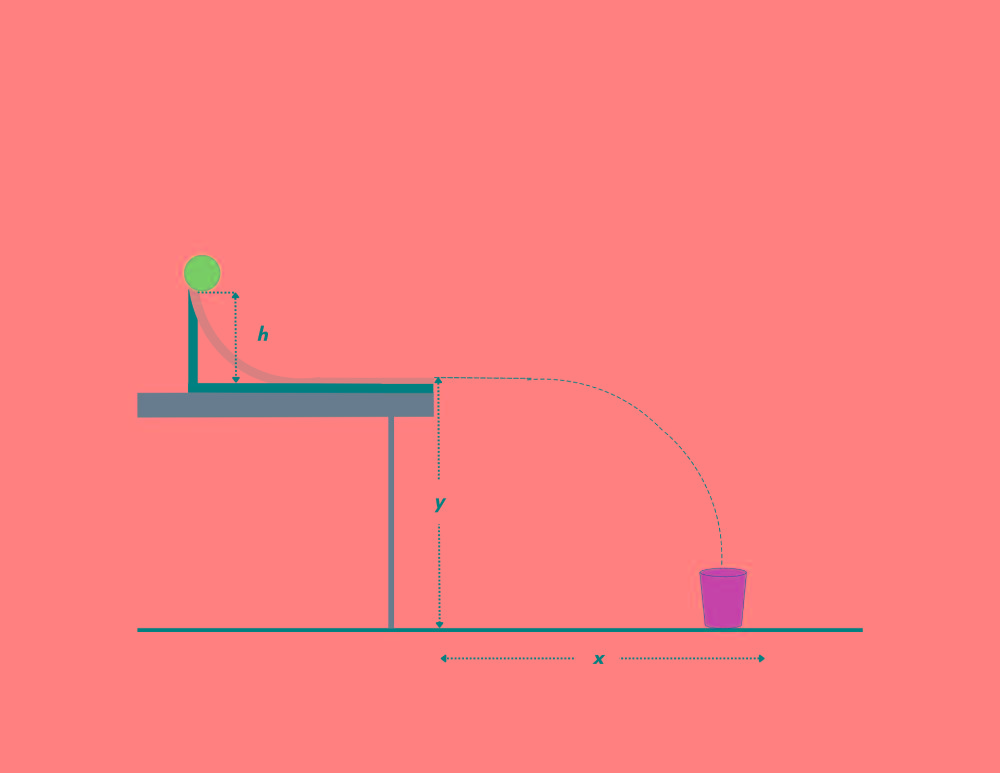 In the setup for an experiment, the height of a ramp is h. The height of a table is y. The horizontal distance the ball travels after it leaves the table is x. You want to try to get the ball to land inside the cup so you want to know how changing the height of the ramp affects how far from the table the ball lands. In other words, you want to know how h affects x. Which type of variable is height (h)? | back 1 Independent Variable |
front 2 In the setup for an experiment, the height of a ramp is h. The height of a table is y. The horizontal distance the ball travels after it leaves the table is x. You want to try to get the ball to land inside the cup so you want to know how changing the height of the ramp affects how far from the table the ball lands. In other words, you want to know how h affects x. Which type of variable is the horizontal distance (x)? | back 2 Dependent Variable |
front 3 In the setup for an experiment, the height of a ramp is h. The height of a table is y. The horizontal distance the ball travels after it leaves the table is x. You want to try to get the ball to land inside the cup so you want to know how changing the height of the ramp affects how far from the table the ball lands. In other words, you want to know how h affects x. Which type of variable is the the material of the ball (glass, plastic, rubber, etc.)? | back 3 Control Variable |
front 4 In the setup for an experiment, the height of a ramp is h. The height of a table is y. The horizontal distance the ball travels after it leaves the table is x. You want to try to get the ball to land inside the cup so you want to know how changing the height of the ramp affects how far from the table the ball lands. In other words, you want to know how h affects x. Which type of variable is the table height (y)? | back 4 Control Variable |
front 5 In general, metal wires expand when they are heated. To test this, you heat a piece of wire and then measure how much the wire’s length changed as a result of the temperature change. In this experiment, what is the wire’s temperature? | back 5 Independent Variable |
front 6 A student records the rising and setting times of the moon each day for a month.
| back 6 Observational Study |
front 7 Scientists at a volcano observatory continuously monitor the ground movements and volcanic gas chemistry between and during eruptions.
| back 7 Observational Study |
front 8 A group of students sprinkle salt onto one of two burning candles and record the color of the two flames.
| back 8 Controlled experiment |
front 9 When scientists want to determine the hardness of minerals, they use a test called the Mohs test. An experimenter trying to identify a mineral will scratch the surface with a set of tools of various hardness and then analyze the results against charts.
| back 9 Controlled experiment |
front 10 The first evidence that light has a finite speed and does not travel from place to place instantaneously came in the 17th century from observations that Jupiter’s moons appear later when Jupiter is farther from Earth as compared to when Jupiter is closer to Earth. This phenomenon was used to show that the difference in the time of appearance of the moons is consistent with a measurable speed. What is this is an example of?
| back 10 An observational study |
front 11 What is an example of a laboratory study?
| back 11 Scientists combine two organic substances in a test tube and measure the amount of product that forms. |
front 12 You heard somewhere that salty water boils faster than pure water. You decide to do a scientific investigation to determine whether this is true. You get three identical pots. You put 4 cups of pure water in the first pot. In the second pot, you put 4 cups of water with 2 tablespoons of salt added. In the third pot, you put 4 cups of water with 4 tablespoons of salt added. Next, you heat all three pots at the same level of heat and measure how long it takes the water in each pot to boil. What type of experiment is this? | back 12 Controlled |
front 13 The time needed for the water in each pot to boil depends on several factors, such as the amount of liquid you use, the level of heat you use, and the size and composition of the pots you use. In this experiment, these are examples of variables. In this experiment, what type of variable is the salinity (concentration of salt) of the water ? | back 13 Independent |
front 14 A group of scientists studies the nature of earthquakes by passing mechanical waves through various materials in a lab. Which type of model are the scientists are using? | back 14 Physical model |
front 15 Which type of model is Newton’s second law of motion, which explains the relationship between force, mass, and acceleration, F=ma? | back 15 Mathematical model |
front 16 Which type of model is a picture of the solar system an example of? | back 16 Conceptual model |
front 17 Which type of model is a light bulb used to model the sun as a source of energy an example of?
| back 17 Physical model |
front 18 Which model could be used to illustrate rocket propulsion?
| back 18 A balloon filled with air with its stem pinched but not tied, which is then released so the balloon moves opposite the direction in which the air is ejected |
front 19 A student records the amount of sugar that can be dissolved in water at four different temperatures. The amount of sugar that dissolves increases with increasing temperature. How would you describe these variables?
| back 19 Directly proportional |
front 20 A student measures the volume of a rubber ball subjected to increasing values of uniform pressure. The volume of the ball decreases as the pressure increases. How would you describe these variables?
| back 20 Inversely proportional |
front 21 Increasing temperature is associated with higher humidity levels in lake environments. That is, the temperature is positively correlated with humidity levels. What is the likely cause of this correlation?
| back 21 Increases in temperature cause an increase in the lake's evaporation rate |
front 22 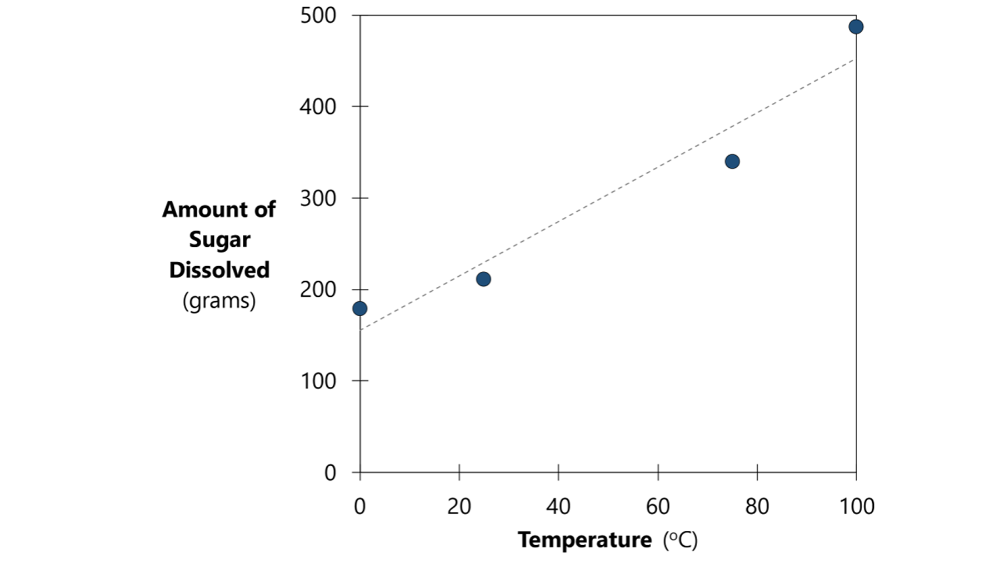 A group of students measure how much sugar they can dissolve in water at different temperatures. Their results are shown on the graph. What is the independent variable of this graph?
| back 22 Temperature |
front 23 Does this graph show a correlation? If so, what type of correlation?
| back 23 Yes, the amount of sugar dissolved is positively correlated with temperature. |
front 24 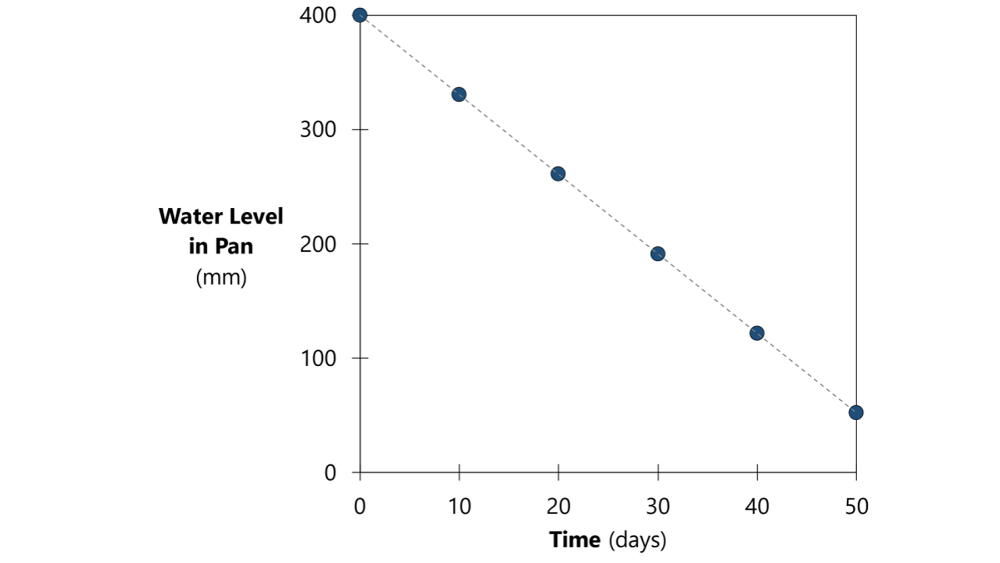 The upward trend of the data indicates a positive correlation. A student places a pan containing 100 milliliters of water outside for 20 days. The student measures the amount of water in the pan after 5, 10, 15, and 20 days. The results are shown in the graph. Which type of correlation does the graph show?
| back 24 Negative correlation |
front 25 What is the best description of the causal relationship between these variables?
| back 25 Longer periods of evaporation remove more water. |
front 26 What best describes length?
| back 26 Distance between two points |
front 27 What best describes mass?
| back 27 Amount of matter in an object |
front 28 Why is it important for scientists to use the same units for measurements?
| back 28 Using the same units enables scientists to easily exchange ideas and compare the results of their measurements with their colleagues around the globe. |
front 29 What is an SI unit of length?
| back 29 Meter (m) |
front 30 What is an SI unit of mass?
| back 30 Kilogram (kg) |
front 31 What is an SI unit of time?
| back 31 Second (s) |
front 32 What is an SI unit of temperature?
| back 32 Kelvin (K) |
front 33 Would the mass of a truck be more than, less than, or about equal to 1,000 g?
| back 33
|
front 34 Would the height of a tall building be more than, less than, or about equal to 100 cm?
| back 34 More than |
front 35 Which symbol stands for milli-?
| back 35 m |
front 36 Which symbol stands for micro-?
| back 36 μ |
front 37 Which symbols stand for nano-?
| back 37 n |
front 38 Which symbol stands for mega-?
| back 38 M |
front 39 Which symbol stands for kilo-?
| back 39 k |
front 40 Which symbol stands for centi-?
| back 40 c |
front 41 What is the approximate length of a thumb?
| back 41 5 cm |
front 42 What is the approximate thickness of a piece of lead in a mechanical pencil?
| back 42 1 mm |
front 43 What is the volume of a 2 L soda bottle?
| back 43 2,000 mL |
front 44 What is a gallon of milk approximately equivalent to?
| back 44 4 L |
front 45 Which of the following is a derived unit?
| back 45 Square meters |
front 46 Which quantity has derived units?
| back 46 Volume |
front 47 A car is driving 60 km/hr due east. What information does this give you about the car?
| back 47 Velocity |
front 48 A ball is initially moving down a ramp with an increasing velocity. Which term describes the ball's acceleration at that instant?
| back 48 Acceleration by speeding up |
front 49 What does acceleration represent a change in? Select two answers.
| back 49
|
front 50 Which of the following involves an acceleration? Select two answers.
| back 50
|
front 51 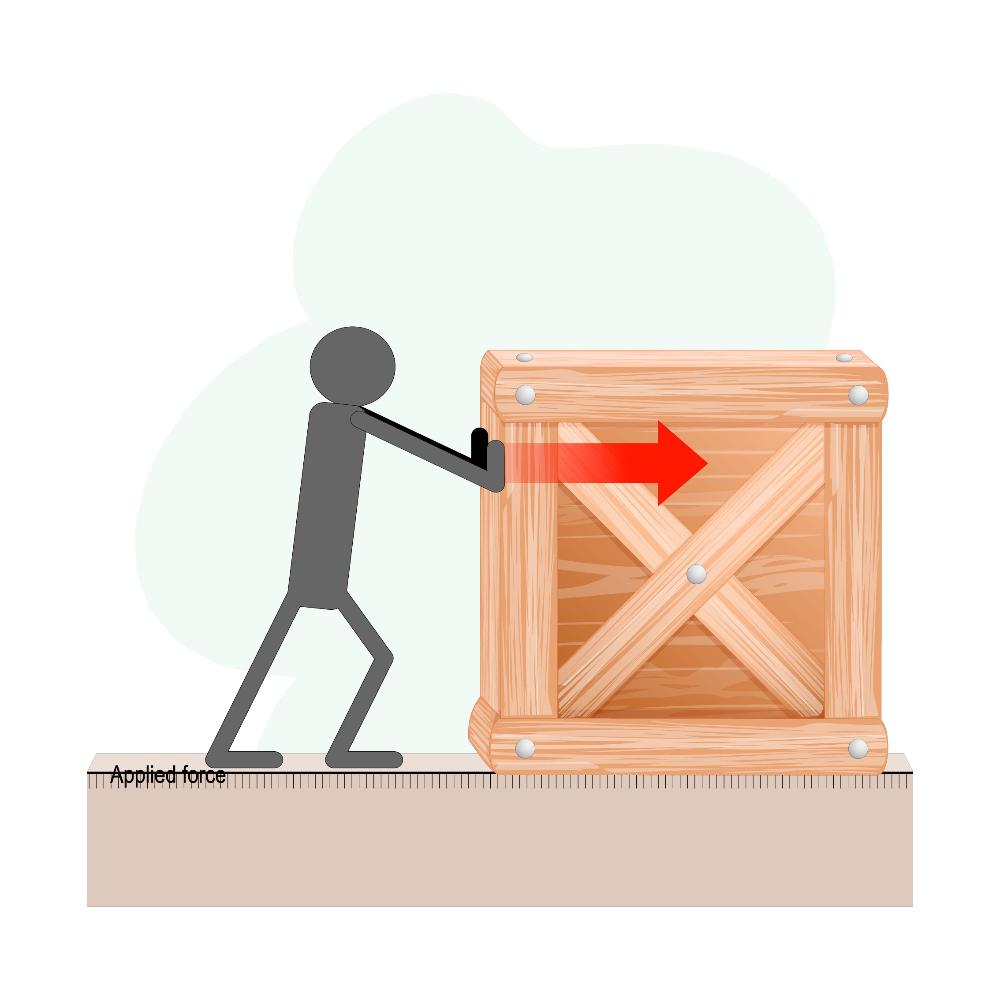 Consider a block resting on a flat surface. When a force is applied to the block as shown, which arrow shows the direction of the acceleration that results?
| back 51 Right |
front 52 Suppose the grocery cart is at rest, and you push it to accelerate it into motion. How does the result differ if you pushed with a force of 40 N instead of 20 N for the same amount of time?
| back 52 The cart ends up moving faster compared to before. |
front 53 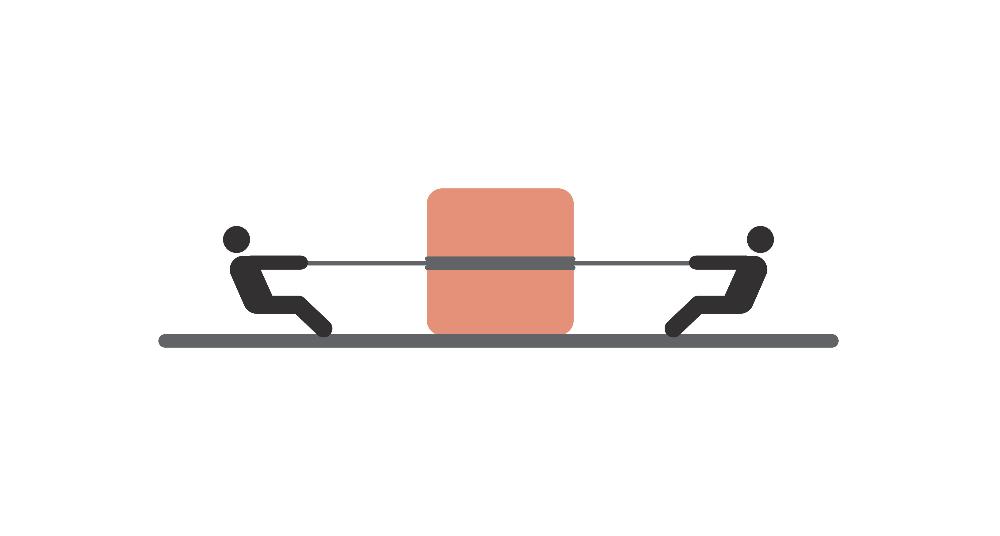 What is true about the net force from two equal forces in opposite directions?
| back 53 The net force is zero. |
front 54 Forces acting on an object that combine to give zero net force are said to be balanced. Why would that term be appropriate?
| back 54 The forces cancel each other and cause zero acceleration. |
front 55 Let us consider the coffee mug again. The force from the hand holding it exerts a force pushing it up. Its weight exerts a force on it pulling it down. The two forces combine to produce a net force. When the two forces are equal, what is the resulting net force?
| back 55 Zero |
front 56 When you first exert extra force upward, what happens to the weight of the cup?
| back 56 It remains the same. The weight of the cup, which is the force of gravity on the cup, does not change when the hand holding it exerts a stronger force upward. |
front 57 The weight of the cup is less than the force from your hand. What is the net force on the cup?
| back 57 Upward When two forces act in opposite directions on the same object, the net force is in the direction of the stronger force, which means the force with the greater magnitude. |
front 58 How does the cup accelerate as a result?
| back 58 Upward The cup accelerates in the direction of the net force. |
front 59 What is true of a hypothesis?
| back 59 It remains to be tested. |
front 60 Which statement is testable?
| back 60 The moon is made entirely of cheese. The moon rocks collected on the Apollo space mission to the moon already show the statement to be false. So the statement is testable. |
front 61 Law of conservation of matter
| back 61 Tested by experiment |
front 62 The law only describes amounts of matter not changing.
| back 62 Statement about something specific observed in nature The law of conservation of matter is specific because it describes only how matter fails to be created or destroyed in a chemical reaction. |
front 63 The law would also apply to chemical reactions in another galaxy.
| back 63 Intended to be universal The law of conservation of matter is universal because it is a statement of what happens everywhere in the universe, not because it deals only with matter failing to be created or destroyed in a chemical reaction. |
front 64 Which is a description of a scientific law?
| back 64 A statement based on many experiments that energy is never created or destroyed A law is a concise statement based on many experiments or observations. |
front 65 Which definition describes a scientific theory?
| back 65 A well-tested explanation A theory is a thoroughly tested explanation of a group of phenomena. |
front 66 Which property must a testable statement have?
| back 66 It is capable of being shown untrue. The statement does not have to be actually false, let alone proved false, to be testable. There only has to be a means to test for its possible falsehood. |
front 67 A spaceship is on a robotic mission to an outer planet of our solar system. Is it necessary for the spacecraft to continue firing its engines to keep it moving toward its destination?
| back 67 No. The spacecraft remains in motion when no net force is acting on it. According to Newton’s first law, it will remain in motion at constant velocity. |
front 68 Two people are both pushing on a ball with equal force in opposite directions. On person suddenly stops pushing. What will happen to the ball?
| back 68 It will begin accelerating. |
front 69 If the net force on an object increases, what happens to its acceleration?
| back 69 It increases. |
front 70 If the mass of the object is greater, what happens to the acceleration from the same force?
| back 70 It is smaller |
front 71 How is the net force applied to an object and the acceleration it produces related?
| back 71 Directly |
front 72 How is the mass of an object and the object’s acceleration related?
| back 72 Inversely |
front 73 To produce the same acceleration with larger mass, what change would need to be made to the net force?
| back 73 It would need to be larger. |
front 74 If the force acting on the box increases, what will happen to the box's acceleration?
| back 74 It will increase. |
front 75 If the mass of the box increases, but the force remains the same, what will happen to the box's acceleration?
| back 75 It will decrease. |
front 76 When the diver is moving downward and is bending the board downward, what is the force of the diver on the board compared to the force of the board on the diver?
| back 76 It is equal. |
front 77 When the diver has bent the board downward as far it bends, what is the force of the diver on the board compared to the force of the board on the diver?
| back 77 it is equal. |
front 78 When the diver is moving upward because of the force from the board, what is the force of the diver on the board compared to the force of the board on the diver?
| back 78 It is equal. |
front 79 When the diver is being accelerated upward by the board unbending, what is the force of the diver on the board compared to the force of the board on the diver?
| back 79 It is equal. |
front 80 When the diver is no longer in contact with the board, what is the force of the diver on the board compared to the force of the board on the diver?
| back 80 It is equal |
front 81 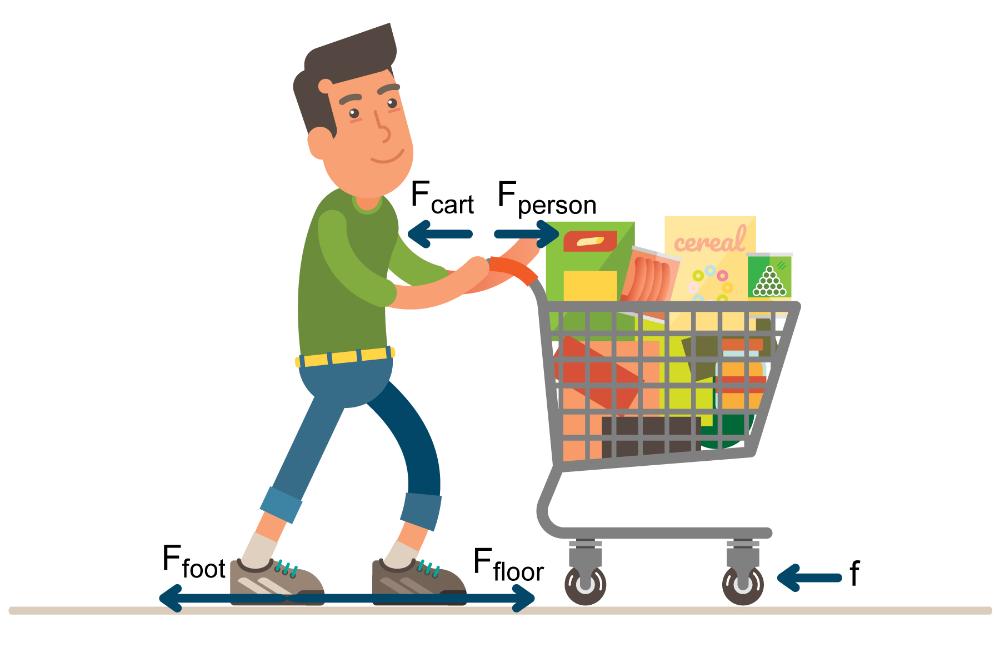 Which force shown in the diagram needs to be included when determining the net force on the cart? The forces are shown with arrows in the diagram.
| back 81 F person |
front 82 A basketball player makes a jump shot. What directly exerted an external force on the player to accelerate him upward into the air?
| back 82 The floor |
front 83 A bumper car at an amusement park bumps into the back of another. The car in front moves faster as a result of the collision, and the car behind it is slowed by the collision. The cars have unequal mass. Which car experiences the greater force during the collision?
| back 83 Each car experiences a force of the same magnitude. |
front 84 When a soccer ball falls, it is accelerated toward Earth while Earth does not move noticeably in response. What is the likely explanation?
| back 84 The soccer ball accelerates more because its mass is small compared to Earth’s mass. |
front 85 One of the members of a river research team measures how far a floating object has traveled at 5.0 second intervals. The intent is to calculate the speed of the water at the center of the river and collect similar data for other rivers. In measuring the distance at each time, what is the independent variable?
| back 85 Time Distance is the measured quantity that seems to respond to the other variable—the other variable is the independent variable. |
front 86 One of the members of a river research team measures how far a floating object has traveled at 5.0 second intervals. The intent is to calculate the speed of the water at the center of the river and collect similar data for other rivers. What is the dependent variable?
| back 86 Distance The speed is merely calculated from the other two variables. |
front 87 A scientist is studying the speed of water flow in rivers by this method. Which type of study would this be classified as?
| back 87 A field study A field study would describe going to the actual river to do the investigation. |
front 88 A scientist is studying the speed of water flow in rivers by this method. Which type of experiment is this an example of?
| back 88 An uncontrolled experiment A field study almost always has hidden variables that the researcher collecting the data cannot hold constant. |
front 89 What is an experiment in which you deliberately change only one variable and observe how a second variable changes as a result while you hold all other variables that you control constant?
| back 89 A controlled experiment A controlled experiment is one in which you keep all other variables other than dependent and independent variables constant. |
front 90 What is a model in science?
| back 90 A simpler system that is analogous to the real system If it were an exact replica, it would not be simpler and easier to examine than the real system. |
front 91 Which quality identifies a scientific statement as testable?
| back 91 There is a way to test it for falseness. Many statements cannot be fully proved true because there is no way to test every single instance of the situation. |
front 92 Which term describes something that tentatively assumes what happens or how it happens in order to test what it assumes?
| back 92 Hypothesis A hypothesis is a tentative statement intended to be tested. |
front 93 The water flowing in a river comes from rain and snow that collected and eventually ran into rivers. As the river flows to the sea, water evaporates from it, and from all over Earth’s surface, back into the atmosphere, where the water can fall as rain and snow again. A team carries out an investigation, and it proposes that maybe the moist air is being cooled when the wind from west to east forces the air upward, based on knowledge that temperatures tend to decrease with increasing height. Which term describes this step?
| back 93 Formulating a hypothesis Proposing, or even just thinking of, an idea to then test is formulating a hypothesis. |
front 94 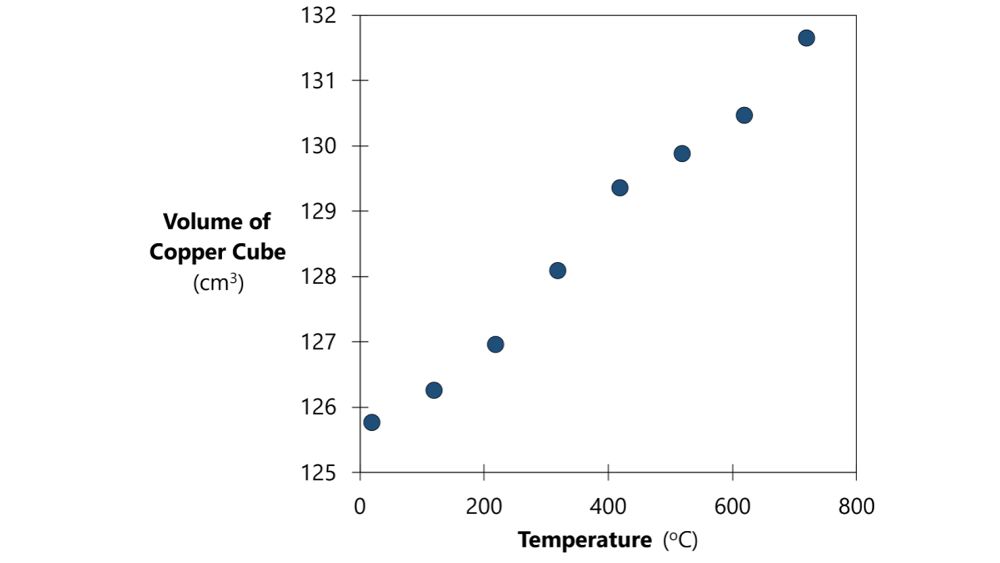 The graph shows the volume of a copper cube as a function of temperature. What is the relationship between volume and temperature in this plot?
| back 94 They are directly proportional. When data points form a line with a positive slope this indicates that the variables are directly proportional. |
front 95 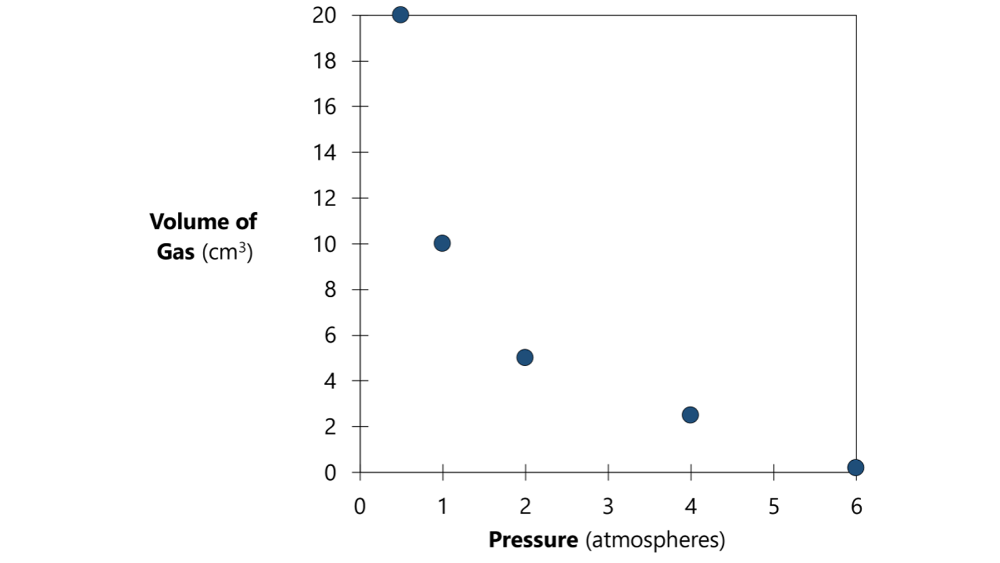 The plot shows the volume of a gas measured at different pressures. What does this data tell you about the relationship between these variables?
| back 95 They are not correlated. The negative downward slope of the data trend indicates an inversely proportional relationship. |
front 96 The following table shows elevation of a weather balloon measured as a function of time after its launch. What do the data indicate about the relationship between these variables? Time (hours) Elevation (meters) 5 1017 10 1019 15 1007 20 1008 25 1018 30 1013 35 1020 40 1007 45 1003 50 1020
| back 96 They are not correlated. The lack of any positive or negative slope to the data points indicates that they are not correlated. |
front 97 What is the zero point of an x-y scatterplot called?
| back 97 Origin The point where both the x and y variables are zero is, by definition, the graph’s origin. |
front 98 A graph shows a positive correlation between temperature on the x-axis and total rainfall amounts on the y-axis. Does this indicate that higher temperatures directly cause the higher rainfall amounts?
| back 98 The correlation does not necessarily mean that there is a causal relationship. By using science methods and critical thought the causal relationships between variables can be established. |
front 99 Which tool would be used to calculate the amount of space taken up by 10 irregularly shaped ice cubes?
| back 99 Graduated beaker A graduated beaker can be used to determine the volume of the cubes. |
front 100 A recipe calls for 300 g of whole-wheat flour. What tool would be used to measure the flour?
| back 100 Balance A balance is used to measure mass. |
front 101 Which cooking measurement is categorized as a derived unit?
| back 101 The volume of cream used in a dessert Volume is a derived quantity, not a base quantity. |
front 102 Which statement is correct?
| back 102 Speed is a derived unit. Speed is derived from the base units of length and time. |
front 103 . Why is it important to have standard measures for physical quantities?
| back 103 To make it more difficult for scientists to exchange and compare results of their measurements Measurements are only useful if their values are meaningful to others. |
front 104 Which unit is categorized as a base unit?
| back 104 meter Only the length unit is involved, which is independent of the other derived units listed. |
front 105 What is the official SI base unit for mass?
| back 105 Kilogram Although a gram measure mass, it is not the official SI base unit for mass. |
front 106 What is the official SI base unit for length?
| back 106 Meter The meter measures length. |
front 107 What is the official SI base unit for time?
| back 107 Second Seconds measure time. |
front 108 Which of these has values that are expressed in terms of a derived unit in the SI system?
| back 108 Area Area is equal to the length times the width of an object. |
front 109 Which unit is categorized as a derived unit?
| back 109 Kilometer/second Kilometers per second combines two base units to make a derived unit. |
front 110 Which characteristic of a sample of liquid does a graduated cylinder measure?
| back 110 Volume Volume is the amount of space an object takes up, often measured by the water displacement test. |
front 111 A cargo spacecraft that brings supplies to the International Space Station (ISS) is launched using rocket propulsion. The spacecraft’s rockets fire hot gases backward. Which statement is true about this situation according to Newton’s third law?
| back 111 When the rockets fire hot gases backward, this creates huge forces in the opposite direction, exerted on the spacecraft by the hot gases. The hot gases create a reaction force on the spacecraft in the opposite direction. |
front 112 A parachute is deployed to slow down a skydiver while descending toward the ground. What happens while the skydiver is descending?
| back 112 Their velocity points downward, and their acceleration points upward. Velocity always points in the direction of motion and acceleration in the direction of the changing velocity, which in this case means upward. |
front 113 As a cargo spacecraft lifts off, its booster rockets are employed to accelerate it. Assume that the booster rockets apply a constant force on the spacecraft. The higher the spacecraft ascends, the less mass it has because some of its fuel is burned. What is happening as the spacecraft is ascending?
| back 113 Both its speed and acceleration increase. Since the mass of the spacecraft is decreasing, the acceleration provided by its booster rockets is increasing, which causes the speed to increase accordingly. |
front 114 An astronaut on board the International Space Station (ISS) gently lifts their feet off the floor of the cabin so that they are not touching any object. At that moment, the ISS rockets start to reboost and accelerate the ISS forward. What will happen to the astronaut initially?
| back 114 To an observer accelerating with the ISS, the astronaut will appear to be accelerating backward. They will appear to be accelerating backward because the ISS will be accelerating forward. They will not move with the ISS due to their inertia since the rest of the ISS is not exerting any force on them. |
front 115 If two boxes with masses of 5 kg and 20 kg are pushed with the same force, which one will accelerate more?
| back 115
The less massive box will accelerate more when the same force is applied. |
front 116 If the net force is zero on a motorcycle traveling at 20 m/s, which statement is true concerning the motion of the motorcycle?
| back 116
An object will keep its same motion unless some non-zero force acts on it. |
front 117 For which case is there a net force acting on the object?
| back 117
Once on the ground, the apple is stationary, so it must have no net force acting on it. |
front 118 A car’s engine provides a force of 200 N forward while a force of 150 N from air resistance acts to oppose the car’s motion. What is the net force and its direction on the car?
| back 118
The net force is 200 N – 150 N. This gives a positive force, indicating the forward direction. |
front 119 If the net force acting on an object is halved, how will the acceleration change?
| back 119
Force and acceleration have a direct relationship. |
front 120 Two tugboats attach their lines to separate barges with the same masses in a shipping channel. If one tugboat pulls Barge A toward the west while the other tugboat pulls Barge B in the same direction, applying twice as much force, which barge will accelerate more?
| back 120
Barge B will accelerate twice as fast because acceleration is directly proportional to the applied force. |
front 121 Which statement regarding inertia is correct?
| back 121
The exact opposite is true. Objects with more inertia are more difficult to accelerate. |
front 122 A moving van worker is trying to move a couch. Due to inertia, what does the amount of force that needs to be applied to get the couch to start moving across the room depend on?
| back 122
The amount of the force required depends on the mass of the object that the force is applied to. |
front 123 If you press your hand downward on a book lying on a table, what is the reaction force to your hand?
| back 123
The reaction force acts backward on the object causing the action, which in this case is your hand. |
front 124 Which scenario involves an action-reaction force pair?
| back 124
The reaction force of Elisa pushing back on John is what causes him to slide backward. |
front 125 Which is true regarding action-reaction forces?
| back 125
This is a false statement and contradicts Newton’s third law. |
front 126 If the acceleration of an empty truck is 1.5 m/s2, what will happen to its acceleration if it is fully loaded and its total mass doubles?
| back 126
The force is the same, and the acceleration is inversely proportional to the mass, so the acceleration will decrease by one-half. |
front 127 A driver uses a forklift to push a full cart of bricks halfway down an aisle with a force of 20 N. If the driver pushes an empty cart the rest of the way down the aisle using the same 20 N of force, how does the acceleration of the empty cart compare with that of the full cart of bricks?
| back 127
The acceleration is inversely proportional to mass, so the empty cart with less mass will have a greater acceleration than the full cart. |
front 128 What best describes the net force acting on an object moving in a straight line at a constant speed?
| back 128
The net force is zero because the object does not change its motion. |
front 129 What is the name of the force that always opposes the motion of an object?
| back 129
Friction is the force that opposes the motion of an object. |
front 130 Why is a car more likely to slide if it tries to stop on an icy road than on pavement?
| back 130
A car is more likely to slide if it tries to stop on an icy road because ice has less friction |
front 131 When the applied force reaches about 100 N, why is the crate not moving?
| back 131
The applied force is equal to the friction force. |
front 132 What is the crate experiencing?
| back 132
The force of static friction acts on the crate because the crate is not moving, but it is experiencing friction. |
front 133 When the force on the crate is 150 N or more, why does the speed of the crate increase?
| back 133
There is a non-zero net force acting on the crate. |
front 134 After the force is removed, what does the crate do?
| back 134
The crate gradually slows down until it stops, because the force of kinetic friction is acting to slow it down. |
front 135 . When is a force of friction not likely to exist between two objects?
| back 135
A force of friction does not exist if two objects are not touching. |
front 136 Why do you need to give a filing cabinet a stronger push to get it to start moving along the floor than to keep it moving?
| back 136
The force of static friction acts to prevent the filing cabinet from starting to move. |
front 137 You can start a fire by rubbing a flint rock with high-carbon steel. What is the force that lets you do this?
| back 137
This is the force of kinetic friction because the rock and steel are moving with respect to each other. |
front 138 Which factors affect the force of friction between two solid objects? Select 2 answers.
| back 138
Both the types of surfaces involved and how hard they press on each other affect the force of friction between two solid objects.Both the types of surfaces involved and how hard they press on each other affect the force of friction between two solid objects. |
front 139 Marie pushes a box across the floor. What causes the box to move?
| back 139
Marie’s force causes the box to move. Without her applied force, the object would not move. |
front 140 What is the attractive force that exists between any two objects known as?
| back 140
Gravitational force is the attractive force that exists between any two objects. |
front 141 What is the force that keeps a planet in orbit around the sun?
| back 141
The force of gravity keeps a planet in orbit around the sun. |
front 142 Earth's mass is much greater than that of the moon. If you were to stand on the surface of the moon, what would the gravitational force you would experience from the moon be?
| back 142
The moon's mass is smaller than Earth's, so its gravitational pull is weaker than Earth's. |
front 143 Which phenomenon is an example of gravity?
| back 143
The moon orbits the earth because of gravitational attraction. |
front 144 Which phenomenon is an example of friction?
| back 144
Jogging is not possible without friction between your shoes and the sidewalk or track. |
front 145 What is the measure of the amount of gravity acting on an object?
| back 145
Weight is the measure of the force of gravity on an object. |
front 146 What affects the gravitational force between two objects?
| back 146
The gravitational force between two objects is affected by both the objects’ masses and the distance between them. |
front 147 With what force of gravity does Earth pull a bike compared to a truck?
| back 147
Earth pulls a bike with a smaller force of gravity because the mass of the bike is smaller. |
front 148 If the distance between two objects is doubled, what happens to the force of gravity between them?
| back 148
If the distance is doubled, the force of gravity decreases. |
front 149 What is the force of gravity exerted by the Earth on you compared to the force of gravity exerted by you on the Earth?
| back 149
The two forces are equal because of Newton’s third law. |
front 150 A bicycle and a train are moving at exactly the same velocity. Which has more momentum, the bicycle or the train?
| back 150
If two objects are moving at the same velocity, the more massive object has more momentum. |
front 151 Now, imagine two identical trains are traveling on parallel tracks. One is moving at 10 km/hr, and the other is moving at 100 km/hr. Which train has more momentum?
| back 151
If two objects have the same mass, the faster moving object has more momentum. |
front 152 One pool ball collides with another, and the balls move away from one another. Which statement is true if there are no losses to heat or friction?
| back 152
|
front 153 A ball rolling across a smooth floor gradually slows to a stop. Why does this occur?
| back 153
|
front 154 Which effect does static friction have on the car?
| back 154
|
front 155 Which effect will kinetic friction have on the car?
| back 155
|
front 156 Although based on popular American-made cars, NASCAR vehicles have many features that are different from ordinary cars. One example is the tires: NASCAR tires are wider and smoother with no tread. Based on your understanding from this module of the factors that affect the force of friction, what is the most likely reason for the unique design of racing tires?
| back 156
|
front 157 To ensure fair competition, rules are in place that govern every aspect of a NASCAR race car, including its weight. A NASCAR race car must weigh a minimum of 3,400 pounds when all required liquids and equipment are on board. Additionally, NASCAR race cars must also weigh at least 1,625 pounds on the front-right and right-rear sides of the car. This rule prevents cars from having too much weight on the left side of the car. Because NASCAR races are around tracks with left-hand turns, drivers would want to have more weight on the left side of the car to aid in turning. The right-side rule limits this advantage. Why is the force of gravity advantageous in this case?
| back 157
|
front 158 Which scenario is a completely inelastic collision?
| back 158
|
front 159 If the mass of an object is halved and its speed doubled, what will happen to its momentum?
| back 159 It will not change. |
front 160 What does the law of conservation of total linear momentum state?
| back 160
|
front 161 Friction usually acts to oppose, or slow down, the velocity of objects. Which situation is an example of friction causing an increase in velocity?
| back 161
|
front 162 What is a disadvantage of friction?
| back 162
|
front 163 Friction is a force that usually slows down or prevents motion. However, friction can sometimes cause an object to speed up, such as when you walk forward. The frictional force between the ground and your foot is what actually pushes you forward (as your foot pushes backward on the ground). Which instance describes a scenario in which the frictional force causes the object it acts upon to speed up rather than slow down?
| back 163
|
front 164 Which factor has no effect on the force of friction between two solid objects?
| back 164
|
front 165 A brick is dragged across a concrete floor. Which type of friction acts between the brick and the floor?
| back 165
|
front 166 Why is an applied force necessary to keep most objects in the world moving at a constant velocity?
| back 166
|
front 167 Which statement is inaccurate about gravity?
| back 167
|
front 168 If you could stop a planet for just an instant and then let it go, what would happen to it?
| back 168 It would fall into the sun. |
front 169 Consider a box lying on a table. If another box is stacked on top of it, how will the gravitational force (weight) of the top box affect the frictional force between the bottom box and the table if someone pushes slowly on the lower box?
| back 169
|
front 170 If the distance between Earth and the sun were decreased, how would the gravitational force between them change?
| back 170
|
front 171 If the mass of Earth were doubled (while keeping its size the same), how much more would you weigh at the surface?
| back 171
|
front 172 A chemical reaction in a battery powers a flashlight.
| back 172
|
front 173 Water is stored behind a dam.
| back 173
|
front 174 A door is propped open so that a spring remains stretched.
| back 174 Potential energy |
front 175 Water flowing over a dam generates electricity.
| back 175
|
front 176 A spring pulls a door shut.
| back 176
|
front 177 Which statement describes the relationship between work and energy?
| back 177
|
front 178 A person pushes against a wall when they stretch. The wall does not move. Is work done on the wall?
| back 178
|
front 179 A driver applies the brakes to a moving car, and the car stops. Is work done on the car?
| back 179
|
front 180 A person lifts a barbell off the ground. Is work done on the barbell?
| back 180
|
front 181 A person holds a barbell above their head. Is work done on the barbell?
| back 181
|
front 182 A small boy cannot lift a heavy bucket off the ground, but his father can. Why?
| back 182
|
front 183 One side of a mountain has a short, steep slope, and the other side has a long, gentle slope. Which statement is true?
| back 183
|
front 184 When a flashlight uses a battery to emit visible light, what happens to the potential energy?
| back 184
|
front 185 When a car uses gasoline, what happens to the potential energy?
| back 185
|
front 186 When a leaf stores the energy in sunlight as sugar, what happens to the potential energy?
| back 186
|
front 187 Which is an example of potential energy?
| back 187
|
front 188 Which is an example of gravitational potential energy?
| back 188
|
front 189 What is chemical potential energy?
| back 189
|
front 190 Which scenario is an example of kinetic energy?
| back 190
|
front 191 If you throw a ball made of rubber and a ball made of steel at a wall with the same force, which will have more kinetic energy and why?
| back 191
|
front 192 A person puts a pot of water on the stove and turns on the burner. The temperature of the water increases from 20°C to 80°C. Which statement about the motion of particles and thermal energy in the water is true?
| back 192
Particle motion and thermal energy increase with temperature. |
front 193 A battery stores chemical energy. When the battery is hooked up to a circuit, what is converted to electrical energy?
| back 193
When the battery is hooked up to a circuit, chemical potential energy is converted to electrical energy. |
front 194 The electrical energy, in turn, can be used to produce another type of energy. For example, in a flashlight, what is the electrical energy used to produce?
| back 194
In a flashlight, the electrical energy is converted into light energy, which is called electromagnetic energy. |
front 195 The flashlight might feel warm because some energy is lost as heat. What has been transferred?
| back 195
Heat is thermal energy that has been transferred. |
front 196 A battery contains chemical potential energy. When a battery is used to run a fan, what happens to the chemical potential energy?
| back 196
When a battery is used to run a fan, chemical potential energy is being used. |
front 197 An object has gravitational potential energy due to its height above Earth’s surface. When a man carries a brick up a staircase, what happens to the gravitational potential energy?
| back 197
An object has gravitational potential energy due to its height above Earth’s surface. When a man carries a brick up a staircase, gravitational potential energy is being stored. |
front 198 A spring that is squeezed or stretched contains elastic potential energy. When a spring pulls a door shut, what happens to the elastic potential energy?
| back 198
A spring that is squeezed or stretched contains elastic potential energy. When a spring pulls a door shut, elastic potential energy is being used. |
front 199 How is energy converted when a lamp is turned on?
| back 199
|
front 200 How is energy converted when a stretched rubber band launches a wad of paper?
| back 200
|
front 201 How is energy converted when a plant uses energy from the sun to produce sugar?
| back 201
|
front 202 Which type of energy is involved with an automobile's rotating wheel?
| back 202
A rotating wheel is moving and thus has energy of motion. |
front 203 As an engine is lowered into a car, what happens to its potential energy?
| back 203
Potential energy depends on an object’s mass and height. |
front 204 What happens to kinetic energy if speed increases?
| back 204
Kinetic energy increases when velocity increases. |
front 205 After an engine is mounted in an automobile, a radiator is added. The purpose of the radiator is to cool the engine. To do that, which type of energy does the radiator remove from the water that circulates through the hot engine block?
| back 205
Thermal energy, or heat, is being transferred. |
front 206 When energy is converted from one form to another, what happens to the total amount of energy?
| back 206
Energy cannot be created or destroyed; the total must remain constant in any process. |
front 207 Many types of energy conversions occur in the assembly and operation of an automobile. Which type of energy conversion is present in the change of chemical potential energy to thermal energy?
| back 207
|
front 208 At the end of the assembly process, an automobile rolls off the production line, and a worker applies the brakes. Which statement describes what happens to the vehicle’s kinetic energy?
| back 208
As the brakes slow the vehicle, they heat up. |
front 209 What is the ability to do work called?
| back 209
Energy enables an object to exert a force through a distance. |
front 210 What is a unit of work called?
| back 210
Work is force (N) times displacement (m), which is measured in joules (J). |
front 211 What does work always result in?
| back 211
An object doing work has given energy to something else, so the object doing work now has less ability to do additional work. |
front 212 What is the energy stored in a compressed spring called?
| back 212
If released, the compressed spring can exert a force through a distance and do work. |
front 213 Which action would increase an object’s kinetic energy the most?
| back 213
Kinetic energy depends on speed. |
front 214 If a car’s speed is tripled, how will the kinetic energy change?
| back 214
Kinetic energy depends on the square of the speed. |
front 215 If a rock is raised to twice its original height, how will the gravitational potential energy change?
| back 215
Increasing the height will increase the gravitational potential energy of the rock. |
front 216 What is thermal energy that is transferred called?
| back 216
Heat is the transfer of thermal energy due to a temperature difference. |
front 217 When a toy dart launcher is used, which type of energy is the potential energy stored in the compressed spring converted to the dart?
| back 217
The stored elastic potential energy of the spring is converted to the toy dart’s energy of motion. |
front 218 When a car’s brakes lock its wheels and cause the car to slide, which effect does the frictional force between the wheels and ground have on the energy of motion of the car?
| back 218
Work done by the frictional force causes the tires and ground to heat up. The ability to do this work comes from the kinetic energy of the car. |
front 219 In which situation would thermal energy be transferred from the given object to the surroundings? (Ignore the effects of friction.)
| back 219
The thermal energy of the egg is transferred to the cold water. |
front 220 Plants convert sunlight into useful energy that is stored in the form of carbohydrates (a process called photosynthesis). Which energy conversion describes this process?
| back 220
Plants convert sunlight into a carbohydrate form that can be used later, even by an animal that eats the plant. |
front 221 What is true of the law of conservation of energy?
| back 221
Energy can be transformed into another energy type, but the total remains the same. |
front 222 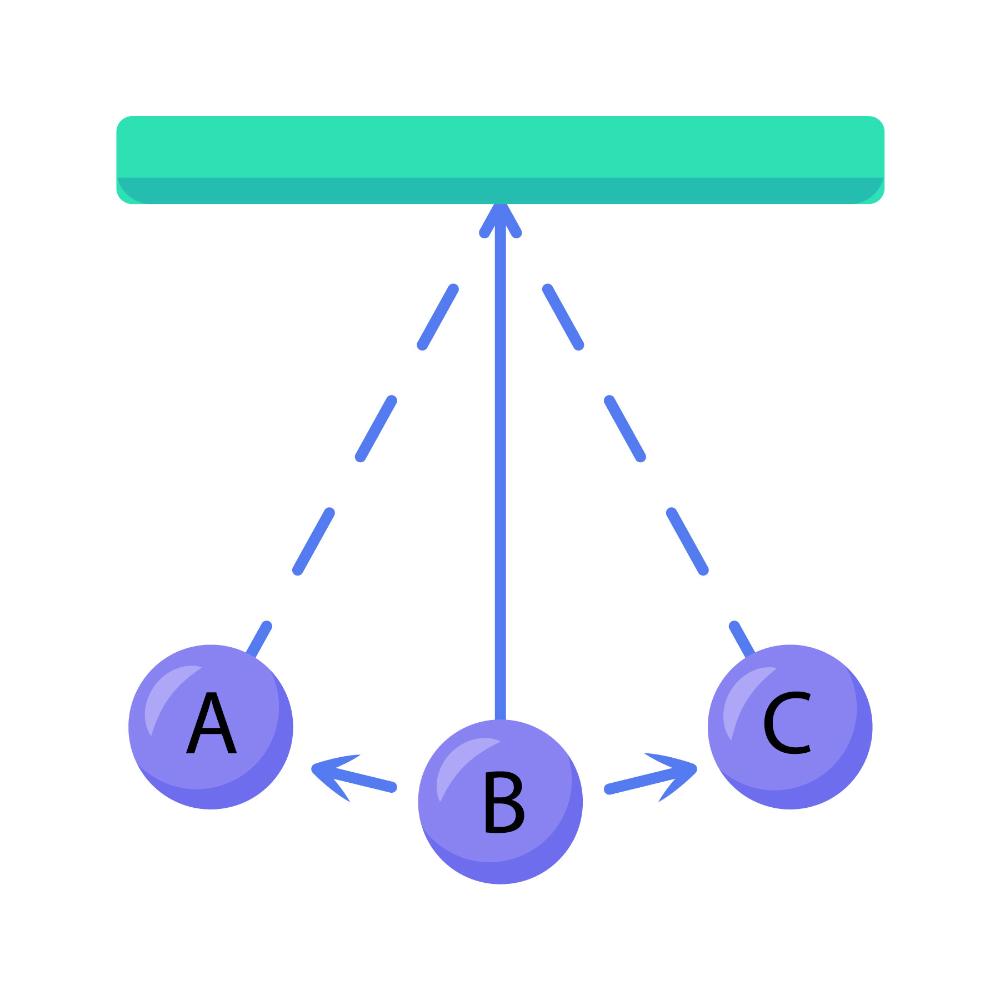 In the figure below, a thin rope is hung from the ceiling and a small ball is attached at the other end of the rope. (This configuration is called a pendulum.) Next, the ball is displaced to point A and let go. As the ball moves, it passes, in this order, through points B, and C, then again points B and A, and so on. Answer the questions below. After submitting, select "Show Answer" to see the correct response. Which point represents the equilibrium position of the ball?
| back 222
|
front 223 What does the ball represent?
| back 223
|
front 224 What is a repeating disturbance that transports energy from one place to another called?
| back 224
A wave is a disturbance that transfers energy from one place to another. |
front 225 What is the material through which a mechanical wave travels called?
| back 225
A medium is a material through which a wave travels. |
front 226 What can a mechanical wave not travel through?
| back 226
A mechanical wave cannot travel through a vacuum. |
front 227 Which type of waves do not require matter to propagate?
| back 227
Water waves require matter to propagate. |
front 228 Why can sound waves not travel in a vacuum?
| back 228
Sound waves are mechanical waves, which means they cannot travel through a vacuum. |
front 229 In which type of wave does matter in the medium oscillate in the same direction the wave travels?
| back 229
In longitudinal waves, matter in the medium oscillates in the same direction the wave travels. |
front 230 What is the region of a longitudinal wave where particles are far apart called?
| back 230
This is a region of expansion. |
front 231 What does a wave transfer from one place to another?
| back 231
A wave transfers energy but not matter from one place to another. |
front 232 A duck is floating on the surface of a lake. When a wave passes through the water, what happens to the duck?
| back 232
The duck will oscillate up and down about its original position. |
front 233 A transverse wave is traveling from your left to your right. How do the particles of the medium move?
| back 233
In a transverse wave, particles travel perpendicular to the direction of the wave. |
front 234 A wave is transferring energy from north to south. The particles of the medium are oscillating in northward and southward directions. What is this is an example of?
| back 234
In a longitudinal wave, particles travel parallel to the direction of the wave. |
front 235 While stepping through the simulation, observe the motion of a green dot. What does it do?
| back 235
The particle does not move horizontally with the wave. |
front 236 Because the green dot moves perpendicular to the direction of the wave, which type of wave is this?
| back 236
The particle moves perpendicular to the wave, which is the characteristic of a transverse wave. |
front 237 While stepping through the simulation, when you increase the frequency, what happens to the wavelength?
| back 237
The horizontal distance from the crest of one peak to the crest of the next peak gets smaller and the wavelength gets shorter. |
front 238 When the frequency of the wave increases, what happens to the amplitude?
| back 238
The amplitude of the wave does not depend on the frequency. |
front 239 What is the horizontal distance from one crest of a transverse wave to the next crest called?
| back 239
This distance is called wavelength. |
front 240 What is the number of wavelengths that pass by a given point each second called?
| back 240
The frequency of a wave tells how many wavelengths pass by a fixed point each second. |
front 241 What is the highest point of a transverse wave called?
| back 241
|
front 242 What is the lowest point of a transverse wave called?
| back 242
|
front 243 What is the maximum vertical distance between an equilibrium and the crest of a wave called?
| back 243
Amplitude is the maximum vertical distance between an equilibrium and the adjacent crest of a wave. |
front 244 What is the time it takes for one full oscillation of a particle in a medium?
| back 244
Period is the time for one full oscillation of a particle in a medium. |
front 245 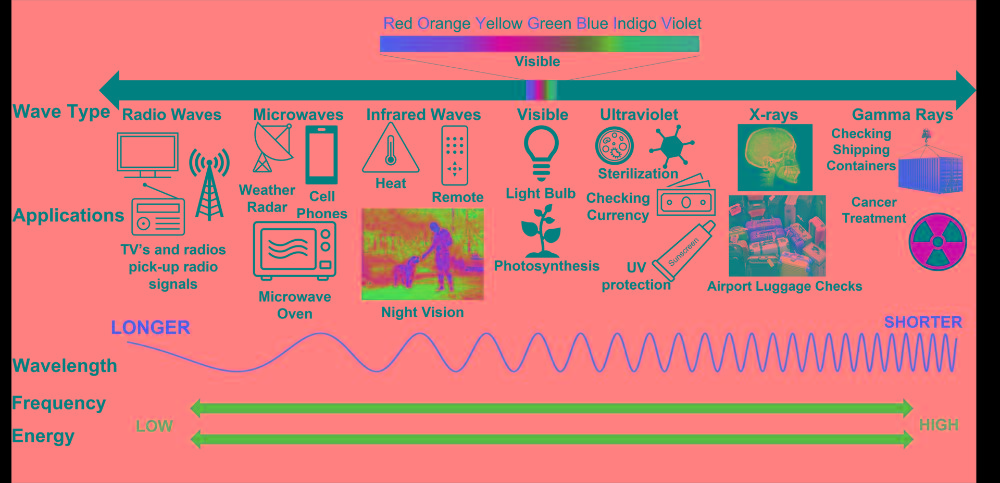 Which part of the EM spectrum has the highest frequency?
| back 245
|
front 246 Which part of the EM spectrum has the highest energy?
| back 246
|
front 247 Which part of the EM spectrum has the longest wavelength?
| back 247
|
front 248 Which color has the longest wavelength?
| back 248
|
front 249 Which color has the shortest wavelength?
| back 249
|
front 250 How much of the EM spectrum is visible to the human eye?
| back 250 Only a small part |
front 251 Which color has the highest energy?
| back 251
|
front 252 Which type of electromagnetic radiation has the lowest relative frequency?
| back 252
|
front 253 Which type of EM radiation would alert emergency personnel of a patient’s condition while the ambulance is still on the way?
| back 253
|
front 254 Which type of EM radiation would detect an approaching tropical storm?
| back 254
|
front 255 What is the region where the air pressure is lower than usual?
| back 255
An expansion is a region where the air pressure is lower than usual. |
front 256 In which region have the particles been pushed closer together?
| back 256
A compression is a region where the air particles have been pushed closer together. |
front 257 When people say that the sound produced by a guitar string is a mechanical wave and not an electromagnetic wave, what do they mean?
| back 257
A mechanical wave needs a medium to transport its energy from one place to another. |
front 258 How does the speed of a sound wave through a piece of glass compare to its speed through air?
| back 258
Sound waves move faster in glass than they do in air. |
front 259 How does the speed of an electromagnetic wave through a piece of glass compare to its speed through air?
| back 259
Electromagnetic waves move slower through a piece of glass than they do in air. |
front 260 While walking on the surface of the moon, which waves do astronauts need to use to talk to each other?
| back 260
Radio waves are a type of electromagnetic waves. As such, they can propagate through the vacuum on the moon’s surface. |
front 261 Why can astronauts easily converse inside the spaceship without any equipment, just like on Earth?
| back 261
Sound waves in the spaceship can travel through air, just like they can on Earth. |
front 262 In which situation can a sound wave propagate?
| back 262
A sound wave can only propagate if there are particles present. Sound waves cannot travel in a vacuum. |
front 263 What accurately describes a sound wave?
| back 263
A sound wave is a disturbance that moves through a medium away from the source of sound. |
front 264 What is the term for the horizontal distance after which a wave repeats itself in space?
| back 264
The horizontal distance after which a wave repeats itself in space is called the wavelength. |
front 265 You and a friend are holding a coiled spring stretched between the two of you. If you push your end toward your friend and then pull it back toward you, what type of wave will be created in the coiled spring?
| back 265
A longitudinal wave will be created. |
front 266 What are regions where the particles of a medium are farther apart called?
| back 266
Regions where the particles of a medium are farther apart are called expansions. |
front 267 What is a sound wave a propagation of?
| back 267
A sound wave is a propagation of compressions and expansions. |
front 268 In an old cowboy movie, a cowboy presses his ear to the ground, listening for the sound of approaching horse hooves. Why does the cowboy listen through the ground and not the air?
| back 268
Sound waves travel faster through the ground. |
front 269 Which statement about light is correct?
| back 269
Light is not slower than sound in air. |
front 270 Which frequency does a shorter wavelength correspond to at constant speed?
| back 270
A shorter wavelength corresponds to higher frequency. |
front 271 While listening to someone playing a piano, you observe that when they hit a key gently, the sound is soft. When they hit the same key again a little harder, the sound is louder. What part of the sound wave increases as the sound that the piano produces becomes louder?
| back 271
Loudness is not related to wavelength. |
front 272 Which statement describes amplitude?
| back 272
|
front 273 What are radio waves commonly used for?
| back 273
Radio waves are commonly used for communication. |
front 274 Why do warm objects, such as humans and warm-blooded animals, stand out on thermal images against cooler backgrounds?
| back 274
They emit infrared radiation. |
front 275 Which property of a sound wave determines its loudness?
| back 275
Loudness of a sound wave is determined by its amplitude. |
front 276 Which property of a sound wave determines pitch?
| back 276
Pitch of a sound wave is determined by its frequency. |
front 277 What is the most energetic radiation?
| back 277
Gamma rays are the most energetic radiation. |
front 278 What is the most penetrating radiation?
| back 278
X-rays are the most penetrating. |
front 279 Suppose you produce a wave that travels along a long coiled spring by repeatedly moving the end of the spring back and forth along the direction of the spring. If you increase the number of times you move the end of the spring back and forward per second, but the speed of the wave stays the same, what increases?
| back 279
An increase in the number of vibrations that pass through a point per second is an increase in frequency. |
front 280 What determines the amount of energy a sound wave carries from a loudspeaker to a listener’s ear?
| back 280
The energy carried by a wave is directly proportional to the square of its amplitude. |
front 281 Which type of electromagnetic radiation has the highest frequency?
| back 281
Gamma rays have the highest frequency. |
front 282 What are microwaves commonly used for?
| back 282
Cell phone communication relies on radio signals in the microwave range. |
front 283 Which kind of electromagnetic radiation is commonly used for controlling air traffic by locating planes?
| back 283
Radar uses radio signals reflected from airplanes to locate their positions, and this is supplemented by radio communications from the aircraft. |
front 284 Which characteristic distinguishes a longitudinal wave from a transverse wave?
| back 284
A transverse wave’s displacement is perpendicular to the direction of the wave, while a longitudinal wave’s displacement moves in the direction the wave travels. |
front 285 When one end of a long rope is secured in a stationary spot and you move the other end of the rope up and down, you will create waves in the rope. Those waves carry energy. How is the energy that is carried along the length of the rope a wave?
| back 285
The energy is being transferred by the rope, not by its surroundings. |
front 286 How does a sound wave carry energy from a loudspeaker to the ear of the listener?
| back 286
There is no long-range motion of matter in the wave. The wave pattern carries the energy. |
front 287 A difference in which of these characteristics distinguishes radio waves from X-rays?
| back 287
Radio waves have much longer wavelengths and much lower frequencies than X-rays. |
front 288 If an electromagnetic wave’s wavelength is equal to the diameter of Earth, which kind of electromagnetic wave is it?
| back 288
Radio waves have the longest wavelengths. |
front 289 If you are told the wavelength of the light emitted by a laser, what could you infer about that light?
| back 289
Each wavelength of light corresponds to a specific color. |
front 290 Which set correctly lists colors of light in order of increasing wavelength?
| back 290
Of the colors listed, red light has the longest wavelength. |
front 291 Electromagnetic radiation travels as waves, and the amount of energy it delivers when absorbed by matter or the damage it can cause depends on its wavelength. Which kind of light delivers the most energy and is the most damaging?
| back 291
X-rays have the shortest wavelength listed and, therefore, deliver the most energy when absorbed by an atom. |
front 292 Which kind of electromagnetic radiation is likely to cause a nasty sunburn if you do not use sunscreen at the beach?
| back 292
UV-B has the most energy and can cause sunburn. |
front 293 Which statement describes sound waves?
| back 293
Light is a transverse wave, and sound is a longitudinal wave. |
front 294 Which statement explains why it might take several seconds after lightning strikes before thunder is heard?
| back 294
The light from the lightning reaches the distant observer much sooner than the sound. |
front 295 Which wave from the list below is known to require a medium to travel?
| back 295
Sound waves are mechanical waves and require a medium to travel. |
front 296 Which wave from the list below has the greatest speed?
| back 296
Electromagnetic waves travel at the greatest speed. |