Instructions for Side by Side Printing
- Print the notecards
- Fold each page in half along the solid vertical line
- Cut out the notecards by cutting along each horizontal dotted line
- Optional: Glue, tape or staple the ends of each notecard together
Chapter 22 HW Respiratory Physiology
front 1 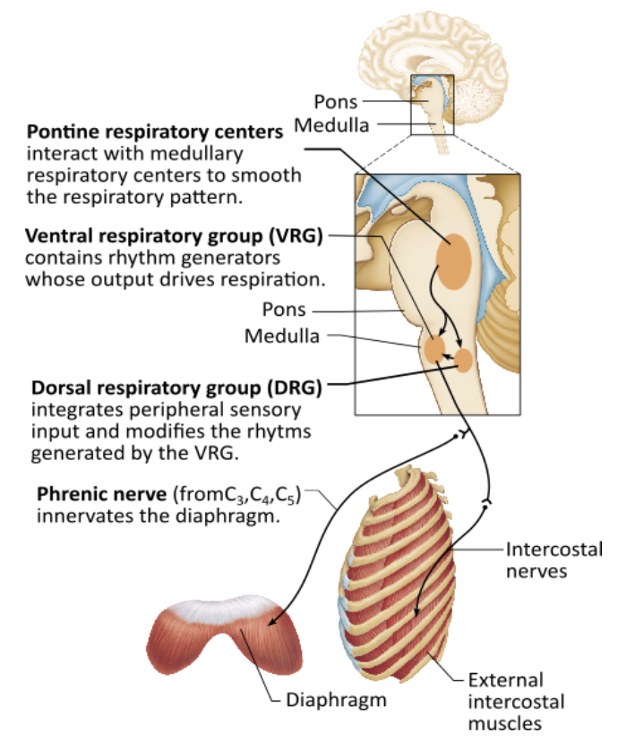 What serves as the origin for the phrenic nerve?
| back 1 the cervical plexus Ex. The cervical plexus is the origin of the phrenic nerve, which descends through the thorax to innervate the diaphragm. |
front 2 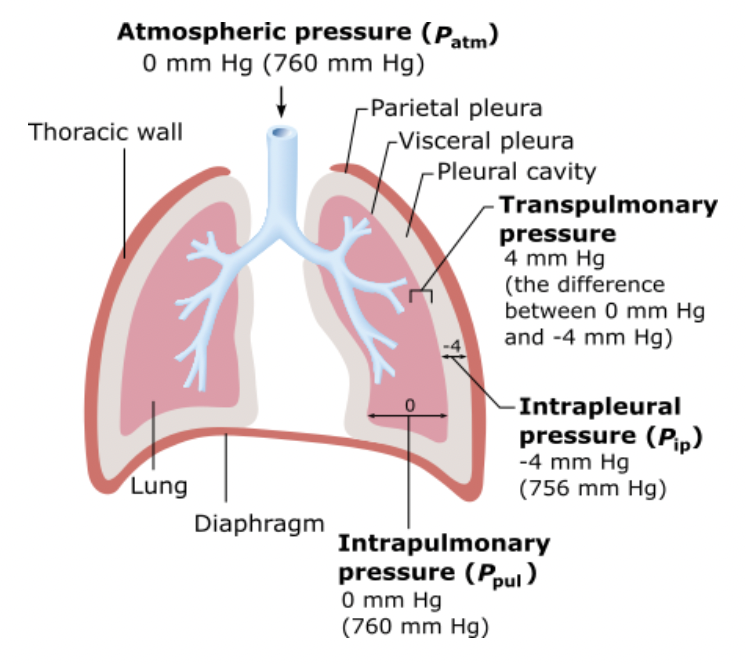 Which of the following pressures rises and falls with the phases of breathing but eventually equalizes with the pressure of the air in the environment?
| back 2 intrapulmonary pressure Ex. Intrapulmonary pressure rises when the thorax volume is reduced (during exhalation) and drops when the thorax volume rises (during inhalation). When there is no change in thorax volume, intrapulmonary pressure equalizes with the atmospheric pressure. |
front 3 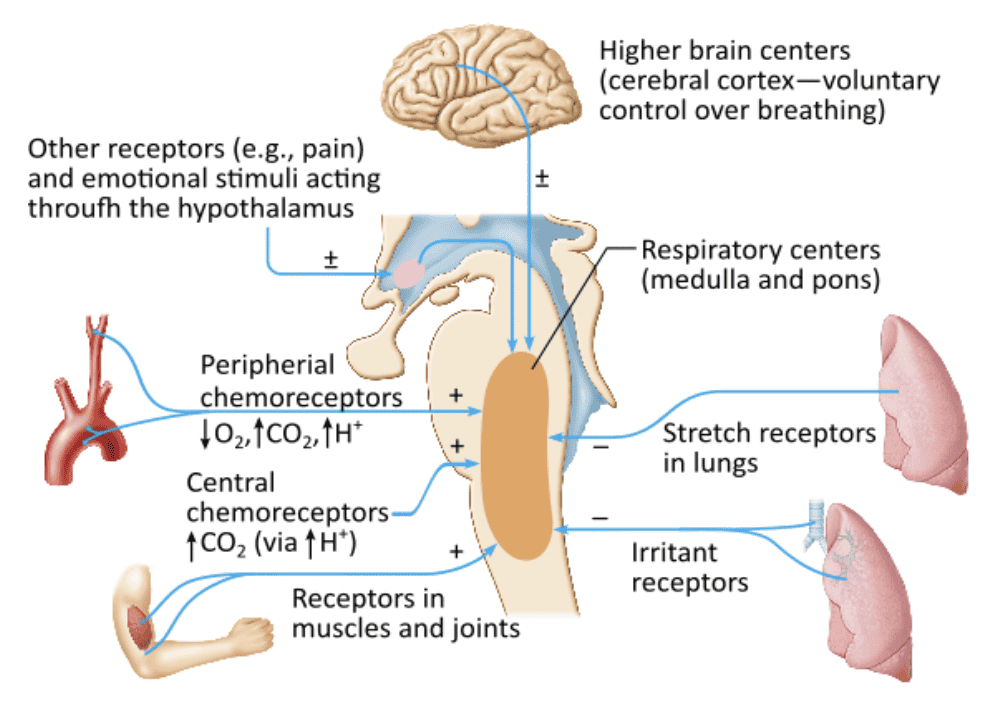 Which of the following conditions or scenarios increases the respiratory rate?
| back 3 acidosis Ex. A low pH in blood indicates a high level of carbon dioxide, which in turn increases the urge to ventilate the lungs. |
front 4 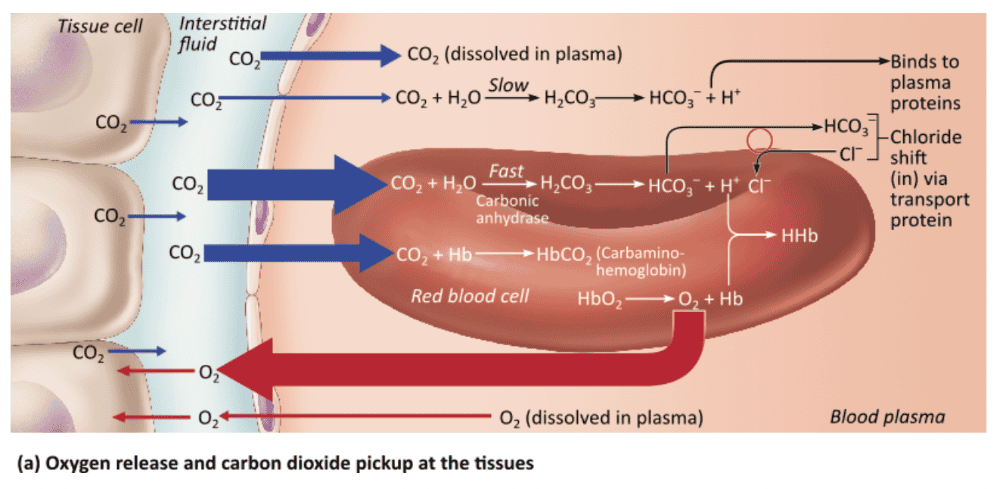 What is the most common method of carbon dioxide transport?
| back 4 as bicarbonate ions in the plasma Ex. Carbon dioxide reacts with water inside RBCs to form carbonic acid, which dissociates into bicarbonate and hydrogen ions. About 70% of carbon dioxide travels in the plasma as bicarbonate. |
front 5 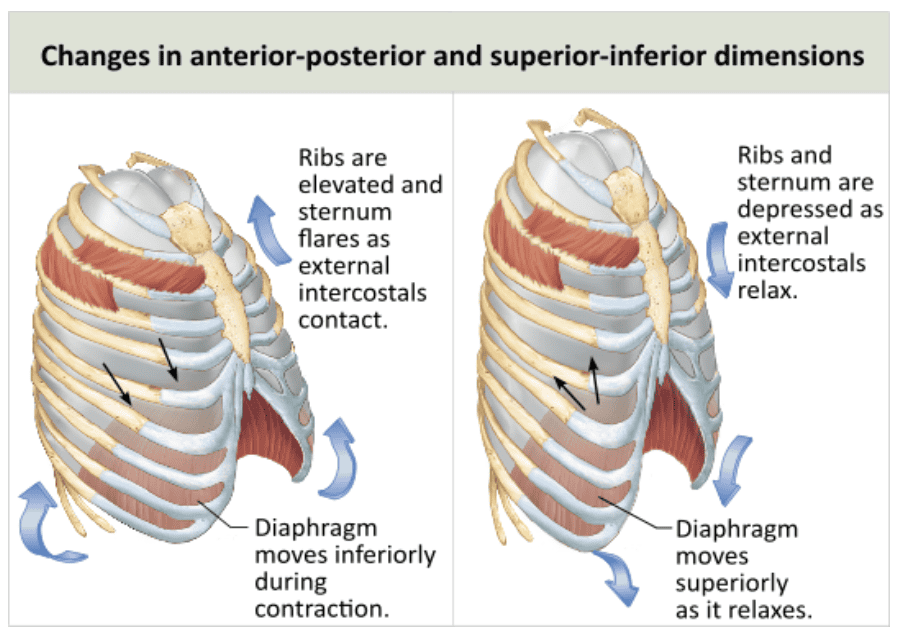 Which muscles are activated during forced expiration?
| back 5 the internal intercostal, oblique, and transversus muscles Ex. During forced expiration, the internal intercostal, oblique, and transversus muscles contract to increase the intra-abdominal pressure and depress the rib cage. |
front 6 In pneumothorax, the lung collapses because ______.
| back 6 intrapleural pressure is equal to intrapulmonary pressure Ex. Intrapleural pressure (Pip) is the gas pressure within the pleural cavity, while intrapulmonary pressure (Ppul) is the gas pressure within the alveoli. Normally Pip is less than Ppul to maintain lung expansion. If Pip exceeds Ppul, then the lungs collapse. |
front 7 The local matching of blood flow with ventilation is ________.
| back 7 ventilation-perfusion coupling |
front 8 Which of the choices below determines the direction of respiratory gas movement?
| back 8 partial pressure gradient |
front 9 Which of the following stimuli is the most powerful respiratory stimulant to increase respiration?
| back 9 rising carbon dioxide levels Ex. Excessive carbon dioxide is a powerful stimulant to respiratory rate, as the brain assumes that when carbon dioxide levels are high, the oxygen levels must be correspondingly low. |
front 10 Which of the following determines lung compliance?
| back 10 alveolar surface tension |
front 11 Air moves out of the lungs when the pressure inside the lungs is ________.
| back 11 greater than the pressure in the atmosphere |
front 12 What is the primary form in which carbon dioxide is carried in blood?
| back 12 as a bicarbonate ion in plasma Ex. About 70% CO2 is transported as bicarbonate. When dissolved CO2 diffuses into RBCs, it combines with water, forming carbonic acid (H2CO3). H2CO3 is unstable and dissociates into hydrogen ions and bicarbonate (HCO3 -) ions. Once generated, bicarbonate moves quickly from the RBCs into the plasma, where it is carried to the lungs. |
front 13 The lung volume that represents the total volume of exchangeable air is the ________.
| back 13 vital capacity |
front 14 The amount of air that can be inspired above the tidal volume is called ________.
| back 14 inspiratory reserve volume |