Instructions for Side by Side Printing
- Print the notecards
- Fold each page in half along the solid vertical line
- Cut out the notecards by cutting along each horizontal dotted line
- Optional: Glue, tape or staple the ends of each notecard together
Chapter 18 and 19 HW Cardiovascular physiology
front 1 Normal heart sounds are caused by which of the following events?
| back 1 closure of the heart valves |
front 2 Arterial blood supply to heart muscle is continuous whether the heart is in systole or diastole. True or False. | back 2 False |
front 3 The first heart sound (the "lub" of the "lub-dup") is caused by __________.
| back 3 closure of the atrioventricular valves Ex. The first heart sound (the "lub" of the "lub-dup") is generated by the closure of the atrioventricular valves. |
front 4 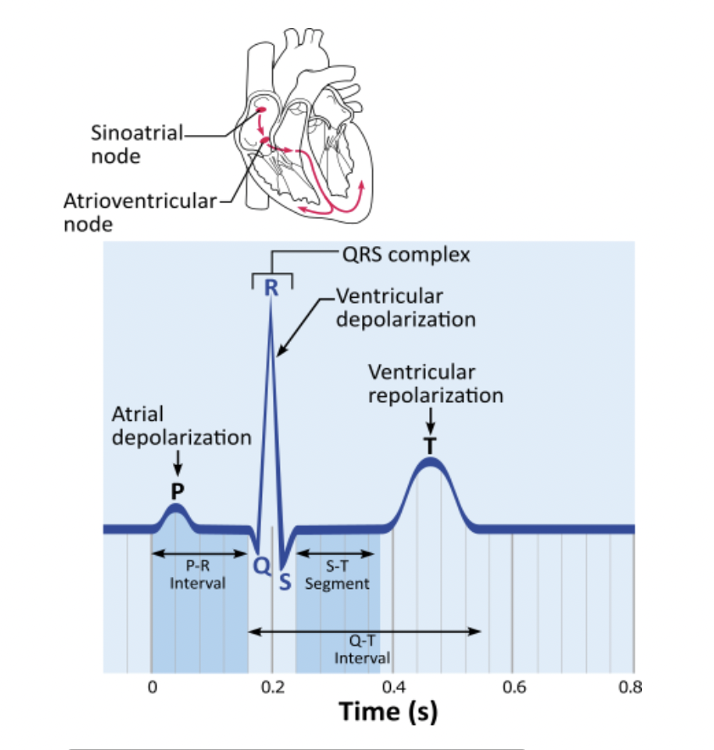 Which portion of the electrocardiogram represents the time during which the ventricles are in systole?
| back 4 Q-T interval Ex. The Q-T interval is the period from the beginning of ventricular depolarization through ventricular repolarization, during which the ventricles are in systole. |
front 5 Select the correct statement about cardiac output.
| back 5 A slow heart rate increases end diastolic volume, stroke volume, and force of contraction. |
front 6 Which of the following terms is correctly matched to its description?
| back 6 quiescent period: period of total heart relaxation Ex. During each cardiac cycle there is a period of time in which both the atria and ventricles are relaxed (in diastole) at the same time; this is called the quiescent period. |
front 7 The atrioventricular (AV) valves are closed ________.
| back 7 when the ventricles are in systole |
front 8 Total peripheral resistance ________.
| back 8 increases as blood viscosity increases |
front 9 Which of the following hormones will lower blood pressure?
| back 9 atrial natriuretic peptide (ANP) Ex. Atrial natriuretic peptide (ANP) is a hormone released by the atria of the heart. It stimulates the kidney to excrete more sodium and water in the urine, which decreases blood volume, leading to a reduction in blood pressure. It also causes generalized vasodilation. |
front 10 Which of the following is involved in long-term regulation of blood pressure?
| back 10 renin-angiotensin-aldosterone mechanism Ex. Long-term control of blood pressure is achieved through direct and indirect renal mechanisms. The kidneys regulate blood pressure indirectly via the renin-angiotensin-aldosterone mechanism, which also involves ADH. In response to low blood pressure, increased release of renin results in increased synthesis of angiotensin II (Ang II). Ang II stimulates secretion of ADH and aldosterone, which work together to promote increased salt and water reabsorption by the kidneys. This in turn decreases urine output and gradually increases blood volume and pressure (assuming the individual is also consuming fluid). The increased thirst that accompanies the fall in blood pressure is due in part to the stimulation of the hypothalamic thirst center by Ang II. |
front 11 Which of the following would decrease total peripheral resistance to blood flow?
| back 11 decreasing the hematocrit Ex. Decreasing the hematocrit (fraction of whole blood consisting of blood cells) would lead to decreased blood viscosity, and thus would decrease resistance. |
front 12 As your skeletal muscles contract during physical activity, more blood is returned to the heart. Which variable would be affected and what would be the outcome of this action?
| back 12 Preload would be increased, which would result in a larger cardiac output. Ex. More blood returning to the heart would increase the volume of blood in the ventricles at the end of their filling phase (called end diastolic volume, or EDV). A larger EDV results in greater stretching of the myocardium, or a greater preload. Stretching (lengthening) the contractile cells brings them closer to their optimal length, allowing them to produce more force when stimulated to contract. The stronger contraction results in a larger stroke volume, and therefore a larger cardiac output. |
front 13 As pressure in the aorta rises due to atherosclerosis, more ventricular pressure is required to open the aortic valve. True or False. | back 13 True |
front 14 Which of the following events best describes when the pulmonary and aortic valves open?
| back 14 At the beginning of systole Ex. During phase 2b the pressure in the ventricles exceeds that of the aorta and pulmonary trunk, so their valves open and allow blood to be ejected. |
front 15 Increasing end-diastolic volume (EDV) and end-systolic volume (ESV) will increase stroke volume. True or False. | back 15 False Ex. Stroke volume (the volume of blood ejected from the ventricle during systole) is equal to the difference between EDV (the volume of blood in the ventricle before it contracts) and ESV (the volume of blood remaining in the ventricle after it contracts). Increasing EDV will result in a larger stroke volume; however, increasing ESV will result in a smaller stroke volume. |