Instructions for Side by Side Printing
- Print the notecards
- Fold each page in half along the solid vertical line
- Cut out the notecards by cutting along each horizontal dotted line
- Optional: Glue, tape or staple the ends of each notecard together
Genetics Ch 24 Connect
front 1 The use of information about a patient's genotype in order to select a medication or therapy that is specifically suited to the patient is called | back 1 personalized medicine |
front 2 Approximately how many human diseases have a genetic basis? | back 2 Thousands |
front 3 True or false: A disease with a genetic origin in a mouse is unlikely to be an inherited disease in humans. | back 3 False |
front 4 Which observations are consistent with a disease having a genetic basis? | back 4 A cancerous growth of immature nerve cells called neuroblastoma is associated with a deletion in a specific region of chromosome 11. The sleep disorder called narcolepsy has been related to an allele for a faulty neural receptor in dogs. Some humans also suffer from narcolepsy. Tay-Sachs disease can occur in 1/2500 births in a specific eastern European population while the frequency is 1/250,000 across Europe. |
front 5 True or false: Identical twins share a genetic disease more often than fraternal twins. | back 5 True Reason: Identical twins share 100% of the same genetic material. |
front 6 Personalized medicine can be used to select a ______. | back 6 medication therapy preventative measure |
front 7 Monozygotic twins ______. | back 7 share 100% of the same alleles |
front 8 When a defect in a single gene causes a human disease, the mutant gene often follows ______. | back 8 simple Mendelian inheritance patterns |
front 9 Dizygotic twins ______. | back 9 share an average of 50% of the same alleles |
front 10 True or false: Comparing someone with a genetic disease to another person in the general population, the person with the disease is more likely to have a family member with the same disease. | back 10 True |
front 11 Nontraumatic epilepsy shows a concordance of 70% for monozygotic twins and 6% for dizygotic twins. This demonstrates that nontraumatic epilepsy is a ______. | back 11 genetic disease |
front 12 Select observations that are consistent with a disease having a genetic basis. | back 12 A person with a disease is more likely to have genetic relatives with the disease than are people in the general population. The disease has a characteristic age of onset. A human disorder may resemble a disorder known to have a genetic basis in animals. The disease doesn't spread to individuals sharing similar environmental situations. Identical twins share the disease more often than non-identical twins. Different populations tend to have different disease frequencies. There is a correlation between a human disease and a mutant gene or chromosomal alteration. |
front 13 True or false: Dizygotic twins share a genetic disease more frequently than monozygotic twins. | back 13 False Reason: Dizygotic twins share an average of 50% of the same genes while monozygotic twins share 100% of the same genes. |
front 14 What tool do scientists use to follow a human pattern of inheritance from generation to generation? | back 14 Pedigree analysis |
front 15 Twins that are genetically identical to each other are called ______ twins. | back 15 monozygotic |
front 16 Twins that share about 50% of their genetic material are called ______ twins. | back 16 dizygotic |
front 17 When a human disease is caused by a mutation in a single gene, the pattern of inheritance is called ___ Mendelian inheritance. | back 17 simple |
front 18 In one study, autism showed 60% concordance for monozygotic twins and 0% concordance for dizygotic twins. This demonstrates that autism is ______. | back 18 a genetic disease Reason: A higher rate of the condition in identical than non-identical twins demonstrates that the disease has a genetic basis. |
front 19 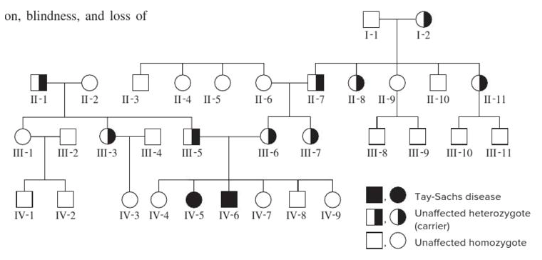 Select all that apply Which of the following characteristics of inheritance can be observed in the accompanying pedigree of a family affected by Tay-Sachs disease? | back 19 An affected offspring can have two unaffected parents. Affected individuals are offspring of heterozygous parents. The trait occurs in both males and females. |
front 20 When a human disease is caused by a mutation in a single gene, scientists follow the pattern of inheritance by analyzing charts called human | back 20 pedigrees |
front 21 What is the inheritance pattern when a trait occurs with the same frequency in both sexes and an affected offspring can have two unaffected parents? | back 21 Autosomal recessive Reason: An affected offspring will have at least one affected parent in autosomal dominant inheritance. |
front 22 Select the human disorders that are inherited in an autosomal recessive fashion. | back 22 Phenylketonuria Cystic fibrosis Sickle cell disease |
front 23 Simple Mendelian inheritance is a pattern observed when a human disorder is caused by ______. | back 23 mutation in a single gene Reason: Simple Mendelian inheritance also applies to diseases caused by recessive alleles. Reason: Simple Mendelian inheritance also applies to diseases caused by dominant alleles. |
front 24 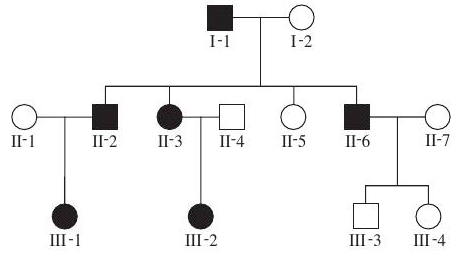 Select all that apply In the accompanying pedigree, a filled symbol indicates an individual with Huntington disease while a clear symbol shows an unaffected individual. Which of the following characteristics of inheritance can be observed for this affected family? | back 24 An affected individual has at least one affected parent. The trait occurs in both males and females. |
front 25 What is the inheritance pattern for a trait that occurs with equal frequency in both sexes and will be inherited, on average, by 50% of the offspring of an affected individual who had only one affected parent? | back 25 Autosomal dominant |
front 26 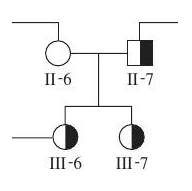 Consider the children of II-6 and II-7 in the accompanying pedigree for a family affected by Tay-Sachs disease. What is one genotype that could have been produced by these two parents but was not observed? | back 26 Unaffected homozygote Reason: A heterozygote would be unaffected by Tay-Sachs disease. Reason: Only one parent carries the Tay-Sachs allele. Reason: 11-6 and 11-7 are unaffected heterozygotes. |
front 27 What is the inheritance pattern when the trait occurs with the same frequency in both sexes and two unaffected heterozygotes have, on average, 25% affected children? | back 27 Autosomal recessive |
front 28 A dominant genetic disorder can be caused by a ______ mutation, where the product of an altered gene gains a new or abnormal function. | back 28 gain-of-function |
front 29 The autosomal recessive human disorder albinism (type I) is caused by a mutation in the gene for ______. | back 29 tyrosinase |
front 30 Select all that apply Select human disorders inherited in an autosomal dominant fashion. | back 30 Marfan syndrome Aniridia Huntington disease |
front 31 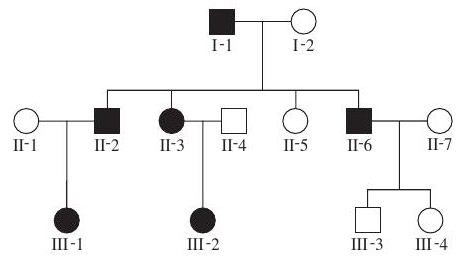 In the accompanying pedigree, a filled symbol indicates an individual with Huntington disease while a clear symbol shows an unaffected individual. Considering the symbol for individual II-5, you conclude that her father, I-1 is ______ allele for Huntington disease. | back 31 heterozygous for the autosomal dominant Reason: Huntington disease is an autosomal dominant trait. Reason: Huntington disease is an autosomal dominant trait which will be expressed when at least one dominant allele is present. Reason: If the father was homozygous dominant for the allele, II-5 would have received the dominant allele and be affected. |
front 32 What is the inheritance pattern for a trait that occurs with the same frequency in both sexes and two affected heterozygous individuals have, on average, 25% unaffected offspring? | back 32 Autosomal dominant Reason: For this pattern, two affected individuals (who would not be heterozygotes), would have 0% unaffected offspring. |
front 33 A dominant genetic disorder can be caused by ______, a situation where one functional copy of an allele is not sufficient to produce a normal phenotype. | back 33 haploinsufficiency |
front 34 Select all that apply Select human diseases that are inherited in an X-linked recessive fashion. | back 34 Hemophilia A Androgen insensitivity syndrome Duchenne muscular dystrophy |
front 35 Marfan syndrome, which is inherited in an autosomal dominant manner, is caused by a mutation in the gene for ______. | back 35 fibrillin-1 |
front 36 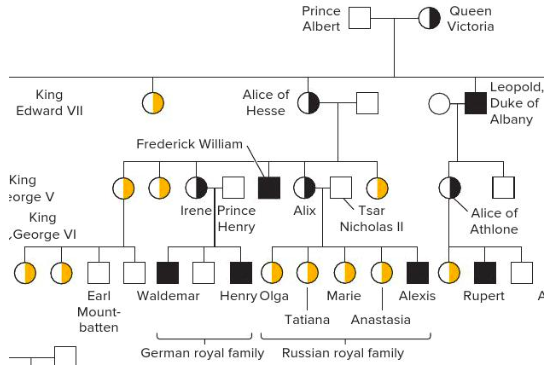 Select all that apply Consider the accompanying partial pedigree showing inheritance of hemophilia in the family of Queen Victoria and Prince Albert. If X h is the allele for hemophilia and X H is the allele for normal blood clotting, which genotypes are missing among the children of Alice of Hesse and her husband, in the middle of the figure? | back 36 X H X H X H Y |
front 37 What is the inheritance pattern for a trait that more commonly affects males than females and can often be observed in brothers or fathers of a woman who has affected sons? | back 37 X-linked recessive Reason: An X-linked dominant trait would be passed to both sons and daughters of an affected mother |
front 38 What is the inheritance pattern for a trait that is more likely to occur in females when it is lethal to males? | back 38 X-linked dominant |
front 39 Duchenne muscular dystrophy, which is inherited in an X-linked recessive manner, is caused by a mutation in the gene for ______. | back 39 dystrophin |
front 40 Rett syndrome, which is inherited in an X-linked dominant manner, is caused by a mutation in the gene for ______. | back 40 methyl-CpG-binding protein-2 |
front 41 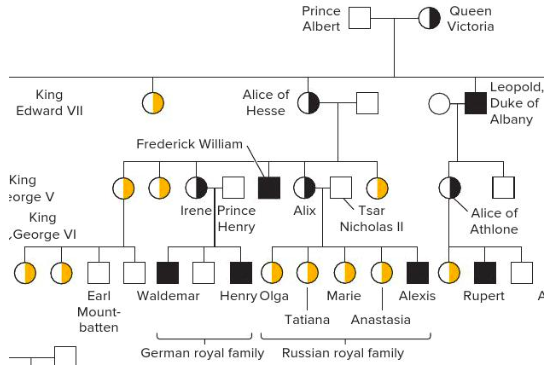 Select all that apply Which of the following characteristics of inheritance for hemophilia can be observed in the accompanying partial pedigree for the family of Queen Victoria and Prince Albert? | back 41 Males are more likely to be affected than females. Mothers of affected males often have brothers with the disease. |
front 42 What is the inheritance pattern for a trait that more commonly affects males than females and which will occur in about 50% of the sons born to the unaffected daughter of an affected male?f | back 42 X-linked recessive Reason: Since the daughter is unaffected, the trait must be inherited as an X-linked recessive. |
front 43 Which statement is true of X-linked dominant disorders such as Rett syndrome and Aicardi syndrome? | back 43 Males die at an early stage of development |
front 44 The disease hemophilia is caused by a deficiency in any one of three blood clotting factors. Two of these factors are encoded by genes on the X chromosome and the other clotting factor gene is located on an autosome. Since mutations in more than one gene can cause hemophilia, this represents ______. | back 44 locus heterogeneity Reason: Heterozygosity refers to one locus rather than a situation where more than one gene affects the same disease. |
front 45 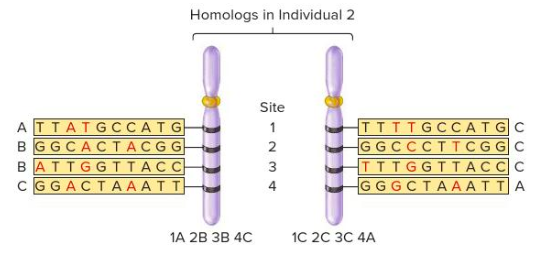 Consider the accompanying figure showing four variable sites along a chromosome that can have any of three different versions, A, B or C, at each site. For this individual, the listing 1C 2C 3C 4A is a ______. | back 45 haplotype |
front 46 Select all that apply Select human disorders that are inherited in an X-linked dominant manner. | back 46 Rett syndrome Vitamin-D resistant rickets Incontinentia pigmenti |
front 47 Which best describes a haplotype? | back 47 A haploid genotype showing linkage of alleles or molecular markers along a single chromosome Reason: Linked alleles or molecular markers in a region of a chromosome form a haplotype. |
front 48 Which factor is likely to contribute to a change in a haplotype between generations? | back 48 Crossing over between molecular markers that are spaced far apart on the chromosome |
front 49 An association between a disease-causing allele and nearby molecular markers can be established because ______. | back 49 haplotypes do not usually change from generation to generation |
front 50 A situation where a disease may be caused by mutations in two or more different genes is called ______. | back 50 locus heterogeneity Reason: A pleiotropic effect involves one gene having multiple phenotypic effects. Reason: Locus heterozygosity involves different alleles of the same gene or locus. |
front 51 A single individual who first had a disease-causing allele is called a | back 51 founder |
front 52 If alleles and molecular markers are associated with each other at a frequency greater than expected by random chance, the situation is described as ______. | back 52 linkage disequilibrium |
front 53 The linkage of alleles or molecular markers along a single chromosome is called a ______. | back 53 haplotype |
front 54 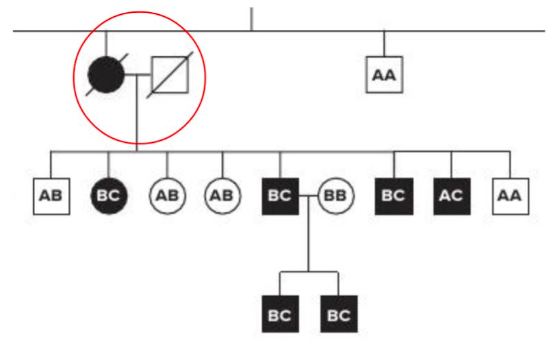 The accompanying pedigree shows the inheritance of Huntington disease with filled symbols and also indicates which combination of four possible forms (A, B C, D) of a molecular marker called G8 that the person has inherited. What is the one possible phenotype and marker combination that is missing among the children of the couple surrounded by the circle? | back 54 BB with Huntington disease Reason: The G8-C marker is associated with Huntington disease. |
front 55 Haplotypes are relatively stable from one generation to the next because ______. | back 55 crossing over is unlikely to occur for molecular markers that are close to each other mutations that would change the haplotype are rare |
front 56 Click and drag on elements in order You are trying to identify the mutant gene responsible for a human disease. You have performed haplotype association, which has identified a short chromosomal region associated with the disease. Place the next steps you should take to identify the gene in order, placing the first step at the top. | back 56  |
front 57 When a new mutation establishes a disease-causing allele in a family member, the allele's location can be traced through ______. | back 57 markers in a haplotype that are located nearby |
front 58 Fill in the blank question. Once a disease-causing allele is identified, progress can often be made on developing ___ to treat the disease and genetic ___ to enable people to determine if they carry the disease-causing allele. | back 58 therapies, strategies, or drugs tests or testing |
front 59 The first individual who carried a disease called allele is called a ______. | back 59 founder |
front 60 A worldwide effort to identify human genetic variation observed for SNPs and other variants is called the International ___ Project. | back 60 HapMap |
front 61 Linkage disequilibrium is a(n) ______ | back 61 higher level of association between a disease allele and a molecular marker than would be expected by chance |
front 62 The purpose of the HapMap project is to ______. | back 62 collect and organize information about human genetic variation Reason: The Hap Map project documents variation, allowing other researchers to search for links to disease-causing alleles. |
front 63 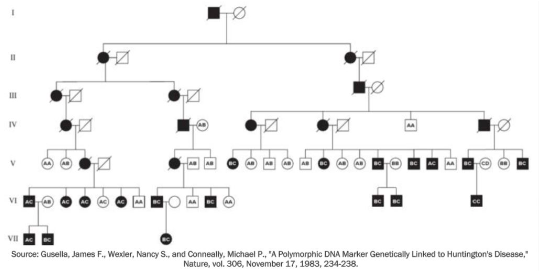 The accompanying pedigree shows the inheritance of Huntington disease with filled symbols and also indicates which combination of four possible forms (A, B C, D) of a molecular marker called G8 that the person has inherited. Although there are some exceptions, the inheritance of Huntington disease is most closely associated with which form of the G8 marker in this pedigree? | back 63  C |
front 64 An examination of the genomes of many different individuals to determine if a specific genetic variant is associated with a human disease is called a genome-wide ___ ___. | back 64 association study |
front 65 To determine which gene in a chromosomal region is responsible for a specific disease, which of the following steps would be used LAST? | back 65 Sequence a candidate gene from both affected and unaffected individuals. Other answer possibilities: Determine whether a candidate gene is active in the cell type that would be affected by the disease. Sequence a candidate gene from both affected and unaffected individuals. Identify a set of candidate genes with a haplotype association study. Use published DNA sequences to identify 5-10 genes located in the chromosomal region identified by haplotype association studies. |
front 66 Select all that apply Identifying disease-causing alleles is useful for ______. Multiple select question. | back 66 developing genetic tests to identify allele carriers developing strategies for treating the disease understanding how genes contribute to the development of the disease |
front 67 The International HapMap Project is an effort to identify differences in human DNA sequences by identifying ______. | back 67 single-nucleotide polymorphisms |
front 68 In a genome-wide association study, the goal is to identify ______ which show a significantly different frequency between a control group and a group of individuals affected by a specific disease. | back 68 single-nucleotide polymorphisms (SNPs) |
front 69 Researchers studying disease-causing genes can use information found in a catalog of common human genetic variants called the | back 69 Hap Map project. Reason: Variation is documented in the Hap Map project. |
front 70 The odds ratio is the odds of ______ a disease for individuals carrying a specific SNP versus the odds of ______ a disease for individuals not carrying the same SNP. | back 70 having; having |
front 71 The goal of a ______ study is to find a relationship between one or more single-nucleotide polymorphisms (SNPs) and a disease or other human trait. | back 71 genome-wide association |
front 72 Which represents a way to visualize the results of a genome-wide association study? | back 72 Manhattan plot |
front 73 For SNPs shown to have a cause-and-effect relationship with a specific disease, which type(s) of changes may be observed? | back 73 For SNPs shown to have a cause-and-effect relationship with a specific disease, which type(s) of changes may be observed? |
front 74 To study the distribution of disease-causing genes, genetic ______ refers to determining if an individual carries the faulty gene, while genetic ______ relates to assessing the presence of the gene throughout a population. | back 74 testing; screening |
front 75 To conduct a genome-wide association study, the ______ of a large group of individuals who are afflicted with the same disease are compared to those of a large group of people without the disease. | back 75 single-nucleotide polymorphisms (SNPs) |
front 76 Suppose a disease-causing allele shows autosomal recessive inheritance. How could a carrier of this disease-causing allele be identified? | back 76 Carriers often show reduced activity for the enzyme encoded by the allele. Reason: Carriers will still have two copies of the disease-causing allele, one will be functional and the other will be non-functional. |
front 77 To identify SNPs for which the frequency is significantly different between a control group and a group of individuals affected by a disease, a(n) ___ ___ is determined and its significance can be evaluated based on the calculation of a(n) ___ value. | back 77 odds ratio P |
front 78 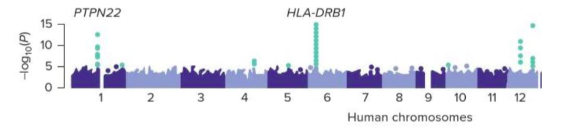 The data shown in the figure represent the results of a ______ study for human chromosomes 1 through 12. | back 78  genome-wide association Reason: The plotted data includes SNPs that can be found in non-genic regions. |
front 79 Which changes can be represented in an SNP identified to have an cause-and-effect relationship with a specific disease through genome-wide association studies? | back 79 A change in the coding sequence of a gene A change in the promoter region of a gene A change in a regulatory sequence such as an enhancer |
front 80 Genetic testing is used to determine whether a(n) ______ has a disease-causing gene, while genetic screening is used to determine how frequently the gene is found in a(n) ______. | back 80 individual; population |
front 81 Select all that apply Which methods can be used at the DNA level to test for specific mutations related to a genetic disease? | back 81 DNA microarray analysis DNA sequencing Fluorescence in situ hybridization (FISH) |
front 82 Click and drag on elements in order Tay-Sachs disease is inherited with an autosomal recessive allele that leads to a defect in the enzyme hexosaminidase A. When cells are collected from patients, cells with different genotypes exhibit different amounts of enzymatic activity. Rank the amount of enzymatic activity that would be detected in a biochemical assay on cells from patients of these genotypes, with the genotype producing the LEAST amount of enzymatic activity on top. InstructionsChoice 1 of 3. Homozygous recessive toggle button Homozygous recessive Choice 2 of 3. Homozygous dominant toggle button Homozygous dominant Choice 3 of 3. Heterozygous toggle button Heterozygous | back 82 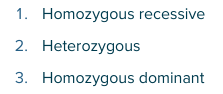 |
front 83 A karyotype can be used to ______. | back 83 identify changes in chromosome number and structure associated with a disease condition |
front 84 Which of these is a common example of widespread genetic screening of newborns to identify certain disorders? | back 84 Test for excess phenylalanine indicating phenylketonuria (PKU) |
front 85 Select all that apply Which of the following are areas of social and ethical concern regarding genetic testing and screening? | back 85 Distress over learning about carrying the gene for an incurable disease Potential discrimination in obtaining jobs or medical insurance Other answer selections: Costs of DNA sequencing and microarray analysis Overuse of therapeutic drugs designed to treat inherited diseases |
front 86 A method for obtaining fetal cells in a sample of the fluid surrounding the fetus is called ______. | back 86 amniocentesis |
front 87 Which method can be used at the DNA level to detect the presence of a specific mutation in a disease-causing allele? | back 87 DNA microarray analysis |
front 88 Chromosomal abnormalities related to genetic diseases can be detected by ______. | back 88 producing a karyotype Reason: DNA microarray analysis can be used to detect gene differences but will not show large scale chromosomal differences. |
front 89 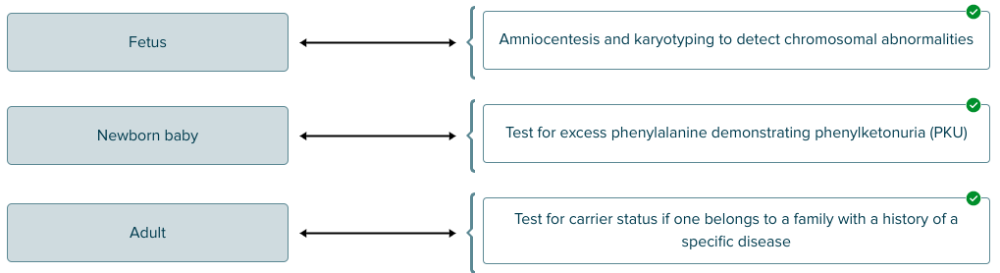 Match the life stage on the left to the type of screening on the right that would be used to detect a genetic disease. | back 89 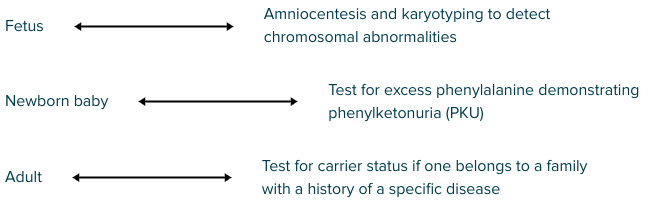 |
front 90 A small portion of the fetal part of the placenta is removed to prepare a karyotype in the process called ______. | back 90 chorionic villus sampling Reason: Amniocentesis involves the removal of amniotic fluid which contains fetal cells. |
front 91 One concern associated with genetic testing and screening is the potential for misuse of private information including ___ by employers or insurance providers. | back 91 discrimination |
front 92 Embryos produced by in vitro fertilization can undergo genetic testing by ______. | back 92 preimplantation genetic diagnosis |
front 93 Amniocentesis is a procedure for ______. | back 93 obtaining fetal cells in a sample from the fluid surrounding the fetus |
front 94 In vitro fertilization is a procedure in which ______. | back 94 sperm and egg are combined outside the mother's body |
front 95 What is the source of cells used in preimplantation genetic diagnosis? | back 95 Cells from an eight-cell stage embryo |
front 96 Select all that apply Which of the following are infectious diseases caused by prions? | back 96 Mad cow disease Kuru Scrapie |
front 97 Chorionic villus sampling is a procedure for ______. | back 97 obtaining a sample of the fetal part of the placenta |
front 98 Preimplantation genetic diagnosis is a method testing for genetic diseases in ______. | back 98 embryos produced by in vitro fertilization |
front 99 A procedure in which sperm and egg are combined outside a mother's body is called ______. | back 99 in vitro fertilization |
front 100 A disease-causing agent made only of protein is called a ______. | back 100 prion |
front 101 Click and drag on elements in order Place the steps of preimplantation genetic diagnosis in the correct order with the first step at the top. | back 101  Abnormal form of the prion protein Reason: Consuming animal products from an animal with prion disease may induce prion disease development. |
front 102 Select all that apply Which of the following are human inherited diseases that are caused by prions? Multiple select question. | back 102 Familial fatal insomnia Creutzfeldt-Jakob disease |
front 103 Which type of catalytic activity occurs in prion-caused diseases? | back 103 The abnormal form of the prion protein catalyzes a reaction that converts normal proteins to misfolded ones. |
front 104 Gene ___ is the introduction of cloned genes into somatic cells to treat disease. | back 104 therapy |
front 105 A prion is a disease-causing agent made ______. | back 105 only of protein |
front 106 Select all that apply Gene therapies were approved by the FDA in 2017 for which of the following diseases? Multiple select question. | back 106 B-cell acute lymphoblastic leukemia Non-Hodgkin lymphoma |
front 107 Select all that apply How can abnormal forms of the prion protein arise within an individual? | back 107 A person may have inherited an allele that causes their normal prion protein to convert to an abnormal one at a low rate. A person can be infected by eating meat from an animal with the disease. |
front 108 Select the types of diseases that are being investigated as potential targets for gene therapy. | back 108 Muscular Blood Lung Metabolic Cancer |
front 109 The abnormal form of a prion protein causes a neurodegenerative disease by ______. | back 109 catalyzing the conversion of the normal protein form to the abnormal form |
front 110 What types of human diseases are the most straightforward targets for gene therapy? | back 110 Inherited diseases involving a single gene abnormality |
front 111 Click and drag. Place the steps by which a cloned gene is transfered into human cells via liposomes in order, with the first step at the top. | back 111 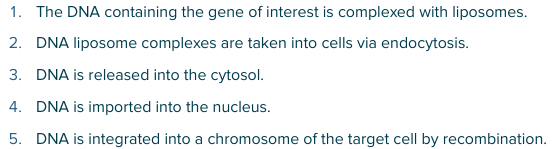 |
front 112 Two gene therapies that target ___ system cells were approved in 2017, to treat B-cell acute lymphoblastic leukemia and non-Hodgkin lymphoma. | back 112 immune |
front 113 An advantage of using liposomes as vectors to transfer cloned genes is that liposomes ______. | back 113 do not elicit an immune response |
front 114 What can cause prion disease in humans when the products of an affected animal are consumed? | back 114 Abnormal form of the prion protein |
front 115 Click and drag on elements in order Place the steps by which a cloned gene is transferred into human cells using a retroviral technique in order, with the first step at the top. | back 115 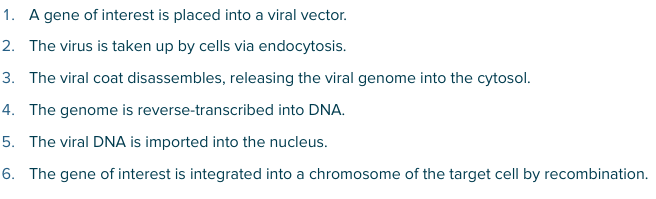 |
front 116 Sickle cell disease, hemophilia, and SCID are all diseases for which gene therapy may be useful. What type of disease are these? | back 116 Blood |
front 117 Scientists have been working on reducing the inflammatory response evoked by ___ vectors, to improve the safety of gene therapy. | back 117 virus, viral, adenovirus, adenoviral, retrovirus, or retroviral |
front 118 One form of severe combined immune deficiency disease (SCID) is caused by inheriting two defective copies of the ______ gene that encodes an enzyme involved in purine metabolism crucial to the maintenance of healthy immune system cells. | back 118 ADA |
front 119 The most common nonviral technique to transfer a cloned gene into human cells involves lipid vesicles called | back 119 liposomes |
front 120 A major disadvantage of using liposomes as vectors to transfer cloned genes is ______. | back 120 low gene transfer efficiency |
front 121 A patient with ADA deficiency can be treated with a bone marrow ___, injections of purified ___ enzyme coupled with polyethylene glycol, or gene ___. | back 121 transplant ADA, adenosine deaminase, or adenosinedeaminase therapy |
front 122 In which way are viruses used for gene transfer different from their wild-type counterparts? | back 122 Viruses used in gene transfer cannot replicate within target cells. Reason: Viruses used for gene transfer can still be targeted by the immune system. |
front 123 The major disadvantage to using viral vectors to transfer cloned genes is ______. | back 123 the potential for an immune response |
front 124 Click and drag on elements in order Place the steps used to treat a patient with adenosine deaminase deficiency via gene therapy in order, with the first step at the top. InstructionsChoice 1 of 4. The retroviral genetic material was inserted into the chromosomal DNA of the lymphocytes. toggle button The retroviral genetic material was inserted into the chromosomal DNA of the lymphocytes. Choice 2 of 4. The lymphocytes were transfected with a retrovirus that had been genetically engineered to contain the normal ADA gene. toggle button The lymphocytes were transfected with a retrovirus that had been genetically engineered to contain the normal ADA gene. Choice 3 of 4. The lymphocytes were reintroduced back into the patient. toggle button The lymphocytes were reintroduced back into the patient. Choice 4 of 4. Lymphocytes were removed from the patient and cultured in the lab. toggle button Lymphocytes were removed from the patient and cultured in the lab. | back 124  |
front 125 If both copies of the ___ gene are defective, deoxyadenosine accumulates within the individual, which can lead to a severely compromised ___ system. | back 125 ADA immune |
front 126 When an experiment or treatment involves genetic manipulation outside of the body, followed by reintroduction into the body, it is called an ______ approach. | back 126 ex vivo |
front 127 Several patients receiving gene therapy for SCID-X1 developed ___, which was caused by integration of the retroviral vector next to a particular gene in the patients' genomes. | back 127 leukemia or cancer |
front 128 Select treatments for patients with adenosine deaminase (ADA) deficiency. | back 128 Gene therapy Bone marrow transplant PEG-ADA treatment |
front 129 Molecular profiling is ______. | back 129 identification of the genes that play a role in the development of a specific type of cancer Reason: Molecular profiling relates to detection of genetic changes. Reason: Molecular profiling is applied after a tumor has developed. |
front 130 The gene delivery system used to treat adenosine deaminase deficiency in the first human gene therapy was ______. | back 130 retroviruses Reason: The normal gene for ADA was cloned into a retroviral vector that can infect lymphocytes. |
front 131 A technique where genetic manipulations occur outside of the body, and then the products are reintroduced into the body is called a(n) ___ ___ approach. | back 131 ex vivo |
front 132 The drug tamoxifen has been used to prevent overexpression of estrogen receptors for a specific and effective breast cancer treatment. Development of drugs that target proteins unique to certain types of cancer is an outcome of | back 132 molecular profiling. |
front 133 The gene therapy trial to treat SCID-X1 ______. | back 133 was the first clear demonstration that gene therapy can offer clinical benefit Reason: This trial was the first demonstration that gene therapy could correct a disease phenotype. Reason: This relates to a clinical trial to treat ADA deficiency inherited through a mutation in an autosomal rather than an X-linked gene. |
front 134 Which method can identify genes that are active in cancer cells but inactive in normal cells? | back 134 DNA microarray analysis |
front 135 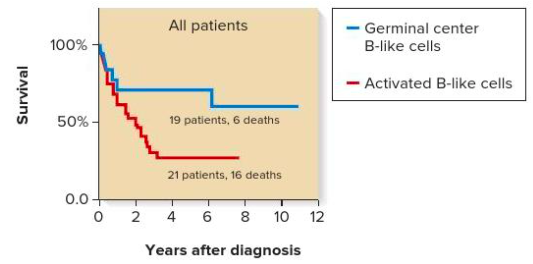 DNA microarray analysis led to the identification of two types of tumors from patients with diffuse large B-cell lymphoma, those originating from germinal center B-like cells and those originating from activated B-like cells. From the accompanying diagram, which group of patients had a higher survival rate? | back 135 Patients with tumors originating from germinal center B-like cells |
front 136 The process of identifying the genes that play a role in the development of a specific type of cancer is called ______. | back 136 molecular profiling Reason: Gene therapy is used to treat inherited diseases after the responsible genes have been identified. |
front 137 Molecular profiling is useful because ______. | back 137 drugs can be developed that will specifically target proteins encoded by cancer-causing gene mutations tumors with similar appearances can be distinguished by differences in their genetic expression patterns |
front 138 The study of genetic variations that cause differing responses to drugs is called ______. | back 138 pharmacogenetics |
front 139 DNA microarrays can be used to ______. | back 139 compare gene activity in cancer cells and normal cells |
front 140 Select all that apply Which factors determine the proper dose of a drug to prescribe for a patient? | back 140 Rate of excretion of drug from the body Ability of drug to be metabolized by the liver Rate of transport of the drug into cells where the it will have its effect Rate of transport of an orally-administered drug from the digestive tract into the bloodstream Ability of drug to affect the function of a target protein |
front 141 Which aspects of drug interaction within the body are affected by genetic variation in humans? | back 141 Drug metabolism Drug transport Ability of drug to affect its target protein |
front 142 The anticoagulant drug warfarin is metabolized by a cytochrome P450 enzyme in the liver. Proper dosages must account for the amount that will be eliminated by the liver in order to provide a sufficient amount of circulating drug to prevent blood clots from forming. Four levels of warfarin metabolism have been identified in the human population, and from highest to lowest these are: ultrarapid, extensive, intermediate, and poor. Which metabolism type would require the lowest dosage of warfarin to prevent blood clotting? | back 142 Poor Reason: An unltrarapid metabolizer would require a high dose because the drug would be rapidly broken down in their body. |
front 143 Pharmacogenetics is the ______. | back 143 study of genetic variations that cause differing responses to drugs |
front 144 Genetic variation in the ability to metabolize the anticoagulant drug warfarin is shown by polymorphisms in the CYP2C9 gene, which encodes a liver enzyme called ___ P450. | back 144 cytochrome |
front 145 Which of the following factors related to proper dosing of drugs would tend to reduce the amount of drug available to provide effective therapy for the patient? | back 145 Rate of excretion of drug from the body Drug uptake and metabolism by the liver |
front 146 In determining the proper dose of a drug to give a patient, which factors need to be considered? Whether the patient has a gene that ______. | back 146 encodes a target protein with a different shape that will not effectively bind to the drug would slow transport of the drug from the digestive system to the bloodstream would cause faster metabolism of the drug than in other patients |
front 147 The anticoagulant drug warfarin is metabolized by a cytochrome P450 enzyme in the liver. Proper dosages must account for the amount that will be eliminated by the liver in order to provide a sufficient amount of circulating drug to prevent blood clots from forming. Four levels of warfarin metabolism have been identified in the human population, and from highest to lowest these are: ultrarapid, extensive, intermediate, and poor. Which metabolism type would require the highest dosage of warfarin to prevent blood clotting? | back 147 Ultrarapid Reason: A poor metabolizer would require a low dose because the drug would remain active in their body for a longer time. |
front 148 Patients taking the anticoagulant drug warfarin vary in the ability to metabolize the drug due to polymorphisms in the CYP2C9 gene that encodes a ______ expressed in the liver. | back 148 cytochrome P450 enzyme |