Instructions for Side by Side Printing
- Print the notecards
- Fold each page in half along the solid vertical line
- Cut out the notecards by cutting along each horizontal dotted line
- Optional: Glue, tape or staple the ends of each notecard together
cell communication mcqs
front 1 1) Which of the following observations suggests that a second messenger is required for the activation of glycogen phosphorylase by epinephrine? A. Glycogen breakdown occurs when epinephrine and glycogen phosphorylase are combined in a cell-free system. B. Glycogen breakdown occurs only when epinephrine is administered to intact cells. C. Epinephrine binds directly to glycogen phosphorylase. D. Glycogen phosphorylase is inactive in the absence of epinephrine in a cell-free system. | back 1 B |
front 2 2) Which of the following statements best describes a key aspect of a G protein signaling pathway? A. A G protein bound is active when bound to GDP. B. A G protein is activated by hydrolysis of bound GTP. C. A G protein-coupled receptor is active when bound to GTP. D. A G protein bound is active when bound to GTP. | back 2 C |
front 3 3) Many G protein-coupled receptors contain seven transmembrane α-helical domains. If the amino terminus of such a protein is located on the extracellular side of the membrane, where would you expect to find the carboxyl terminus of the protein? A. at the exterior surface of the plasma membrane B. covalently bound to the amino end of the protein C. at the cytosolic surface of the plasma membrane D. embedded in the phospholipid bilayer of the membrane | back 3 C |
front 4 4) Certain receptor tyrosine kinases (RTKs) that promote excessive cell division are found at high levels in various cancer cells. HER2 is an RTK that is present at excessively high levels in some breast cancer cells. Herceptin is a protein that binds to HER2 and inhibits cell division. Herceptin may be an effective treatment for breast cancer treatment under which of the following conditions? A. If the patient's cancer cells have excessive levels of HER2. B. If the patient has excessive levels of other RTKs in cancer cells. C. If injection of HER2 in the patient's cancer cells inhibits cell division. D. If the patient lacks functional HER2 proteins. | back 4 A |
front 5 5) Caffeine is an inhibitor of phosphodiesterase. Therefore, the cells of a person who has recently consumed coffee would have increased levels of which of the following molecules? A. adenylyl cyclase B. activated G proteins C. cAMP D. phosphorylated proteins | back 5 C |
front 6 6) At puberty, an adolescent female body changes in both structure and function of several organ systems, primarily under the influence of changing concentrations of estrogen and other steroid hormones. How can one hormone, such as estrogen, mediate so many different effects? A. Estrogen is produced in very large concentration by nearly every tissue of the body. B. Estrogen is kept away from the surface of any cells, not able to bind it at the surface. C. Estrogen binds to specific receptors inside many kinds of cells, each with different responses. D. Each cell responds in the same way when steroids bind to the cell surface. | back 6 C |
front 7 7) Which of the following statements best describes scaffolding proteins? A. large molecules to which several relay proteins attach to facilitate cascade effects B. proteins that enter the nucleus of a cell to regulate transcription C. relay proteins that orient receptors and their ligands in appropriate directions to facilitate complex formation D. microtubule arrays that allow lipid-soluble hormones to get from the cell membrane to the nuclear pores | back 7 A |
front 8 8) Which of the following statements best describes the effect of a mutation that knocks out the GTPase activity of a G protein? A. The G protein would always be active. B. The number of G proteins in the cell would increase. C. The G protein would be inactivated by a G protein-coupled receptor/signal molecule complex. D. The concentration of available GTP would decrease. | back 8 A |
front 9 9) A loss of function of Apaf1, the human homologue of ced-4 in nematodes, is most likely to result in which of the following? A. extensive tissue damage due to excess apoptosis B. activation of a developmental pathway found in the nematode but not in humans C. excess activation of the human analog of the ced-3 protease D. a form of cancer in which normal apoptosis fails | back 9 D |
front 10 10) Some cases of human melanoma have been shown to result from inhibition of apoptosis in these cells. The human analogue of which of the following defects in C. elegans could cause these cancers? A. A death-signaling molecule receptor that is always active. B. A ced-4 protein that is always active. C. A ced-3 protein that is always inactive. D. A ced-9 protein that is always inactive. | back 10 C |
front 11 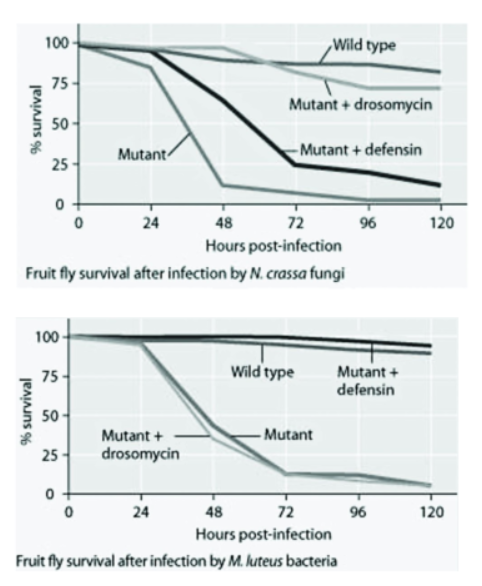 11) Use the graphs to answer the following question. Mutant fruit flies that do not make antimicrobial peptides were tested for survival after infection with Neurospora crassa fungi or with Micrococcus luteus bacteria. The mutant flies were also transfected with the genes for antimicrobial peptides (drosomycin or defensin) and tested for survival. Which of the following hypotheses is best supported using the data? A. adding the drosomycin gene to such mutants protects them from death by bacterial infection B. adding the defensin gene to such mutants protects them from death by bacterial infection C. wild-type flies with the full set of genes for antimicrobial peptides are highly susceptible to both fungal and bacterial pathogens D. the presence of any single antimicrobial peptide protects against both fungal and bacterial pathogens | back 11 B |
front 12 12) Benadryl is an antihistamine. Which of the following is most likely to occur if a person that was stung by a bee takes Benadryl? A. more antibodies will be produced B. the site of injury will become less red and swollen C. more histamine will be released D. the thymus will become enlarged | back 12 B |
front 13 13) An organism that lacks their thymus would ________. A. be unable to genetically rearrange antigen receptors B. lack innate immunity C. be unable to differentiate and mature T cells D. have a reduced number of B cells and be unable to form antibodies | back 13 C |
front 14 14) Use the following information to answer the following question. An otherwise healthy student in your class was infected with Epstein Barr virus (EBV) (the virus that causes infectious mononucleosis) when she was a child, at which time she had merely experienced a mild sore throat and swollen lymph nodes in her neck. When she is exposed to EBV again later in life, she does not get sick or develop any symptoms of mononucleosis. Which of the following statements explains why your classmate does not exhibit symptoms of EBV infection? A. Her innate immune response was better at recognizing the EBV antigen during the second infection. B. She was infected with a weaker strain of EBV during her second exposure. C. Complement proteins effectively controlled the EBV during the second infection. D. Memory T cells recognized the virus upon the second exposure and activated cells that destroyed the virally infected cells. | back 14 D |
front 15 15) A nonfunctional CD4 protein on a helper T cell would result in the helper T cell being unable to ________. A. lyse tumor cells B. stimulate a cytotoxic T cell C. interact with a class II MHC-antigen complex D. respond to circulating viral antigens | back 15 C |
front 16 16) Which treatment could relieve the symptoms of an individual who has been bitten by a poisonous snake that has a fast-acting toxin? A. injection of interferon B. vaccination with a weakened form of the toxin C. injection of interleukin-1 D. injection of antibodies to the toxin | back 16 D |
front 17 17) The number of major histocompatibility (MHC) protein combinations possible in a given population is enormous. However, an individual in the population has a far more limited array of MHC molecules because ________. A. MHC proteins from one individual can only be of class I or class II B. once a B cell has matured in the bone marrow, it is limited to two MHC response categories C. the MHC proteins are made from several different gene regions that are capable of rearranging in a number of ways D. each of the MHC genes has a large number of alleles, but each individual only inherits two for each gene | back 17 D |
front 18 18) A patient has a high level of mast cell activity, dilation of blood vessels, and acute drop in blood pressure. Which condition is most consistent with these symptoms? A. an organ transplant, such as a skin graft B. an autoimmune disease C. a typical skin allergy (contact dermatitis) that can be treated by antihistamines D. anaphylactic shock immediately following exposure to an allergen | back 18 D |
front 19 19) Which of the following would help a virus avoid triggering an effective adaptive immune response? I) having frequent mutations in genes for surface proteins II) building the viral shell from host proteins III) producing proteins very similar to those of other viruses IV) infecting and killing helper T cells A. only I and III B. only I, II, and IV C. only II, III, and IV D. only I, II, and III | back 19 B |
front 20 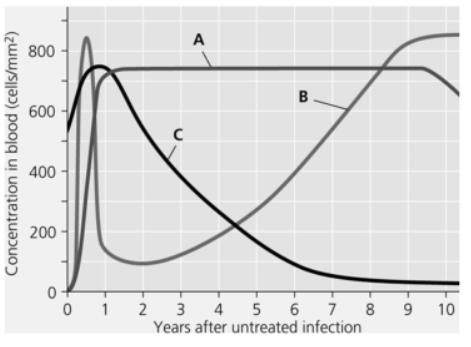 20) The figure shows the progress of an untreated HIV infection. Which curve represents the concentration of helper T cells in the blood? A. curve A B. curve B C. curve C D. None of the curves show helper T cell concentration. | back 20 C |
front 21 21) Testosterone is an example of a chemical signal that affects, variously, the very cells that synthesize it in the testis, the neighboring cells, and distant cells outside the gonads. Thus, testosterone is an example of ________. A. a paracrine signal, a synaptic signal, and an exocrine product B. an autocrine signal, a paracrine signal, and an endocrine signal C. an autocrine signal, a neuroendocrine signal, and a synaptic signal D. neurohormone signal, a neuroendocrine signal, and an exocrine product | back 21 B |
front 22 22) A certain hormone activates the cAMP second messenger system in its target cells. Which of the following would yield the greatest response by a target cell? A. inject the hormone into the cytoplasm of the cell B. inject activated, cAMP-dependent protein kinase into the cytoplasm of the cell C. apply the hormone to the extracellular fluid surrounding the cell D. apply cAMP to the extracellular fluid surrounding the cell | back 22 C |
front 23 23) Which of the following functions would most likely be disrupted by an injury to the hypothalamus? A. coordinated movements during locomotion B. short-term memory C. regulation of water balance D. executive functions, such as decision making | back 23 C |
front 24 24) Diabetes insipidus is a disorder that results in the kidneys not being able to conserve water during urine production. Which hormone most likely plays a role in diabetes insipidus? A. antidiuretic hormone (ADH) B. glucagon C. insulin D. thyroid stimulating hormone (TSH) | back 24 A |
front 25 25) When a person drinks alcohol, the rate of urination increases. Which of the following best explains the increase in urination above normal rates? A. Alcohol stimulates the release of thyroid hormones. B. Alcohol inhibits the actions of calcitonin. C. Alcohol stimulates the release of oxytocin. D. Alcohol inhibits the release of ADH. | back 25 D |
front 26 26) Which of the following is the most likely effect of a drug that increases adrenocorticotropic hormone (ACTH) synthesis? A. decreased release of cortisol B. increased release of glucocorticoids C. decreased release of calcitonin D. increased release of prolactin | back 26 B |
front 27 27) Thyroxine can trigger growth, temperature tolerance, or osmoregulation depending on the organism in which it is produced. Which is the most likely mechanism for such diverse responses in different organisms? A. The concentration of thyroxine varies in different organisms. Invertebrate organisms do not have as much thyroxine as vertebrate organisms. B. The function of thyroxine in a particular tissue is determined by the genes that are transcribed by the activated thyroxine receptor. C. Thyroxine and its receptor molecules have different binding affinities in different organisms. D. Receptor molecules for thyroxine are located on different tissues in different organisms. | back 27 B |
front 28 28) Which of the following contributes to poor health when people experience chronic stress? A. suppression of growth hormone allows pathogens to proliferate B. high levels of glucocorticoids suppress the immune response C. high levels of parathyroid hormones make blood sugar regulation difficult D. melatonin levels remain elevated | back 28 B |
front 29 29) Which of the following events will be initiated by the fight-or-flight response following a stressful stimulus? A. ADH secretion reduces urine output B. liver cells convert glycogen into glucose C. the hypothalamus releases prolactin D. the anterior pituitary releases secretin | back 29 B |
front 30 30) Which one of the following statements is true? A. Hormones often regulate homeostasis through antagonistic functions. B. Hormones are secreted by specialized cells usually located in exocrine glands. C. Hormones of the same chemical class usually have the same function. D. Hormone pathways involved in homeostasis typically exhibit positive feedback. | back 30 A |
front 31 31) A researcher uses the chemical inhibitor cyanide to reduce ATP production in a neuron. What would be one effect of preventing ATP production? A. The "resting" distribution of potassium and sodium ions would be altered. B. The sodium and potassium channels would all be closed. C. The physical structure of the plasma membrane would break down. D. The membrane would become more permeable to sodium. | back 31 A |
front 32 32) If you experimentally increase the concentration of Na+ outside a cell while maintaining other ion concentrations as they were, what would happen to the cell's membrane potential? A. The membrane potential would be unaffected. B. The membrane potential would become more negative. C. The membrane potential would become positive. D. The membrane potential would become less negative. | back 32 D |
front 33 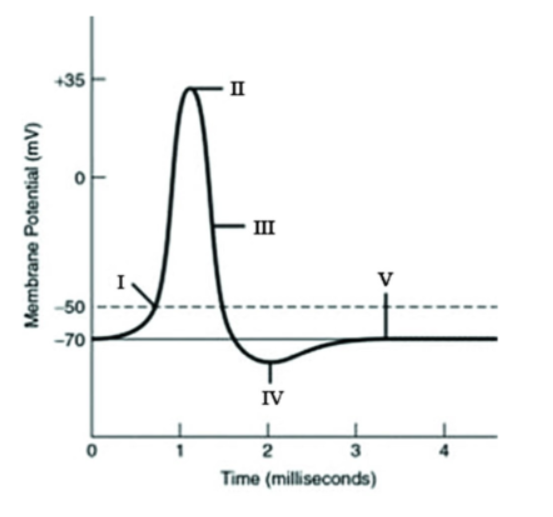 33) Refer to the following graph of an action potential to answer the question. Which Roman numeral in the graph indicates the point when the membrane potential is closest to the equilibrium potential for potassium? A. I B. II C. III D. IV | back 33 D |
front 34 34) Refer to the following graph of an action potential to answer the question. Which Roman numeral in the graph indicates the point when the membrane's permeability to sodium ions is greatest? A. I B. II C. IV D. V | back 34 B |
front 35 35) Refer to the following graph of an action potential to answer the question. Which Roman numeral in the graph indicates the minimum graded depolarization needed to operate the voltage-gated sodium and potassium channels? A. I B. II C. IV D. V | back 35 A |
front 36 36) Refer to the following graph of an action potential to answer the question. Which Roman numeral in the graph indicates the falling phase of the action potential? A. I B. II C. III D. IV | back 36 C |
front 37 37) Refer to the following graph of an action potential to answer the question. Which Roman numeral in the graph indicates when the neuronal membrane is at its resting potential? A. I B. II C. IV D. V | back 37 D |
front 38 38) Which answer explains why Na+ ions enter the cell when voltage-gated Na+ channels are opened in neurons? A. the Na+ ions are actively transported by the sodium-potassium pump into the cell B. the Na+ concentration is much lower outside the cell than it is inside the cell C. the Na+ concentration is much higher outside the cell than it is inside, and the Na+ ions are attracted to the negatively charged interior D. the Na+ concentration is much higher outside the cell than it is inside, and the Na+ ions are actively transported by the sodium-potassium pump into the cell | back 38 C |
front 39 39) Tetrodotoxin blocks voltage-gated sodium channels, and ouabain blocks sodium-potassium pumps. If you added both tetrodotoxin and ouabain to a solution containing neural tissue, what responses would you expect? A. immediate loss of resting potential B. slow decrease of resting potential and action potential amplitudes C. immediate loss of action potential with gradual shift of resting potential D. No effect; the substances counteract each other | back 39 C |
front 40 40) Which of the following is the most likely effect of applying the naturally occurring acetylcholinesterase inhibitor onchidal (produced by the mollusc Onchidella binneyi) to a neuromuscular junction? A. there would be no effect on the muscle cell function B. there would be a decrease in the frequency of action potentials C. the muscle cell would receive constant stimulation D. the muscle cell would not be able to contract | back 40 C |
front 41 41) Imagine you are resting comfortably after a long day of work. What is the most likely state of your peripheral nervous system? A. decreased activity in the sympathetic, parasympathetic, and enteric nervous systems B. decreased activity in the sympathetic nervous system, and increased activity in the parasympathetic and enteric nervous systems C. increased activity in the sympathetic nervous system, and decreased activity in the parasympathetic and enteric nervous systems D. increased activity in the sympathetic, parasympathetic, and enteric nervous systems | back 41 B |
front 42 42) A patient's reflexes were tested during a medical exam. There is no reaction to the patellar tendon reflex. Where might pathology occur? A. cerebrospinal fluid B. gray matter in the brain C. the spinal cord D. white matter in the brain | back 42 C |
front 43 43) What enables the sympathetic and parasympathetic divisions to bring about opposing effects in most organs they impact? A. postganglionic neurons in the sympathetic division release norepinephrine; postganglionic neurons in the parasympathetic division release acetylcholine B. the sympathetic division is associated with ganglia while the parasympathetic division does not involve ganglia C. axons in the sympathetic division are myelinated while axons in the parasympathetic division are unmyelinated D. the sympathetic division consists only of gray matter; the parasympathetic division consists only of white matter | back 43 A |
front 44 44) Which of the following is most likely caused by an injury to the brainstem? A. visual hallucinations B. an inability to regulate body temperature C. auditory hallucinations D. an inability to regulate heart function | back 44 D |
front 45 45) Which of the following best explains the differences in the relative size of particular brain regions of vertebrates? A. the type of thermoregulation used by a group of vertebrates B. variations in circulatory patterns of blood C. increased responsibilities of a particular brain region D. how long a particular group has evolved | back 45 C |
front 46 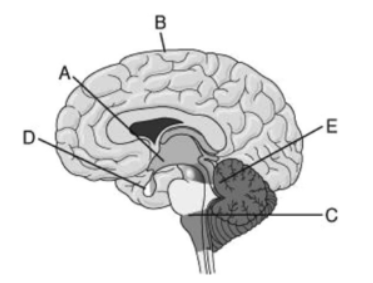 46) Use the figure to answer the following question. If a person suffered a serious blow to the head that resulted in damage to the outer layer of brain region B, what might be the expected outcome? A. The person would not be able to detect any light in the environment. B. Emotional responses would be impaired. C. The person's perception, voluntary movement, and/or learning would be impaired. D. The person would be unable to breathe | back 46 C |
front 47 47) Which part(s) of your brain are most involved in writing an essay? A. parietal lobe B. Broca's area C. occipital lobe D. frontal lobes | back 47 D |
front 48 48) What sense is most likely to be impaired by an injury to the temporal lobe? A. taste B. hearing C. touch D. sight | back 48 B |
front 49 49) In which of the following have advances in research most improved our understanding of mental illness? A. the sequence of developmental specialization B. the nature of the blood-brain barrier C. the chemicals involved in brain communications D. the structural organization of the brain | back 49 C |
front 50 50) Stem cell transplants may someday be used to treat Parkinson's disease. How could stem cell transplants alleviate the symptoms of Parkinson's disease? A. by repairing sites of traumatic brain injury B. by secreting the neurotransmitter dopamine C. by preventing temporal lobe seizures D. by replenishing missing ion channels | back 50 B |
front 51 51) What sensation would likely be produced by artificial electrical stimulation of a human's capsaicin-sensitive neurons? A. deep pressure B. tactile stimulus C. hot temperature D. cold temperature | back 51 C |
front 52 52) Immediately after putting on a shirt, you are aware of the shirt touching your skin. After a few minutes, this perception fades. Which of the following processes results in the decreased responsiveness despite continued stimulation? A. reduced receptor amplification B. accommodation C. sensory adaptation D. reduced motor unit recruitment | back 52 C |
front 53 53) Elephants hear sounds that are too low pitched for humans to hear. Which of the following best explains the differences in sensitivity? A. size and shape of the outer ear B. flexibility of the basilar membrane in the cochlea C. size and flexibility of the tympanic membrane (eardrum) D. arrangement and shape of the ossicles | back 53 B |
front 54 54) Which of the following would stimulate the umami receptor? A. acidic orange juice B. chocolate milk C. a slice of roast beef D. salt water | back 54 C |
front 55 55) Two students studying physiology taste a known "bitter" substance, and both report sensing bitterness. They then sample another substance. With the new substance, student A reports sensing both a bitter taste and a salty taste, but student B reports only a salty taste. Which of the following best explains the observations from the experiment? A. Student A has a protein receptor capable of detecting a bitter molecule found in that substance, whereas student B lacks that particular protein receptor. B. Student A had an allergic reaction to the food, causing her to perceive the food as being bitter. C. Student A has normal saliva, whereas student B's saliva is more alkaline than normal. D. Student B has a protein receptor capable of detecting a bitter molecule found in that substance, whereas student A lacks that particular protein receptor. | back 55 A |
front 56 56) Most of the ATP supplies for a skeletal muscle undergoing prolonged exercise come from ________. A. glucose metabolized by aerobic respiration B. tropomyosin binding to calcium C. the transfer of a phosphate group from creatine phosphate D. glycolysis | back 56 A |
front 57 57) The muscles of a recently deceased human can remain in a contracted state, termed rigor mortis, for several hours. What prevents the muscles from relaxing soon after death? A. the depletion of ATP required to break actin-myosin bonds B. myoglobin is overwhelmed by a buildup of carbon dioxide C. sodium ions required for action potentials are concentrated outside the muscle cells D. calcium ions cannot bind to the troponin complex | back 57 A |
front 58 58) For the following five events, which is the correct sequence that describes the excitation and contraction of a skeletal muscle fiber? 1. Tropomyosin shifts, exposing the myosin-binding sites on actin. 2. Calcium is released from the sarcoplasmic reticulum and binds to the troponin complex. 3 . An action potential is propagated down the transverse tubules. 4. Cycles of myosin cross-bridge formation and breakdown cause the thin filaments to slide toward the center of the sarcomere. 5. An action potential in a motor neuron causes the axon to release acetylcholine, which triggers an action potential in a muscle fiber. A. 1 → 2 → 3 → 4 → 5 B. 2 → 3 → 4 → 1 → 5 C. 5 → 3 → 2 → 1 → 4 D. 2 → 1 → 3 → 5 → 4 | back 58 C |